
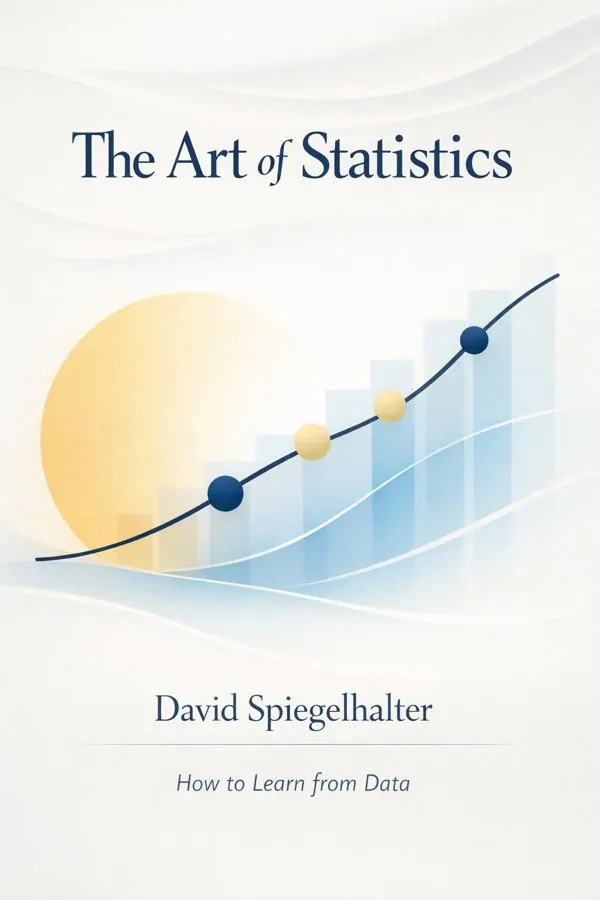
The Art of Statistics: How to Learn from Data: Summary & Key Insights
 10 min8 chaptersAudio available
Key Takeaways from The Art of Statistics: How to Learn from Data
The most important part of statistics often happens before any calculation begins: deciding what question is actually being asked.
A number on its own is rarely informative; its meaning comes from comparison, scale, and background.
One of the book’s most liberating insights is that variation is not an annoyance to be ignored—it is a basic feature of reality that statistics helps us understand.
Many people assume that statistics exists to produce certainty, but Spiegelhalter makes the opposite case: its real value lies in helping us reason honestly under uncertainty.
Few statistical lessons are as famous—or as frequently ignored—as the distinction between correlation and causation.
What Is The Art of Statistics: How to Learn from Data About?
The Art of Statistics: How to Learn from Data by David Spiegelhalter is a popular_sci book. In a world flooded with numbers, charts, rankings, risk scores, and bold claims backed by “data,” the real challenge is no longer finding information—it is learning how to think about it well. The Art of Statistics by David Spiegelhalter is a lucid, practical guide to understanding what data can reveal, what it can hide, and how we can avoid being misled by false certainty. Rather than treating statistics as a dry collection of formulas, Spiegelhalter presents it as a humane, investigative discipline: a way of making sense of uncertainty in medicine, politics, science, business, and everyday life. What makes this book especially valuable is its balance of accessibility and intellectual rigor. Spiegelhalter, one of the world’s leading statisticians, draws on decades of experience communicating risk, probability, and evidence to the public. He explains complex ideas—variation, causation, bias, inference, and prediction—through vivid examples and real-world case studies rather than technical jargon. The result is a book that helps readers become calmer, sharper, and more skeptical consumers of information. For anyone who wants to understand how evidence should guide decisions, this is an essential modern primer.
This FizzRead summary covers all 8 key chapters of The Art of Statistics: How to Learn from Data in approximately 10 minutes, distilling the most important ideas, arguments, and takeaways from David Spiegelhalter's work. Also available as an audio summary and Key Quotes Podcast.
The Art of Statistics: How to Learn from Data
In a world flooded with numbers, charts, rankings, risk scores, and bold claims backed by “data,” the real challenge is no longer finding information—it is learning how to think about it well. The Art of Statistics by David Spiegelhalter is a lucid, practical guide to understanding what data can reveal, what it can hide, and how we can avoid being misled by false certainty. Rather than treating statistics as a dry collection of formulas, Spiegelhalter presents it as a humane, investigative discipline: a way of making sense of uncertainty in medicine, politics, science, business, and everyday life.
What makes this book especially valuable is its balance of accessibility and intellectual rigor. Spiegelhalter, one of the world’s leading statisticians, draws on decades of experience communicating risk, probability, and evidence to the public. He explains complex ideas—variation, causation, bias, inference, and prediction—through vivid examples and real-world case studies rather than technical jargon. The result is a book that helps readers become calmer, sharper, and more skeptical consumers of information. For anyone who wants to understand how evidence should guide decisions, this is an essential modern primer.
Who Should Read The Art of Statistics: How to Learn from Data?
This book is perfect for anyone interested in popular_sci and looking to gain actionable insights in a short read. Whether you're a student, professional, or lifelong learner, the key ideas from The Art of Statistics: How to Learn from Data by David Spiegelhalter will help you think differently.
- ✓Readers who enjoy popular_sci and want practical takeaways
- ✓Professionals looking to apply new ideas to their work and life
- ✓Anyone who wants the core insights of The Art of Statistics: How to Learn from Data in just 10 minutes
Want the full summary?
Get instant access to this book summary and 100K+ more with Fizz Moment.
Get Free SummaryAvailable on App Store • Free to download
Key Chapters
The most important part of statistics often happens before any calculation begins: deciding what question is actually being asked. Spiegelhalter shows that bad statistical thinking usually starts with vague problems, poorly framed measurements, or assumptions that slip by unnoticed. Data never “speak for themselves.” People choose what to count, how to define categories, which comparisons to make, and what outcomes matter. If the question is weak, even sophisticated analysis will produce weak conclusions.
This is why good statisticians behave like careful investigators. They ask: What exactly do we want to know? Compared with what? Measured how? Over what period? In which population? A report might claim that a treatment “works,” but does that mean it reduces symptoms, extends life, improves quality of life, or helps only a particular group? A business dashboard may show growth, but is that revenue, profit, user engagement, or temporary traffic spikes caused by marketing? Clarifying the question changes the meaning of the data.
Spiegelhalter’s deeper point is that statistics is not merely computational—it is conceptual. Numbers gain significance only through context. This applies everywhere: schools comparing test performance, hospitals measuring patient outcomes, governments reporting crime, or individuals reading headlines about health risks. When people skip the framing stage, they confuse correlation for explanation, average effects for universal truths, and dramatic numbers for meaningful insight.
A practical way to apply this idea is to pause whenever you encounter a statistical claim and restate the question in your own words. Ask what decision the number is supposed to inform. Ask what would count as convincing evidence. Ask what may have been left out. Actionable takeaway: before trusting any statistic, identify the exact question, the population, and the outcome being measured—because clear questions are the foundation of sound conclusions.
A number on its own is rarely informative; its meaning comes from comparison, scale, and background. Spiegelhalter repeatedly emphasizes that raw data can be deceptive if we fail to place them in context. Saying that a city had 500 crimes, a hospital had a 10% mortality rate, or a drug cuts risk by 30% tells us very little unless we know compared with what baseline, across which groups, and under what conditions.
Context transforms abstract figures into usable knowledge. A 30% risk reduction may sound impressive, but if the original risk falls from 10 in 10,000 to 7 in 10,000, the real-world effect may be modest. A school with lower average exam scores may appear weaker than another, but if it serves more disadvantaged students or has smaller classes, the interpretation changes. In public debate, numbers are often used persuasively rather than carefully; they are selected because they sound large, alarming, or politically useful. Statistics helps us resist this by demanding denominators, baselines, and meaningful comparisons.
Spiegelhalter is particularly strong on the communication of risk. People react differently to percentages, frequencies, and absolute numbers, even when they describe the same reality. A risk “doubling” sounds frightening, but if it increases from 1 in a million to 2 in a million, the emotional impact far outweighs the practical significance. This is not just a media problem; doctors, businesses, and policymakers can all unintentionally mislead if they present data without the right frame.
In everyday life, context helps with decisions about health screenings, financial products, school rankings, and news stories. Instead of asking whether a number is big or small, ask what normal looks like, what the trend has been, and what benchmark matters. Actionable takeaway: whenever you see a statistic, look for the denominator, the baseline, and the relevant comparison before deciding what it means.
One of the book’s most liberating insights is that variation is not an annoyance to be ignored—it is a basic feature of reality that statistics helps us understand. Human outcomes differ across people, places, and time. Patients respond differently to treatment, students learn at different rates, crime fluctuates from month to month, and investment returns rise and fall unpredictably. Spiegelhalter argues that many mistakes come from overreacting to ordinary variation as if every upturn or downturn requires a dramatic explanation.
This matters because people are drawn to stories. If a hospital’s infection rate rises one month, administrators may rush to blame staff behavior. If sales dip after a new campaign, managers may assume the campaign failed. But small samples and natural randomness can create patterns that look meaningful even when nothing fundamental has changed. Statistics teaches us to distinguish signal from noise—to ask whether a difference is large enough, sustained enough, and well-supported enough to reflect a genuine underlying effect.
Spiegelhalter also shows that averages can conceal important spread. Knowing the average income in an area tells you less than knowing how unequal that income is. Knowing the average treatment effect in a trial does not tell you whether some people benefit greatly while others do not benefit at all. Variation is where much of the real story lives.
A practical application is to be cautious with short-term fluctuations. A restaurant owner should not redesign the menu after one quiet week. A school should not celebrate or panic over one year’s ranking change without looking at longer trends. Control charts, confidence intervals, and repeated measurement all help put variability in perspective. Actionable takeaway: when numbers change, do not ask only “What caused this?”—first ask whether the change exceeds what ordinary variation would lead you to expect.
Many people assume that statistics exists to produce certainty, but Spiegelhalter makes the opposite case: its real value lies in helping us reason honestly under uncertainty. In medicine, policy, science, and personal decisions, we rarely possess complete information. The question is not whether uncertainty exists; it always does. The question is whether we handle it responsibly or hide it behind overconfident language.
Spiegelhalter argues that uncertainty should be communicated, not concealed. That means recognizing margins of error, confidence intervals, model assumptions, and the limits of available evidence. Polls are not predictions of destiny. Forecasts are not guarantees. A study result is not the final word. Yet public culture often rewards precision theater—confident percentages, definite rankings, neat narratives—because uncertainty feels uncomfortable. Statisticians provide a healthier alternative: calibrated judgment.
This is especially important in risk communication. Patients making medical choices deserve to know not just the estimated benefit of a treatment, but also the possible range of outcomes and the strength of the evidence. Governments using models to plan for epidemics or economic shocks must explain assumptions and scenarios rather than pretend that one projection is certain. Even in business, estimates of demand or customer behavior should be presented as ranges and probabilities, not promises.
Acknowledging uncertainty is not weakness. It improves trust because it matches how the world actually works. People can handle nuance when it is explained clearly. A weather forecast that gives probabilities is more useful than a falsely exact prediction. An investment planner who discusses risk bands is more credible than one who guarantees returns.
Actionable takeaway: when making or evaluating a claim, replace absolute language with probabilistic thinking—ask what is known, what is uncertain, and how wide the plausible range of outcomes really is.
Few statistical lessons are as famous—or as frequently ignored—as the distinction between correlation and causation. Spiegelhalter explores why humans are so eager to infer causes from patterns and why that impulse can be dangerous. Two things moving together does not prove that one produces the other. They may both be influenced by a third factor, linked by coincidence, or connected through a more complicated chain than first appears.
This issue matters in almost every domain. If children who read more books tend to score better on exams, does reading cause the higher scores, or do more advantaged families encourage both reading and academic success? If neighborhoods with more police have more crime, does policing increase crime, or are police assigned where crime is already high? If coffee drinkers appear healthier in one dataset, is coffee protective, or are coffee drinkers different in many other ways? Without careful design and adjustment, observational data can mislead.
Spiegelhalter does not dismiss observational studies, but he insists they require humility. Randomized controlled trials are powerful because they help isolate causal effects by balancing unseen differences between groups. When experiments are impossible, statisticians use matching, adjustment, natural experiments, and sensitivity analysis—but even then, causal claims should be made cautiously.
For readers, the practical skill is learning to challenge headlines that leap from association to explanation. “Linked to” is not the same as “caused by.” “Predicts” is not the same as “produces.” Before accepting a causal claim, ask whether there was a credible comparison group, whether confounders were considered, and whether the proposed mechanism makes sense.
Actionable takeaway: whenever you hear that one factor leads to another, ask what else could explain the relationship and what kind of evidence would be needed to establish a true causal effect.
Models are among the most powerful tools in statistics, but Spiegelhalter reminds readers that every model is a simplification. A model selects certain variables, assumes certain relationships, and ignores countless details in order to make understanding possible. That is not a flaw; it is the point. The danger comes when people forget that a model is a tool for thinking rather than a perfect mirror of the world.
In practice, models are everywhere: credit scoring, election forecasting, medical prognosis, weather prediction, insurance pricing, and algorithmic recommendations. Each offers useful structure, but each depends on assumptions about behavior, measurement, and stability. A model trained on past data may fail when circumstances change. A risk model may perform differently across populations. A forecast may appear accurate overall while being unreliable in extreme cases. Spiegelhalter encourages readers to treat models with respect but not reverence.
One of his key contributions is demystifying model-based reasoning. You do not need advanced mathematics to understand that all models involve trade-offs. Simpler models may be more interpretable and robust; more complex models may capture more detail but also overfit the data. The best model is not always the most elaborate one. It is the one that is fit for purpose, transparent enough to evaluate, and honest about its limitations.
This lesson is increasingly relevant in the age of AI and automated decision systems. If a hiring model screens applicants or a healthcare model predicts patient risk, decision-makers must understand what the model was built to do, what data it learned from, and where it may go wrong. Actionable takeaway: use models as disciplined aids to judgment, but always ask what assumptions they make, what they omit, and how their predictions should be checked against reality.
More data do not automatically produce better knowledge. Spiegelhalter emphasizes that evidence depends not only on quantity but on how the data were collected. Big datasets can be biased, incomplete, unrepresentative, or poorly measured. If the design is flawed, scale merely magnifies the flaw. This is one of the most important lessons for an age that often confuses data abundance with truth.
A classic problem is selection bias. If a survey relies only on online volunteers, the sample may exclude important segments of the population. If customer reviews come mostly from highly satisfied or highly dissatisfied users, they may not reflect the average experience. If a health study loses track of certain participants, the final results may be distorted. Data quality also matters. Inconsistent definitions, missing values, and noisy measurements can make precise-looking analysis unreliable.
Spiegelhalter encourages readers to think like detectives of evidence. Who was included? Who was left out? How were outcomes measured? Could incentives have shaped reporting? This mindset applies to research papers, internal business metrics, public policy evaluations, and media reporting. A company with millions of user clicks may still misunderstand customer satisfaction if it tracks only behavior and not motivation. A government may collect vast administrative records but still fail to capture marginalized populations.
The practical consequence is that careful sampling and study design often matter more than sheer size. A well-designed small study can be more informative than a massive but biased database. Random sampling, clear measurement standards, and transparent methods create evidence that deserves trust.
Actionable takeaway: before being impressed by the size of a dataset, examine how the data were gathered, who they represent, and what biases may have shaped the results.
At its core, Spiegelhalter’s book is not about mathematics for its own sake; it is about making wiser decisions in an uncertain world. Statistics helps convert incomplete information into better judgment. It cannot remove ambiguity, but it can reduce avoidable error. This is why it matters so deeply in healthcare, law, public policy, education, journalism, and everyday personal choices.
Decision-making improves when we combine evidence with humility. A doctor deciding whether to recommend screening must weigh average benefits, possible harms, and the patient’s own values. A policymaker deciding whether to fund a program must compare likely outcomes against costs and uncertainty. A parent evaluating a school should look beyond one ranking and ask about variation, context, and evidence quality. Statistics does not replace human values; it helps ensure that choices are informed rather than driven by anecdote, fear, or wishful thinking.
Spiegelhalter also highlights the ethical dimension of statistical reasoning. Numbers can illuminate, but they can also be used to intimidate, manipulate, or conceal. Responsible use of statistics means presenting evidence fairly, acknowledging uncertainty, and avoiding false precision. It means resisting the temptation to cherry-pick favorable results or dramatize weak findings. In this sense, statistical literacy is a civic skill as much as an analytical one.
For individual readers, the book’s greatest gift may be confidence. You do not need to be a professional statistician to ask intelligent questions about evidence. You can learn to read graphs more critically, interpret risks more calmly, and detect unsupported claims more quickly. That shift in mindset has practical value every day.
Actionable takeaway: use statistical thinking as a decision tool—seek evidence, compare alternatives, weigh uncertainty, and let numbers inform judgment without surrendering your critical thinking to them.
All Chapters in The Art of Statistics: How to Learn from Data
About the Author
David Spiegelhalter is a British statistician, academic, and leading public communicator of risk and uncertainty. He is widely known for making complex statistical ideas understandable to non-specialists, especially in areas such as medicine, public policy, and scientific evidence. Spiegelhalter has held prominent positions at the University of Cambridge, including serving as Winton Professor for the Public Understanding of Risk. Across his career, he has focused on how data should be interpreted and communicated responsibly, particularly when decisions affect public well-being. His work combines technical expertise with an unusual gift for clarity, helping bridge the gap between professional statistics and everyday understanding. Through books, media appearances, and public lectures, he has become one of the most trusted voices explaining how numbers can inform, and sometimes distort, modern life.
Get This Summary in Your Preferred Format
Read or listen to the The Art of Statistics: How to Learn from Data summary by David Spiegelhalter anytime, anywhere. FizzRead offers multiple formats so you can learn on your terms — all free.
Available formats: App · Audio · PDF · EPUB — All included free with FizzRead
Download The Art of Statistics: How to Learn from Data PDF and EPUB Summary
Key Quotes from The Art of Statistics: How to Learn from Data
“The most important part of statistics often happens before any calculation begins: deciding what question is actually being asked.”
“A number on its own is rarely informative; its meaning comes from comparison, scale, and background.”
“One of the book’s most liberating insights is that variation is not an annoyance to be ignored—it is a basic feature of reality that statistics helps us understand.”
“Many people assume that statistics exists to produce certainty, but Spiegelhalter makes the opposite case: its real value lies in helping us reason honestly under uncertainty.”
“Few statistical lessons are as famous—or as frequently ignored—as the distinction between correlation and causation.”
Frequently Asked Questions about The Art of Statistics: How to Learn from Data
The Art of Statistics: How to Learn from Data by David Spiegelhalter is a popular_sci book that explores key ideas across 8 chapters. In a world flooded with numbers, charts, rankings, risk scores, and bold claims backed by “data,” the real challenge is no longer finding information—it is learning how to think about it well. The Art of Statistics by David Spiegelhalter is a lucid, practical guide to understanding what data can reveal, what it can hide, and how we can avoid being misled by false certainty. Rather than treating statistics as a dry collection of formulas, Spiegelhalter presents it as a humane, investigative discipline: a way of making sense of uncertainty in medicine, politics, science, business, and everyday life. What makes this book especially valuable is its balance of accessibility and intellectual rigor. Spiegelhalter, one of the world’s leading statisticians, draws on decades of experience communicating risk, probability, and evidence to the public. He explains complex ideas—variation, causation, bias, inference, and prediction—through vivid examples and real-world case studies rather than technical jargon. The result is a book that helps readers become calmer, sharper, and more skeptical consumers of information. For anyone who wants to understand how evidence should guide decisions, this is an essential modern primer.
You Might Also Like

Structures: Or Why Things Don"t Fall Down
J.E. Gordon
10 min
The Road to Wigan Pier
George Orwell
10 min
Bonk: The Curious Coupling of Science and Sex
Mary Roach
10 min
First Bite: How We Learn to Eat
Bee Wilson
10 min
In Pursuit Of The Unknown: 17 Equations That Changed The World
Ian Stewart
10 min
Napoleon's Buttons: 17 Molecules That Changed History
Penny Le Couteur and Jay Burreson
10 minBrowse by Category
Ready to read The Art of Statistics: How to Learn from Data?
Get the full summary and 100K+ more books with Fizz Moment.