
David Spiegelhalter Books
Sir David Spiegelhalter is a British statistician and Winton Professor for the Public Understanding of Risk at the University of Cambridge. He is known for his work in medical statistics, risk communication, and public engagement with data and probability.
Known for: The Art of Statistics: How to Learn from Data
Books by David Spiegelhalter
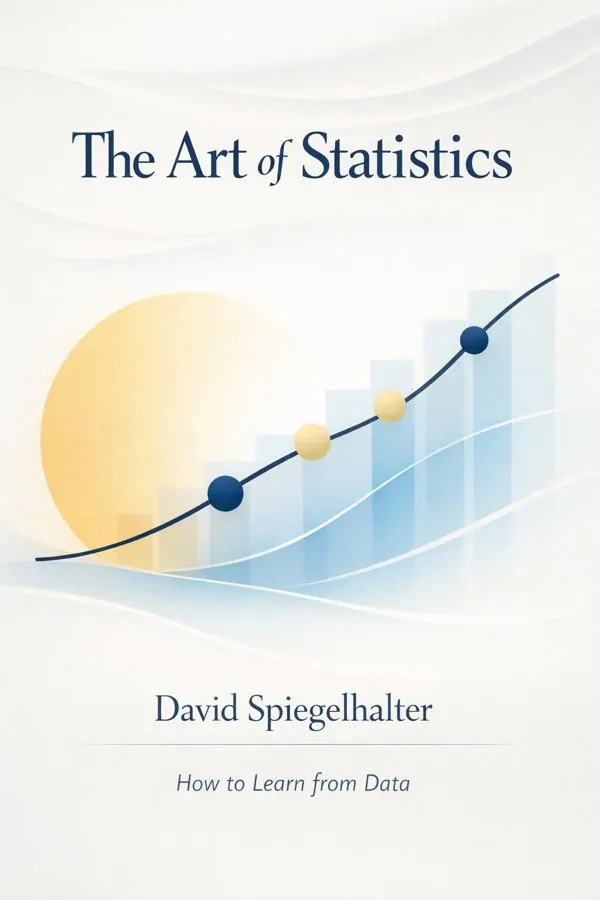
The Art of Statistics: How to Learn from Data
In a world flooded with numbers, charts, rankings, risk scores, and bold claims backed by “data,” the real challenge is no longer finding information—it is learning how to think about it well. The Art of Statistics by David Spiegelhalter is a lucid, practical guide to understanding what data can reveal, what it can hide, and how we can avoid being misled by false certainty. Rather than treating statistics as a dry collection of formulas, Spiegelhalter presents it as a humane, investigative discipline: a way of making sense of uncertainty in medicine, politics, science, business, and everyday life. What makes this book especially valuable is its balance of accessibility and intellectual rigor. Spiegelhalter, one of the world’s leading statisticians, draws on decades of experience communicating risk, probability, and evidence to the public. He explains complex ideas—variation, causation, bias, inference, and prediction—through vivid examples and real-world case studies rather than technical jargon. The result is a book that helps readers become calmer, sharper, and more skeptical consumers of information. For anyone who wants to understand how evidence should guide decisions, this is an essential modern primer.
Read SummaryKey Insights from David Spiegelhalter
Statistics Begins With Better Questions
The most important part of statistics often happens before any calculation begins: deciding what question is actually being asked. Spiegelhalter shows that bad statistical thinking usually starts with vague problems, poorly framed measurements, or assumptions that slip by unnoticed. Data never “spea...
From The Art of Statistics: How to Learn from Data
Data Need Context To Mean Anything
A number on its own is rarely informative; its meaning comes from comparison, scale, and background. Spiegelhalter repeatedly emphasizes that raw data can be deceptive if we fail to place them in context. Saying that a city had 500 crimes, a hospital had a 10% mortality rate, or a drug cuts risk by ...
From The Art of Statistics: How to Learn from Data
Variation Is Normal, Not Noise
One of the book’s most liberating insights is that variation is not an annoyance to be ignored—it is a basic feature of reality that statistics helps us understand. Human outcomes differ across people, places, and time. Patients respond differently to treatment, students learn at different rates, cr...
From The Art of Statistics: How to Learn from Data
Uncertainty Should Be Acknowledged Openly
Many people assume that statistics exists to produce certainty, but Spiegelhalter makes the opposite case: its real value lies in helping us reason honestly under uncertainty. In medicine, policy, science, and personal decisions, we rarely possess complete information. The question is not whether un...
From The Art of Statistics: How to Learn from Data
Correlation Does Not Explain Causation
Few statistical lessons are as famous—or as frequently ignored—as the distinction between correlation and causation. Spiegelhalter explores why humans are so eager to infer causes from patterns and why that impulse can be dangerous. Two things moving together does not prove that one produces the oth...
From The Art of Statistics: How to Learn from Data
Good Models Simplify, Not Replace Reality
Models are among the most powerful tools in statistics, but Spiegelhalter reminds readers that every model is a simplification. A model selects certain variables, assumes certain relationships, and ignores countless details in order to make understanding possible. That is not a flaw; it is the point...
From The Art of Statistics: How to Learn from Data
About David Spiegelhalter
Sir David Spiegelhalter is a British statistician and Winton Professor for the Public Understanding of Risk at the University of Cambridge. He is known for his work in medical statistics, risk communication, and public engagement with data and probability.


Frequently Asked Questions
Sir David Spiegelhalter is a British statistician and Winton Professor for the Public Understanding of Risk at the University of Cambridge. He is known for his work in medical statistics, risk communication, and public engagement with data and probability.
Read David Spiegelhalter's books in 15 minutes
Get AI-powered summaries with key insights from 1 book by David Spiegelhalter.