
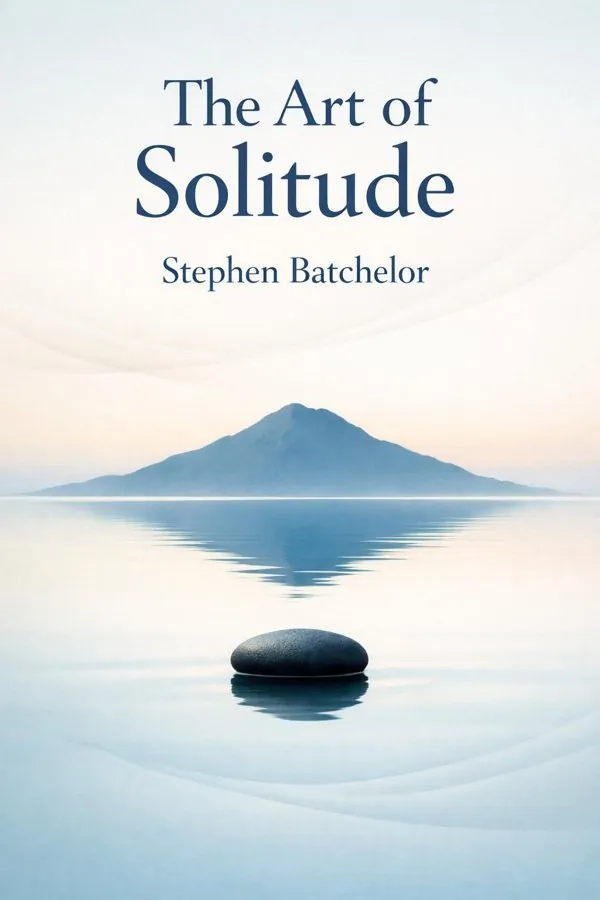
The Art of Solitude: Summary & Key Insights
 10 min10 chaptersAudio available
Key Takeaways from The Art of Solitude
Solitude becomes most meaningful when we stop treating it as a modern problem and start seeing it as an ancient human practice.
We rarely understand solitude the first time we encounter it.
The quality of your solitude depends less on where you are than on how you pay attention.
Creativity often requires more than talent; it requires a protected inner space where thoughts can ripen before they are exposed to the world.
Being alone is not only psychologically restorative; it can also make us morally clearer.
What Is The Art of Solitude About?
The Art of Solitude by Stephen Batchelor is a eastern_wisdom book spanning 10 pages. In The Art of Solitude, Stephen Batchelor offers a thoughtful meditation on what it means to be alone without feeling cut off, isolated, or diminished. Rather than treating solitude as a luxury for monks, artists, or introverts, he presents it as a deeply human capacity: the ability to stand in one’s own life with clarity, attention, and care. Drawing on Buddhist philosophy, Western literature, personal retreat experience, and secular reflection, Batchelor reframes solitude as a practice of presence rather than withdrawal. In a culture saturated by noise, distraction, and constant connection, this question becomes urgent: how can we recover an inner space in which thought, feeling, and ethical awareness can mature? Batchelor is especially well suited to answer it. A former monk in both Tibetan and Zen traditions, and one of the most influential voices in secular Buddhism, he combines philosophical rigor with lived experience. The result is a book that is quiet but not passive, reflective but not abstract. It invites readers to rediscover solitude as a source of creativity, freedom, compassion, and a more grounded way of being in the world.
This FizzRead summary covers all 10 key chapters of The Art of Solitude in approximately 10 minutes, distilling the most important ideas, arguments, and takeaways from Stephen Batchelor's work. Also available as an audio summary and Key Quotes Podcast.
The Art of Solitude
In The Art of Solitude, Stephen Batchelor offers a thoughtful meditation on what it means to be alone without feeling cut off, isolated, or diminished. Rather than treating solitude as a luxury for monks, artists, or introverts, he presents it as a deeply human capacity: the ability to stand in one’s own life with clarity, attention, and care. Drawing on Buddhist philosophy, Western literature, personal retreat experience, and secular reflection, Batchelor reframes solitude as a practice of presence rather than withdrawal. In a culture saturated by noise, distraction, and constant connection, this question becomes urgent: how can we recover an inner space in which thought, feeling, and ethical awareness can mature? Batchelor is especially well suited to answer it. A former monk in both Tibetan and Zen traditions, and one of the most influential voices in secular Buddhism, he combines philosophical rigor with lived experience. The result is a book that is quiet but not passive, reflective but not abstract. It invites readers to rediscover solitude as a source of creativity, freedom, compassion, and a more grounded way of being in the world.
Who Should Read The Art of Solitude?
This book is perfect for anyone interested in eastern_wisdom and looking to gain actionable insights in a short read. Whether you're a student, professional, or lifelong learner, the key ideas from The Art of Solitude by Stephen Batchelor will help you think differently.
- ✓Readers who enjoy eastern_wisdom and want practical takeaways
- ✓Professionals looking to apply new ideas to their work and life
- ✓Anyone who wants the core insights of The Art of Solitude in just 10 minutes
Want the full summary?
Get instant access to this book summary and 100K+ more with Fizz Moment.
Get Free SummaryAvailable on App Store • Free to download
Key Chapters
Solitude becomes most meaningful when we stop treating it as a modern problem and start seeing it as an ancient human practice. Batchelor places his reflections within a long lineage of people who turned toward aloneness not out of misery, but out of seriousness about life. In Western thought, essayists and philosophers such as Montaigne used solitude to examine the self without fleeing the world. In religious and contemplative traditions, hermits, monks, and seekers sought silence not because they despised society but because they wanted to encounter reality more directly. Batchelor shows that solitude has long been understood as a discipline of attention, honesty, and freedom.
This historical context matters because today solitude is often confused with loneliness, social failure, or emotional deficiency. Batchelor pushes back against that assumption. To be solitary is not necessarily to be alienated. It can instead be a deliberate and nourishing stance, one that creates room for reflection in the midst of pressure, noise, and performance. Seen this way, solitude is not anti-social. It is one of the conditions that makes mature participation in society possible.
A practical way to apply this insight is to rethink the role of time spent alone. Instead of asking whether being alone is productive or efficient, ask whether it allows deeper perception. A walk without a phone, an hour of reading in silence, or a journal session at the end of the day can become modern versions of an old human art.
Actionable takeaway: Reclaim 20 minutes of intentional solitude this week and approach it as a meaningful practice, not an empty gap in your schedule.
We rarely understand solitude the first time we encounter it. Batchelor reflects on how his own relationship with aloneness changed over time, especially through years in Zen monasteries and Tibetan retreat settings. At first, solitude seemed to mean physical separation, silence, and distance from ordinary life. It was defined externally: fewer people, fewer words, fewer distractions. But lived experience gradually taught him that real solitude is not guaranteed by remote surroundings. One can be in a monastery and still feel inwardly crowded by anxiety, memory, ambition, and restlessness.
This insight is crucial. Solitude is not simply a condition imposed from outside; it is a quality of being present to oneself. That is why some people feel deeply scattered even on a vacation alone, while others discover genuine inward spaciousness in the middle of a city. Batchelor’s personal narrative gives the book warmth and credibility. He is not romanticizing retreat. He shows that being alone can be uncomfortable, exposing, and even destabilizing before it becomes liberating.
For modern readers, this means solitude should not be measured by how far away we can get from others. It begins when we stop fleeing our own minds. A person might experiment with this by sitting quietly for ten minutes without reaching for music, messages, or tasks, and simply noticing the stream of thoughts and feelings that arise.
Actionable takeaway: Treat discomfort in solitude not as failure, but as the beginning of learning how to be honestly present with yourself.
The quality of your solitude depends less on where you are than on how you pay attention. Batchelor argues that solitude is fundamentally tied to attention: the capacity to remain with experience without immediately reacting, escaping, or turning it into entertainment. In this sense, solitude is not mere absence of company. It is a mode of receptivity. When attention steadies, the world becomes more vivid. Ordinary details emerge from the blur of habit. One begins to notice the texture of thought, the rhythm of breath, the movement of fear, the play of light in a room, or the emotional undertones of a conversation long after it has ended.
This form of attention is difficult precisely because modern life trains the opposite habit. Notifications, fragmented media, and constant stimulation weaken our tolerance for unstructured awareness. Batchelor’s contribution is to show that solitude can restore that tolerance. By staying with what is here, instead of chasing what is next, we begin to inhabit our experience more fully.
Practically, this means solitude is not just about withdrawing from noise but about refining perception. You might drink tea without multitasking, take a walk without headphones, or spend a few minutes observing your reactions before replying to a difficult email. These are small acts, but they retrain the mind to remain present rather than scattered.
Actionable takeaway: Choose one daily activity and do it in complete attention, without media, multitasking, or interruption, as a way of cultivating real solitude.
Creativity often requires more than talent; it requires a protected inner space where thoughts can ripen before they are exposed to the world. Batchelor connects solitude to imagination by showing that original insight rarely emerges from constant reaction. When we are perpetually engaged with other people’s opinions, demands, and noise, our inner life becomes crowded. Solitude clears room for associations, memories, and intuitions that would otherwise remain buried under distraction.
This is not limited to artists or writers. Anyone solving a problem, rethinking a career, navigating grief, or making a moral decision depends on this creative interior space. Solitude allows experience to settle into meaning. It lets us hear our own language before it is edited by social expectation. Batchelor suggests that silence does not empty the mind; it often reveals how alive the mind actually is.
Modern culture often treats creativity as something optimized by productivity systems, collaboration tools, and visible output. Batchelor offers a more patient view. Imagination needs periods of apparent idleness, wandering, and inwardness. A notebook kept during quiet mornings, a technology-free hour after work, or even solitary travel can help this process unfold. The point is not to force inspiration, but to create the conditions in which it can arise.
Actionable takeaway: Set aside one recurring block of undisturbed time each week for open-ended thinking, writing, drawing, or reflection without the pressure to produce immediate results.
Being alone is not only psychologically restorative; it can also make us morally clearer. Batchelor emphasizes that solitude creates the distance needed to see our motives, habits, and actions without the fog of social momentum. Much of everyday behavior is automatic. We imitate others, follow the emotional climate of a group, or act from impulse before we understand what is driving us. Solitude interrupts that flow. It allows conscience to speak more distinctly.
This ethical dimension is one of the book’s most important contributions. Batchelor does not present solitude as self-absorption. On the contrary, he suggests that only by stepping back from the pressures of performance and conformity can we become more responsible human beings. Solitude helps us notice resentment before it becomes cruelty, craving before it becomes exploitation, and fear before it becomes avoidance. In that sense, time alone can deepen compassion because it reduces confusion.
A practical application is to use solitude for moral inquiry, not just relaxation. After a difficult interaction, instead of immediately venting or distracting yourself, pause and ask: What was I protecting? What did I fail to see? What would a more generous response have looked like? This does not mean harsh self-judgment. It means honest examination.
Actionable takeaway: Once a week, use a short period of solitude to review one recent conflict or decision and identify one clearer, kinder action you could take next time.
One of the paradoxes Batchelor explores is that solitude, properly understood, does not weaken our relationships; it improves them. When we never step back from social life, we risk becoming dependent on approval, engulfed by group identity, or unable to distinguish connection from emotional fusion. Solitude gives us the space to recover our own center. From that grounded place, we can meet others with greater steadiness and less neediness.
This point matters because many people fear solitude precisely because they equate it with disconnection. Batchelor shows the opposite. The person who can be alone without panic is often more available to others, not less. Such a person listens better, clings less, and does not demand that every relationship fill an existential void. Solitude matures love by freeing it from possession.
This can be applied in ordinary ways. Partners may benefit from protecting some independent time rather than interpreting every separate activity as rejection. Friends may find that space renews conversation. Parents can model for children that being alone is normal and healthy. Even teams and communities can benefit when members have time for reflection instead of constant meetings and instant reactions.
Actionable takeaway: Build one intentional rhythm of separation into an important relationship, such as a weekly hour alone for each person, and notice whether the quality of connection improves.
The greatest obstacle to solitude today may not be other people but the devices that prevent us from ever fully encountering ourselves. Batchelor examines the modern condition of perpetual connection and suggests that digital life often fills every pause that might otherwise become reflective space. We check messages while waiting in line, scroll before sleep, listen while walking, and consume information the moment silence appears. The result is not simply distraction, but a shrinking capacity to dwell in our own experience.
Batchelor is not arguing for a nostalgic rejection of technology. The issue is not whether tools are good or bad, but whether we use them in ways that undermine inward freedom. Constant connectivity can create a false sense of company while leaving us inwardly fragmented. It also encourages reactive attention: quick, scattered, externally directed. Solitude, by contrast, asks for sustained attention, patience, and receptivity.
A practical response is not total withdrawal but deliberate boundaries. Keep the phone out of reach during meals. Begin the day without screens for the first fifteen minutes. Take a walk without audio input. Let boredom return as a doorway rather than an emergency. These simple acts can feel surprisingly difficult, which reveals how much our minds have been conditioned.
Actionable takeaway: Create one daily technology-free interval, even just 20 minutes, and protect it as a non-negotiable space for silence, reflection, or undistracted observation.
Meditation matters in this book not as a specialized religious exercise but as training in how to be alone without fleeing. Batchelor draws on Buddhist practice to show that meditation cultivates the very capacities solitude requires: stillness, patience, observation, and non-reactivity. To sit quietly and watch the mind is to encounter directly how difficult aloneness can be. Thoughts proliferate, emotions surface, memories intrude, plans multiply. Yet this same process reveals that we do not have to obey every mental movement.
That is why meditative solitude is transformative. It teaches us to remain with experience without turning away. Over time, this creates a more spacious relationship to thought and feeling. We become less entangled in passing moods and more capable of simply noticing them. Batchelor’s secular orientation makes this especially accessible. The point is not to adopt metaphysical beliefs, but to practice attentive presence.
For everyday readers, meditation can begin very simply: five or ten minutes of sitting still, feeling the breath, and noticing when the mind wanders. The goal is not blankness or serenity on demand. The goal is familiarity with the inner landscape. This familiarity reduces fear of silence because silence is no longer unknown territory.
Actionable takeaway: Start a brief daily meditation practice and treat it as rehearsal for meeting yourself with calm honesty rather than as a performance of spiritual success.
When external noise quiets down, an unsettling truth appears: no one else can fully live your life for you. Batchelor links solitude to existential freedom by arguing that time alone exposes the contingency of our roles, routines, and borrowed identities. Without the constant reinforcement of social scripts, we are confronted with choice. How do I want to live? What matters when no one is watching? What beliefs are actually mine? Solitude can feel uncomfortable precisely because it strips away distractions and returns us to responsibility.
Yet this is also where its liberating power lies. Freedom is not merely the absence of constraints; it is the willingness to face uncertainty and still choose deliberately. Batchelor presents solitude as the space in which such freedom becomes real. We begin to see that many aspects of life are impermanent and unresolved, but rather than seeking false certainty, we can respond with attentiveness and courage.
This idea has immediate relevance for people in transition: changing careers, ending relationships, grieving losses, or questioning inherited beliefs. Solitude does not hand us answers, but it creates the conditions in which more authentic answers can emerge. Journaling, silent retreats, solo travel, or simply sustained time away from social pressure can help clarify what is genuinely ours to affirm.
Actionable takeaway: Use one period of solitude to ask a single serious question about your life and write down your answer before seeking advice, approval, or distraction.
The deepest lesson of solitude is not how to withdraw from the world, but how to return to it more fully alive. Batchelor insists that solitude should not become another identity, performance, or refuge from difficulty. Its value lies in integration. We step back in order to see more clearly, feel more honestly, and act more wisely. Solitude that remains sealed off from ordinary life becomes sterile. Solitude that feeds attention, ethics, and compassion becomes transformative.
This final movement is essential because many readers may romanticize retreat. Batchelor resists that tendency. The real test of solitude is not what happens in a quiet room, but what happens afterward: Are we less reactive? More capable of listening? More at ease with uncertainty? More willing to inhabit our commitments without resentment or confusion? Solitude should deepen participation in life, not remove us from it.
Practically, this means building small cycles of withdrawal and return. A morning of reflection can reshape the tone of a workday. A solitary walk can prepare us for a difficult conversation. A silent weekend can renew our sense of purpose in family or community life. The art lies in weaving these moments into an ongoing rhythm rather than treating them as rare emergencies.
Actionable takeaway: After any period of solitude, identify one concrete way to bring its clarity back into daily life, whether through gentler speech, better boundaries, or more deliberate attention.
All Chapters in The Art of Solitude
About the Author
Stephen Batchelor is a British author, translator, and Buddhist teacher best known for his secular reinterpretation of Buddhist philosophy. Born in Scotland, he trained extensively in both Tibetan and Zen traditions and was ordained as a monk before later leaving monastic life to develop a more agnostic and contemporary approach to the dharma. His writing explores meditation, ethics, doubt, freedom, and the relevance of Buddhist insights in a modern, non-dogmatic context. Batchelor has become one of the most distinctive voices in contemporary contemplative thought because he combines deep traditional knowledge with philosophical independence and literary clarity. His books appeal to both longtime practitioners and curious general readers seeking reflective, practical wisdom for everyday life.
Get This Summary in Your Preferred Format
Read or listen to the The Art of Solitude summary by Stephen Batchelor anytime, anywhere. FizzRead offers multiple formats so you can learn on your terms — all free.
Available formats: App · Audio · PDF · EPUB — All included free with FizzRead
Download The Art of Solitude PDF and EPUB Summary
Key Quotes from The Art of Solitude
“Solitude becomes most meaningful when we stop treating it as a modern problem and start seeing it as an ancient human practice.”
“We rarely understand solitude the first time we encounter it.”
“The quality of your solitude depends less on where you are than on how you pay attention.”
“Creativity often requires more than talent; it requires a protected inner space where thoughts can ripen before they are exposed to the world.”
“Being alone is not only psychologically restorative; it can also make us morally clearer.”
Frequently Asked Questions about The Art of Solitude
The Art of Solitude by Stephen Batchelor is a eastern_wisdom book that explores key ideas across 10 chapters. In The Art of Solitude, Stephen Batchelor offers a thoughtful meditation on what it means to be alone without feeling cut off, isolated, or diminished. Rather than treating solitude as a luxury for monks, artists, or introverts, he presents it as a deeply human capacity: the ability to stand in one’s own life with clarity, attention, and care. Drawing on Buddhist philosophy, Western literature, personal retreat experience, and secular reflection, Batchelor reframes solitude as a practice of presence rather than withdrawal. In a culture saturated by noise, distraction, and constant connection, this question becomes urgent: how can we recover an inner space in which thought, feeling, and ethical awareness can mature? Batchelor is especially well suited to answer it. A former monk in both Tibetan and Zen traditions, and one of the most influential voices in secular Buddhism, he combines philosophical rigor with lived experience. The result is a book that is quiet but not passive, reflective but not abstract. It invites readers to rediscover solitude as a source of creativity, freedom, compassion, and a more grounded way of being in the world.
You Might Also Like
A New Earth
Eckhart Tolle
10 min
The Daily Stoic
Ryan Holiday, Stephen Hanselman
10 min
Buddhism: Plain and Simple
Steve Hagen
10 min
Enchiridion
Epictetus
10 min
The Book of Tea
Kakuzō Okakura
10 min
The Light We Give: How Sikh Wisdom Can Transform Your Life
Simran Jeet Singh
10 minBrowse by Category
Ready to read The Art of Solitude?
Get the full summary and 100K+ more books with Fizz Moment.