
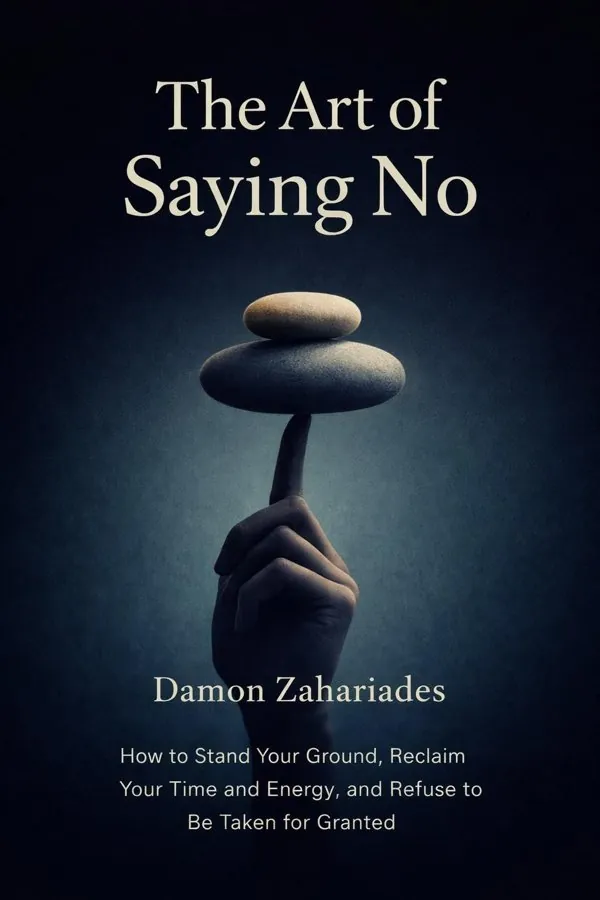
The Art of Saying No: How to Stand Your Ground, Reclaim Your Time and Energy, and Refuse to Be Taken for Granted: Summary & Key Insights
 10 min9 chaptersAudio available
Key Takeaways from The Art of Saying No: How to Stand Your Ground, Reclaim Your Time and Energy, and Refuse to Be Taken for Granted
Many people do not say yes because they truly want to.
Saying yes often feels harmless in the moment, but Zahariades insists that every commitment carries a price.
It is hard to say no when you have not decided what deserves your yes.
Not every request is innocent.
One reason people struggle to set limits is that guilt arrives the moment they try.
What Is The Art of Saying No: How to Stand Your Ground, Reclaim Your Time and Energy, and Refuse to Be Taken for Granted About?
The Art of Saying No: How to Stand Your Ground, Reclaim Your Time and Energy, and Refuse to Be Taken for Granted by Damon Zahariades is a productivity book spanning 10 pages. Damon Zahariades’s The Art of Saying No is a practical guide for anyone who feels stretched too thin, trapped by obligations, or quietly resentful after agreeing to things they never wanted to do. At its core, the book argues that saying no is not selfish, rude, or unkind. It is a vital skill for protecting your time, energy, priorities, and self-respect. Zahariades examines why so many people default to yes, from fear of conflict and rejection to ingrained people-pleasing habits, then offers clear strategies for changing those patterns. What makes the book especially useful is its emphasis on real-life application: how to refuse requests without guilt, how to recognize manipulation, and how to stay firm when others push back. Zahariades writes from the perspective of a productivity expert who understands that every unnecessary commitment steals attention from what matters most. For readers overwhelmed by constant demands at work, at home, or in social life, this book delivers a simple but powerful message: boundaries are not barriers to a better life; they are the foundation of one.
This FizzRead summary covers all 9 key chapters of The Art of Saying No: How to Stand Your Ground, Reclaim Your Time and Energy, and Refuse to Be Taken for Granted in approximately 10 minutes, distilling the most important ideas, arguments, and takeaways from Damon Zahariades's work. Also available as an audio summary and Key Quotes Podcast.
The Art of Saying No: How to Stand Your Ground, Reclaim Your Time and Energy, and Refuse to Be Taken for Granted
Damon Zahariades’s The Art of Saying No is a practical guide for anyone who feels stretched too thin, trapped by obligations, or quietly resentful after agreeing to things they never wanted to do. At its core, the book argues that saying no is not selfish, rude, or unkind. It is a vital skill for protecting your time, energy, priorities, and self-respect. Zahariades examines why so many people default to yes, from fear of conflict and rejection to ingrained people-pleasing habits, then offers clear strategies for changing those patterns. What makes the book especially useful is its emphasis on real-life application: how to refuse requests without guilt, how to recognize manipulation, and how to stay firm when others push back. Zahariades writes from the perspective of a productivity expert who understands that every unnecessary commitment steals attention from what matters most. For readers overwhelmed by constant demands at work, at home, or in social life, this book delivers a simple but powerful message: boundaries are not barriers to a better life; they are the foundation of one.
Who Should Read The Art of Saying No: How to Stand Your Ground, Reclaim Your Time and Energy, and Refuse to Be Taken for Granted?
This book is perfect for anyone interested in productivity and looking to gain actionable insights in a short read. Whether you're a student, professional, or lifelong learner, the key ideas from The Art of Saying No: How to Stand Your Ground, Reclaim Your Time and Energy, and Refuse to Be Taken for Granted by Damon Zahariades will help you think differently.
- ✓Readers who enjoy productivity and want practical takeaways
- ✓Professionals looking to apply new ideas to their work and life
- ✓Anyone who wants the core insights of The Art of Saying No: How to Stand Your Ground, Reclaim Your Time and Energy, and Refuse to Be Taken for Granted in just 10 minutes
Want the full summary?
Get instant access to this book summary and 100K+ more with Fizz Moment.
Get Free SummaryAvailable on App Store • Free to download
Key Chapters
Many people do not say yes because they truly want to. They say yes because saying no feels dangerous. Zahariades argues that people-pleasing is often driven by fear: fear of rejection, fear of conflict, fear of being seen as selfish, and fear of disappointing others. Over time, this fear becomes a habit. You begin to equate being helpful with being valuable, and being agreeable with being lovable. The result is that your decisions are no longer guided by your priorities, but by other people’s expectations.
The book encourages readers to look beneath their automatic responses. If a coworker asks you to take on extra work, or a friend pressures you into a favor, your immediate yes may not come from generosity at all. It may come from anxiety. Zahariades explains that unless you understand the emotional drivers behind your behavior, boundary-setting will always feel unnatural. Self-awareness is the first step toward change.
A practical way to apply this idea is to pause whenever a request makes you tense. Instead of answering immediately, ask yourself: Do I want to do this, or do I just want to avoid discomfort? That single question can reveal a lot. It separates genuine willingness from reflexive compliance.
The key takeaway is simple: if your yes is motivated by fear, it is not a healthy yes. Start noticing when people-pleasing, rather than honest choice, is making your decisions for you.
Saying yes often feels harmless in the moment, but Zahariades insists that every commitment carries a price. Time, attention, emotional energy, and mental clarity are limited resources. When you casually agree to tasks, favors, meetings, or social obligations that do not align with your priorities, you are spending those resources whether you realize it or not. The cost may not be visible immediately, but it accumulates as stress, resentment, exhaustion, and reduced focus.
One of the book’s strongest insights is that overcommitment is not merely a scheduling issue. It is a quality-of-life issue. A parent who says yes to every school committee may become too drained to be present at home. An employee who constantly accepts extra assignments may damage their performance on core responsibilities. A friend who is always available may start to feel used. What looks like kindness from the outside can become self-neglect on the inside.
Zahariades encourages readers to stop evaluating requests in isolation. Instead, measure them against what they displace. If you agree to stay late at work, what personal time disappears? If you volunteer for another project, what meaningful goal gets delayed? This shift in thinking makes refusal easier because it reveals the hidden trade-offs.
The actionable takeaway: before saying yes, ask, What will this cost me in time, energy, and attention? When you start seeing commitments as exchanges rather than obligations, you become far more intentional about where your life goes.
It is hard to say no when you have not decided what deserves your yes. Zahariades emphasizes that boundaries become much easier when they are anchored in clear personal values and goals. If you know what matters most, protecting it feels less like selfishness and more like responsibility. Without that clarity, every request seems equally urgent, and you end up reacting to other people’s priorities instead of living by your own.
This idea is especially useful for people who feel constantly busy but strangely unfulfilled. The problem is not always too much to do; it is often too little alignment. You may spend hours helping colleagues, answering messages, attending events, and solving other people’s problems, while your own meaningful projects sit untouched. Zahariades encourages readers to define what success, health, relationships, and peace look like for them personally. Once those priorities are visible, boundary-setting becomes a practical tool for protecting them.
For example, if family dinners are one of your core values, you may decide not to answer work emails after a certain hour. If creative work is your top goal, you may decline low-value meetings. If rest is a non-negotiable need, you may stop accepting social invitations out of guilt.
The actionable takeaway is to write down your top three priorities for this season of life. Then use them as a filter. If a request consistently pulls you away from those priorities, it deserves a thoughtful no.
Not every request is innocent. Zahariades explains that many people, consciously or unconsciously, use manipulation to get compliance. They may guilt-trip you, flatter you, invoke urgency, appeal to your sense of duty, or make you feel uniquely responsible for fixing their problem. These tactics are effective because they bypass rational evaluation and trigger emotional reflexes. If you are unaware of them, you can mistake pressure for obligation.
The book helps readers identify common patterns. A coworker might say, “You’re the only one I can trust with this,” making refusal feel disloyal. A relative might say, “After everything I’ve done for you,” turning a request into a debt. A friend may frame a favor as an emergency when it is really poor planning. Zahariades does not suggest becoming cynical, but he does urge readers to become more discerning. The goal is to respond to the request itself, not to the emotional packaging around it.
A useful strategy is to separate facts from pressure. What is actually being asked? Is it truly urgent? Is it your responsibility? Are you being given room to choose freely? When you pause to answer these questions, manipulative dynamics become easier to spot.
The actionable takeaway is to watch for emotional hooks such as guilt, flattery, and manufactured urgency. The moment you notice them, slow down. Pressure thrives on instant agreement; boundaries grow stronger when you give yourself time to think.
One reason people struggle to set limits is that guilt arrives the moment they try. Zahariades makes an important distinction: feeling guilty does not mean you have done something wrong. It often means you are doing something unfamiliar. If you have spent years being available, accommodating, and conflict-avoidant, asserting a boundary can feel emotionally unsettling even when it is completely appropriate.
The book encourages readers to stop treating guilt as a moral authority. Instead, view it as an emotional aftershock from breaking an old pattern. For example, declining to lend money you cannot afford to lose may feel uncomfortable, but discomfort does not equal cruelty. Refusing to attend an event because you need rest may spark self-doubt, but it may still be the healthiest choice. Zahariades argues that if you always let guilt decide, you will remain trapped in obligations that drain you.
One practical method is to prepare short, respectful refusals in advance so you are not improvising under pressure. Another is to remind yourself that protecting your limits prevents bigger problems later, including resentment and burnout. In many cases, a clear no now is kinder than a reluctant yes followed by frustration.
The actionable takeaway is to expect guilt when you begin changing your habits, but do not obey it automatically. Let your decisions be guided by reason, values, and capacity, not by the temporary discomfort of disappointing someone.
Many people think saying no requires lengthy explanations, apologies, or elaborate excuses. Zahariades argues the opposite. The most effective refusals are brief, direct, and respectful. When you over-explain, you often weaken your position because you invite debate. The other person starts treating your reason as a problem to solve instead of a decision to respect.
Assertive communication is not aggressive. It does not humiliate, attack, or dismiss. It simply states your boundary with clarity. Phrases like “I’m not able to do that,” “I can’t commit to this,” or “That doesn’t work for me” are powerful because they are unambiguous. They leave little room for misunderstanding while still preserving civility. Zahariades notes that confidence often comes less from finding the perfect words and more from delivering simple words without excessive justification.
This approach is especially helpful in professional settings. If a manager or colleague asks for more than you can reasonably handle, a response such as “I can help next week, but I can’t take this on today” is far better than panicked agreement. In personal life, the same principle applies. You can decline an invitation, a favor, or a family request without writing a legal brief in your defense.
The actionable takeaway is to practice a few standard no-statements until they feel natural. Keep them short, polite, and final. You do not need a dramatic excuse to honor your limits.
When you start setting boundaries, not everyone will welcome the change. Zahariades points out that some people benefited from your old habits. They were used to your availability, your compliance, and your willingness to carry extra burdens. Once you begin saying no, they may react with disappointment, irritation, persuasion, or even anger. This does not necessarily mean your boundary is wrong. Often, it means the boundary is real.
The book stresses that pushback is part of the process, not proof of failure. If you cave the moment someone insists, complains, or questions your decision, your no becomes negotiable. People quickly learn whether your limits are genuine or just temporary resistance. Consistency is what teaches others how to treat you.
A practical strategy is the “broken record” technique: calmly repeat your refusal without getting pulled into new arguments. For example, if someone keeps pressing you to help, you can say, “I understand, but I’m not available,” and repeat the same message if needed. This prevents you from being dragged into emotional bargaining. Zahariades also reminds readers that another person’s frustration belongs to them. Your job is to communicate respectfully, not to manage every reaction.
The actionable takeaway is to plan for resistance instead of being surprised by it. If someone pushes back, stay calm, repeat your boundary, and avoid defending yourself endlessly. A steady no is stronger than a guilty maybe.
Many people fear that saying no will damage their relationships, but Zahariades argues that the opposite is often true. Relationships become strained not because of honest boundaries, but because of hidden resentment. When you constantly say yes out of obligation, you may appear generous on the surface while feeling depleted underneath. Over time, that imbalance can lead to frustration, passive aggression, avoidance, or emotional distance.
Healthy relationships allow room for limits. A respectful friend can hear no without treating it as betrayal. A mature colleague understands capacity. A caring partner recognizes that your needs matter too. Boundaries clarify where responsibility begins and ends, which actually reduces confusion and conflict. They also reveal which relationships are built on mutual respect and which are built on access to your labor, time, or emotional support.
This does not mean becoming rigid or unavailable. Zahariades is not promoting selfishness; he is promoting self-respect. You can still be generous, dependable, and kind while refusing what is unreasonable, unhealthy, or unsustainable. In fact, when your yes is chosen rather than coerced, it becomes more meaningful.
The actionable takeaway is to see boundaries as a relationship filter and a relationship safeguard. The right people may not love every no, but they will learn to respect it. And the relationships that survive honest limits are usually stronger, calmer, and more genuine.
One successful refusal does not change a lifetime of conditioning. Zahariades emphasizes that learning to say no is an ongoing practice, not a one-time breakthrough. Because old habits are deeply ingrained, you need systems that make boundary-setting easier over time. Without reinforcement, it is easy to slip back into automatic yeses, especially when you are tired, stressed, or caught off guard.
The book suggests building a personal decision-making framework. You might create rules such as: never answer non-urgent requests immediately, never commit without checking your calendar, or never agree to favors that create resentment before they even begin. These small structures reduce emotional decision-making and make your responses more consistent. Reflection also matters. After a difficult interaction, review what happened. Where did you feel pressured? What worked? What will you say next time?
Another useful step is to notice the positive effects of your boundaries. Maybe you have more time for deep work, less anxiety, improved sleep, or better relationships. Paying attention to these gains strengthens your motivation. Habits stick when you see that they improve your life.
The actionable takeaway is to turn saying no into a repeatable practice. Use pause rules, prepared responses, and regular reflection to support your boundaries. Confidence grows through repetition. The more often you protect your time and energy, the more natural and sustainable it becomes.
All Chapters in The Art of Saying No: How to Stand Your Ground, Reclaim Your Time and Energy, and Refuse to Be Taken for Granted
About the Author
Damon Zahariades is a productivity author and personal effectiveness expert best known for writing practical guides that help readers take control of their time, habits, and attention. His books focus on clear, actionable strategies rather than abstract theory, covering topics such as self-discipline, focus, simplicity, and decision-making. Zahariades has earned a loyal readership by addressing everyday problems that undermine performance and peace of mind, especially in an age of constant demands and distractions. In The Art of Saying No, he applies his productivity lens to the challenge of boundary-setting, showing how weak limits can lead to overcommitment, stress, and resentment. His work appeals to readers who want concise advice, usable frameworks, and immediate improvements in both work and personal life.
Get This Summary in Your Preferred Format
Read or listen to the The Art of Saying No: How to Stand Your Ground, Reclaim Your Time and Energy, and Refuse to Be Taken for Granted summary by Damon Zahariades anytime, anywhere. FizzRead offers multiple formats so you can learn on your terms — all free.
Available formats: App · Audio · PDF · EPUB — All included free with FizzRead
Download The Art of Saying No: How to Stand Your Ground, Reclaim Your Time and Energy, and Refuse to Be Taken for Granted PDF and EPUB Summary
Key Quotes from The Art of Saying No: How to Stand Your Ground, Reclaim Your Time and Energy, and Refuse to Be Taken for Granted
“Many people do not say yes because they truly want to.”
“Saying yes often feels harmless in the moment, but Zahariades insists that every commitment carries a price.”
“It is hard to say no when you have not decided what deserves your yes.”
“Zahariades explains that many people, consciously or unconsciously, use manipulation to get compliance.”
“One reason people struggle to set limits is that guilt arrives the moment they try.”
Frequently Asked Questions about The Art of Saying No: How to Stand Your Ground, Reclaim Your Time and Energy, and Refuse to Be Taken for Granted
The Art of Saying No: How to Stand Your Ground, Reclaim Your Time and Energy, and Refuse to Be Taken for Granted by Damon Zahariades is a productivity book that explores key ideas across 9 chapters. Damon Zahariades’s The Art of Saying No is a practical guide for anyone who feels stretched too thin, trapped by obligations, or quietly resentful after agreeing to things they never wanted to do. At its core, the book argues that saying no is not selfish, rude, or unkind. It is a vital skill for protecting your time, energy, priorities, and self-respect. Zahariades examines why so many people default to yes, from fear of conflict and rejection to ingrained people-pleasing habits, then offers clear strategies for changing those patterns. What makes the book especially useful is its emphasis on real-life application: how to refuse requests without guilt, how to recognize manipulation, and how to stay firm when others push back. Zahariades writes from the perspective of a productivity expert who understands that every unnecessary commitment steals attention from what matters most. For readers overwhelmed by constant demands at work, at home, or in social life, this book delivers a simple but powerful message: boundaries are not barriers to a better life; they are the foundation of one.
More by Damon Zahariades

You Might Also Like



Browse by Category
Ready to read The Art of Saying No: How to Stand Your Ground, Reclaim Your Time and Energy, and Refuse to Be Taken for Granted?
Get the full summary and 100K+ more books with Fizz Moment.