
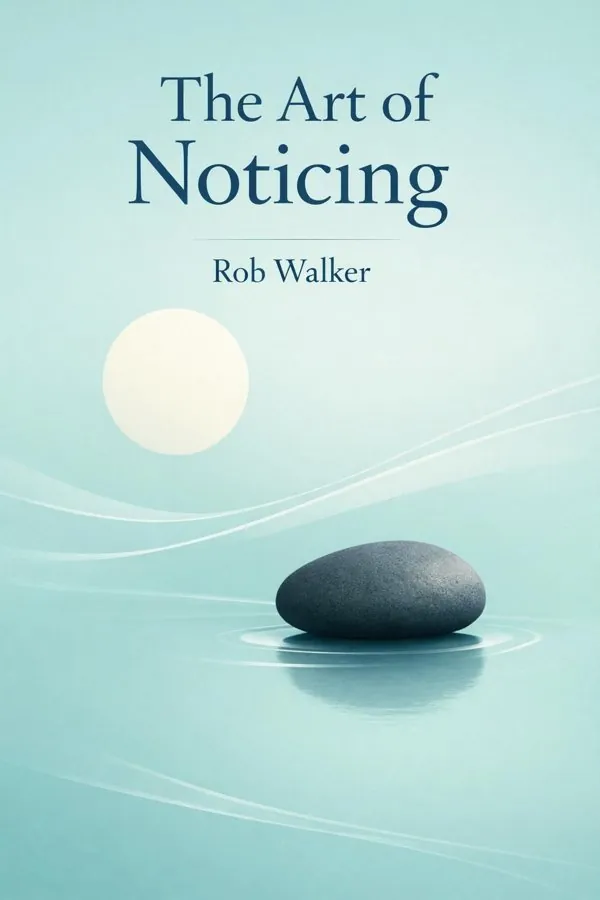
The Art of Noticing: 131 Ways to Spark Creativity, Find Inspiration, and Discover Joy in the Everyday: Summary & Key Insights
by Rob Walker
 10 min9 chaptersAudio available
Key Takeaways from The Art of Noticing: 131 Ways to Spark Creativity, Find Inspiration, and Discover Joy in the Everyday
The modern crisis is not a lack of information but a lack of presence.
Seeing is never just seeing; it is interpreting, selecting, and engaging.
A fresh perspective often arrives not through inspiration but through structure.
We tend to equate noticing with seeing, yet much of the world reveals itself through sound.
If you want to escape boredom, study people.
What Is The Art of Noticing: 131 Ways to Spark Creativity, Find Inspiration, and Discover Joy in the Everyday About?
The Art of Noticing: 131 Ways to Spark Creativity, Find Inspiration, and Discover Joy in the Everyday by Rob Walker is a creativity book spanning 12 pages. Most of us move through our days on autopilot, guided by habits, screens, deadlines, and familiar routines that flatten the world into the predictable. Rob Walker’s The Art of Noticing argues that this numbness is not inevitable. Attention, he suggests, is a skill we can rebuild—and once we do, ordinary life becomes richer, more creative, and more meaningful. Part manifesto, part field guide, the book offers 131 playful prompts designed to help readers observe more deeply, listen more carefully, and reconnect with the surprising details hidden in plain sight. What makes this book valuable is its practical spirit. Walker does not treat creativity as a rare gift for artists alone. Instead, he shows that imagination begins with perception: the way we look at a street corner, overhear a conversation, or notice patterns in our daily commute. A respected journalist and writer on design, culture, and technology, Walker brings curiosity, clarity, and cultural insight to the subject. The result is an energizing invitation to slow down, pay attention, and rediscover the everyday world as a source of wonder, invention, and joy.
This FizzRead summary covers all 9 key chapters of The Art of Noticing: 131 Ways to Spark Creativity, Find Inspiration, and Discover Joy in the Everyday in approximately 10 minutes, distilling the most important ideas, arguments, and takeaways from Rob Walker's work. Also available as an audio summary and Key Quotes Podcast.
The Art of Noticing: 131 Ways to Spark Creativity, Find Inspiration, and Discover Joy in the Everyday
Most of us move through our days on autopilot, guided by habits, screens, deadlines, and familiar routines that flatten the world into the predictable. Rob Walker’s The Art of Noticing argues that this numbness is not inevitable. Attention, he suggests, is a skill we can rebuild—and once we do, ordinary life becomes richer, more creative, and more meaningful. Part manifesto, part field guide, the book offers 131 playful prompts designed to help readers observe more deeply, listen more carefully, and reconnect with the surprising details hidden in plain sight.
What makes this book valuable is its practical spirit. Walker does not treat creativity as a rare gift for artists alone. Instead, he shows that imagination begins with perception: the way we look at a street corner, overhear a conversation, or notice patterns in our daily commute. A respected journalist and writer on design, culture, and technology, Walker brings curiosity, clarity, and cultural insight to the subject. The result is an energizing invitation to slow down, pay attention, and rediscover the everyday world as a source of wonder, invention, and joy.
Who Should Read The Art of Noticing: 131 Ways to Spark Creativity, Find Inspiration, and Discover Joy in the Everyday?
This book is perfect for anyone interested in creativity and looking to gain actionable insights in a short read. Whether you're a student, professional, or lifelong learner, the key ideas from The Art of Noticing: 131 Ways to Spark Creativity, Find Inspiration, and Discover Joy in the Everyday by Rob Walker will help you think differently.
- ✓Readers who enjoy creativity and want practical takeaways
- ✓Professionals looking to apply new ideas to their work and life
- ✓Anyone who wants the core insights of The Art of Noticing: 131 Ways to Spark Creativity, Find Inspiration, and Discover Joy in the Everyday in just 10 minutes
Want the full summary?
Get instant access to this book summary and 100K+ more with Fizz Moment.
Get Free SummaryAvailable on App Store • Free to download
Key Chapters
The modern crisis is not a lack of information but a lack of presence. Walker begins from a simple but unsettling reality: our attention is constantly being claimed, fragmented, and monetized. Phones buzz, feeds refresh, alerts interrupt, and the habit of constant checking trains us to skim life rather than inhabit it. When attention becomes shallow, noticing becomes difficult. We stop seeing what is right in front of us, and the world begins to feel repetitive not because it lacks richness, but because we are no longer available to experience it.
Walker’s point is not that technology is evil or that we must retreat from modern life. Instead, he asks us to recognize how distraction reshapes perception. If every spare second is filled with scrolling, there is no room for curiosity to arise. The quiet moments in line, on a walk, or between meetings—once fertile spaces for observation and reflection—are now often surrendered automatically. Over time, this weakens creativity because creativity depends on absorbing textures, patterns, oddities, and human details.
A practical application is to create “attention thresholds” in your day. Leave your phone in your pocket during a short walk. Spend five minutes at a café observing sounds, gestures, colors, and interactions without documenting any of it. Notice how quickly discomfort appears—and how quickly it gives way to awareness. You might realize that the world is more eventful than your screen.
The key takeaway is simple: if you want to notice more, you must protect some part of your attention from constant capture.
Seeing is never just seeing; it is interpreting, selecting, and engaging. One of Walker’s most useful reframings is that observation is not passive reception but active participation. Two people can walk down the same block and come away with completely different experiences. One remembers only getting from point A to point B. The other notices a crooked sign, a fragment of overheard dialogue, the rhythm of footsteps, a mural fading beneath weather and time. The difference is not eyesight. It is intention.
This matters because many people assume creativity begins with making something. Walker shows that it begins earlier, at the level of perception. The novelist, designer, entrepreneur, teacher, and parent all rely on the same raw material: what they have learned to notice. To observe well is to gather sparks. It means approaching the world with questions instead of conclusions. What is unusual here? What repeats? What feels out of place? What story might explain this scene?
In practical terms, this can mean assigning yourself a lens for the day. On one commute, notice only typography and signage. On another, notice how people carry bags, wait in line, or signal impatience. In a park, look for evidence of human care or neglect. By narrowing focus, you paradoxically expand perception. You begin to train your mind to distinguish instead of blur.
The actionable takeaway: stop treating observation as something that happens automatically. Choose a lens, apply it deliberately, and watch how your ordinary environment becomes creatively charged.
A fresh perspective often arrives not through inspiration but through structure. One reason Walker’s book is so effective is that it replaces vague advice like “be more mindful” with concrete assignments. The 131 exercises are built on a powerful idea: constraints sharpen awareness. When you give yourself a specific prompt—notice only red objects, photograph overlooked corners, follow an unfamiliar sound—you interrupt automatic perception and make the familiar strange again.
This matters because most people do not fail to notice due to laziness; they fail because habit is efficient. The brain filters aggressively so that daily life remains manageable. Prompts help bypass that filter. They nudge us into paying attention to categories of experience we usually ignore. A rainy sidewalk becomes a study in reflections. A supermarket becomes a museum of packaging, persuasion, and social behavior. A routine route becomes an expedition.
These exercises are especially useful for people who feel creatively blocked. Instead of waiting for a mood, you perform a task. For example, keep a notebook and write down five things each day that surprise you. Or spend ten minutes observing one single object—a mug, a staircase, a tree—and describe it in as much detail as possible. Another exercise is to revisit a place you think you know well and search specifically for what you have never noticed before.
The practical takeaway is to use prompts as tools, not gimmicks. Build a personal practice of assigned noticing. The world changes when your questions change.
We tend to equate noticing with seeing, yet much of the world reveals itself through sound. Walker expands attention beyond the visual and reminds us that listening is one of the most neglected forms of perception. In noisy, fast-moving environments, we often hear only functionally: enough to respond, comply, or move on. Deep listening, by contrast, treats sound as information, atmosphere, and meaning. It reveals moods, social patterns, hidden structures, and emotional undercurrents that the eye alone might miss.
Think about how different a neighborhood becomes when you tune in: distant traffic, birds, snippets of conversation, construction rhythms, a dog barking behind a fence, music leaking from a store. These sounds create an acoustic map of place. In relationships, listening matters even more. Noticing tone, pauses, repeated phrases, and what goes unsaid can deepen empathy and sharpen understanding. A person’s energy may be audible before it is visible.
Walker’s approach encourages deliberate listening practices. Sit somewhere for five minutes with your eyes closed and identify every sound you can detect, near and far. On a commute, notice how environments shift sonically from station to station or block to block. During a conversation, listen for cadence and emotional texture rather than planning your reply. You can also keep a “sound journal” of memorable audio moments—an unusual laugh, a train echo, rain on different surfaces.
The actionable takeaway is to widen your sensory field. Spend part of each day noticing through your ears, and you will discover details, stories, and emotional cues that vision alone cannot provide.
If you want to escape boredom, study people. Walker treats human behavior as one of the richest terrains for noticing because other people are endlessly expressive, contradictory, and revealing. Yet routine often makes us flatten them into roles: barista, driver, coworker, neighbor. Once categorized, they fade into the background. The art of noticing asks us to recover their complexity—not in a voyeuristic way, but in a humane, curious one.
Noticing people can expand creativity and compassion at the same time. A writer may gather character details; a leader may better understand group dynamics; a parent may become more responsive; anyone can become less isolated. Observe gestures, pacing, habits of speech, clothing choices, rituals of waiting, and patterns of interaction. How do strangers negotiate space? How do friends mirror one another? What tiny signs reveal confidence, fatigue, generosity, or anxiety?
Walker also gestures toward the social dimension of attention: noticing is not only solitary. It can be relational. Asking better questions, remembering details from previous conversations, and becoming more aware of who tends to be ignored are all forms of attentive living. In a community, what gets noticed often gets valued. What gets ignored can disappear.
A practical exercise is to spend a day observing social choreography: who speaks first, who interrupts, who apologizes unnecessarily, who creates ease for others. Or after a conversation, write down three specific things you noticed about the other person beyond the content of what they said.
The takeaway: practice paying fuller attention to people. Human detail is one of the greatest fuels for insight, empathy, and original thought.
Familiar places are often invisible to us not because they lack character, but because repetition dulls perception. Walker invites readers to become explorers of their own environments, treating neighborhoods, workplaces, and daily routes as sites of investigation rather than background scenery. This shift is powerful because it proves that novelty does not always require travel. Often, it requires a new mode of attention.
Places contain layers: history, infrastructure, weather, commerce, memory, design, power, and habit. A single street can be read in dozens of ways. You can notice architecture, signage, plant life, sounds, smells, evidence of maintenance or decline, traces of past uses, and how different groups inhabit the same space at different times. Once you begin looking, a familiar area becomes less like a fixed setting and more like a living system.
Walker’s exercises encourage micro-adventures. Take a different route home. Visit the same place at a different hour. Walk slowly where you usually hurry. Stand still in a busy area and let the place reveal itself. You might realize that a block you thought was boring contains subtle rituals: delivery rhythms, school dismissal patterns, storefront reinventions, informal landmarks, territorial markings, and unexpected beauty.
This kind of noticing also changes how we feel. The world becomes more inhabited, less generic. We become less trapped in our mental loops because external reality regains vividness. For creative people, places offer texture and prompts; for everyone else, they offer renewed aliveness.
The actionable takeaway: choose one ordinary place this week and explore it with deliberate curiosity, as if you were visiting it for the first time.
What you fail to record, you often fail to develop. Walker emphasizes the value of documenting what we notice—not as a performance for others, but as a method of deepening attention. A note, sketch, photograph, voice memo, or list can transform a passing impression into something usable. Documentation slows perception just enough for reflection to begin. It says: this mattered; look again.
This matters because noticing is fragile. Without some form of capture, many observations vanish before they can influence thought or creativity. A phrase overheard on a bus, an unusual shadow pattern, a recurring behavior at work, or a question sparked by a street corner may feel vivid in the moment and disappear by evening. Keeping a record creates continuity between noticing and meaning-making.
The best documentation systems are simple. Carry a small notebook or use one notes app folder for observations only. Create categories if helpful: visual details, human behavior, questions, sounds, ideas, patterns. If you prefer photography, avoid taking endless generic pictures; instead, choose intentional themes such as hands, reflections, thresholds, or accidental color matches. You can also review your notes weekly and ask: What repeats? What surprises me? What could become a story, project, conversation, or experiment?
Walker’s deeper point is that documentation is not about hoarding content. It is about building a relationship with your own attention. You learn what draws you, what you overlook, and how your perception changes over time.
The takeaway: create a lightweight system for capturing observations, then revisit it regularly so noticing becomes cumulative rather than fleeting.
When people say they feel uninspired, they often assume the problem lies in talent, motivation, or discipline. Walker offers a subtler diagnosis: sometimes the block begins before making anything at all. It begins in dull perception. If your days blur together, your inputs become repetitive, and your attention is passive, then your outputs will likely feel stale. Creativity struggles when observation is thin.
This is hopeful because it shifts the solution away from pressure and toward curiosity. Instead of demanding that yourself produce better ideas immediately, start by enriching what you notice. A blocked writer can eavesdrop on real speech. A designer can study overlooked textures, instructions, and everyday interfaces. A teacher can watch how students actually move, hesitate, and engage. A business founder can notice friction points in ordinary customer experiences. Creative renewal often begins with better raw material.
Walker’s prompts are effective here because they lower the stakes. You do not need to create a masterpiece; you need to pay attention to something specific. Spend a day collecting examples of awkward design. Note every metaphor people use in conversation. Search for signs of repair versus replacement in your city. Follow what genuinely catches your interest, even if it seems trivial. Trivial details often become original starting points.
This approach also reduces perfectionism. Noticing is exploratory, not evaluative. You can be curious without being good. And once curiosity returns, momentum often follows.
The actionable takeaway: when you feel creatively stuck, stop trying first to make. Spend time gathering vivid, concrete observations. Better attention is often the fastest route back to original work.
What we notice shapes not only our creativity, but our character. One of the book’s most meaningful implications is that attention is ethical. To notice something is to grant it significance; to overlook it repeatedly is, in a sense, to diminish it. Walker encourages readers to consider the moral dimension of everyday awareness: who gets seen, what gets ignored, and how our habits of attention influence the quality of our lives and relationships.
This idea works on several levels. Personally, attention affects joy. We often assume happiness comes from dramatic events, yet much of it depends on whether we register the small pleasures already present: changing light, a shared joke, a well-made object, a moment of stillness. Socially, attention affects care. If we notice who is excluded in a meeting, who does invisible labor, or what in our environment signals neglect, we become more responsive and responsible. Culturally, attention affects values. Industries, platforms, and institutions compete to direct our focus because what captures attention gains power.
Walker does not turn this into a lecture. Instead, he suggests that reclaiming attention can be both liberating and humane. To notice intentionally is to resist passivity. It is to choose what deserves your mind. That choice can improve art, work, conversation, and community.
A practical application is to ask one question at the end of the day: What did I give my attention to, and was it worthy of it? You can also deliberately notice one overlooked person, task, or detail each day and respond with appreciation or action.
The takeaway: treat attention as a value statement. What you regularly notice becomes, in part, the life you live.
All Chapters in The Art of Noticing: 131 Ways to Spark Creativity, Find Inspiration, and Discover Joy in the Everyday
About the Author
Rob Walker is an American journalist, columnist, and author whose work explores design, technology, business, and consumer culture. He has written for prominent publications including The New York Times, The Atlantic, and Bloomberg Businessweek, earning a reputation for translating everyday phenomena into sharp cultural insight. Walker is especially interested in how people assign meaning to objects, experiences, and systems, and that curiosity runs through much of his writing. In The Art of Noticing, he applies his journalistic eye and cultural analysis to the subject of attention, showing how observation can fuel creativity and enrich daily life. His work stands out for being thoughtful, practical, and highly accessible, making complex ideas feel relevant to ordinary readers.
Get This Summary in Your Preferred Format
Read or listen to the The Art of Noticing: 131 Ways to Spark Creativity, Find Inspiration, and Discover Joy in the Everyday summary by Rob Walker anytime, anywhere. FizzRead offers multiple formats so you can learn on your terms — all free.
Available formats: App · Audio · PDF · EPUB — All included free with FizzRead
Download The Art of Noticing: 131 Ways to Spark Creativity, Find Inspiration, and Discover Joy in the Everyday PDF and EPUB Summary
Key Quotes from The Art of Noticing: 131 Ways to Spark Creativity, Find Inspiration, and Discover Joy in the Everyday
“The modern crisis is not a lack of information but a lack of presence.”
“Seeing is never just seeing; it is interpreting, selecting, and engaging.”
“A fresh perspective often arrives not through inspiration but through structure.”
“We tend to equate noticing with seeing, yet much of the world reveals itself through sound.”
“If you want to escape boredom, study people.”
Frequently Asked Questions about The Art of Noticing: 131 Ways to Spark Creativity, Find Inspiration, and Discover Joy in the Everyday
The Art of Noticing: 131 Ways to Spark Creativity, Find Inspiration, and Discover Joy in the Everyday by Rob Walker is a creativity book that explores key ideas across 9 chapters. Most of us move through our days on autopilot, guided by habits, screens, deadlines, and familiar routines that flatten the world into the predictable. Rob Walker’s The Art of Noticing argues that this numbness is not inevitable. Attention, he suggests, is a skill we can rebuild—and once we do, ordinary life becomes richer, more creative, and more meaningful. Part manifesto, part field guide, the book offers 131 playful prompts designed to help readers observe more deeply, listen more carefully, and reconnect with the surprising details hidden in plain sight. What makes this book valuable is its practical spirit. Walker does not treat creativity as a rare gift for artists alone. Instead, he shows that imagination begins with perception: the way we look at a street corner, overhear a conversation, or notice patterns in our daily commute. A respected journalist and writer on design, culture, and technology, Walker brings curiosity, clarity, and cultural insight to the subject. The result is an energizing invitation to slow down, pay attention, and rediscover the everyday world as a source of wonder, invention, and joy.
You Might Also Like
Dimensions Of Creativity
Margaret A. Boden
10 min
How to Fly a Horse: The Secret History of Creation, Invention, and Discovery
Kevin Ashton
10 min
Imagine: How Creativity Works
Jonah Lehrer
10 min
The Accidental Creative: How to Be Brilliant at a Moment's Notice
Todd Henry
10 min
The Origins of Creativity
Edward O. Wilson
10 min
Wired to Create: Unraveling the Mysteries of the Creative Mind
Scott Barry Kaufman, Carolyn Gregoire
10 minBrowse by Category
Ready to read The Art of Noticing: 131 Ways to Spark Creativity, Find Inspiration, and Discover Joy in the Everyday?
Get the full summary and 100K+ more books with Fizz Moment.