
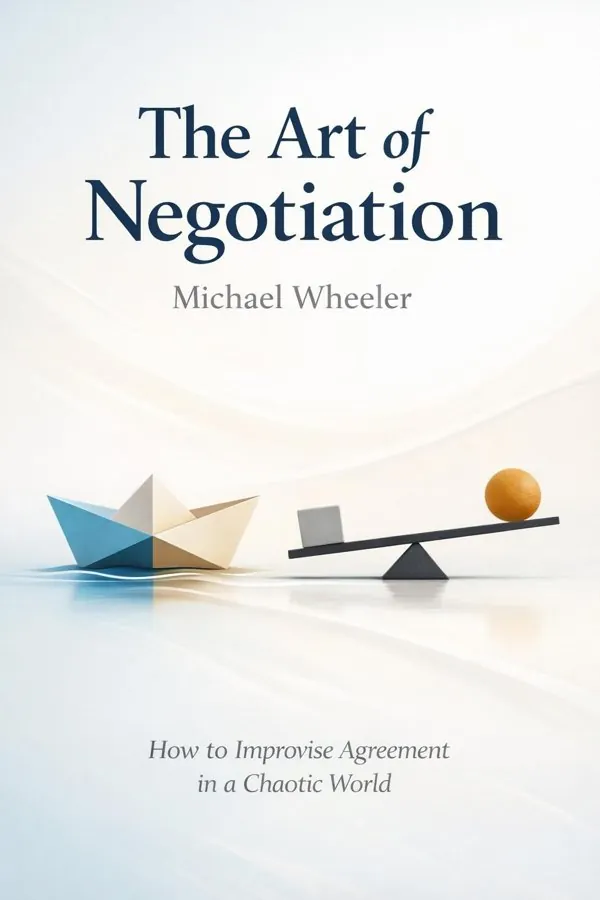
The Art of Negotiation: How to Improvise Agreement in a Chaotic World: Summary & Key Insights
 10 min9 chaptersAudio available
Key Takeaways from The Art of Negotiation: How to Improvise Agreement in a Chaotic World
The biggest mistake negotiators make is assuming that the process will unfold according to plan.
Improvisation is often confused with winging it, but Wheeler makes a sharper distinction: good improvisation is impossible without preparation.
A rigid plan can create a dangerous illusion of control.
Negotiators often believe that success goes to whoever has the most information.
Many people imagine negotiation as a rational contest of offers and counteroffers, yet Wheeler shows that emotion is always present.
What Is The Art of Negotiation: How to Improvise Agreement in a Chaotic World About?
The Art of Negotiation: How to Improvise Agreement in a Chaotic World by Michael Wheeler is a communication book spanning 9 pages. Negotiation is often taught as if it were a clean sequence: prepare your goals, choose your tactics, sit down at the table, and execute the plan. Michael Wheeler argues that this picture is dangerously incomplete. In The Art of Negotiation, he shows that real negotiation is messy, emotional, fluid, and full of surprise. People change their minds, information arrives late, power shifts, and unexpected opportunities emerge. The best negotiators are not those who cling most tightly to a script, but those who can adapt intelligently in the moment. Drawing on decades of teaching at Harvard Business School, along with research in psychology, behavioral economics, strategy, and leadership, Wheeler reframes negotiation as a form of disciplined improvisation. Preparation still matters, but not as a rigid map. It matters as a foundation for agile judgment under pressure. This book matters because negotiation is not limited to boardrooms and legal deals. It shapes salaries, partnerships, family decisions, political disputes, and everyday collaboration. Wheeler’s great contribution is to show that success comes from combining planning with flexibility, confidence with curiosity, and strategic intent with the ability to respond creatively to uncertainty.
This FizzRead summary covers all 9 key chapters of The Art of Negotiation: How to Improvise Agreement in a Chaotic World in approximately 10 minutes, distilling the most important ideas, arguments, and takeaways from Michael Wheeler's work. Also available as an audio summary and Key Quotes Podcast.
The Art of Negotiation: How to Improvise Agreement in a Chaotic World
Negotiation is often taught as if it were a clean sequence: prepare your goals, choose your tactics, sit down at the table, and execute the plan. Michael Wheeler argues that this picture is dangerously incomplete. In The Art of Negotiation, he shows that real negotiation is messy, emotional, fluid, and full of surprise. People change their minds, information arrives late, power shifts, and unexpected opportunities emerge. The best negotiators are not those who cling most tightly to a script, but those who can adapt intelligently in the moment.
Drawing on decades of teaching at Harvard Business School, along with research in psychology, behavioral economics, strategy, and leadership, Wheeler reframes negotiation as a form of disciplined improvisation. Preparation still matters, but not as a rigid map. It matters as a foundation for agile judgment under pressure.
This book matters because negotiation is not limited to boardrooms and legal deals. It shapes salaries, partnerships, family decisions, political disputes, and everyday collaboration. Wheeler’s great contribution is to show that success comes from combining planning with flexibility, confidence with curiosity, and strategic intent with the ability to respond creatively to uncertainty.
Who Should Read The Art of Negotiation: How to Improvise Agreement in a Chaotic World?
This book is perfect for anyone interested in communication and looking to gain actionable insights in a short read. Whether you're a student, professional, or lifelong learner, the key ideas from The Art of Negotiation: How to Improvise Agreement in a Chaotic World by Michael Wheeler will help you think differently.
- ✓Readers who enjoy communication and want practical takeaways
- ✓Professionals looking to apply new ideas to their work and life
- ✓Anyone who wants the core insights of The Art of Negotiation: How to Improvise Agreement in a Chaotic World in just 10 minutes
Want the full summary?
Get instant access to this book summary and 100K+ more with Fizz Moment.
Get Free SummaryAvailable on App Store • Free to download
Key Chapters
The biggest mistake negotiators make is assuming that the process will unfold according to plan. Wheeler challenges the traditional image of negotiation as a linear exercise in setting goals, preparing tactics, and executing them step by step. In reality, negotiation is more like navigating changing weather than following a blueprint. New facts appear, emotions flare, hidden interests surface, and other parties react in ways no one predicted. A strategy that seemed brilliant in advance can become irrelevant in minutes.
This does not mean planning is useless. It means plans must be treated as provisional. A negotiator should know their priorities, alternatives, and limits, but also stay alert to changing conditions. For example, in a salary negotiation, you may enter focused on pay, only to discover the employer has little budget flexibility but can offer remote work, professional development, or a faster review cycle. If you cling too tightly to your initial script, you may miss a better overall package.
Wheeler’s view is especially powerful in complex business settings, diplomatic talks, and team conflicts, where multiple stakeholders, incomplete information, and shifting incentives make certainty impossible. The negotiator’s true task is not to control the whole interaction, but to influence it while adapting to what emerges.
Actionable takeaway: Prepare thoroughly, but treat your plan as a guide rather than a cage. Before any negotiation, identify what you know, what may change, and how you will respond if the conversation takes an unexpected turn.
Improvisation is often confused with winging it, but Wheeler makes a sharper distinction: good improvisation is impossible without preparation. The jazz musician who plays freely has mastered scales, rhythm, and structure. The skilled negotiator works the same way. Flexibility in the moment depends on prior thinking about interests, likely scenarios, trade-offs, and the other side’s possible motivations.
Preparation builds a repertoire. Instead of memorizing a script, you develop options, questions, framing moves, and fallback positions. You also build self-awareness. What triggers your impatience? When do you become too eager to please? What kind of pressure makes you concede too quickly? These are not side issues; they are core elements of readiness.
Consider a vendor contract discussion. A poorly prepared negotiator may arrive with a single target price and little else. A well-prepared negotiator, by contrast, understands market benchmarks, service-level priorities, implementation risks, and where timing or scope can be adjusted. That knowledge allows them to improvise productively if the supplier rejects the opening terms.
Wheeler emphasizes that preparation should include mindset as well as data. You are not preparing to force a result. You are preparing to notice possibilities, make better judgments, and stay balanced when the situation changes.
Actionable takeaway: Before your next negotiation, prepare in layers. Know your goals, alternatives, and limits, but also map possible surprises, emotional triggers, and creative trades so you can adapt without losing your footing.
A rigid plan can create a dangerous illusion of control. Wheeler argues that while preparation is essential, overcommitting to one strategy can leave negotiators brittle and blind. The most effective negotiators enter with a clear sense of direction but remain willing to alter tactics, sequencing, and even assumptions as the conversation unfolds.
Flexibility matters because negotiation is interactive. You are not just implementing your own plan; you are responding to another person’s goals, fears, constraints, and style. If the other side raises a concern you did not expect, your success depends less on whether you predicted it and more on how well you can respond. Sometimes flexibility means changing the order of issues. Sometimes it means pausing to gather more information. Sometimes it means abandoning a favored proposal in favor of one that better fits the moment.
Think of a merger discussion in which one side assumes valuation will be the central issue. Once talks begin, it becomes clear that leadership roles and post-merger culture are more sensitive than price. A negotiator who keeps forcing the valuation conversation may deepen resistance. A more adaptive counterpart recognizes the shift and addresses the real source of tension first.
Wheeler’s point is not that anything goes. Flexibility is not drift. It is disciplined responsiveness rooted in judgment. Knowing when to stay firm and when to pivot is one of the defining arts of negotiation.
Actionable takeaway: Build a plan with branches, not a single track. For every important negotiation, ask yourself: If my main approach fails, what are two other paths to agreement that still protect my core interests?
Negotiators often believe that success goes to whoever has the most information. Wheeler agrees that information is valuable, but he insists that judgment is even more important. Data is never complete, and raw facts do not interpret themselves. Negotiators must decide what matters, what may be misleading, and how to act when ambiguity remains.
Much of negotiation involves inference. What does a delayed response mean? Is a hardline opening demand a true bottom line, a bluff, or a ritual? Does silence signal resistance, confusion, or reflection? These questions cannot be answered mechanically. They require pattern recognition, emotional intelligence, and the ability to update one’s reading as new cues appear.
Behavioral biases complicate this task. We may anchor too heavily on first numbers, see what confirms our assumptions, or become overconfident in our reading of the other side. Wheeler encourages negotiators to remain curious and provisional. A strong negotiator forms hypotheses, tests them through questions, and revises them quickly when reality pushes back.
For instance, in a real estate transaction, a buyer may assume the seller’s urgency means weakness and press aggressively. But if the urgency comes from a competing opportunity rather than financial distress, the buyer may misplay the situation. Better judgment would involve asking, listening, and checking interpretations rather than rushing to exploit a shaky assumption.
Actionable takeaway: Treat your assumptions as working drafts, not facts. In your next negotiation, identify three things you believe about the other side and ask what evidence would confirm or challenge each one.
Many people imagine negotiation as a rational contest of offers and counteroffers, yet Wheeler shows that emotion is always present. Anxiety, pride, resentment, hope, fear, and trust do not sit outside the negotiation; they influence how people interpret statements, assess risks, and make decisions. Ignoring emotions does not make them disappear. It only makes them harder to manage.
Emotional intelligence is therefore a strategic asset. Skilled negotiators regulate their own reactions and read the emotional tone of others. They notice when tension is rising, when someone feels dismissed, or when face-saving is becoming more important than the substantive issue. They also understand that relationships can be both a means and an outcome. A deal that damages trust may create problems long after the immediate agreement is signed.
Imagine a manager discussing responsibilities with a talented employee who feels overlooked. If the manager focuses only on tasks and compensation, the employee’s underlying need for recognition may remain unmet. The conversation can stall or turn sour. But if the manager acknowledges the frustration, asks about career aspirations, and treats the issue with respect, the negotiation can open up.
Wheeler does not suggest becoming sentimental or avoiding hard truths. Rather, he argues that emotional awareness improves clarity and influence. People are more likely to solve problems when they feel heard, respected, and safe enough to explore options.
Actionable takeaway: In every important negotiation, track not just what is being said but how it is being felt. Ask yourself: What emotions are present, what might be driving them, and what can I do to lower defensiveness and increase trust?
One of Wheeler’s most practical themes is that negotiation is not only about dividing a fixed pie. Often, the better question is how to enlarge it before arguing over slices. Value creation happens when negotiators uncover different priorities, time horizons, tolerances for risk, or non-monetary interests that make trade-offs possible.
This requires moving beyond positions to interests. A position is what someone asks for; an interest is why they want it. Two sides may both insist on incompatible demands, yet still have room for agreement if they understand the underlying motivations. A supplier may want a higher price because of cash-flow pressure. A buyer may need lower upfront costs but be willing to sign a longer-term contract. Once interests are clear, a creative package may satisfy both sides better than a narrow compromise.
Wheeler highlights that improvisational negotiators are especially good at spotting these openings in real time. They listen for clues, ask diagnostic questions, and remain open to reframing the issue. In workplace negotiations, this could mean combining salary, schedule flexibility, title, and future opportunities rather than arguing only over one number. In disputes, it may mean separating symbolic concerns from operational ones so each can be addressed appropriately.
Of course, creating value does not eliminate claiming value. Eventually, parties still need to decide who gets what. But those decisions are easier and often more productive after the range of possibilities has expanded.
Actionable takeaway: When a negotiation feels stuck, ask each side to rank their top priorities and least important issues. Use those differences to design trades that produce mutual gains instead of simple concessions.
Power in negotiation is often treated as a fixed fact: one side has more money, more status, more options, or more authority. Wheeler complicates that view by showing that power is real but rarely absolute. It depends on context, perception, timing, alternatives, and skill. Even a seemingly weaker party can gain leverage by changing the frame, building coalitions, controlling information, or demonstrating credible alternatives.
A common source of power is BATNA, the best alternative to a negotiated agreement. The party with stronger outside options usually has more room to walk away. But BATNA is not the whole story. Reputation, legitimacy, urgency, expertise, and the ability to shape public perception can all affect influence. So can the ability to ask the right questions and slow down a conversation that the stronger party wants to rush.
Consider a smaller company negotiating with a large client. At first glance, the client appears dominant. Yet the smaller firm may possess specialized knowledge, faster execution, or a unique technology the client urgently needs. If it presents those strengths clearly and resists being framed as replaceable, the balance changes.
Wheeler also reminds readers that perceived power can distort behavior. A powerful party may become careless or arrogant. A weaker party may surrender too soon. Both errors reduce effectiveness. Good negotiators assess power soberly, neither inflating nor underestimating it, and look for ways to reshape the field.
Actionable takeaway: Before your next negotiation, list your sources of leverage beyond money or title. Then ask how you can make those sources visible and credible without resorting to threats.
Deadlock is not always a sign that negotiation has failed. Often it is a signal that the current frame is too narrow. Wheeler encourages negotiators to treat impasse as an invitation to rethink the problem, the process, or the assumptions driving both sides.
When talks stall, people tend to repeat their arguments more loudly. This usually hardens positions. A more productive response is to ask what exactly is blocked. Is the disagreement substantive, procedural, relational, or symbolic? Are parties stuck on one issue because they are really fighting over trust, fairness, identity, or fear of setting a precedent? Reframing changes the conversation from “Who gives in?” to “What problem are we actually trying to solve?”
For example, two departments may clash over budget allocation. If framed as a zero-sum contest, each side digs in. But if the conversation is reframed around organizational priorities, timing of spending, shared metrics, or phased commitments, new options may emerge. In personal disputes, reframing may involve shifting from blame to future arrangements: not “Who caused this?” but “What would a workable solution look like from here?”
Wheeler also sees value in pauses, process changes, and the introduction of fresh perspectives. Bringing in objective standards, changing the sequence of issues, or setting aside the hardest point temporarily can restore movement.
Actionable takeaway: When you hit an impasse, stop arguing the same point. Ask three reframing questions: What problem are we really solving, what assumptions are trapping us, and what process change might help the conversation move again?
Negotiation skill does not come only from talent or theory; it develops through reflection, feedback, and repeated adjustment. Wheeler emphasizes that every negotiation is both a performance and a lesson. The best negotiators review what happened, examine their choices, and refine their instincts over time.
This learning starts during the negotiation itself. Adaptive negotiators monitor the effects of their words and actions. Did that proposal create openness or resistance? Did the tone shift after a certain comment? Did a question uncover useful information or put the other side on guard? This habit of observing while acting allows for course correction before mistakes become costly.
Reflection after the fact is equally important. Many people evaluate a negotiation only by outcome: Did I get the deal or not? Wheeler encourages a deeper review. Did I understand the other side accurately? Did I protect what mattered most? Was I too aggressive, too passive, or too attached to one idea? What would I do differently next time? Over many negotiations, these questions sharpen judgment.
A sales leader, for instance, might discover that deals go better when she spends more time exploring implementation concerns before discussing price. A manager may realize he concedes too early when conversations become emotionally tense. Such insights become part of a growing personal playbook.
Actionable takeaway: After every important negotiation, conduct a short debrief. Write down what surprised you, what worked, what failed, and one specific behavior you will test in your next negotiation.
All Chapters in The Art of Negotiation: How to Improvise Agreement in a Chaotic World
About the Author
Michael Wheeler is a professor emeritus at Harvard Business School, where he taught negotiation for more than two decades. He is known for blending academic rigor with practical insight, helping leaders, managers, and students understand negotiation as a dynamic process shaped by uncertainty, judgment, and human behavior. His work draws on psychology, behavioral economics, strategy, and organizational leadership, and he has written extensively on how people make decisions and manage conflict in complex environments. Wheeler’s teaching and writing emphasize adaptability over rigid formulas, making his ideas especially useful in today’s fast-changing world. Through his scholarship, case analysis, and executive education work, he has influenced how professionals think about bargaining, leadership, and agreement-making across business and everyday life.
Get This Summary in Your Preferred Format
Read or listen to the The Art of Negotiation: How to Improvise Agreement in a Chaotic World summary by Michael Wheeler anytime, anywhere. FizzRead offers multiple formats so you can learn on your terms — all free.
Available formats: App · Audio · PDF · EPUB — All included free with FizzRead
Download The Art of Negotiation: How to Improvise Agreement in a Chaotic World PDF and EPUB Summary
Key Quotes from The Art of Negotiation: How to Improvise Agreement in a Chaotic World
“The biggest mistake negotiators make is assuming that the process will unfold according to plan.”
“Improvisation is often confused with winging it, but Wheeler makes a sharper distinction: good improvisation is impossible without preparation.”
“A rigid plan can create a dangerous illusion of control.”
“Negotiators often believe that success goes to whoever has the most information.”
“Many people imagine negotiation as a rational contest of offers and counteroffers, yet Wheeler shows that emotion is always present.”
Frequently Asked Questions about The Art of Negotiation: How to Improvise Agreement in a Chaotic World
The Art of Negotiation: How to Improvise Agreement in a Chaotic World by Michael Wheeler is a communication book that explores key ideas across 9 chapters. Negotiation is often taught as if it were a clean sequence: prepare your goals, choose your tactics, sit down at the table, and execute the plan. Michael Wheeler argues that this picture is dangerously incomplete. In The Art of Negotiation, he shows that real negotiation is messy, emotional, fluid, and full of surprise. People change their minds, information arrives late, power shifts, and unexpected opportunities emerge. The best negotiators are not those who cling most tightly to a script, but those who can adapt intelligently in the moment. Drawing on decades of teaching at Harvard Business School, along with research in psychology, behavioral economics, strategy, and leadership, Wheeler reframes negotiation as a form of disciplined improvisation. Preparation still matters, but not as a rigid map. It matters as a foundation for agile judgment under pressure. This book matters because negotiation is not limited to boardrooms and legal deals. It shapes salaries, partnerships, family decisions, political disputes, and everyday collaboration. Wheeler’s great contribution is to show that success comes from combining planning with flexibility, confidence with curiosity, and strategic intent with the ability to respond creatively to uncertainty.
You Might Also Like

Magic Words: The Science and Secrets Behind Seven Words That Motivate, Engage, and Influence
Tim David
10 min
Talking Across The Divide: How to Communicate with People You Disagree with and Maybe Even Change the World
Justin Lee
10 min
The Exceptional Presenter: A Proven Formula to Open Up! and Own the Room
Timothy J. Koegel
10 min
4 Essential Keys to Effective Communication in Love, Life, Work--Anywhere!: Including the 12-Day Communication Challenge!
Bento C. Leal III
10 min
Active Listening Techniques: 30 Practical Tools to Hone Your Communication Skills
Nisha Gupta
10 min
Bargaining for Advantage: Negotiation Strategies for Reasonable People
G. Richard Shell
10 minBrowse by Category
Ready to read The Art of Negotiation: How to Improvise Agreement in a Chaotic World?
Get the full summary and 100K+ more books with Fizz Moment.