
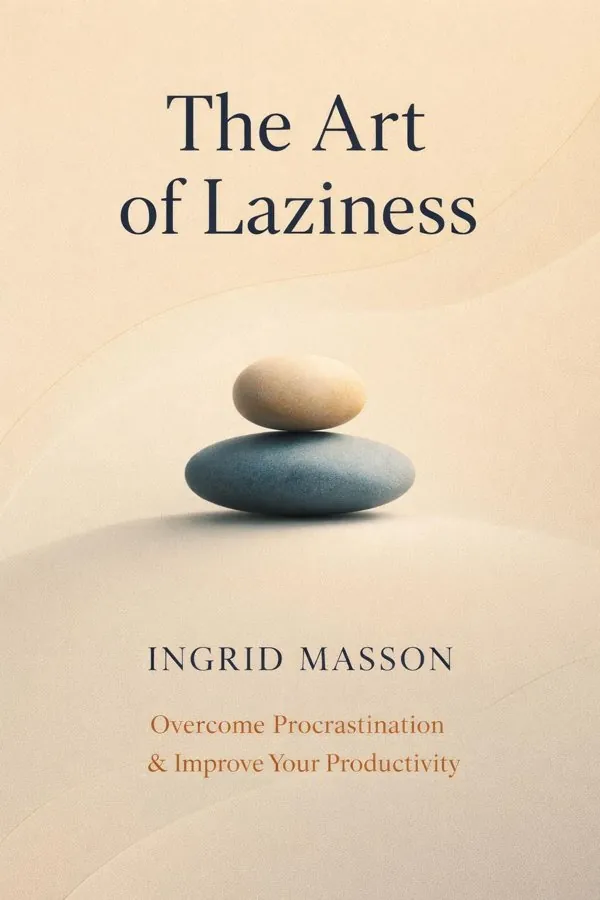
The Art of Laziness: Overcome Procrastination & Improve Your Productivity: Summary & Key Insights
 10 min9 chaptersAudio available
Key Takeaways from The Art of Laziness: Overcome Procrastination & Improve Your Productivity
What looks like laziness is often a disguised form of fear, overload, or emotional resistance.
One of the biggest productivity myths is that you must feel ready before you begin.
When a task feels too big, the mind treats it like a threat.
Not all hours are equal, and Masson makes the case that productivity depends as much on energy as on scheduling.
The desire to do something well can become the reason it never gets done.
What Is The Art of Laziness: Overcome Procrastination & Improve Your Productivity About?
The Art of Laziness: Overcome Procrastination & Improve Your Productivity by Ingrid Masson is a productivity book. What if laziness is not a moral failure, but a signal that your habits, energy, and priorities are out of alignment? In The Art of Laziness: Overcome Procrastination & Improve Your Productivity, Ingrid Masson reframes procrastination as something more nuanced than simple irresponsibility. Instead of relying on guilt, hustle culture, or punishing self-discipline, the book explores how people can work with their minds rather than against them. It offers a practical guide to understanding avoidance, reducing mental resistance, and building productive routines that feel sustainable. Masson’s approach matters because so many productivity systems fail in real life. They assume endless motivation, perfect focus, and ideal circumstances. This book addresses the reality most readers live with: distraction, stress, inconsistency, and self-criticism. By breaking productivity into manageable psychological and behavioral shifts, Masson presents a framework that feels humane and usable. For readers who feel stuck between ambition and inaction, this book offers both relief and direction. It is less about becoming a work machine and more about learning how to start, continue, and finish meaningful tasks with less friction and more clarity.
This FizzRead summary covers all 9 key chapters of The Art of Laziness: Overcome Procrastination & Improve Your Productivity in approximately 10 minutes, distilling the most important ideas, arguments, and takeaways from Ingrid Masson's work. Also available as an audio summary and Key Quotes Podcast.
The Art of Laziness: Overcome Procrastination & Improve Your Productivity
What if laziness is not a moral failure, but a signal that your habits, energy, and priorities are out of alignment? In The Art of Laziness: Overcome Procrastination & Improve Your Productivity, Ingrid Masson reframes procrastination as something more nuanced than simple irresponsibility. Instead of relying on guilt, hustle culture, or punishing self-discipline, the book explores how people can work with their minds rather than against them. It offers a practical guide to understanding avoidance, reducing mental resistance, and building productive routines that feel sustainable.
Masson’s approach matters because so many productivity systems fail in real life. They assume endless motivation, perfect focus, and ideal circumstances. This book addresses the reality most readers live with: distraction, stress, inconsistency, and self-criticism. By breaking productivity into manageable psychological and behavioral shifts, Masson presents a framework that feels humane and usable.
For readers who feel stuck between ambition and inaction, this book offers both relief and direction. It is less about becoming a work machine and more about learning how to start, continue, and finish meaningful tasks with less friction and more clarity.
Who Should Read The Art of Laziness: Overcome Procrastination & Improve Your Productivity?
This book is perfect for anyone interested in productivity and looking to gain actionable insights in a short read. Whether you're a student, professional, or lifelong learner, the key ideas from The Art of Laziness: Overcome Procrastination & Improve Your Productivity by Ingrid Masson will help you think differently.
- ✓Readers who enjoy productivity and want practical takeaways
- ✓Professionals looking to apply new ideas to their work and life
- ✓Anyone who wants the core insights of The Art of Laziness: Overcome Procrastination & Improve Your Productivity in just 10 minutes
Want the full summary?
Get instant access to this book summary and 100K+ more with Fizz Moment.
Get Free SummaryAvailable on App Store • Free to download
Key Chapters
What looks like laziness is often a disguised form of fear, overload, or emotional resistance. One of the book’s most helpful ideas is that procrastination rarely begins with a lack of character. More often, it starts when a task feels confusing, too large, emotionally uncomfortable, or tied to the possibility of failure. In that sense, “laziness” is frequently a symptom rather than the true problem.
Masson encourages readers to stop labeling themselves and instead investigate what is happening beneath the surface. Are you avoiding a project because you do not know the first step? Are you delaying an email because you fear the reply? Are you scrolling on your phone because your brain is tired and wants relief? This shift from judgment to diagnosis is powerful. Once you identify the real obstacle, you can respond intelligently instead of piling on guilt.
For example, a student who keeps postponing an essay might not be lazy at all. They may feel overwhelmed by the topic, unsure how to structure the paper, and anxious about being graded. A professional who delays a presentation might be wrestling with perfectionism, not idleness. In both cases, calling the problem “laziness” solves nothing. Clarifying the source of resistance opens the door to action.
This idea also reduces shame. Shame keeps people stuck because it turns one delayed task into a negative identity: “I’m the kind of person who never follows through.” Masson pushes back against that thinking by showing that productivity improves when people become curious about their patterns.
Actionable takeaway: The next time you procrastinate, do not ask, “Why am I so lazy?” Ask, “What exactly am I resisting right now?” Write down the answer and solve that specific problem.
One of the biggest productivity myths is that you must feel ready before you begin. Masson argues the opposite: action often creates motivation. Waiting for inspiration can turn into a sophisticated form of delay, because the perfect emotional state rarely arrives on demand. People imagine that productive individuals are always driven, but in reality they often begin before they feel fully prepared.
The book explains that momentum is psychological. Starting reduces uncertainty, and uncertainty is one of the main forces behind procrastination. A task that seems huge in your mind often shrinks once you engage with it. Writing the first sentence, opening the spreadsheet, or cleaning one corner of a room interrupts the cycle of avoidance. Your brain receives evidence that the task is survivable, and resistance decreases.
This is why tiny beginnings matter. A person who tells themselves, “I have to write for three hours” may freeze. But someone who says, “I will write for five minutes” can usually begin. Once started, continuing becomes easier than anticipated. The same principle applies to exercise, studying, paperwork, and household chores. The goal is not to trick yourself into working endlessly. It is to remove the false belief that motivation must come first.
Masson’s framing is especially useful for people who repeatedly postpone important goals because they are waiting to feel energized, confident, or inspired. In many cases, those feelings are the result of movement, not the cause of it.
Actionable takeaway: Choose one task you have been delaying and commit to just two minutes of action today. Open the file, draft the outline, or organize the first item. Let motion generate motivation.
When a task feels too big, the mind treats it like a threat. Masson emphasizes that many people procrastinate not because the work is impossible, but because it has not been broken down into approachable parts. Vague goals create friction. Specific next steps create progress.
A task like “finish the report” is mentally heavy because it contains many hidden actions: reviewing notes, finding missing data, organizing sections, writing, editing, formatting, and sending it. The brain sees the whole burden at once and responds with avoidance. By contrast, a smaller instruction such as “write the heading,” “collect last week’s numbers,” or “draft the introduction” lowers psychological resistance.
This principle is practical because it transforms productivity from dramatic effort into manageable sequencing. It also helps people who feel paralyzed by perfectionism. When the standard is “complete the entire thing brilliantly,” starting feels risky. When the standard is “do the next visible step,” the barrier falls.
Masson’s advice can be applied almost anywhere. If cleaning your home feels overwhelming, choose one drawer or one surface. If job searching feels exhausting, divide it into updating your résumé, identifying three companies, and writing one cover letter. If you are avoiding financial admin, start by gathering your bills into one place. The smaller the step, the more likely you are to act consistently.
Importantly, this is not about underestimating your capabilities. It is about designing tasks for follow-through. Productivity improves when goals are structured to reduce hesitation and create quick wins.
Actionable takeaway: Rewrite one overwhelming task as a checklist of steps that each take 5 to 15 minutes. Then do only the first step, without thinking about the rest.
Not all hours are equal, and Masson makes the case that productivity depends as much on energy as on scheduling. Traditional advice often focuses on squeezing more into the day, but this misses a central truth: a tired, distracted, or emotionally drained mind cannot perform at its best, no matter how well the calendar is organized.
The book encourages readers to notice when they naturally have the most focus, patience, and mental sharpness. Some people think best in the morning. Others become productive in the afternoon or evening. Instead of forcing important work into low-energy periods, Masson suggests aligning demanding tasks with your strongest hours and reserving easier work for weaker ones.
This perspective also legitimizes rest. Many people treat breaks as indulgences, but strategic recovery can be a productivity tool. Short pauses, sleep, hydration, movement, and reduced multitasking all affect concentration. If you repeatedly delay work, the issue may not be poor discipline but chronic depletion.
Consider a manager who schedules creative planning at 8 p.m. after a draining day of meetings. Their difficulty concentrating may have little to do with commitment. If they move that work to the morning and save routine emails for later, performance improves without increasing total hours. Similarly, a parent trying to complete paperwork while exhausted may benefit more from a 20-minute reset than from self-criticism.
Masson’s point is simple but transformative: productivity is not about forcing output from an empty battery. It is about using your energy wisely.
Actionable takeaway: For one week, track when you feel most focused and when you feel mentally flat. Then match your hardest task to your best energy window.
The desire to do something well can become the reason it never gets done. Masson highlights perfectionism as a major driver of procrastination, especially among capable, ambitious people. When every task becomes a test of intelligence, talent, or worth, starting feels dangerous. If the result might be imperfect, avoidance feels safer than trying.
Perfectionism often disguises itself as high standards, but the book shows its hidden cost: unfinished work, missed opportunities, and chronic stress. A person may spend hours planning, researching, tweaking, or waiting for ideal conditions, all while telling themselves they are being thorough. In reality, they may be protecting themselves from criticism or disappointment.
Masson encourages a shift from perfection to completion and improvement. A first draft is supposed to be incomplete. A rough plan is supposed to evolve. Progress usually comes from iteration, not brilliance on the first attempt. This mindset makes action less emotionally loaded. Instead of asking, “Can I do this perfectly?” the more useful question is, “Can I make this good enough to move forward?”
This applies in professional and personal settings. An entrepreneur may delay launching a website because it is not flawless. A student may postpone submitting an assignment because one section feels weak. A person may avoid starting a fitness routine because they cannot commit to the ideal plan. In each case, the pursuit of perfection blocks the value of real-world progress.
Masson does not argue for carelessness. She argues for standards that support action rather than suffocate it.
Actionable takeaway: Pick one task you have been overthinking and define a “good enough” version you can complete today. Finish that version before improving anything.
Willpower matters less than most people think when the environment keeps inviting distraction. Masson stresses that productivity is not just an internal struggle; it is also a design problem. If your space, devices, and routines constantly pull your attention away, procrastination becomes easier and focus becomes harder.
This idea is liberating because it means you do not have to rely entirely on self-control. You can make productive behavior more automatic by adjusting the conditions around you. A cluttered desk can increase mental noise. Open notifications can fracture attention. A phone within reach can turn a brief pause into 25 minutes of scrolling. By contrast, a prepared workspace, visible task list, and reduced digital interruptions make starting simpler.
Masson encourages practical environmental changes. Put the materials for your next task in one place before you stop working. Use website blockers during focused sessions. Keep your phone in another room when doing deep work. If you want to read more, leave a book where you usually sit. If you want to exercise, prepare your clothes in advance. Small design choices reduce decision fatigue and lower the odds of drifting into avoidance.
These adjustments are especially useful for people who assume they lack discipline. In many cases, they are trying to do difficult cognitive work in an environment optimized for distraction. The more your surroundings support your intentions, the less energy you waste fighting yourself.
Actionable takeaway: Identify the top two distractions that derail your work most often and change your environment today so they become harder to access during focused time.
People often overestimate what they can do in a burst and underestimate what they can accomplish through repetition. Masson argues that sustainable productivity is built on consistency, not heroic effort. This is especially important for procrastinators, who often cycle between avoidance and last-minute overwork. That pattern may produce occasional results, but it also creates stress, uneven quality, and burnout.
The book promotes a steadier model: smaller actions performed regularly. Writing 300 words a day can finish a book draft. Studying 30 minutes daily can outperform irregular marathon sessions. Clearing one administrative task every morning can prevent weeks of buildup. Repeated effort compounds, while intensity without structure usually collapses.
This principle also restores trust in yourself. When you rely on emergency motivation, you teach yourself that action only happens under pressure. But when you show up consistently, even in modest ways, you build a stronger identity: someone who follows through. That identity matters because behavior tends to align with self-perception.
Masson also recognizes that consistency does not mean rigid perfection. Missing a day is not failure. The danger lies in turning one interruption into a full abandonment of the habit. A practical approach allows for imperfection while protecting the routine.
For example, if you cannot do a full workout, do ten minutes. If you cannot complete a chapter, review your notes. If you cannot clean the whole kitchen, wash the dishes. The reduced version keeps the pattern alive.
Actionable takeaway: Choose one meaningful goal and set a minimum daily version so small you can maintain it even on difficult days. Protect the rhythm before increasing the intensity.
The voice in your head can either support action or quietly sabotage it. Masson pays close attention to self-talk because procrastination is often reinforced by the way people speak to themselves. Harsh inner commentary may seem motivating, but it usually increases dread, defensiveness, and avoidance. If every task begins with “I’m behind,” “I always mess this up,” or “I’m so lazy,” the mind starts to associate work with threat.
The book suggests replacing judgment with constructive honesty. This does not mean empty positivity or pretending everything is easy. It means using language that leads to action. Compare “I’ll never finish this” with “I only need to do the next step.” Compare “I’ve wasted the whole day” with “I can still use the next 20 minutes well.” These shifts matter because thoughts influence emotional state, and emotional state affects follow-through.
Masson’s approach is especially useful after setbacks. Many people lose more time criticizing themselves for procrastinating than they lost in the original delay. Self-reproach becomes a second layer of wasted energy. A compassionate but responsible mindset helps people restart faster.
This is relevant in work, study, and personal goals. Someone trying to build better habits will make more progress with realistic encouragement than with constant internal attack. Productivity improves when the inner voice acts like a coach instead of a prosecutor.
Actionable takeaway: Catch one recurring negative phrase you say to yourself about work. Replace it with a neutral, action-oriented sentence and use that sentence every time resistance appears today.
Getting more done is not automatically the same as living better. One of the book’s most grounded insights is that productivity is a tool, not an identity. Masson warns against treating busyness as a badge of worth. When people chase output without clarifying what matters, they can become efficient at the wrong things.
This is where the book moves beyond simple anti-procrastination tactics. It asks readers to consider why they want to be productive in the first place. Is the goal to reduce stress, create more freedom, finish important projects, support a family, or make space for health and creativity? When your efforts connect to genuine values, discipline feels less like punishment and more like alignment.
This perspective can prevent a common trap: replacing procrastination with frantic overcommitment. Someone may become better at completing tasks but still feel exhausted because they are saying yes to everything, checking off low-value work, or chasing other people’s expectations. Productivity without direction leads to busyness, not fulfillment.
Masson encourages readers to prioritize what is meaningful and let lesser tasks shrink, delegate, or disappear where possible. A person who values writing may need to protect quiet time. Someone who values family may need systems that reduce work spillover into evenings. Someone who values wellbeing may need to stop glorifying constant urgency.
In this sense, the “art” of laziness is not about doing nothing. It is about refusing wasteful effort and directing energy toward what genuinely matters.
Actionable takeaway: List your three most important priorities for this season of life. Then compare your weekly actions to that list and remove one recurring task that does not support any of them.
All Chapters in The Art of Laziness: Overcome Procrastination & Improve Your Productivity
About the Author
Ingrid Masson is a productivity and self-improvement author whose work focuses on procrastination, habit change, and practical personal effectiveness. She writes for readers who want to improve their output without relying on harsh self-judgment or unrealistic routines. In The Art of Laziness: Overcome Procrastination & Improve Your Productivity, Masson explores the emotional, behavioral, and environmental causes of delay, offering an accessible framework for building better habits and reducing resistance to work. Her style is direct, encouraging, and solution-oriented, making complex psychological patterns easier to understand and apply. Masson’s perspective is especially appealing to readers who value sustainable productivity, self-awareness, and steady progress over hustle, perfectionism, and burnout.
Get This Summary in Your Preferred Format
Read or listen to the The Art of Laziness: Overcome Procrastination & Improve Your Productivity summary by Ingrid Masson anytime, anywhere. FizzRead offers multiple formats so you can learn on your terms — all free.
Available formats: App · Audio · PDF · EPUB — All included free with FizzRead
Download The Art of Laziness: Overcome Procrastination & Improve Your Productivity PDF and EPUB Summary
Key Quotes from The Art of Laziness: Overcome Procrastination & Improve Your Productivity
“What looks like laziness is often a disguised form of fear, overload, or emotional resistance.”
“One of the biggest productivity myths is that you must feel ready before you begin.”
“When a task feels too big, the mind treats it like a threat.”
“Not all hours are equal, and Masson makes the case that productivity depends as much on energy as on scheduling.”
“The desire to do something well can become the reason it never gets done.”
Frequently Asked Questions about The Art of Laziness: Overcome Procrastination & Improve Your Productivity
The Art of Laziness: Overcome Procrastination & Improve Your Productivity by Ingrid Masson is a productivity book that explores key ideas across 9 chapters. What if laziness is not a moral failure, but a signal that your habits, energy, and priorities are out of alignment? In The Art of Laziness: Overcome Procrastination & Improve Your Productivity, Ingrid Masson reframes procrastination as something more nuanced than simple irresponsibility. Instead of relying on guilt, hustle culture, or punishing self-discipline, the book explores how people can work with their minds rather than against them. It offers a practical guide to understanding avoidance, reducing mental resistance, and building productive routines that feel sustainable. Masson’s approach matters because so many productivity systems fail in real life. They assume endless motivation, perfect focus, and ideal circumstances. This book addresses the reality most readers live with: distraction, stress, inconsistency, and self-criticism. By breaking productivity into manageable psychological and behavioral shifts, Masson presents a framework that feels humane and usable. For readers who feel stuck between ambition and inaction, this book offers both relief and direction. It is less about becoming a work machine and more about learning how to start, continue, and finish meaningful tasks with less friction and more clarity.
You Might Also Like


Browse by Category
Ready to read The Art of Laziness: Overcome Procrastination & Improve Your Productivity?
Get the full summary and 100K+ more books with Fizz Moment.