
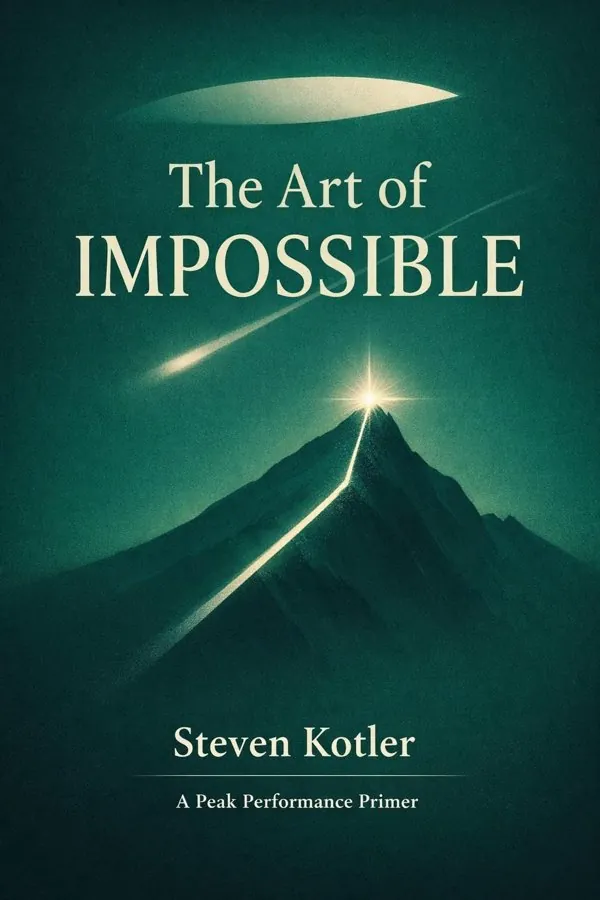
The Art of Impossible: A Peak Performance Primer: Summary & Key Insights
 10 min6 chaptersAudio available
What Is The Art of Impossible: A Peak Performance Primer About?
The Art of Impossible: A Peak Performance Primer by Steven Kotler is a mindset book spanning 6 pages. The Art of Impossible is a comprehensive guide to achieving peak performance, written by Steven Kotler, a leading expert on human performance and flow science. Drawing on neuroscience, psychology, and real-world examples, Kotler explains how to stretch beyond perceived limits, cultivate motivation, and sustain focus to accomplish seemingly impossible goals. The book provides a structured framework for mastering the art of the possible through deliberate practice, mindset shifts, and the science of flow.
This FizzRead summary covers all 6 key chapters of The Art of Impossible: A Peak Performance Primer in approximately 10 minutes, distilling the most important ideas, arguments, and takeaways from Steven Kotler's work. Also available as an audio summary and Key Quotes Podcast.
The Art of Impossible: A Peak Performance Primer
The Art of Impossible is a comprehensive guide to achieving peak performance, written by Steven Kotler, a leading expert on human performance and flow science. Drawing on neuroscience, psychology, and real-world examples, Kotler explains how to stretch beyond perceived limits, cultivate motivation, and sustain focus to accomplish seemingly impossible goals. The book provides a structured framework for mastering the art of the possible through deliberate practice, mindset shifts, and the science of flow.
Who Should Read The Art of Impossible: A Peak Performance Primer?
This book is perfect for anyone interested in mindset and looking to gain actionable insights in a short read. Whether you're a student, professional, or lifelong learner, the key ideas from The Art of Impossible: A Peak Performance Primer by Steven Kotler will help you think differently.
- ✓Readers who enjoy mindset and want practical takeaways
- ✓Professionals looking to apply new ideas to their work and life
- ✓Anyone who wants the core insights of The Art of Impossible: A Peak Performance Primer in just 10 minutes
Want the full summary?
Get instant access to this book summary and 100K+ more with Fizz Moment.
Get Free SummaryAvailable on App Store • Free to download
Key Chapters
The first question is always: where does drive come from? Motivation is not a single emotion. It’s a layered system built into the human brain to orient behavior toward survival and growth. The problem is, most of us misunderstand how it works. We think motivation is something we either have or don’t, but really, it’s something we can build.
At the base are our biological drivers — the need for safety, belonging, and autonomy. Once these are met, higher-order motivations emerge: curiosity, passion, and purpose. The science is clear — intrinsic motivation is far more powerful than extrinsic rewards. Money, reputation, and praise can get you started, but they rarely sustain you through the grind required to achieve the extraordinary.
From my research and from interviews with top performers, the consistent pattern is this: curiosity lights the fuse. When you follow what fascinates you, even just slightly, you begin to feed the dopamine system that underpins learning and persistence. Feed that curiosity consistently, and it evolves into passion. Passion gives you the emotional energy to sustain hard work when progress slows. Only then — when you’re deeply invested emotionally — can purpose arise. Purpose is passion aimed outward, aligning your personal fascination with a cause greater than yourself. And that alignment is the ultimate motivator, because it makes effort feel meaningful.
In practice, cultivating motivation means structuring your days around pursuing curiosity, nurturing your passions, and connecting them to a deeper purpose. This is not fluffy advice — it’s neuroscience. When you work from intrinsic drivers, your brain releases norepinephrine and dopamine, sharpening focus and increasing persistence. That’s how motivation becomes the emotional architecture of the impossible.
Motivation may get you moving, but without proper goal architecture, it quickly disperses. Peak performers are masters at converting big ambitions into actionable maps. They use what I call a dual system: high-hard goals and clear daily goals.
High-hard goals define your horizon — the impossible dream that forces you to stretch beyond comfort. They provide your life with direction and narrative coherence. But a big vision without structure is paralyzing. That’s where clear goals come in. These are measurable, immediate objectives, usually nested within a single day. They tell your brain what to aim at right now, reducing uncertainty, and thus reducing the stress that otherwise blocks creative focus.
Neuroscientifically, goal setting aligns the brain’s reward and decision-making networks. Clear goals suppress the medial prefrontal cortex — the part of the brain responsible for self-critique — allowing you to enter flow states more easily. When you know precisely what success looks like in the next hour, you eliminate ambiguity, the greatest threat to progress.
The transition from vision to clarity is what bridges the gap between motivation and execution. A surfer perfecting his timing, an entrepreneur refining a pitch, a writer aiming for a thousand words — all use clear, proximal goals to transform the impossible dream into a series of doable steps. Over time, this process rewires your sense of capability, creating a self-reinforcing loop of confidence and achievement.
+ 4 more chapters — available in the FizzRead app
All Chapters in The Art of Impossible: A Peak Performance Primer
About the Author
Steven Kotler is an American author, journalist, and entrepreneur known for his work on the science of human performance. He is the executive director of the Flow Research Collective and has co-authored several bestsellers, including 'Bold' and 'The Rise of Superman'. His writing explores the intersection of technology, neuroscience, and human potential.
Get This Summary in Your Preferred Format
Read or listen to the The Art of Impossible: A Peak Performance Primer summary by Steven Kotler anytime, anywhere. FizzRead offers multiple formats so you can learn on your terms — all free.
Available formats: App · Audio · PDF · EPUB — All included free with FizzRead
Download The Art of Impossible: A Peak Performance Primer PDF and EPUB Summary
Key Quotes from The Art of Impossible: A Peak Performance Primer
“The first question is always: where does drive come from?”
“Motivation may get you moving, but without proper goal architecture, it quickly disperses.”
Frequently Asked Questions about The Art of Impossible: A Peak Performance Primer
The Art of Impossible: A Peak Performance Primer by Steven Kotler is a mindset book that explores key ideas across 6 chapters. The Art of Impossible is a comprehensive guide to achieving peak performance, written by Steven Kotler, a leading expert on human performance and flow science. Drawing on neuroscience, psychology, and real-world examples, Kotler explains how to stretch beyond perceived limits, cultivate motivation, and sustain focus to accomplish seemingly impossible goals. The book provides a structured framework for mastering the art of the possible through deliberate practice, mindset shifts, and the science of flow.
More by Steven Kotler

The Rise of Superman: Decoding the Science of Ultimate Human Performance
Steven Kotler
10 min
Bold: How to Go Big, Create Wealth and Impact the World
Peter H. Diamandis, Steven Kotler
10 min
Abundance: The Future Is Better Than You Think
Peter H. Diamandis, Steven Kotler
10 min
The Future Is Faster Than You Think: How Converging Technologies Are Transforming Business, Industries, and Our Lives
Peter H. Diamandis, Steven Kotler
10 minYou Might Also Like



Browse by Category
Ready to read The Art of Impossible: A Peak Performance Primer?
Get the full summary and 100K+ more books with Fizz Moment.