
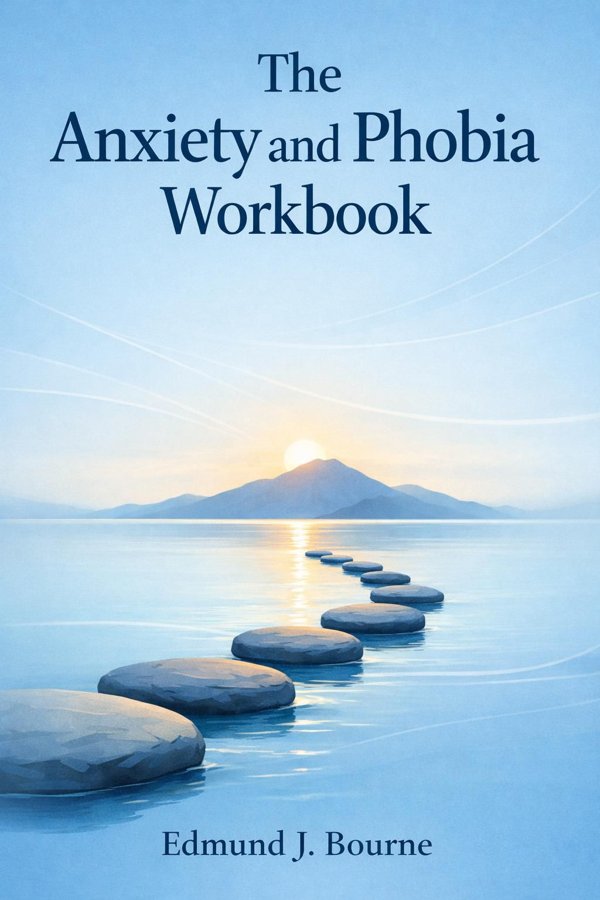
The Anxiety and Phobia Workbook: Summary & Key Insights
 10 min8 chaptersAudio available
Key Takeaways from The Anxiety and Phobia Workbook
One of the most liberating ideas in the book is that anxiety may feel all-consuming, but it is not who you are.
Fear becomes more powerful when it is vague.
Anxiety is not only mental; it is physiological.
What we avoid often grows in psychological power.
Anxiety is often amplified not just by events, but by the meaning we attach to them.
What Is The Anxiety and Phobia Workbook About?
The Anxiety and Phobia Workbook by Edmund J. Bourne is a mental_health book. The Anxiety and Phobia Workbook by Edmund J. Bourne is one of the most practical and enduring self-help guides for people struggling with anxiety in its many forms, from chronic worry and panic attacks to social anxiety, phobias, and stress-related physical symptoms. Rather than offering vague encouragement, Bourne provides a structured program of proven tools that readers can use to understand their anxiety, reduce its intensity, and gradually reclaim a sense of control. The book matters because anxiety is often both deeply personal and highly misunderstood; it can distort thoughts, strain relationships, disrupt sleep, and shrink daily life. Bourne approaches these challenges with compassion and clinical clarity, helping readers see that anxiety is not a personal failure but a treatable pattern involving mind, body, and behavior. Drawing on his background as a psychologist and anxiety-treatment specialist, he combines cognitive, behavioral, lifestyle, and relaxation methods into a step-by-step workbook format. The result is a resource that feels less like a lecture and more like a guided recovery plan for anyone ready to move from fear and avoidance toward confidence and emotional resilience.
This FizzRead summary covers all 8 key chapters of The Anxiety and Phobia Workbook in approximately 10 minutes, distilling the most important ideas, arguments, and takeaways from Edmund J. Bourne's work. Also available as an audio summary and Key Quotes Podcast.
The Anxiety and Phobia Workbook
The Anxiety and Phobia Workbook by Edmund J. Bourne is one of the most practical and enduring self-help guides for people struggling with anxiety in its many forms, from chronic worry and panic attacks to social anxiety, phobias, and stress-related physical symptoms. Rather than offering vague encouragement, Bourne provides a structured program of proven tools that readers can use to understand their anxiety, reduce its intensity, and gradually reclaim a sense of control. The book matters because anxiety is often both deeply personal and highly misunderstood; it can distort thoughts, strain relationships, disrupt sleep, and shrink daily life. Bourne approaches these challenges with compassion and clinical clarity, helping readers see that anxiety is not a personal failure but a treatable pattern involving mind, body, and behavior. Drawing on his background as a psychologist and anxiety-treatment specialist, he combines cognitive, behavioral, lifestyle, and relaxation methods into a step-by-step workbook format. The result is a resource that feels less like a lecture and more like a guided recovery plan for anyone ready to move from fear and avoidance toward confidence and emotional resilience.
Who Should Read The Anxiety and Phobia Workbook?
This book is perfect for anyone interested in mental_health and looking to gain actionable insights in a short read. Whether you're a student, professional, or lifelong learner, the key ideas from The Anxiety and Phobia Workbook by Edmund J. Bourne will help you think differently.
- ✓Readers who enjoy mental_health and want practical takeaways
- ✓Professionals looking to apply new ideas to their work and life
- ✓Anyone who wants the core insights of The Anxiety and Phobia Workbook in just 10 minutes
Want the full summary?
Get instant access to this book summary and 100K+ more with Fizz Moment.
Get Free SummaryAvailable on App Store • Free to download
Key Chapters
One of the most liberating ideas in the book is that anxiety may feel all-consuming, but it is not who you are. Bourne encourages readers to separate their identity from their symptoms. That distinction matters because many people begin to think of themselves as “an anxious person,” “a worrier,” or “someone who can’t cope.” Once anxiety becomes part of a person’s self-definition, change feels almost impossible. Bourne reframes anxiety as a set of learned responses involving the nervous system, thinking patterns, habits of attention, and avoidance behaviors. If those patterns were learned, they can also be unlearned or reshaped.
This perspective reduces shame. Instead of asking, “What’s wrong with me?” readers are invited to ask, “What is my mind and body doing, and how can I respond differently?” That shift moves a person from helplessness to curiosity. A panic attack, for example, can be understood as an exaggerated alarm response rather than evidence of weakness or danger. Social anxiety can be viewed as a cycle of self-monitoring, catastrophic prediction, and avoidance rather than proof that someone is defective. Even generalized anxiety becomes more manageable when broken into triggers, thoughts, bodily arousal, and coping habits.
Bourne’s workbook approach reflects this belief in change. Readers assess symptoms, identify patterns, and practice targeted strategies. Improvement does not come from wishful thinking; it comes from repeated action, patience, and self-observation. By treating anxiety as a process instead of a fixed trait, the book creates hope grounded in method.
Actionable takeaway: Stop describing yourself by your symptoms. For one week, replace identity statements like “I am anxious” with process statements like “I am experiencing anxiety right now,” and note how this changes your sense of control.
Fear becomes more powerful when it is vague. Bourne argues that one of the first steps toward recovery is learning how anxiety works in your own life. Anxiety is not a single experience; it can appear as racing thoughts, muscle tension, digestive issues, insomnia, avoidance, perfectionism, irritability, or sudden panic. When people do not understand these patterns, they often fear the symptoms themselves. A pounding heart feels like a medical emergency. Dizziness feels like loss of control. Constant worry feels like preparation rather than a problem. The workbook helps readers map their personal anxiety system so that symptoms become intelligible instead of mysterious.
This self-understanding includes identifying triggers, habitual thoughts, bodily sensations, and the situations most likely to provoke distress. Someone with panic disorder may notice attacks are triggered by enclosed spaces, caffeine, or fear of bodily sensations. A person with social anxiety may realize their distress spikes before meetings because they assume others are judging them. Someone with generalized anxiety may discover that uncertainty, not the actual event, is the deeper trigger.
Bourne’s method is practical because diagnosis is only the beginning. Once patterns are visible, tools can be matched to them. Relaxation techniques help with physical arousal. cognitive restructuring helps with catastrophic thoughts. Exposure helps with avoidance. Lifestyle changes support the nervous system overall. In this way, self-knowledge becomes leverage for change.
A key strength of the book is that it normalizes the complexity of anxiety. Readers learn that symptoms are interconnected, and that progress often starts with careful observation rather than immediate elimination.
Actionable takeaway: Keep an anxiety log for seven days, noting triggers, thoughts, physical sensations, behaviors, and intensity from 1 to 10. Look for repeating patterns before trying to solve everything at once.
Anxiety is not only mental; it is physiological. Bourne emphasizes that the body’s arousal system often needs direct intervention before the mind can think clearly. This is a crucial insight because many anxious people try to reason their way out of states that are being driven by adrenaline, muscle tension, shallow breathing, and nervous system activation. When the body is in alarm mode, logic alone has limited power. That is why the workbook devotes serious attention to relaxation training, diaphragmatic breathing, progressive muscle relaxation, meditation, and other calming practices.
These techniques are not framed as luxuries. They are essential skills for regulating the stress response. Slow abdominal breathing, for example, can counter hyperventilation and reduce the spiral of dizziness, chest tightness, and panic. Progressive muscle relaxation helps people recognize how much tension they carry without noticing it. Regular meditation strengthens the capacity to observe anxious thoughts without automatically reacting to them. Even simple practices such as stretching, warm baths, or calming routines can signal safety to an overstimulated nervous system.
Bourne also highlights an important principle: these methods work best when practiced regularly, not only during crises. Just as physical fitness develops through repetition, relaxation skills become more available under pressure when they are built in calm moments. A person who practices breathing for ten minutes every day is more likely to use it effectively during a stressful commute or before a difficult conversation.
The broader message is empowering. While readers may not control every trigger in life, they can train their bodies to become less reactive over time.
Actionable takeaway: Practice diaphragmatic breathing twice daily for five minutes, inhaling slowly into your abdomen and exhaling longer than you inhale, so your body learns calm before the next stressful moment arrives.
What we avoid often grows in psychological power. Bourne makes clear that avoidance is one of the main forces that keeps anxiety alive. In the short term, escaping a feared situation brings relief. That relief feels rewarding, so the brain learns to repeat avoidance. But the long-term cost is severe: the feared situation remains untested, confidence shrinks, and life becomes increasingly restricted. Whether someone avoids elevators, public speaking, highways, conflict, dating, or bodily sensations associated with panic, the pattern is the same. Avoidance teaches the mind that the danger was real and that escape was necessary.
The workbook counters this cycle through gradual exposure. Instead of forcing readers into overwhelming situations, Bourne advocates a step-by-step approach in which feared experiences are broken into manageable levels. Someone with a driving phobia might begin by sitting in a parked car, then driving around the block, then taking short local trips, and eventually returning to highways. A person afraid of social judgment might practice making small talk, asking a stranger for directions, attending a brief gathering, and later speaking up in a group. The point is not recklessness but retraining.
Exposure works because repeated, tolerable contact with what is feared creates new learning. The person discovers that anxiety rises and falls, catastrophe usually does not occur, and discomfort can be survived. Over time, the brain updates its predictions. Confidence does not come before action; it grows from action.
Bourne’s treatment of exposure is especially helpful because it combines courage with structure. Readers are encouraged to plan, pace themselves, and persist rather than waiting to “feel ready.”
Actionable takeaway: Make a fear ladder with 10 steps from least scary to most scary, then begin practicing the easiest step repeatedly until your anxiety decreases before moving to the next level.
Anxiety is often amplified not just by events, but by the meaning we attach to them. Bourne shows how distorted thinking patterns turn manageable discomfort into escalating fear. A skipped heartbeat becomes “I’m in danger.” A delayed reply becomes “They must be upset with me.” A presentation becomes “If I stumble once, everyone will think I’m incompetent.” These interpretations happen quickly and often feel like facts, yet they are frequently exaggerated, selective, or catastrophizing.
The workbook teaches readers to identify automatic thoughts and challenge them with more balanced alternatives. This is not about blind positivity or pretending everything is fine. It is about accuracy. For instance, someone prone to panic might replace “I’m going to pass out” with “This is anxiety, and I’ve felt it before without losing consciousness.” A socially anxious person might question the assumption that others are scrutinizing every flaw. A chronic worrier might ask whether constant rehearsal is actually solving anything or only increasing tension.
Bourne’s cognitive methods are effective because they are concrete. Readers learn to write down triggering situations, note the thoughts that appeared, evaluate evidence for and against them, and develop calmer, more realistic responses. Over time, this practice builds mental flexibility. The goal is not to eliminate all anxious thoughts, but to stop treating every fearful thought as truth.
This idea is especially powerful because it shows that thoughts can be worked with. Even when emotions are intense, interpretation remains an area where change is possible. The more accurately you think, the less fuel anxiety receives.
Actionable takeaway: The next time anxiety spikes, write down the exact thought in your mind, then ask: What evidence supports this, what evidence does not, and what is a more balanced statement I can choose instead?
Recovery from anxiety is not only about what happens during moments of fear; it is also about how you live when fear is absent. Bourne stresses that daily habits can either sensitize or stabilize the nervous system. Sleep deprivation, caffeine overuse, poor nutrition, chronic busyness, alcohol misuse, and lack of exercise can all lower resilience and make anxiety more likely to flare. Many people search for one dramatic fix while ignoring the smaller behaviors that steadily shape their mental state.
The workbook gives these factors the attention they deserve. Adequate sleep helps regulate mood and reduces emotional reactivity. Exercise burns off excess stress hormones, improves energy, and supports emotional balance. Limiting stimulants can significantly reduce jitteriness and panic-like sensations. Balanced meals help stabilize blood sugar, which can otherwise mimic or worsen anxiety symptoms. Consistent routines also matter; an overstretched schedule can keep the body in a near-constant state of activation.
Bourne does not present lifestyle change as a moral issue. He treats it as practical nervous system care. For example, a reader who drinks several cups of coffee and sleeps five hours a night may believe their panic is entirely mysterious, when in fact their body is being pushed toward hyperarousal every day. Likewise, someone who never pauses, never rests, and carries unresolved stress may be unknowingly training themselves into chronic tension.
This approach broadens the definition of treatment. Healing anxiety involves not just reducing symptoms, but creating a life that makes those symptoms less likely to dominate.
Actionable takeaway: Choose one stabilizing habit to improve this week, such as cutting afternoon caffeine, taking a 20-minute walk daily, or setting a consistent bedtime, and track whether your anxiety intensity changes.
Many people with anxiety suffer twice: once from the symptoms themselves and again from how harshly they judge themselves for having them. Bourne’s work implicitly challenges this second layer of suffering. Readers often feel embarrassed by panic, frustrated by worry, ashamed of avoidance, or angry that they are not coping better. These reactions create additional tension and can deepen the very anxiety they are trying to escape. A compassionate stance, by contrast, makes recovery more sustainable.
Self-compassion does not mean passivity. It means responding to distress in a way that is firm, honest, and kind. If someone has a panic attack in a grocery store, self-judgment sounds like: “This is pathetic. I should be over this.” A compassionate response sounds more like: “This is painful, but it is a known anxiety response. I can use the tools I’ve practiced.” The second response reduces escalation and preserves dignity. The same principle applies to setbacks. Missing an exposure exercise or having a difficult week does not erase progress; it simply reveals where more support or practice is needed.
Bourne’s workbook format supports this attitude by treating change as gradual. Anxiety rarely disappears in a straight line. There are breakthroughs, plateaus, and relapses. What matters is persistence. People who approach themselves with patience are more likely to stay engaged long enough for the methods to work.
This idea is especially important because harsh self-criticism often disguises itself as motivation, when in reality it drains confidence. Recovery flourishes in an atmosphere of steady encouragement, not internal attack.
Actionable takeaway: When anxiety appears, speak to yourself as you would to a close friend in the same situation, and write down one compassionate sentence you can reuse during difficult moments.
Anxiety often isolates people, but healing rarely happens in isolation alone. Bourne recognizes that support systems, professional help, and structured routines can dramatically improve progress. While the workbook is designed for self-help, it does not pretend that readers must do everything by themselves. In many cases, accountability, encouragement, and informed guidance make the difference between good intentions and lasting change.
Support can take many forms. A therapist can help tailor exposure exercises, challenge entrenched thinking, and address trauma or co-occurring depression. A physician can rule out medical issues and discuss treatment options when symptoms are severe. Friends or family can assist by understanding triggers, encouraging practice, and avoiding over-accommodation. Even a simple check-in partner can help someone stay consistent with breathing exercises, journaling, or gradual exposure steps.
Structure matters just as much as support. Anxiety thrives in vagueness: “I should probably work on this sometime” rarely leads to action. Bourne’s workbook encourages clear plans, scheduled practice, written goals, and measurable steps. For example, instead of vaguely hoping to reduce panic, a reader might commit to ten minutes of relaxation each morning, three exposure practices per week, and one thought record after each anxiety spike. Structure turns recovery into a process rather than a wish.
Perhaps the most reassuring message here is that needing support does not mean weakness. It means you are treating anxiety seriously and wisely. Many people improve faster when they stop trying to white-knuckle everything alone.
Actionable takeaway: Create a simple weekly recovery plan with three specific practices and share it with one supportive person who can help you stay accountable.
All Chapters in The Anxiety and Phobia Workbook
About the Author
Edmund J. Bourne was an American psychologist and author best known for his influential work in the treatment of anxiety disorders. He specialized in translating clinical knowledge into practical self-help tools that ordinary readers could use to manage panic, chronic worry, phobias, and stress-related symptoms. Bourne earned wide recognition for The Anxiety and Phobia Workbook, a book that became a long-standing resource in the mental health field because of its clear structure, compassionate tone, and evidence-based techniques. His approach combined cognitive therapy, behavioral methods, relaxation training, and lifestyle changes into an accessible recovery system. Through his writing, Bourne helped countless readers understand that anxiety is not a personal weakness, but a condition that can be addressed with skill, consistency, and support.
Get This Summary in Your Preferred Format
Read or listen to the The Anxiety and Phobia Workbook summary by Edmund J. Bourne anytime, anywhere. FizzRead offers multiple formats so you can learn on your terms — all free.
Available formats: App · Audio · PDF · EPUB — All included free with FizzRead
Download The Anxiety and Phobia Workbook PDF and EPUB Summary
Key Quotes from The Anxiety and Phobia Workbook
“One of the most liberating ideas in the book is that anxiety may feel all-consuming, but it is not who you are.”
“Fear becomes more powerful when it is vague.”
“Anxiety is not only mental; it is physiological.”
“What we avoid often grows in psychological power.”
“Anxiety is often amplified not just by events, but by the meaning we attach to them.”
Frequently Asked Questions about The Anxiety and Phobia Workbook
The Anxiety and Phobia Workbook by Edmund J. Bourne is a mental_health book that explores key ideas across 8 chapters. The Anxiety and Phobia Workbook by Edmund J. Bourne is one of the most practical and enduring self-help guides for people struggling with anxiety in its many forms, from chronic worry and panic attacks to social anxiety, phobias, and stress-related physical symptoms. Rather than offering vague encouragement, Bourne provides a structured program of proven tools that readers can use to understand their anxiety, reduce its intensity, and gradually reclaim a sense of control. The book matters because anxiety is often both deeply personal and highly misunderstood; it can distort thoughts, strain relationships, disrupt sleep, and shrink daily life. Bourne approaches these challenges with compassion and clinical clarity, helping readers see that anxiety is not a personal failure but a treatable pattern involving mind, body, and behavior. Drawing on his background as a psychologist and anxiety-treatment specialist, he combines cognitive, behavioral, lifestyle, and relaxation methods into a step-by-step workbook format. The result is a resource that feels less like a lecture and more like a guided recovery plan for anyone ready to move from fear and avoidance toward confidence and emotional resilience.
More by Edmund J. Bourne
You Might Also Like
Big Feelings: How to Be Okay When Things Are Not Okay
Liz Fosslien, Mollie West Duffy
10 min
Creative Arts Therapies Handbook: Art, Music and Dance Therapy Practices for Wellbeing
Susan I. Buchalter
10 min
Emotional First Aid: Healing Rejection, Guilt, Failure, and Other Everyday Hurts
Guy Winch
10 min
Lost Connections: Why You're Depressed and How to Find Hope
Johann Hari
10 min
No Time to Panic: How to Stop Worrying and Embrace Life
Matt Gutman
10 min
Overcoming Mobbing: A Recovery Guide for Workplace Aggression and Bullying
Maureen Duffy, Len Sperry
10 minBrowse by Category
Ready to read The Anxiety and Phobia Workbook?
Get the full summary and 100K+ more books with Fizz Moment.