
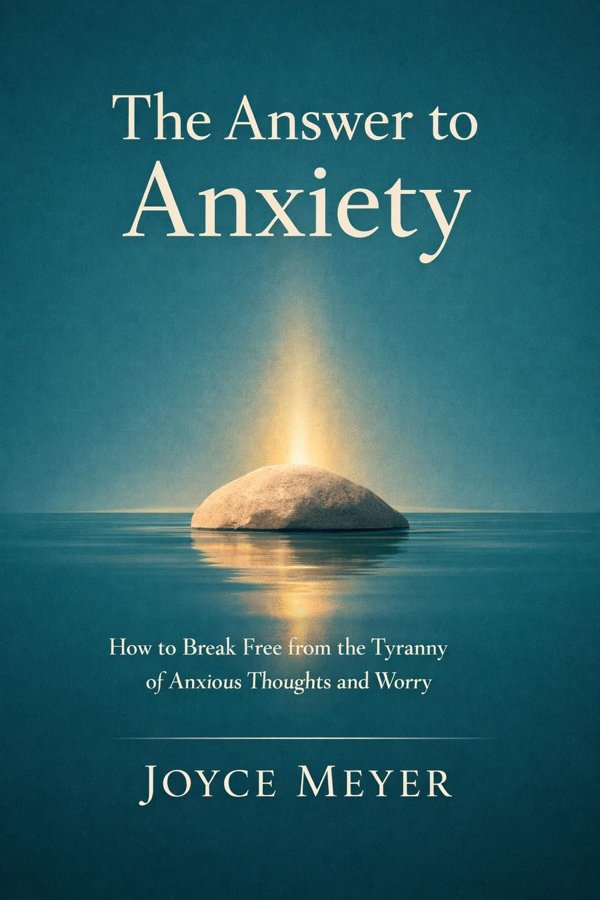
The Answer to Anxiety: How to Break Free from the Tyranny of Anxious Thoughts and Worry: Summary & Key Insights
by Joyce Meyer
 10 min9 chaptersAudio available
Key Takeaways from The Answer to Anxiety: How to Break Free from the Tyranny of Anxious Thoughts and Worry
Anxiety rarely arrives all at once; more often, it begins as a quiet agreement with fear.
Peace, in Meyer’s framework, is not the absence of problems but the presence of trust.
Worry fills mental space, but prayer redirects it.
An anxious life is often sustained by an unchallenged thought life.
Much anxiety is fueled by the illusion that if we think hard enough, prepare enough, or monitor enough, we can prevent pain.
What Is The Answer to Anxiety: How to Break Free from the Tyranny of Anxious Thoughts and Worry About?
The Answer to Anxiety: How to Break Free from the Tyranny of Anxious Thoughts and Worry by Joyce Meyer is a mental_health book spanning 8 pages. Anxiety often feels like an invisible force that drains joy, steals focus, and keeps the mind trapped in endless “what if” scenarios. In The Answer to Anxiety, Joyce Meyer approaches this struggle not only as an emotional and mental burden, but also as a spiritual battle that can be met with faith, disciplined thinking, and trust in God. Rather than offering abstract encouragement, she gives readers a practical path for identifying anxious thought patterns, interrupting them, and replacing them with biblical truth. What makes this book resonate is Meyer’s direct, conversational style and her long-standing focus on everyday spiritual growth. Known for translating Christian teaching into practical habits, she speaks to people who feel overwhelmed by worry, fear of the future, and the pressure to control what they cannot control. Her message is simple but powerful: peace is not found by mastering every circumstance, but by surrendering anxious thoughts to God and learning to live one day at a time. For readers seeking a faith-centered response to worry, this book offers comfort, clarity, and actionable help.
This FizzRead summary covers all 9 key chapters of The Answer to Anxiety: How to Break Free from the Tyranny of Anxious Thoughts and Worry in approximately 10 minutes, distilling the most important ideas, arguments, and takeaways from Joyce Meyer's work. Also available as an audio summary and Key Quotes Podcast.
The Answer to Anxiety: How to Break Free from the Tyranny of Anxious Thoughts and Worry
Anxiety often feels like an invisible force that drains joy, steals focus, and keeps the mind trapped in endless “what if” scenarios. In The Answer to Anxiety, Joyce Meyer approaches this struggle not only as an emotional and mental burden, but also as a spiritual battle that can be met with faith, disciplined thinking, and trust in God. Rather than offering abstract encouragement, she gives readers a practical path for identifying anxious thought patterns, interrupting them, and replacing them with biblical truth.
What makes this book resonate is Meyer’s direct, conversational style and her long-standing focus on everyday spiritual growth. Known for translating Christian teaching into practical habits, she speaks to people who feel overwhelmed by worry, fear of the future, and the pressure to control what they cannot control. Her message is simple but powerful: peace is not found by mastering every circumstance, but by surrendering anxious thoughts to God and learning to live one day at a time. For readers seeking a faith-centered response to worry, this book offers comfort, clarity, and actionable help.
Who Should Read The Answer to Anxiety: How to Break Free from the Tyranny of Anxious Thoughts and Worry?
This book is perfect for anyone interested in mental_health and looking to gain actionable insights in a short read. Whether you're a student, professional, or lifelong learner, the key ideas from The Answer to Anxiety: How to Break Free from the Tyranny of Anxious Thoughts and Worry by Joyce Meyer will help you think differently.
- ✓Readers who enjoy mental_health and want practical takeaways
- ✓Professionals looking to apply new ideas to their work and life
- ✓Anyone who wants the core insights of The Answer to Anxiety: How to Break Free from the Tyranny of Anxious Thoughts and Worry in just 10 minutes
Want the full summary?
Get instant access to this book summary and 100K+ more with Fizz Moment.
Get Free SummaryAvailable on App Store • Free to download
Key Chapters
Peace, in Meyer’s framework, is not the absence of problems but the presence of trust. One of the book’s central convictions is that Scripture does not merely sympathize with human anxiety; it offers a different way to live. Passages like 1 Peter 5:7, which calls believers to cast their cares on God, and Philippians 4, which links prayer, gratitude, and peace, form the backbone of Meyer’s message. She presents these verses not as decorative inspiration, but as daily instructions for the worried mind.
This matters because anxious people often want certainty before they can rest. Meyer reverses that order. Biblical peace does not depend on knowing exactly how life will unfold. It depends on knowing God’s character. If God is faithful, loving, wise, and attentive, then fear does not have to lead. That does not mean difficult feelings disappear instantly. It means believers have a stable reference point that is stronger than fluctuating emotions.
Meyer also stresses that faith is active. Trusting God is not passive resignation or spiritual denial. It is a deliberate choice to hand over what you cannot carry well. For someone anxious about finances, that may mean praying specifically, making wise plans, and refusing to obsess over worst-case outcomes. For someone worried about a loved one, it may mean continuing to care deeply without trying to control every detail of that person’s journey.
The biblical foundation for peace also creates emotional honesty. Readers are not asked to pretend they are calm when they are not. They are invited to bring distress into relationship with God instead of letting it isolate them. Actionable takeaway: choose one Bible verse about peace, write it where you will see it daily, and use it to interrupt anxious thinking whenever your mind begins spiraling.
Worry fills mental space, but prayer redirects it. Joyce Meyer teaches that prayer is one of the most practical responses to anxiety because it moves the burden from internal rehearsal to honest surrender. Many people spend hours thinking about what could go wrong without spending even a few focused minutes placing those concerns before God. Meyer sees this as one reason anxiety grows stronger: what is not surrendered is often magnified.
Her teaching on prayer is grounded in simplicity. Prayer does not need to be polished, lengthy, or emotionally dramatic. It can be as direct as, “God, I am afraid of this meeting,” or “Lord, I keep imagining the worst, and I need Your help.” That kind of honesty interrupts the false belief that we must handle everything alone. Prayer creates a pause in which fear no longer dominates the conversation.
Gratitude works alongside prayer by shifting attention from scarcity and threat to evidence of God’s faithfulness. Meyer is careful not to present gratitude as denial. It does not mean ignoring pain or pretending that real problems do not exist. Instead, it means refusing to let fear be the only lens through which life is seen. Someone worried about an uncertain future can still thank God for today’s provision, supportive relationships, or previous moments of rescue. That practice softens the intensity of panic and strengthens perspective.
In daily life, this may look like replacing a late-night worry spiral with a short prayer list and three specific reasons for gratitude. Over time, this trains the mind to move toward trust more quickly. Actionable takeaway: when anxiety rises, stop and pray about the exact issue for two minutes, then list three concrete things you are grateful for in the present moment.
An anxious life is often sustained by an unchallenged thought life. Meyer repeatedly returns to the importance of mental renewal because emotions usually follow the direction of repeated thoughts. If the mind constantly rehearses disaster, rejection, failure, or loss, the body and emotions begin reacting as if those outcomes are already happening. This is why anxiety can feel so powerful even before anything has actually gone wrong.
Meyer’s solution is not superficial positive thinking. She calls readers to examine their inner dialogue and replace distorted, fear-based thinking with truth. That process requires discipline. Thoughts such as “I can’t handle this,” “Something bad is about to happen,” or “If I make one mistake, everything will collapse” often feel natural because they have been repeated so often. Renewing the mind means noticing those statements and refusing to grant them automatic authority.
A practical example might be a person who becomes anxious before every difficult conversation. The old thought pattern says, “This will go terribly, and I won’t be able to recover.” Renewed thinking responds, “This may be uncomfortable, but God will help me respond with wisdom and peace.” The situation may still be challenging, but the emotional climate changes when the internal script changes.
Meyer also highlights the importance of consistency. One peaceful thought does not erase years of mental habit. But repeated truth gradually reshapes expectation. Scripture reading, spoken affirmations grounded in faith, and selective attention to what is mentally healthy all support this renewal.
Actionable takeaway: identify one recurring anxious thought and write a truthful replacement statement rooted in faith and reality; repeat it every time the old thought returns.
Much anxiety is fueled by the illusion that if we think hard enough, prepare enough, or monitor enough, we can prevent pain. Meyer exposes how exhausting that mindset becomes. Control feels protective in the moment, but in practice it often creates more tension, not less. The person trying to control every outcome becomes trapped in vigilance, unable to rest because there is always another variable to manage.
This theme is especially relevant for competent, responsible people. Many anxious individuals are not careless; they are deeply conscientious. They want to do what is right, avoid mistakes, and shield themselves and others from harm. Meyer does not criticize wise planning. Instead, she draws a line between responsibility and domination. Planning is healthy. Obsessive control is an attempt to carry what only God can carry.
Examples of this show up everywhere: parents trying to manage every aspect of their children’s future, professionals replaying every decision after work, or individuals trying to eliminate all uncertainty before making a choice. In each case, the deeper belief is the same: “If I do enough, I can guarantee safety.” Meyer argues that such guarantees do not exist in human hands. Real peace begins when readers accept their limits without collapsing into helplessness.
Surrender, then, is not passivity. It means doing what is yours to do and releasing what is not. You prepare responsibly for an interview, but you do not torment yourself over every possible outcome. You support a loved one, but you do not assume total responsibility for their choices. Actionable takeaway: make two lists today—what is within your responsibility and what is outside your control—and consciously release the second list to God in prayer.
Peace is most valuable when life is not easy. Meyer emphasizes that freedom from anxiety is not built only in calm moments; it is strengthened through repeated trust during difficulty. Spiritual resilience is the capacity to remain grounded when circumstances are unstable. It does not mean never feeling shaken. It means learning how to return to trust more quickly and more consistently.
This resilience grows through habits, not sudden breakthroughs alone. Regular prayer, Scripture meditation, worship, healthy boundaries, and honest self-examination create inner stability over time. Meyer’s insight here is practical: when a crisis hits, people usually fall back on whatever spiritual and mental patterns they have already practiced. If worry has been the default pattern for years, anxiety will likely intensify under stress. But if surrender, truth, and gratitude have been practiced regularly, the mind has stronger pathways to follow.
Resilience also involves endurance. Meyer acknowledges that some seasons of anxiety do not lift immediately. Waiting for answers, healing, open doors, or restored relationships can test faith deeply. In those moments, spiritual maturity is shown not by pretending everything is fine but by continuing to trust God without having all the evidence one wants. This protects readers from the discouragement of expecting instant emotional perfection.
A resilient person may still have difficult days, but they know how to respond. They pray sooner, isolate less, and resist the urge to let one fearful thought define the entire day. Actionable takeaway: choose one daily spiritual habit—such as ten minutes of Scripture reading or evening prayer—and practice it consistently for two weeks to strengthen your inner response to stress.
The future is one of anxiety’s favorite playgrounds. Meyer shows how worry often fast-forwards the mind into imagined disasters, creating emotional pain about events that may never happen. Fear of the future can involve finances, aging, health, career changes, family concerns, or general uncertainty. The common thread is the attempt to mentally secure tomorrow before it arrives.
What makes this fear so draining is that it disguises itself as preparation. It can feel wise to think ahead constantly, but there is a difference between thoughtful planning and fear-based forecasting. Meyer argues that the anxious mind keeps demanding answers to questions that life has not yet asked. “What if I fail?” “What if no one helps me?” “What if things fall apart?” These thoughts consume energy needed for the present.
Her response is rooted in trust and daily dependence. God gives grace for today, not imaginary strength for every hypothetical scenario months or years away. This perspective does not eliminate practical responsibility. It does, however, limit the mind’s tendency to create suffering in advance. For instance, someone awaiting medical results can acknowledge uncertainty, take appropriate next steps, and still refuse to mentally live through every possible diagnosis before facts are known.
Meyer calls readers back to one day at a time. This is not avoidance; it is wisdom. The future becomes less tyrannical when today is lived faithfully. Actionable takeaway: whenever you catch yourself spiraling about tomorrow, ask, “What is actually required of me today?” Then focus your energy on that single answer instead of trying to solve an unwritten future.
Anxiety pulls attention away from the life that is actually being lived. Meyer’s call to live in the present is not simplistic advice to “just relax.” It is a spiritual and mental discipline of refusing to let fear drag the mind into regret about the past or panic about the future. Many people miss ordinary joy because they are mentally elsewhere—replaying mistakes, anticipating conflict, or bracing for problems that have not arrived.
Living in the present brings peace because it restores proportion. The current moment is often more manageable than the stories anxiety tells about it. A person may not be able to solve next year’s uncertainties, but they can have one honest conversation, complete one task, enjoy one meal, or pray one sincere prayer today. Meyer sees this focus as deeply liberating. It reduces overwhelm by shrinking life back down to the size of the moment God has actually given.
This principle also improves relationships. Anxious thinking can make people physically present but emotionally absent. They may sit with family while mentally scanning threats or rehearsing tomorrow’s demands. Presence means giving full attention to the person, responsibility, or opportunity in front of you. This does not erase all concern, but it interrupts the fragmentation that anxiety creates.
Simple practices support this shift: taking a slow breath before entering a room, putting away the phone during a conversation, noticing small blessings, or completing one task without multitasking. Actionable takeaway: pick one everyday activity—such as eating lunch, walking, or talking with a loved one—and practice being fully present during it without drifting into future-focused worry.
Meyer’s message ultimately points beyond crisis management toward a way of life. Anxiety is not defeated only in dramatic moments of prayer; it is weakened through repeated daily choices that protect peace. A peaceful life is built intentionally. That includes what you think about, what you say aloud, how you spend your time, what voices you listen to, and how quickly you return your cares to God.
One of the book’s strengths is its emphasis on habits. Many readers want immediate relief, but Meyer encourages them to develop routines that make peace more sustainable. This might involve starting the day with prayer instead of instantly checking distressing news, limiting conversations that intensify fear, or speaking words of trust instead of verbalizing every anxious thought as fact. Such choices may seem small, but repeated daily, they shape the atmosphere of the mind.
Peace also requires boundaries. Not every responsibility is yours to accept, and not every thought deserves your attention. Some anxiety thrives because life is overcrowded with noise, urgency, and unrealistic expectations. Meyer invites readers to simplify where possible and to guard their inner life with greater care. Rest, reflection, and spiritual focus are not luxuries; they are part of emotional stewardship.
Over time, this lifestyle creates steadiness. Problems still arise, but they no longer dictate the entire emotional climate. The goal is not a perfectly calm personality but a practiced return to peace. Actionable takeaway: design a simple daily peace routine with three elements—one practice for morning, one for stressful moments, and one for evening—and follow it for the next seven days.
All Chapters in The Answer to Anxiety: How to Break Free from the Tyranny of Anxious Thoughts and Worry
About the Author
Joyce Meyer is an American Christian author, Bible teacher, and speaker widely known for her practical approach to spiritual growth and emotional healing. After overcoming a difficult early life, she built a global ministry focused on helping people apply biblical truth to everyday struggles such as fear, insecurity, anger, and unhealthy thinking. Through Joyce Meyer Ministries, she reaches audiences around the world through books, conferences, television broadcasts, podcasts, and charitable outreach. Meyer has written numerous bestselling books that blend Scripture with direct, experience-based encouragement. Her teaching style is conversational, candid, and action-oriented, making complex spiritual ideas feel accessible to everyday readers. In her work on anxiety, she draws on both personal insight and biblical teaching to help readers pursue peace, renewed thinking, and a deeper trust in God.
Get This Summary in Your Preferred Format
Read or listen to the The Answer to Anxiety: How to Break Free from the Tyranny of Anxious Thoughts and Worry summary by Joyce Meyer anytime, anywhere. FizzRead offers multiple formats so you can learn on your terms — all free.
Available formats: App · Audio · PDF · EPUB — All included free with FizzRead
Download The Answer to Anxiety: How to Break Free from the Tyranny of Anxious Thoughts and Worry PDF and EPUB Summary
Key Quotes from The Answer to Anxiety: How to Break Free from the Tyranny of Anxious Thoughts and Worry
“Anxiety rarely arrives all at once; more often, it begins as a quiet agreement with fear.”
“Peace, in Meyer’s framework, is not the absence of problems but the presence of trust.”
“Worry fills mental space, but prayer redirects it.”
“An anxious life is often sustained by an unchallenged thought life.”
“Much anxiety is fueled by the illusion that if we think hard enough, prepare enough, or monitor enough, we can prevent pain.”
Frequently Asked Questions about The Answer to Anxiety: How to Break Free from the Tyranny of Anxious Thoughts and Worry
The Answer to Anxiety: How to Break Free from the Tyranny of Anxious Thoughts and Worry by Joyce Meyer is a mental_health book that explores key ideas across 9 chapters. Anxiety often feels like an invisible force that drains joy, steals focus, and keeps the mind trapped in endless “what if” scenarios. In The Answer to Anxiety, Joyce Meyer approaches this struggle not only as an emotional and mental burden, but also as a spiritual battle that can be met with faith, disciplined thinking, and trust in God. Rather than offering abstract encouragement, she gives readers a practical path for identifying anxious thought patterns, interrupting them, and replacing them with biblical truth. What makes this book resonate is Meyer’s direct, conversational style and her long-standing focus on everyday spiritual growth. Known for translating Christian teaching into practical habits, she speaks to people who feel overwhelmed by worry, fear of the future, and the pressure to control what they cannot control. Her message is simple but powerful: peace is not found by mastering every circumstance, but by surrendering anxious thoughts to God and learning to live one day at a time. For readers seeking a faith-centered response to worry, this book offers comfort, clarity, and actionable help.
You Might Also Like
Big Feelings: How to Be Okay When Things Are Not Okay
Liz Fosslien, Mollie West Duffy
10 min
Creative Arts Therapies Handbook: Art, Music and Dance Therapy Practices for Wellbeing
Susan I. Buchalter
10 min
Emotional First Aid: Healing Rejection, Guilt, Failure, and Other Everyday Hurts
Guy Winch
10 min
Lost Connections: Why You're Depressed and How to Find Hope
Johann Hari
10 min
No Time to Panic: How to Stop Worrying and Embrace Life
Matt Gutman
10 min
Overcoming Mobbing: A Recovery Guide for Workplace Aggression and Bullying
Maureen Duffy, Len Sperry
10 minBrowse by Category
Ready to read The Answer to Anxiety: How to Break Free from the Tyranny of Anxious Thoughts and Worry?
Get the full summary and 100K+ more books with Fizz Moment.