
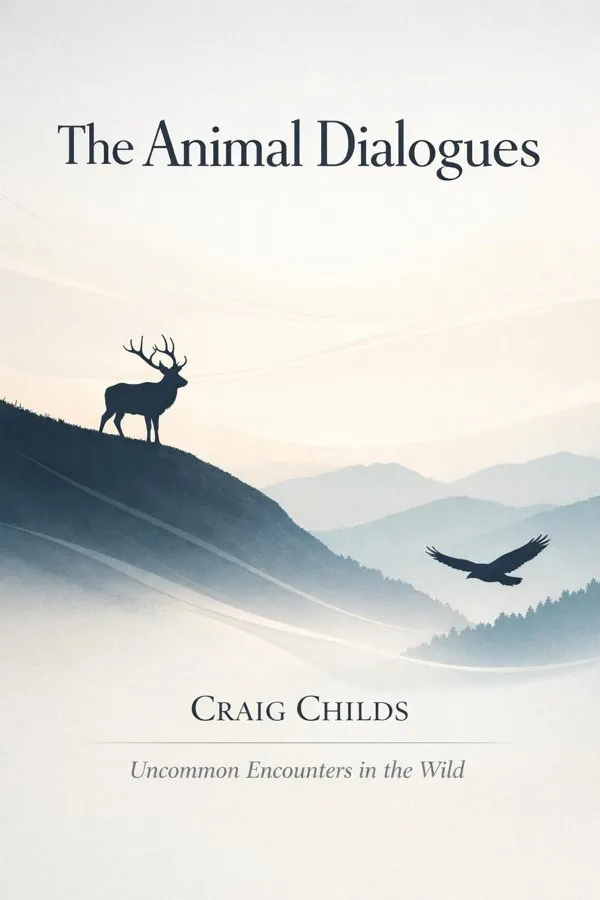
The Animal Dialogues: Uncommon Encounters in the Wild: Summary & Key Insights
by Craig Childs
 10 min5 chaptersAudio available
What Is The Animal Dialogues: Uncommon Encounters in the Wild About?
The Animal Dialogues: Uncommon Encounters in the Wild by Craig Childs is a environment book spanning 5 pages. A collection of essays in which Craig Childs recounts his intimate encounters with wild animals across North America, exploring the boundaries between human and animal worlds with vivid naturalist detail and philosophical reflection.
This FizzRead summary covers all 5 key chapters of The Animal Dialogues: Uncommon Encounters in the Wild in approximately 10 minutes, distilling the most important ideas, arguments, and takeaways from Craig Childs's work. Also available as an audio summary and Key Quotes Podcast.
The Animal Dialogues: Uncommon Encounters in the Wild
A collection of essays in which Craig Childs recounts his intimate encounters with wild animals across North America, exploring the boundaries between human and animal worlds with vivid naturalist detail and philosophical reflection.
Who Should Read The Animal Dialogues: Uncommon Encounters in the Wild?
This book is perfect for anyone interested in environment and looking to gain actionable insights in a short read. Whether you're a student, professional, or lifelong learner, the key ideas from The Animal Dialogues: Uncommon Encounters in the Wild by Craig Childs will help you think differently.
- ✓Readers who enjoy environment and want practical takeaways
- ✓Professionals looking to apply new ideas to their work and life
- ✓Anyone who wants the core insights of The Animal Dialogues: Uncommon Encounters in the Wild in just 10 minutes
Want the full summary?
Get instant access to this book summary and 100K+ more with Fizz Moment.
Get Free SummaryAvailable on App Store • Free to download
Key Chapters
The desert is a place of scarcity, and within that scarcity, everything becomes intensely alive. In the arid landscapes I have crossed, each creature carves its existence from stone and shadow, adapting not through abundance but through precision. Meeting a snake here is different than encountering a snake elsewhere; its patience, its measured coil, mirrors the stillness of the land itself. I remember waiting for hours beside a dry wash, watching a sidewinder emerge, its motion less like crawling and more like writing across the sand. To share space with such a being is to feel the land breathe through it.
Coyotes too inhabit this space, their presence both eerie and familiar. You hear their voices before you see them—the high, sharp calls threading through moonlight—and you know they’re speaking the language of survival. In the desert, every sound matters. Every movement betrays intent. My encounters here taught me that adaptation is not only a physical act but a spiritual one. Life persists where it seems impossible, and the desert demands respect for that resilience.
What these interactions revealed most profoundly was the reciprocity of observation. When I sit still long enough, the desert animals come forth not as specimens but as messengers. They are telling me about endurance—not the kind wrought by power, but by balance. Watching a lizard bask and then vanish into the rocks reminds me that to survive harshness, one must become part of it, not stand apart. In their quiet, deliberate movements, I found echoes of wisdom that apply to all living things: adaptation is not conquest; it’s conversation.
There is a moment, standing on a rocky ledge in the canyonlands, when you realize that you are not the top of the food chain. You feel it before you understand it—your skin prickles, your pulse slows—and then you see the eyes. The mountain lion does not charge. It watches. In its gaze is not the hunger of a beast but the assessment of an equal. That encounter redefined what it means to be a participant in wildness. The predator-prey relationship, so often charted in diagrams and theories, becomes immediate, visceral, and deeply human.
Fear, I discovered, is not the enemy of understanding; it is its threshold. When you feel the closeness of a carnivore, your senses sharpen until the world becomes utterly present. Every rustle, every scent, every flicker matters. You are no longer an observer; you are part of the fabric of the land. In such moments, it becomes clear that humans have long tried to remove themselves from this primal dance, crafting safety at the expense of awareness. Yet the mountain lion reminds us that instinct, whether hers or mine, is sacred.
Watching predator and prey interact is to witness the raw mechanics of existence. When a hawk stoops over a rabbit, or when a wolf moves through snow tracking elk, there is no cruelty—only continuity. Life feeds life. The mountain lion’s grace, the rabbit’s vigilance, the hawk’s precision—all are expressions of a single truth: survival is a conversation between energy and need. In understanding them, I begin to understand myself.
+ 3 more chapters — available in the FizzRead app
All Chapters in The Animal Dialogues: Uncommon Encounters in the Wild
About the Author
Craig Childs is an American author and naturalist known for his works on wilderness, archaeology, and environmental issues. His writing often blends scientific observation with personal narrative, focusing on the relationship between humans and the natural world.
Get This Summary in Your Preferred Format
Read or listen to the The Animal Dialogues: Uncommon Encounters in the Wild summary by Craig Childs anytime, anywhere. FizzRead offers multiple formats so you can learn on your terms — all free.
Available formats: App · Audio · PDF · EPUB — All included free with FizzRead
Download The Animal Dialogues: Uncommon Encounters in the Wild PDF and EPUB Summary
Key Quotes from The Animal Dialogues: Uncommon Encounters in the Wild
“The desert is a place of scarcity, and within that scarcity, everything becomes intensely alive.”
“There is a moment, standing on a rocky ledge in the canyonlands, when you realize that you are not the top of the food chain.”
Frequently Asked Questions about The Animal Dialogues: Uncommon Encounters in the Wild
The Animal Dialogues: Uncommon Encounters in the Wild by Craig Childs is a environment book that explores key ideas across 5 chapters. A collection of essays in which Craig Childs recounts his intimate encounters with wild animals across North America, exploring the boundaries between human and animal worlds with vivid naturalist detail and philosophical reflection.
You Might Also Like

A Life on Our Planet: My Witness Statement and a Vision for the Future
David Attenborough
10 min
A Sky Full Of Birds
Matt Merritt
10 min
Carbon Zero: Imagining Cities That Can Save the Planet
Alex Steffen
10 min
Eaarth: Making a Life on a Tough New Planet
Bill McKibben
10 min
The Social Contract and Environmental Governance
Various Editors
10 min
The Wild Places
Robert Macfarlane
10 minBrowse by Category
Ready to read The Animal Dialogues: Uncommon Encounters in the Wild?
Get the full summary and 100K+ more books with Fizz Moment.