
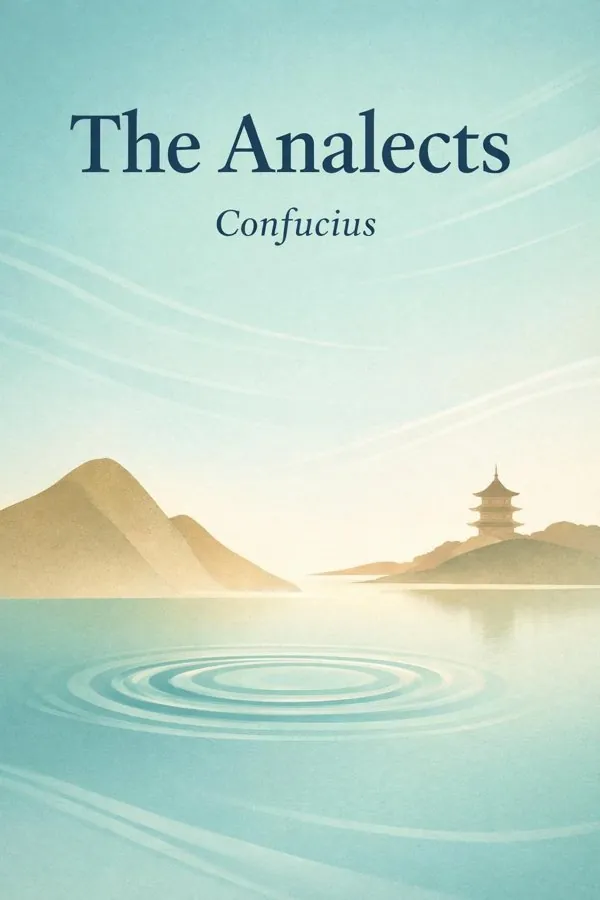
The Analects: Summary & Key Insights
by Confucius
 10 min11 chaptersAudio available
What Is The Analects About?
The Analects by Confucius is a eastern_wisdom book spanning 11 pages. The Analects is a collection of sayings and ideas attributed to the Chinese philosopher Confucius and his disciples. Compiled during the Warring States period, it presents discussions on ethics, politics, education, and proper conduct. The work embodies the core values of Confucianism, such as benevolence, propriety, and the doctrine of the mean, and has profoundly influenced Chinese and East Asian thought and culture.
This FizzRead summary covers all 11 key chapters of The Analects in approximately 10 minutes, distilling the most important ideas, arguments, and takeaways from Confucius's work. Also available as an audio summary and Key Quotes Podcast.
The Analects
The Analects is a collection of sayings and ideas attributed to the Chinese philosopher Confucius and his disciples. Compiled during the Warring States period, it presents discussions on ethics, politics, education, and proper conduct. The work embodies the core values of Confucianism, such as benevolence, propriety, and the doctrine of the mean, and has profoundly influenced Chinese and East Asian thought and culture.
Who Should Read The Analects?
This book is perfect for anyone interested in eastern_wisdom and looking to gain actionable insights in a short read. Whether you're a student, professional, or lifelong learner, the key ideas from The Analects by Confucius will help you think differently.
- ✓Readers who enjoy eastern_wisdom and want practical takeaways
- ✓Professionals looking to apply new ideas to their work and life
- ✓Anyone who wants the core insights of The Analects in just 10 minutes
Want the full summary?
Get instant access to this book summary and 100K+ more with Fizz Moment.
Get Free SummaryAvailable on App Store • Free to download
Key Chapters
Whenever I spoke of virtue, I began with *ren*, for it is the pulse of moral life. Without *ren*, propriety becomes hollow form, righteousness becomes stubborn pride, and knowledge becomes cunning. *Ren* is the warmth that allows one to regard others as oneself. When Zilu once asked me what *ren* meant, I said, 'To love others.' Yet love here is no indulgent sentiment; it is the steady inclination to do what benefits others, to act as though their pain were our own. In a world divided by ambition, such love demands courage.
To cultivate *ren*, one must look inward constantly. I often told my followers: ‘Do not worry that others do not recognize you; worry that you do not recognize others.’ A person of *ren* delights not in praise but in honesty, not in victory but in uprightness. The disciple Yan Hui embodied this best—he lived in poverty, yet his spirit was rich, for he found joy in becoming better, not bitter. Through *ren*, life itself becomes a study in compassion: one learns to see that each gesture of kindness anchors the world a little more firmly in moral order.
When I urged the rulers of my age to govern through virtue, I spoke of *ren*. The ruler who loves his people as parents love their children will need no harsh decrees; his example will move hearts more surely than punishment can restrain hands. Thus *ren* is not only the private compass of the individual—it is the secret strength of nations. Where rulers embody benevolence, the people will rise in loyalty; where fathers embody benevolence, sons will emulate them. Humanity, once awakened, becomes self-renewing.
Benevolence has its inner fire, but that fire needs a form; that form is *li*, ritual propriety. In my time, many thought *li* meant bowing and ceremony, but I told my students: ritual without respect is empty, and respect without form is rootless. *Li* brings feeling into order; it teaches reverence through action. When one bows to a parent, serves a guest tea, or speaks with measured tone before elders, one shapes inner virtue through outer gesture.
I saw the loss of *li* as the great tragedy of my age. Rulers demanded obedience but not sincerity; their courts glittered with ceremony but lacked reverence. I urged them to restore the essence of *li*—that every ritual act must affirm our shared roles within the web of life. To honor parents is to remember our beginning; to show respect to rulers and teachers is to affirm our belonging in a moral lineage. When *li* and *ren* unite, courtesy becomes the language of love.
But *li* does more than guide manners—it protects the heart from chaos. In restraint there is freedom, for discipline tempers desire. As I once said, 'If a man is guided by *li*, he will not stray from the path of righteousness.' Society that forgets *li* may grow loud with rights but poor in duty; it gains power but loses peace. Through *li*, the individual learns humility; through humility, the world learns balance.
+ 9 more chapters — available in the FizzRead app
All Chapters in The Analects
About the Author
Confucius (551–479 BCE) was a Chinese philosopher, teacher, and political figure known for his teachings on morality, social relationships, and justice. As the founder of Confucianism, his ideas have shaped Chinese civilization and influenced cultures across East Asia for over two millennia.
Get This Summary in Your Preferred Format
Read or listen to the The Analects summary by Confucius anytime, anywhere. FizzRead offers multiple formats so you can learn on your terms — all free.
Available formats: App · Audio · PDF · EPUB — All included free with FizzRead
Download The Analects PDF and EPUB Summary
Key Quotes from The Analects
“Whenever I spoke of virtue, I began with *ren*, for it is the pulse of moral life.”
“Benevolence has its inner fire, but that fire needs a form; that form is *li*, ritual propriety.”
Frequently Asked Questions about The Analects
The Analects by Confucius is a eastern_wisdom book that explores key ideas across 11 chapters. The Analects is a collection of sayings and ideas attributed to the Chinese philosopher Confucius and his disciples. Compiled during the Warring States period, it presents discussions on ethics, politics, education, and proper conduct. The work embodies the core values of Confucianism, such as benevolence, propriety, and the doctrine of the mean, and has profoundly influenced Chinese and East Asian thought and culture.
You Might Also Like

A New Earth
Eckhart Tolle
10 min
The Daily Stoic
Ryan Holiday, Stephen Hanselman
10 min
Buddhism: Plain and Simple
Steve Hagen
10 min
Enchiridion
Epictetus
10 min
The Book of Tea
Kakuzō Okakura
10 min
The Light We Give: How Sikh Wisdom Can Transform Your Life
Simran Jeet Singh
10 minBrowse by Category
Ready to read The Analects?
Get the full summary and 100K+ more books with Fizz Moment.