
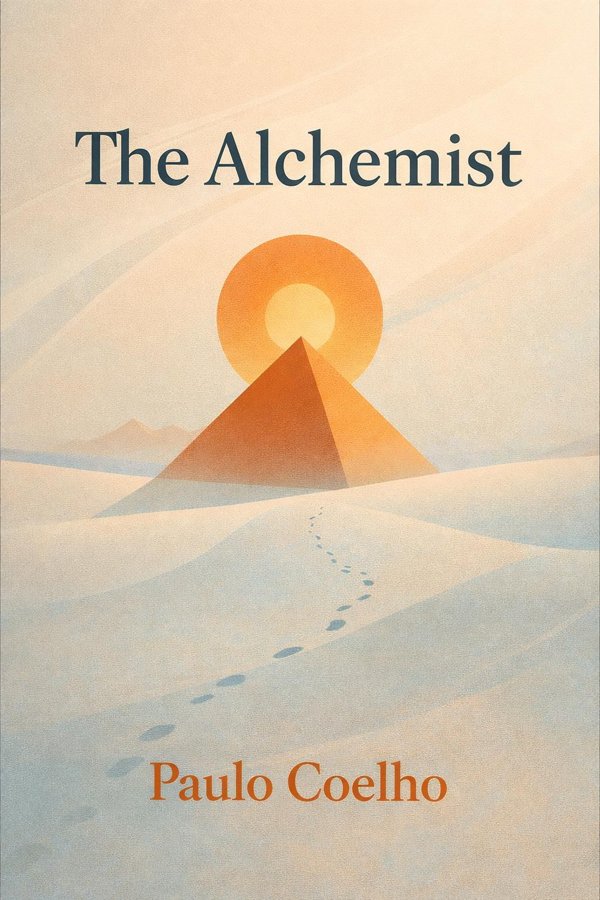
The Alchemist: Summary & Key Insights
by Paulo Coelho
 10 min9 chaptersAudio available
Key Takeaways from The Alchemist
Every life is shaped by a quiet choice: follow the voice of your deepest desire, or silence it in the name of safety.
A recurring dream is often less about sleep than about truth insisting on being noticed.
Sometimes the path toward purpose begins with humiliation rather than progress.
Wisdom does not always arrive as logic; sometimes it appears as pattern, timing, and felt recognition.
The Alchemist suggests that individual lives are not isolated events but expressions of a deeper unity.
What Is The Alchemist About?
The Alchemist by Paulo Coelho is a fiction book. The Alchemist is a short novel with the emotional force of a myth. Paulo Coelho tells the story of Santiago, a young shepherd from Spain who keeps dreaming of a treasure buried near the Egyptian pyramids. What begins as a simple quest for gold gradually becomes a deeper journey into purpose, intuition, fear, love, and the mysterious ways life nudges us toward what we are meant to become. Along the road, Santiago encounters teachers, setbacks, omens, and moments of wonder that reveal one of the book’s central ideas: when we commit fully to our deepest calling, the world seems to respond. The novel matters because it transforms big philosophical questions into a clear, memorable fable. It asks what happens when we stop ignoring our inner voice, and what it costs us when we settle for comfort instead of meaning. Coelho, one of the most widely read contemporary authors in the world, writes with unusual simplicity and spiritual resonance. His authority comes not from academic theory, but from his ability to express timeless truths about courage, destiny, and self-discovery in a form that feels immediate, personal, and universal.
This FizzRead summary covers all 9 key chapters of The Alchemist in approximately 10 minutes, distilling the most important ideas, arguments, and takeaways from Paulo Coelho's work. Also available as an audio summary and Key Quotes Podcast.
The Alchemist
The Alchemist is a short novel with the emotional force of a myth. Paulo Coelho tells the story of Santiago, a young shepherd from Spain who keeps dreaming of a treasure buried near the Egyptian pyramids. What begins as a simple quest for gold gradually becomes a deeper journey into purpose, intuition, fear, love, and the mysterious ways life nudges us toward what we are meant to become. Along the road, Santiago encounters teachers, setbacks, omens, and moments of wonder that reveal one of the book’s central ideas: when we commit fully to our deepest calling, the world seems to respond.
The novel matters because it transforms big philosophical questions into a clear, memorable fable. It asks what happens when we stop ignoring our inner voice, and what it costs us when we settle for comfort instead of meaning. Coelho, one of the most widely read contemporary authors in the world, writes with unusual simplicity and spiritual resonance. His authority comes not from academic theory, but from his ability to express timeless truths about courage, destiny, and self-discovery in a form that feels immediate, personal, and universal.
Who Should Read The Alchemist?
This book is perfect for anyone interested in fiction and looking to gain actionable insights in a short read. Whether you're a student, professional, or lifelong learner, the key ideas from The Alchemist by Paulo Coelho will help you think differently.
- ✓Readers who enjoy fiction and want practical takeaways
- ✓Professionals looking to apply new ideas to their work and life
- ✓Anyone who wants the core insights of The Alchemist in just 10 minutes
Want the full summary?
Get instant access to this book summary and 100K+ more with Fizz Moment.
Get Free SummaryAvailable on App Store • Free to download
Key Chapters
Every life is shaped by a quiet choice: follow the voice of your deepest desire, or silence it in the name of safety. The Alchemist speaks directly to that choice. Although it reads like a fable, its real subject is the tension between comfort and calling. Paulo Coelho suggests that each person carries a “Personal Legend,” a unique path of fulfillment that expresses who they most truly are. The tragedy is not that people fail, but that many never begin.
The book’s power lies in how simply it frames a universal experience. As children, we tend to believe life has meaning and possibility. Over time, fear, routine, disappointment, and other people’s expectations teach us to lower our sights. Santiago’s story restores that original sense of possibility. His journey tells readers that dreams are not naive fantasies to be outgrown, but clues pointing toward a fuller life.
In practical terms, this idea applies far beyond grand adventures. A Personal Legend might mean changing careers, starting a creative project, ending a stagnant pattern, or finally pursuing a long-postponed goal. The point is not that every desire is wise, but that ignored aspirations often become sources of regret and spiritual fatigue.
Coelho also reminds us that pursuing meaning rarely feels efficient. It involves uncertainty, sacrifice, and trust. Yet the novel argues that the cost of avoiding your path is ultimately higher than the cost of pursuing it.
Actionable takeaway: identify one dream or ambition you have repeatedly dismissed, write down why it still matters to you, and take one small concrete step toward it this week.
A recurring dream is often less about sleep than about truth insisting on being noticed. Santiago’s journey begins with such a dream: twice he sees a child leading him to treasure hidden near the Egyptian pyramids. He could easily dismiss it as imagination, but the dream unsettles him because it feels meaningful. That unrest is the beginning of transformation.
Coelho shows that the call to adventure rarely arrives in a convenient form. It appears as longing, curiosity, discontent, or a strange inner certainty that life holds something more. Santiago seeks interpretation from a dream reader and then meets Melchizedek, the mysterious king who introduces the idea of a Personal Legend. Together, these moments validate what Santiago already senses: he is being asked to move beyond the familiar.
This idea matters because many people wait for absolute clarity before acting. The novel argues that clarity often comes after movement, not before it. Santiago does not know exactly what will happen, only that he must begin. In everyday life, this might look like applying for a role before you feel fully ready, enrolling in a course before you know the whole plan, or saying yes to an opportunity that awakens your energy.
The call to adventure is not a guarantee of ease. It is an invitation into growth. The first decision is often the most important because it breaks the spell of passivity. By choosing to sell his sheep and pursue the dream, Santiago turns possibility into commitment.
Actionable takeaway: think of a dream or direction that keeps returning to your mind; instead of debating it endlessly, define the first visible action that would signal a real beginning.
Sometimes the path toward purpose begins with humiliation rather than progress. When Santiago arrives in Tangier, he is robbed almost immediately and loses the money he had planned to use for his journey. In an instant, his dream seems foolish. He is alone, unable to speak the language, and tempted to believe the adventure has already failed.
This episode is essential because it strips away romantic ideas about destiny. Following a dream does not exempt anyone from confusion, betrayal, or bad luck. In fact, early losses often test whether the dream is genuine or merely attractive in theory. Santiago could return home defeated, but instead he chooses to work for a crystal merchant. This period becomes one of the novel’s most realistic lessons in resilience.
The merchant himself represents another path in life: a man with aspirations he never fulfilled. He dreams of making a pilgrimage to Mecca, yet preserves the dream by never acting on it. Through him, Coelho explores how people become attached to longing itself because action would force change. Santiago, by contrast, uses hardship as training. He improves the merchant’s business, learns initiative, saves money, and discovers that setbacks can become education.
In practical life, many goals are abandoned not because they are impossible, but because the first obstacle feels like a verdict. The novel suggests a different interpretation: difficulty is not always a sign to stop; sometimes it is the price of entry into maturity.
Actionable takeaway: when a setback disrupts one of your goals, ask not “Why is this happening to me?” but “What capability is this situation asking me to develop?”
Wisdom does not always arrive as logic; sometimes it appears as pattern, timing, and felt recognition. One of The Alchemist’s most distinctive ideas is that life communicates through omens. For Santiago, these are not superstitions but signals that help him stay aligned with his path. He learns to notice coincidences, emotional resonances, repeated symbols, and the subtle guidance that emerges when attention sharpens.
Coelho’s deeper point is that intuition is a legitimate form of intelligence. Modern life often prizes analysis above all else, yet many important decisions involve incomplete information. Relationships, career choices, creative risks, and moments of moral courage cannot always be solved through spreadsheets. Santiago’s progress depends on learning to trust a kind of inner literacy—a sensitivity to what feels alive, timely, and true.
That said, the book does not suggest abandoning reason. Omens are useful when paired with responsibility. Santiago still works, observes, adapts, and learns from experience. Intuition is not wishful thinking; it is disciplined attention to reality, including one’s own inner reactions. In practical terms, this might mean noticing which opportunities energize rather than drain you, which environments deepen your focus, or which repeated invitations seem to point toward an emerging direction.
People often ignore intuition because it lacks the certainty of formal proof. But many regrets come from overriding what we quietly knew all along. The novel encourages readers to become better listeners—to the world, to timing, and to themselves.
Actionable takeaway: for the next week, keep a brief journal of repeated signs, surprising opportunities, and strong intuitive nudges, then review what consistent pattern may be trying to guide you.
The Alchemist suggests that individual lives are not isolated events but expressions of a deeper unity. Coelho calls this larger reality the “Soul of the World,” a spiritual principle connecting all beings, desires, and transformations. In the novel, this idea is not presented as abstract theology but as lived experience: Santiago senses that when he is fully committed to his Personal Legend, he enters into cooperation with something greater than himself.
At one level, this concept gives the story its mystical tone. At another, it offers a practical truth: life often becomes more coherent when our actions are aligned with our deepest values. We may describe that coherence spiritually, psychologically, or ethically, but the experience is recognizable. People often report that when they stop pretending and begin acting from conviction, they notice more energy, more meaningful encounters, and more doors opening.
The Soul of the World also implies interdependence. Santiago learns from strangers, nature, silence, and love. Nothing on the journey is wasted; each part belongs to the whole. This perspective counters the modern temptation to see success as purely individual. Achievement may require personal effort, but growth is relational. We become who we are through dialogue with the world around us.
In daily life, this idea can help shift a person from control to participation. Instead of forcing outcomes at all costs, we can ask where life is already moving and how our gifts fit into that movement. This does not remove uncertainty, but it can replace alienation with trust.
Actionable takeaway: choose one current goal and ask how it serves not only your ambition, but also connection, contribution, or a larger sense of meaning.
One of the book’s most memorable insights is that real love deepens purpose rather than demanding its abandonment. When Santiago meets Fatima at the oasis, he encounters a form of happiness powerful enough to make him reconsider his quest. Here Coelho addresses a common human fear: that pursuing one’s calling will require sacrificing love, or that love requires shrinking one’s destiny.
Fatima challenges that false choice. She does not ask Santiago to stay and become smaller for her comfort. Instead, she understands that if his love is real, it must include fidelity to his Personal Legend. Coelho presents this as mature love—supportive, expansive, and unpossessive. It trusts that what is genuine can withstand distance, uncertainty, and time.
This idea applies broadly. People often abandon meaningful goals because they fear disappointing a partner, family member, or community. Sometimes those pressures are external, but often they are internal assumptions about what love demands. The novel argues that any bond built on self-betrayal will eventually carry resentment. By contrast, relationships become stronger when both people honor what is most alive and true in each other.
That does not mean every dream automatically justifies every sacrifice. Responsibility matters. But Coelho invites readers to distinguish between love and attachment. Love wants growth; attachment wants control. Fatima’s role in the story shows that encouragement can be more powerful than possession.
Actionable takeaway: have one honest conversation with someone important in your life about a goal you have minimized, and explain why pursuing it would help you become more fully yourself, not less committed to the relationship.
People are often less defeated by difficulty than by the anticipation of difficulty. Late in Santiago’s journey, the novel makes one of its clearest claims: the fear of suffering is worse than suffering itself. This is a central psychological truth. Much of human paralysis comes not from actual failure, but from imagined pain—rejection, embarrassment, uncertainty, loss of identity, or the possibility that effort may not pay off.
Santiago repeatedly faces situations that could send him backward: being robbed, working in a foreign city, crossing the desert, confronting tribal conflict, and standing before apparent impossibilities. Each challenge reveals that courage is not the absence of fear but movement despite fear. Once acted upon, many threats become manageable realities rather than endless internal phantoms.
In ordinary life, fear disguises itself as practicality. We tell ourselves it is “not the right time,” that we need “more certainty,” or that we are “being realistic.” Sometimes caution is wise, but sometimes it is simply fear wearing intelligent language. The Alchemist encourages readers to inspect these narratives carefully. Are they grounded in fact, or in self-protection?
Coelho does not romanticize pain. Santiago suffers. But suffering that emerges from meaningful pursuit differs from the quieter suffering of stagnation. One stretches the soul; the other shrinks it. This distinction is why the novel continues to resonate with readers who feel stuck between longing and hesitation.
Actionable takeaway: write down one decision you have delayed out of fear, list the worst realistic outcome, then list the cost of doing nothing for another year; compare the two honestly before choosing.
The desert in The Alchemist is not just a setting; it is a discipline. It strips away distraction, tests endurance, and teaches Santiago how to listen. In many stories, transformation comes through dramatic revelation. In this novel, it also comes through slowness, silence, and exposure to vastness. The desert demands patience, humility, and attention—qualities modern life often neglects.
Traveling with the Englishman and later meeting the alchemist, Santiago learns that knowledge has layers. The Englishman seeks truth through books and systems, while the alchemist embodies lived wisdom. Coelho does not reject study, but he emphasizes that intellectual understanding alone is incomplete. Some truths must be practiced, risked, and embodied. Santiago’s education is therefore both external and internal.
The desert also symbolizes periods in life when progress feels barren. Projects stall. Answers do not come quickly. Old identities dissolve before new ones fully form. Such times can feel empty, but they are often intensely formative. Without noise, we discover what remains essential. Santiago learns to converse with nature, trust his heart, and perceive reality beyond appearances.
In practical terms, many people try to escape their deserts too quickly. They fill uncertainty with distraction rather than allowing it to teach them. Yet some of the most important transitions—career changes, grief, spiritual searching, creative development—require spaciousness and endurance.
Actionable takeaway: create one regular period each week without phone, media, or multitasking, and use that time to reflect on what your current season of life may be trying to teach you beneath the noise.
The final irony of The Alchemist is also its deepest wisdom: the treasure Santiago seeks lies far away, yet in another sense it has been near him from the beginning. After reaching the pyramids, suffering violence, and uncovering the final clue, he learns that the material treasure is actually buried back in Spain, near the sycamore tree where his dream first began. This ending does not cancel the journey; it reveals why the journey was necessary.
Coelho’s message is subtle. The goal matters, but the seeker is transformed more than the destination. Santiago could not have discovered the treasure at the start because he lacked the experience, courage, and understanding to receive its meaning. The road gave him not just information, but identity. He returns home carrying inner wealth: self-trust, spiritual vision, and a lived relationship with the world.
This pattern appears often in real life. People pursue achievement—a promotion, a degree, a move, a creative milestone—only to realize that the external reward is inseparable from the person they became while pursuing it. Sometimes what we are really seeking is not elsewhere, but hidden within familiar ground that only new eyes can recognize.
The novel therefore rejects both naive escapism and cynical realism. Yes, there is treasure. Yes, the world contains wonder. But the greatest discovery is that outer quests awaken inner knowledge. Home becomes meaningful again after transformation.
Actionable takeaway: look back on one major goal you pursued and ask not only what you gained externally, but what qualities, insights, and strengths the journey itself developed in you.
All Chapters in The Alchemist
About the Author
Paulo Coelho is a Brazilian author born in Rio de Janeiro in 1947 and one of the most widely read contemporary writers in the world. Before becoming a novelist, he worked in theater, journalism, and songwriting, experiences that helped shape his distinctive voice. His writing often blends simplicity, symbolism, spirituality, and themes of destiny, transformation, and self-discovery. Coelho achieved global fame with The Alchemist, a novel that has been translated into dozens of languages and has become a modern classic. Over the course of his career, he has written numerous bestselling books that explore the search for meaning and the courage required to live authentically. His influence extends far beyond literature, reaching readers interested in personal growth, philosophy, and spiritual reflection.
Get This Summary in Your Preferred Format
Read or listen to the The Alchemist summary by Paulo Coelho anytime, anywhere. FizzRead offers multiple formats so you can learn on your terms — all free.
Available formats: App · Audio · PDF · EPUB — All included free with FizzRead
Download The Alchemist PDF and EPUB Summary
Key Quotes from The Alchemist
“Every life is shaped by a quiet choice: follow the voice of your deepest desire, or silence it in the name of safety.”
“A recurring dream is often less about sleep than about truth insisting on being noticed.”
“Sometimes the path toward purpose begins with humiliation rather than progress.”
“Wisdom does not always arrive as logic; sometimes it appears as pattern, timing, and felt recognition.”
“The Alchemist suggests that individual lives are not isolated events but expressions of a deeper unity.”
Frequently Asked Questions about The Alchemist
The Alchemist by Paulo Coelho is a fiction book that explores key ideas across 9 chapters. The Alchemist is a short novel with the emotional force of a myth. Paulo Coelho tells the story of Santiago, a young shepherd from Spain who keeps dreaming of a treasure buried near the Egyptian pyramids. What begins as a simple quest for gold gradually becomes a deeper journey into purpose, intuition, fear, love, and the mysterious ways life nudges us toward what we are meant to become. Along the road, Santiago encounters teachers, setbacks, omens, and moments of wonder that reveal one of the book’s central ideas: when we commit fully to our deepest calling, the world seems to respond. The novel matters because it transforms big philosophical questions into a clear, memorable fable. It asks what happens when we stop ignoring our inner voice, and what it costs us when we settle for comfort instead of meaning. Coelho, one of the most widely read contemporary authors in the world, writes with unusual simplicity and spiritual resonance. His authority comes not from academic theory, but from his ability to express timeless truths about courage, destiny, and self-discovery in a form that feels immediate, personal, and universal.
Compare The Alchemist
More by Paulo Coelho



You Might Also Like



Browse by Category
Ready to read The Alchemist?
Get the full summary and 100K+ more books with Fizz Moment.