
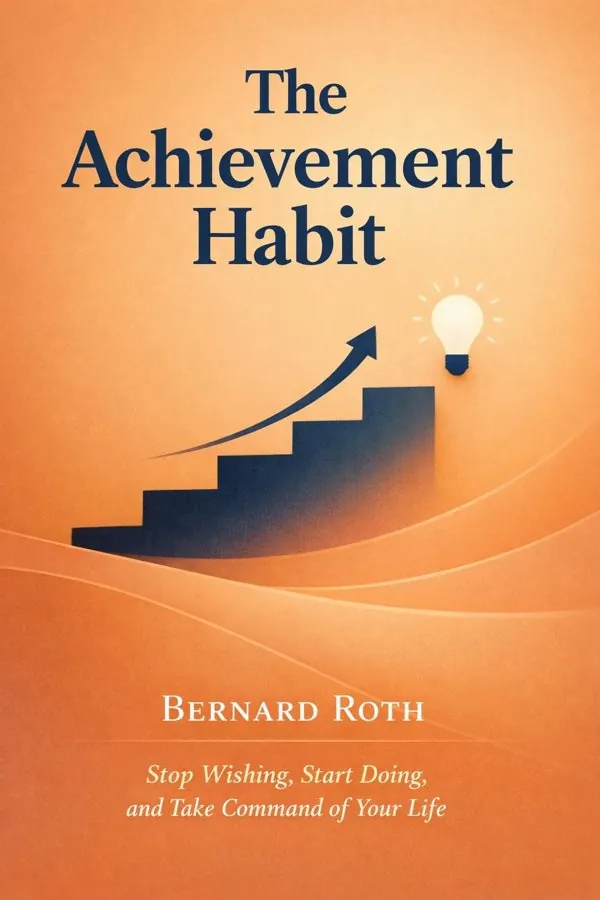
The Achievement Habit: Stop Wishing, Start Doing, and Take Command of Your Life: Summary & Key Insights
by Bernard Roth
 10 min10 chaptersAudio available
What Is The Achievement Habit: Stop Wishing, Start Doing, and Take Command of Your Life About?
The Achievement Habit: Stop Wishing, Start Doing, and Take Command of Your Life by Bernard Roth is a productivity book spanning 10 pages. In The Achievement Habit, Bernard Roth, co-founder of Stanford’s d.school, draws on design thinking principles to show how to transform ideas into action and overcome the internal obstacles that prevent success. Through practical exercises and real-world examples, Roth teaches readers to reframe problems, replace excuses with action, and cultivate a mindset of achievement in both personal and professional life.
This FizzRead summary covers all 10 key chapters of The Achievement Habit: Stop Wishing, Start Doing, and Take Command of Your Life in approximately 10 minutes, distilling the most important ideas, arguments, and takeaways from Bernard Roth's work. Also available as an audio summary and Key Quotes Podcast.
The Achievement Habit: Stop Wishing, Start Doing, and Take Command of Your Life
In The Achievement Habit, Bernard Roth, co-founder of Stanford’s d.school, draws on design thinking principles to show how to transform ideas into action and overcome the internal obstacles that prevent success. Through practical exercises and real-world examples, Roth teaches readers to reframe problems, replace excuses with action, and cultivate a mindset of achievement in both personal and professional life.
Who Should Read The Achievement Habit: Stop Wishing, Start Doing, and Take Command of Your Life?
This book is perfect for anyone interested in productivity and looking to gain actionable insights in a short read. Whether you're a student, professional, or lifelong learner, the key ideas from The Achievement Habit: Stop Wishing, Start Doing, and Take Command of Your Life by Bernard Roth will help you think differently.
- ✓Readers who enjoy productivity and want practical takeaways
- ✓Professionals looking to apply new ideas to their work and life
- ✓Anyone who wants the core insights of The Achievement Habit: Stop Wishing, Start Doing, and Take Command of Your Life in just 10 minutes
Want the full summary?
Get instant access to this book summary and 100K+ more with Fizz Moment.
Get Free SummaryAvailable on App Store • Free to download
Key Chapters
Design thinking is often described as a framework for innovation, but at its heart, it’s a way of approaching human problems with empathy, creativity, and iteration. When I introduced these principles at Stanford, our goal was to help engineers innovate, but soon I realized how powerfully they apply to living itself. The same processes that help a team build a better product—a deep understanding of needs, brainstorming, prototyping, and testing—can help individuals design better lives.
The key is human-centeredness. In product work, we design for real people, not abstract markets. Similarly, in life, we must design around our authentic experiences, not the expectations society imposes on us. Many of us pursue goals because we believe we *should*, not because they resonate with who we are. Design thinking asks us to pause, empathize with ourselves and others, and ask: what truly matters here?
When we redefine our personal challenges as design problems, we stop being trapped by linear thinking. We stop assuming that life operates by fixed solutions. Instead, we experiment. We reframe. We test hypotheses and learn from results. In the classroom, I saw time and again how students transformed their lives simply by embracing this mindset—shifting from analysis to action, from fear to curiosity. This is the foundation of the achievement habit: becoming designers of our own behavior.
One of the most common phrases I hear is, “I’m trying.” People say it to express effort, but often it covers for inaction. You don’t “try” to pick up a pencil—you either pick it up, or you don’t. The same applies to life. The language of trying gives us psychological escape, a way to avoid commitment. But if you want achievement to become a habit, you must leave that word behind.
In class, I challenge my students to physically act out the difference. I tell them to “try” to pick up a chair. They hover over it, fingers twitching. Then I say, “Now actually pick it up.” Suddenly it’s in their hands. The point is simple yet profound: trying occupies mental space without producing results. Doing, even imperfectly, produces feedback, data, and growth.
So how do we transition from trying to doing? By removing the drama of perfection. The secret is not in willpower but in iteration. Just as designers prototype quickly and refine through feedback, you can approach actions as experiments. Each step—no matter how small—shifts you from intention to embodiment. Once you start doing, learning becomes natural. Effort no longer feels forced, because it flows from engagement rather than obligation. This is the beginning of mastery.
+ 8 more chapters — available in the FizzRead app
All Chapters in The Achievement Habit: Stop Wishing, Start Doing, and Take Command of Your Life
About the Author
Bernard Roth is the Rodney H. Adams Professor of Engineering and a founding member of the Hasso Plattner Institute of Design (d.school) at Stanford University. His research and teaching focus on design thinking, creativity, and the psychology of achievement. Roth has been a pioneer in applying design principles to human behavior and personal development.
Get This Summary in Your Preferred Format
Read or listen to the The Achievement Habit: Stop Wishing, Start Doing, and Take Command of Your Life summary by Bernard Roth anytime, anywhere. FizzRead offers multiple formats so you can learn on your terms — all free.
Available formats: App · Audio · PDF · EPUB — All included free with FizzRead
Download The Achievement Habit: Stop Wishing, Start Doing, and Take Command of Your Life PDF and EPUB Summary
Key Quotes from The Achievement Habit: Stop Wishing, Start Doing, and Take Command of Your Life
“Design thinking is often described as a framework for innovation, but at its heart, it’s a way of approaching human problems with empathy, creativity, and iteration.”
“One of the most common phrases I hear is, “I’m trying.”
Frequently Asked Questions about The Achievement Habit: Stop Wishing, Start Doing, and Take Command of Your Life
The Achievement Habit: Stop Wishing, Start Doing, and Take Command of Your Life by Bernard Roth is a productivity book that explores key ideas across 10 chapters. In The Achievement Habit, Bernard Roth, co-founder of Stanford’s d.school, draws on design thinking principles to show how to transform ideas into action and overcome the internal obstacles that prevent success. Through practical exercises and real-world examples, Roth teaches readers to reframe problems, replace excuses with action, and cultivate a mindset of achievement in both personal and professional life.
You Might Also Like




Browse by Category
Ready to read The Achievement Habit: Stop Wishing, Start Doing, and Take Command of Your Life?
Get the full summary and 100K+ more books with Fizz Moment.