
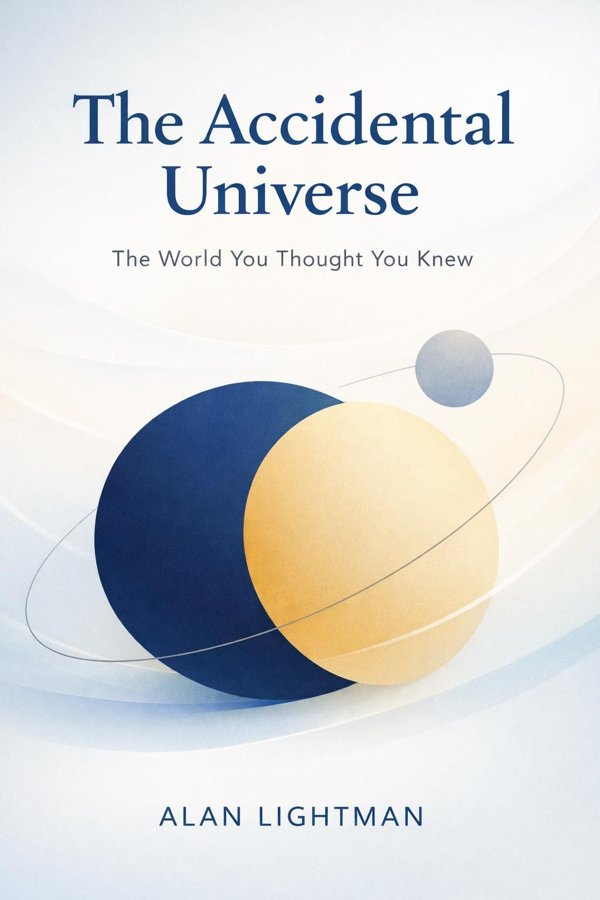
The Accidental Universe: The World You Thought You Knew: Summary & Key Insights
 10 min9 chaptersAudio available
Key Takeaways from The Accidental Universe: The World You Thought You Knew
One of the most destabilizing ideas in modern cosmology is that our universe may not be unique at all.
We often live as if stability were the natural condition of things.
Modern science has explained astonishingly much, but Lightman argues that explanation alone does not erase the human longing for spiritual experience.
Few ideas have guided physics as deeply as symmetry.
A lawful universe is one of science’s deepest assumptions: events unfold according to regular principles that can be investigated, tested, and expressed mathematically.
What Is The Accidental Universe: The World You Thought You Knew About?
The Accidental Universe: The World You Thought You Knew by Alan Lightman is a popular_sci book spanning 7 pages. What if the universe was not designed for us, not guided by purpose, and not even uniquely suited to exist? In The Accidental Universe, physicist and novelist Alan Lightman explores that unsettling possibility with unusual clarity and grace. Through a series of reflective essays, he examines how modern physics, cosmology, and neuroscience reshape some of humanity’s oldest questions: Why is there something rather than nothing? Does the universe have meaning? What can science explain, and where do its limits begin? Rather than offering a cold scientific account, Lightman connects these abstract ideas to everyday human concerns—wonder, mortality, consciousness, ethics, and spiritual longing. He writes as both an accomplished scientist and a literary thinker, making difficult concepts accessible without stripping them of their depth. This book matters because it confronts the emotional consequences of scientific discovery. If the cosmos is accidental, temporary, and indifferent, how should we live? Lightman’s answer is neither cynical nor dogmatic. Instead, he invites readers to embrace uncertainty, cherish fleeting beauty, and find meaning not in cosmic guarantees, but in human experience itself.
This FizzRead summary covers all 9 key chapters of The Accidental Universe: The World You Thought You Knew in approximately 10 minutes, distilling the most important ideas, arguments, and takeaways from Alan Lightman's work. Also available as an audio summary and Key Quotes Podcast.
The Accidental Universe: The World You Thought You Knew
What if the universe was not designed for us, not guided by purpose, and not even uniquely suited to exist? In The Accidental Universe, physicist and novelist Alan Lightman explores that unsettling possibility with unusual clarity and grace. Through a series of reflective essays, he examines how modern physics, cosmology, and neuroscience reshape some of humanity’s oldest questions: Why is there something rather than nothing? Does the universe have meaning? What can science explain, and where do its limits begin? Rather than offering a cold scientific account, Lightman connects these abstract ideas to everyday human concerns—wonder, mortality, consciousness, ethics, and spiritual longing. He writes as both an accomplished scientist and a literary thinker, making difficult concepts accessible without stripping them of their depth. This book matters because it confronts the emotional consequences of scientific discovery. If the cosmos is accidental, temporary, and indifferent, how should we live? Lightman’s answer is neither cynical nor dogmatic. Instead, he invites readers to embrace uncertainty, cherish fleeting beauty, and find meaning not in cosmic guarantees, but in human experience itself.
Who Should Read The Accidental Universe: The World You Thought You Knew?
This book is perfect for anyone interested in popular_sci and looking to gain actionable insights in a short read. Whether you're a student, professional, or lifelong learner, the key ideas from The Accidental Universe: The World You Thought You Knew by Alan Lightman will help you think differently.
- ✓Readers who enjoy popular_sci and want practical takeaways
- ✓Professionals looking to apply new ideas to their work and life
- ✓Anyone who wants the core insights of The Accidental Universe: The World You Thought You Knew in just 10 minutes
Want the full summary?
Get instant access to this book summary and 100K+ more with Fizz Moment.
Get Free SummaryAvailable on App Store • Free to download
Key Chapters
One of the most destabilizing ideas in modern cosmology is that our universe may not be unique at all. Lightman opens with the possibility of the multiverse: countless universes, each with different physical laws, constants, and structures. In such a picture, our universe is not carefully tuned for life by design. It may simply be one of the few places where the conditions happened to allow stars, planets, chemistry, and conscious beings to arise. This idea challenges the comforting intuition that human life reveals some deep cosmic intention.
Lightman explains how theories such as inflationary cosmology and string theory have led some physicists to take the multiverse seriously. If many universes exist, then the astonishingly precise constants of our own universe may not require a special explanation. We observe them because only in a universe with those values could observers exist. This is a version of the anthropic principle: we see a life-permitting universe because otherwise we would not be here to notice it.
The emotional force of this idea matters as much as the scientific one. If the universe is accidental, many traditional ideas about destiny, chosenness, and cosmic meaning become harder to maintain. Yet Lightman does not treat this as a tragedy. Instead, he suggests that contingency can deepen our appreciation. A rare, improbable world may be even more precious because it was not guaranteed.
In practical life, this perspective can make us humbler and more attentive. We stop assuming reality owes us coherence or comfort. We become more grateful for existence itself, relationships, art, and consciousness.
Actionable takeaway: Spend time reflecting on one ordinary part of your life—a conversation, a tree, your own breath—as something not guaranteed by the universe, but astonishingly contingent and therefore worth valuing more deeply.
We often live as if stability were the natural condition of things. Lightman reminds us that physics says otherwise. Entropy, the tendency toward disorder, governs the physical universe at every scale. Stars burn through their fuel, galaxies drift apart, bodies age, structures decay, and even the most durable material arrangements eventually break down. The universe is not a static stage. It is a process of formation and dissolution.
This scientific fact has existential consequences. Human beings resist impermanence because we crave continuity—of identity, memory, possessions, institutions, and civilizations. But the temporary nature of the cosmos means that change is not an interruption of reality; it is reality. Lightman connects thermodynamics to human life by showing that mortality, loss, and transience are not accidental exceptions in an otherwise permanent world. They are woven into the fabric of existence.
Far from encouraging despair, this insight can sharpen perception. A sunset matters because it fades. A child’s voice matters because it changes. Love matters because people do not remain forever. Scientific knowledge here converges with wisdom traditions that emphasize the fleeting nature of all things.
In everyday terms, accepting impermanence can change how we spend time. It may encourage us to preserve memories, mend relationships while we can, and stop postponing what matters most. It can also reduce the shock of inevitable change in careers, family structures, and personal ambitions.
Actionable takeaway: Choose one important area of life you have been treating as permanent—health, work, a relationship, a parent’s presence—and act this week as if its temporary nature were fully real. Say what should be said, make the visit, start the project, or let go of the illusion of endless time.
Modern science has explained astonishingly much, but Lightman argues that explanation alone does not erase the human longing for spiritual experience. He distinguishes spirituality from organized religion and doctrinal belief. For him, spirituality can mean awe, connectedness, humility before vastness, and moments when the self feels briefly dissolved into something larger. Science may describe the mechanisms of the cosmos, but many people still seek experiences of wonder that are emotional, moral, and inward.
This is a crucial nuance in Lightman’s work. He does not advocate abandoning science for mysticism, nor does he claim that spiritual feeling proves supernatural truths. Instead, he suggests that scientific understanding and spiritual experience occupy different dimensions of human life. Knowing the age of the stars does not cancel the feeling of standing beneath them. Understanding neural correlates of meditation does not empty contemplation of significance.
The practical implication is that we need not choose between rationality and reverence. A person can accept evolution, cosmology, and neuroscience while still experiencing deep gratitude, silence, and mystery. In fact, Lightman implies that a scientifically informed view of the universe can intensify awe because it reveals how improbable and intricate existence is.
In ordinary life, this may mean creating room for non-utilitarian experiences: listening to music without multitasking, walking in nature without turning it into exercise data, sitting quietly without demanding productivity from the moment.
Actionable takeaway: Set aside ten minutes this week for an experience of undistracted wonder—look at the night sky, listen to a piece of music, or sit in silence—and notice how understanding and awe can coexist rather than compete.
A lawful universe is one of science’s deepest assumptions: events unfold according to regular principles that can be investigated, tested, and expressed mathematically. Lightman celebrates this achievement while also probing its philosophical implications. The success of science depends on the fact that nature is not random chaos. Planets move predictably, light behaves consistently, and matter follows recognizable rules. Without lawful regularity, there would be no physics at all.
Yet Lightman asks an important follow-up question: does the existence of natural laws explain everything we care about? Knowing the laws of motion does not tell us how to grieve. Understanding neurochemistry does not settle questions of beauty, justice, or meaning. Scientific laws describe patterns in nature, but they do not automatically generate values. This distinction matters because modern societies often confuse explanatory power with total authority.
Lightman does not diminish science by drawing this boundary. Instead, he protects its integrity. Science is extraordinarily good at answering certain kinds of questions—how matter behaves, how stars form, how brains process signals. But when we ask what kind of life is worth living, we enter a domain that requires philosophy, art, and moral reflection as well.
In everyday life, this idea encourages intellectual honesty. We can demand evidence where evidence is appropriate, while also admitting that not every important human decision can be solved by measurement alone. Choosing a career, forgiving a friend, or caring for a dying parent involves facts, but also judgment and feeling.
Actionable takeaway: The next time you face a difficult decision, separate the scientific or factual questions from the ethical and personal ones. Clarifying which domain you are in can lead to wiser choices.
Consciousness feels intimate, private, and almost untouchable. That is why the scientific idea that mind arises from physical processes in the brain can feel so alienating. In exploring the disembodied universe, Lightman wrestles with neuroscience and the possibility that what we call the self is not a separate soul but an emergent pattern generated by neurons, chemistry, memory, and sensation. If that is true, then our most cherished inward experiences belong fully to the material world.
This view can seem reductive at first. Many people fear that if love, grief, imagination, and moral struggle can be mapped to brain activity, they will somehow become less real. Lightman pushes back against that assumption. Explaining a phenomenon biologically does not strip it of lived significance. A sonnet remains moving even if the brain’s response can be measured. Compassion remains noble even if it has evolutionary roots.
What changes is our understanding of identity. The self may be less fixed and independent than we imagine. Memory, bodily state, trauma, disease, and environment all shape the person we experience ourselves to be. This perspective can increase empathy. If mental life depends on material conditions, then psychological suffering is not weakness but part of embodied existence.
Practically, this insight affects how we think about mental health, aging, education, and responsibility. Caring for the mind requires caring for the body, sleep, nutrition, stress, and social connection. It also encourages humility about the stability of our own beliefs and moods.
Actionable takeaway: Treat one aspect of your mental life this week—focus, anxiety, mood, creativity—not as a purely moral issue, but as an embodied condition. Adjust a physical variable such as sleep, exercise, or overstimulation and observe the difference.
The universe appears astonishingly calibrated for complexity. Lightman examines the fact that small changes in physical constants—the strength of gravity, the masses of particles, the rate of cosmic expansion—could have produced a barren cosmos with no stars, no stable atoms, and certainly no life. This fine-tuning has inspired both scientific and religious interpretations. Some see it as evidence of design. Others argue that it supports the multiverse: if there are innumerable universes, it is not surprising that at least one would have the right conditions for observers.
Lightman does not insist on a final answer. Instead, he lingers in the productive tension of the problem. The striking suitability of the universe for life invites wonder whether or not it proves intention. What matters is that human existence rests on a delicate physical balance we did not create and cannot control.
This insight can deepen intellectual modesty. We often live inside local concerns—emails, deadlines, status, irritation—while forgetting how dependent we are on cosmic conditions set long before our species emerged. The atoms in our bodies, the stable chemistry of water, the lifespan of the sun: all are part of a chain of unlikely physical circumstances.
In practical terms, awareness of fine-tuning can support gratitude and stewardship. If life is rare and fragile, then preserving habitats, social institutions, and human dignity becomes more urgent. Rarity increases value.
Actionable takeaway: When overwhelmed by trivial frustrations, pause and zoom out. Remind yourself that your life depends on a chain of unlikely conditions. Use that perspective to decide what truly deserves your attention and care.
If the universe is accidental, temporary, and governed by impersonal laws, many readers naturally ask: then what becomes of meaning? Lightman’s answer is one of the book’s most humane insights. Meaning does not have to be written into the cosmos to be real. A universe without built-in purpose does not force us into nihilism. It instead places responsibility on human beings to create significance through love, work, curiosity, moral action, and attention.
This is a difficult but liberating position. Many traditional worldviews offer ready-made narratives in which human life fits into a grand design. Lightman recognizes the comfort of those stories, but he also sees that modern science has destabilized them. Rather than deny the evidence, he asks us to build an honest form of meaning that does not depend on cosmic favoritism.
That shift has practical consequences. It encourages us to value relationships because they matter to conscious beings, not because they are externally ordained. It asks us to pursue justice because suffering is real, not because the universe guarantees reward. It frames art, learning, and compassion as ways of making life richer from within.
This view also changes how we think about legacy. If there is no cosmic script, then everyday acts carry more weight, not less. A kind conversation, a well-taught class, a thoughtful creation, or a protected ecosystem becomes part of the meaning we leave behind.
Actionable takeaway: Write down three sources of meaning in your life that do not depend on external validation or metaphysical certainty. Then devote concrete time this week to one of them.
A recurring achievement of Lightman’s essays is that they preserve wonder without relying on certainty. Many people assume that science makes the world emotionally flat: once things are explained, mystery disappears. Lightman argues the opposite. The more we learn, the more extraordinary reality becomes. Quantum mechanics reveals strangeness at the smallest scales. Cosmology reveals unimaginable vastness. Neuroscience reveals the delicate complexity of thought itself. Knowledge does not eliminate wonder; it often gives wonder better foundations.
At the same time, modern discovery has weakened many simple certainties. We no longer occupy the center of the cosmos. Matter is not solid in the way it appears. Time is not absolute. The self may be less unified than it feels. For some, this creates anxiety. But Lightman suggests that maturity involves learning to live with unanswered questions without surrendering either reason or joy.
This balance has broad application beyond science. In personal life, certainty is often impossible: careers shift, relationships evolve, values mature, and future outcomes remain opaque. The habit of remaining open, curious, and steady in uncertainty is therefore not just intellectual; it is practical wisdom.
Instead of demanding final answers, Lightman invites a more spacious attitude—one that welcomes inquiry, accepts limits, and still delights in existence. Wonder becomes not a substitute for understanding, but a companion to it.
Actionable takeaway: The next time you encounter something you cannot fully explain, resist the urge to rush toward a simplistic answer. Practice staying with the question, and see whether curiosity can replace discomfort.
All Chapters in The Accidental Universe: The World You Thought You Knew
About the Author
Alan Lightman is an American physicist, novelist, and essayist whose work is renowned for bridging science and the humanities. Trained as a theoretical physicist, he taught at Harvard and MIT and later became one of the first professors of the practice of the humanities at MIT. Lightman is best known to many readers for Einstein’s Dreams, an internationally acclaimed novel that imagines different conceptions of time, but his nonfiction has been equally influential in exploring the philosophical implications of modern science. Across his books and essays, he examines cosmology, consciousness, mortality, and spirituality with both scientific rigor and literary sensitivity. His distinctive voice combines the precision of a scientist with the reflective depth of a humanist, making complex ideas accessible, elegant, and emotionally resonant.
Get This Summary in Your Preferred Format
Read or listen to the The Accidental Universe: The World You Thought You Knew summary by Alan Lightman anytime, anywhere. FizzRead offers multiple formats so you can learn on your terms — all free.
Available formats: App · Audio · PDF · EPUB — All included free with FizzRead
Download The Accidental Universe: The World You Thought You Knew PDF and EPUB Summary
Key Quotes from The Accidental Universe: The World You Thought You Knew
“One of the most destabilizing ideas in modern cosmology is that our universe may not be unique at all.”
“We often live as if stability were the natural condition of things.”
“Modern science has explained astonishingly much, but Lightman argues that explanation alone does not erase the human longing for spiritual experience.”
“Few ideas have guided physics as deeply as symmetry.”
“A lawful universe is one of science’s deepest assumptions: events unfold according to regular principles that can be investigated, tested, and expressed mathematically.”
Frequently Asked Questions about The Accidental Universe: The World You Thought You Knew
The Accidental Universe: The World You Thought You Knew by Alan Lightman is a popular_sci book that explores key ideas across 9 chapters. What if the universe was not designed for us, not guided by purpose, and not even uniquely suited to exist? In The Accidental Universe, physicist and novelist Alan Lightman explores that unsettling possibility with unusual clarity and grace. Through a series of reflective essays, he examines how modern physics, cosmology, and neuroscience reshape some of humanity’s oldest questions: Why is there something rather than nothing? Does the universe have meaning? What can science explain, and where do its limits begin? Rather than offering a cold scientific account, Lightman connects these abstract ideas to everyday human concerns—wonder, mortality, consciousness, ethics, and spiritual longing. He writes as both an accomplished scientist and a literary thinker, making difficult concepts accessible without stripping them of their depth. This book matters because it confronts the emotional consequences of scientific discovery. If the cosmos is accidental, temporary, and indifferent, how should we live? Lightman’s answer is neither cynical nor dogmatic. Instead, he invites readers to embrace uncertainty, cherish fleeting beauty, and find meaning not in cosmic guarantees, but in human experience itself.
More by Alan Lightman
You Might Also Like

Structures: Or Why Things Don"t Fall Down
J.E. Gordon
10 min
The Road to Wigan Pier
George Orwell
10 min
Bonk: The Curious Coupling of Science and Sex
Mary Roach
10 min
First Bite: How We Learn to Eat
Bee Wilson
10 min
In Pursuit Of The Unknown: 17 Equations That Changed The World
Ian Stewart
10 min
Napoleon's Buttons: 17 Molecules That Changed History
Penny Le Couteur and Jay Burreson
10 minBrowse by Category
Ready to read The Accidental Universe: The World You Thought You Knew?
Get the full summary and 100K+ more books with Fizz Moment.