
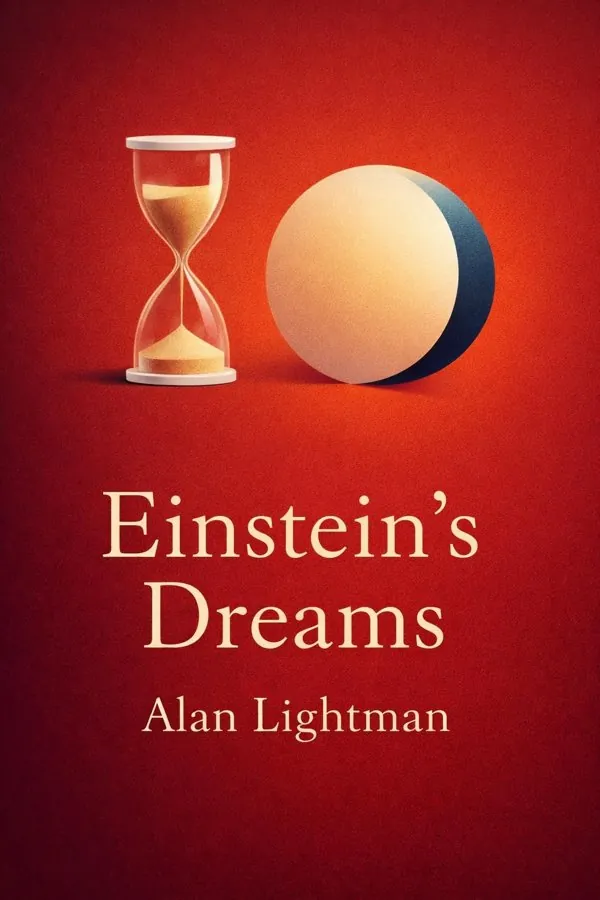
Einstein's Dreams: Summary & Key Insights
 10 min9 chaptersAudio available
Key Takeaways from Einstein's Dreams
One of the book’s most unsettling insights is that repetition can be either comforting or terrifying, depending on what you are forced to relive.
Human beings often say they want more time, but what they usually want is not more duration—it is the power to preserve a beloved moment.
If time moved backward, would regret disappear—or would life become even more disorienting?
Lightman’s imagined worlds often begin with scientific possibility and end in human revelation.
A life is more than a collection of moments; it is the thread connecting them.
What Is Einstein's Dreams About?
Einstein's Dreams by Alan Lightman is a classics book spanning 11 pages. What if time were not a single steady force, but a thousand different realities shaping love, ambition, regret, and hope in radically different ways? Einstein's Dreams is Alan Lightman’s lyrical, inventive novel built around that question. Set in 1905, during the period when Albert Einstein was developing ideas that would transform physics, the book imagines a sequence of dreams in which time behaves differently in each world. In one, time repeats forever. In another, it stands still in select places. Elsewhere, it moves backward, splinters into endless possibilities, or becomes visible to the eye. These dream-worlds are not scientific lectures. They are philosophical fables that reveal how human beings organize their lives around clocks, memory, mortality, and meaning. What makes the book so enduring is Lightman’s rare authority: he is both a trained physicist and a gifted novelist, capable of translating abstract ideas into intimate emotional experience. Einstein's Dreams matters because it turns time from a measurement into a mirror, showing us how our assumptions about hours and days quietly determine what we value most.
This FizzRead summary covers all 9 key chapters of Einstein's Dreams in approximately 10 minutes, distilling the most important ideas, arguments, and takeaways from Alan Lightman's work. Also available as an audio summary and Key Quotes Podcast.
Einstein's Dreams
What if time were not a single steady force, but a thousand different realities shaping love, ambition, regret, and hope in radically different ways? Einstein's Dreams is Alan Lightman’s lyrical, inventive novel built around that question. Set in 1905, during the period when Albert Einstein was developing ideas that would transform physics, the book imagines a sequence of dreams in which time behaves differently in each world. In one, time repeats forever. In another, it stands still in select places. Elsewhere, it moves backward, splinters into endless possibilities, or becomes visible to the eye. These dream-worlds are not scientific lectures. They are philosophical fables that reveal how human beings organize their lives around clocks, memory, mortality, and meaning. What makes the book so enduring is Lightman’s rare authority: he is both a trained physicist and a gifted novelist, capable of translating abstract ideas into intimate emotional experience. Einstein's Dreams matters because it turns time from a measurement into a mirror, showing us how our assumptions about hours and days quietly determine what we value most.
Who Should Read Einstein's Dreams?
This book is perfect for anyone interested in classics and looking to gain actionable insights in a short read. Whether you're a student, professional, or lifelong learner, the key ideas from Einstein's Dreams by Alan Lightman will help you think differently.
- ✓Readers who enjoy classics and want practical takeaways
- ✓Professionals looking to apply new ideas to their work and life
- ✓Anyone who wants the core insights of Einstein's Dreams in just 10 minutes
Want the full summary?
Get instant access to this book summary and 100K+ more with Fizz Moment.
Get Free SummaryAvailable on App Store • Free to download
Key Chapters
One of the book’s most unsettling insights is that repetition can be either comforting or terrifying, depending on what you are forced to relive. In one dream, time is circular: every event returns, every conversation is spoken again, every joy and every sorrow repeat without end. There is no true beginning and no final conclusion, only recurrence. Lightman uses this imagined world to ask a piercing question: if your life would happen exactly as it has, over and over forever, would you live differently now?
In this world, people respond in two broad ways. Some become fatalistic, believing that effort is pointless because every action has already been folded into an eternal cycle. Others become reverent, cherishing each small gesture because it is destined to recur infinitely. A kiss, a mistake, a missed opportunity, an act of kindness—all become permanent in a deeper sense than mere memory. The idea echoes philosophical notions of eternal recurrence, but Lightman makes it personal rather than abstract. He shows how a structure of time shapes moral psychology.
The practical value of this dream lies in self-examination. Imagine that your current habits—how you speak to family, what work you postpone, what grudges you carry—would replay forever. That thought clarifies what is trivial and what is essential. It encourages responsibility without demanding perfection. We may not literally live in a loop, but routines often create loop-like lives. Days blur into repeated patterns, and those patterns become character.
Actionable takeaway: Choose one recurring pattern in your life this week—perhaps a daily interaction, morning habit, or private thought—and improve it as if it were something you would relive forever.
Human beings often say they want more time, but what they usually want is not more duration—it is the power to preserve a beloved moment. In one of Lightman’s most memorable dreams, time stands still in certain places: a square, a lakeside, a garden, a mountain path. These are sanctuaries where motion ceases and moments remain suspended. People seek them out desperately, hoping to stop aging, halt grief, or protect happiness from decay.
This dream captures a truth about memory and attachment. We are drawn to stillness because we know life passes. Lovers want the afternoon never to end. Parents wish to freeze a child’s laughter at a certain age. The elderly return to remembered streets because they contain a version of the self that has not yet disappeared. In the dream, people arrange their lives around these timeless pockets, but the result is not pure peace. To live in frozen time is also to stop change, growth, and surprise. Preservation can become a subtle form of imprisonment.
The concept speaks directly to modern behavior. We try to “freeze” life through photographs, digital archives, scrapbooks, and rituals. We revisit favorite songs and old messages to hold onto versions of ourselves. These practices can be beautiful, but they can also prevent us from entering the present. Lightman suggests that the desire to preserve experience is deeply human, yet life gains meaning precisely because moments cannot be kept unchanged.
Actionable takeaway: Revisit one cherished memory today, but instead of trying to preserve it, ask what it teaches you about how to live fully in the moving present.
If time moved backward, would regret disappear—or would life become even more disorienting? In another dream, Lightman imagines a world where time reverses direction. The dead rise from graves, old age contracts into youth, and human lives move from consequence back toward innocence. At first glance, this may sound like a fantasy of undoing mistakes. But Lightman quickly reveals its strangeness. Meaning itself changes when causes follow effects and endings come before beginnings.
In such a world, familiar emotional structures collapse. Mourning is replaced by a bizarre form of anticipation. Separation leads backward into intimacy. Knowledge drains away rather than accumulates. The dream forces us to see how much of identity depends on sequence: we become ourselves not only through events, but through remembering them in order. Time’s forward motion gives narrative coherence to a human life. Without that direction, experience loses its moral and psychological shape.
This idea has practical relevance because many people mentally live backward already. They rehearse old conversations, imagine corrections, and replay turning points with the fantasy that life might be revised. We often wish to return to an earlier self, before a failure, heartbreak, or compromise. Lightman’s backward-time world exposes the limits of this wish. To truly reverse life would not simply erase pain; it would erase growth, responsibility, and learned wisdom as well.
A better response to regret is not reversal but integration. The past cannot be undone, but it can be understood. Reflection becomes useful when it helps us act more wisely now rather than retreat into impossible revision.
Actionable takeaway: Write down one regret you revisit often, then identify the specific lesson it gave you and one present action that honors that lesson.
Lightman’s imagined worlds often begin with scientific possibility and end in human revelation. In one dream, time flows at different speeds depending on altitude. Those living high in the mountains age more quickly than those in valleys below. The premise echoes relativity while remaining poetic, and it leads to profound social consequences. Lovers must choose whether to live together or preserve unequal clocks. Families are divided by geography and by time itself. Ambition and intimacy become rival allegiances.
The dream dramatizes a hidden truth of ordinary life: people rarely inhabit time in the same way. Even without literal differences in clock speed, our experience of time varies according to environment, age, work, attention, and emotional state. A year in childhood feels vast; a year in middle age can vanish. A quiet weekend differs from a stressful quarter at work. Some social worlds accelerate life; others deepen it. Lightman turns a scientific metaphor into an emotional reality.
Practically, this dream encourages us to examine the places and systems that shape our days. A city built on urgency makes time feel scarce. A life dominated by deadlines can shorten the felt texture of existence. Conversely, environments that permit reflection—walks, silence, conversation, reading—can expand subjective time. The people around us matter too. Some relationships make us race. Others make us arrive.
The broader lesson is that time is not only measured by clocks but also designed by choices. Where we live, how we work, and what pace we normalize all affect the quality of life. We cannot control physics, but we can influence tempo.
Actionable takeaway: Identify one aspect of your environment—schedule, space, commute, device use, or social rhythm—that speeds up your life unnecessarily, and change it in a small but concrete way.
A life is more than a collection of moments; it is the thread connecting them. In one of the book’s more philosophically rich dreams, time consists of disconnected instants rather than a continuous flow. Moments do not lead naturally into one another. Experience becomes a series of isolated points, each complete in itself but cut off from what came before and what might come after. Lightman uses this unsettling model to examine what continuity contributes to identity, responsibility, and love.
In such a world, commitment becomes fragile. Promises matter less when the self who made them is not fully linked to the self who must keep them. Memory weakens as a structuring force. The emotional arc of a life—falling in love, maturing, grieving, forgiving—depends on continuity. Remove the connective tissue, and existence becomes vivid but shallow, full of sensation yet short on meaning. The dream acts as a warning against lives lived in pure immediacy.
This is especially relevant in an age of constant distraction. Notifications, fragmented media, multitasking, and endless scrolling can train attention into disconnected moments. We move from impulse to impulse, losing the longer narratives that give depth to our choices. Productivity suffers, but more importantly, selfhood suffers. Relationships need remembered context. Purpose requires sustained direction. Wisdom comes from linking events rather than merely surviving them.
Lightman does not argue against presence; instead, he suggests that presence without continuity is incomplete. The richest life balances attentiveness to the current moment with faithfulness to a larger story. We need both immediacy and duration to become whole.
Actionable takeaway: Create one practice that restores continuity—journaling, weekly reflection, a long-term project, or a recurring conversation—and use it to connect today’s actions to the person you want to become.
Some abstractions are bearable only because we cannot see them. In a striking dream, time becomes visible, almost tangible, moving through streets and rooms like a physical presence. People can watch it pass, observe its density, and feel its nearness. What is normally hidden becomes impossible to ignore. The result is not simply wonder; it is heightened anxiety, obsession, and altered behavior. Once time is visible, mortality is no longer an idea but a constantly perceived fact.
This dream reveals the psychological role of invisibility. Much of everyday functioning depends on not noticing the passage of life too intensely. We make plans, joke with friends, eat lunch, and commute because time remains backgrounded. If every second were visible, many people would become either hyper-disciplined or paralyzed. Some would count and optimize. Others would despair at constant loss. Lightman shows that our relationship to time is partly a relationship to ignorance, and that ignorance can be merciful.
Yet there is also value in making time more visible in controlled ways. Calendars, milestone birthdays, anniversaries, and even memento mori practices can jolt us out of complacency. They remind us that life is finite and therefore precious. The challenge is not to become consumed by time-awareness, but to let it sharpen attention to what matters. Visibility should produce clarity, not panic.
In practical terms, this means noticing where your time truly goes instead of relying on vague impressions. Time tracking, reflection, and honest scheduling can uncover misalignment between values and behavior. If your hours were visible, would they match your priorities?
Actionable takeaway: For one week, track your time honestly in broad categories, then compare the record with your stated values and adjust one recurring mismatch.
When people know exactly when their lives will end, the future stops being abstract and becomes architecture. In another dream, each person lives with a fixed, known endpoint. Death is not uncertain; it is scheduled. This certainty transforms society. Some become calm and efficient, arranging their affairs with care. Others surrender to indulgence or despair. Relationships change too, because timing becomes central to every decision: whom to love, when to risk, how long to wait, what to build.
Lightman’s insight here is that uncertainty is not merely a limitation—it is one of the conditions that makes ordinary freedom possible. Because we do not know our ending, we often postpone, wander, experiment, and hope. A fixed end would clarify priorities but also compress possibility. The dream asks whether certainty would make us wiser or simply more anxious.
The answer, as Lightman suggests, depends on character. Some people already live as though time were endless, deferring meaningful action. Others live under a diffuse awareness that life is brief but fail to convert that awareness into practice. The dream functions as a moral lens. It asks: if your horizon were visible, what would immediately become unnecessary? What excuses would collapse? What acts of courage would finally move from intention to reality?
This idea can be applied without morbidity. We do not need to know our exact endpoint to benefit from finitude. Deadlines increase focus because they force selection. Mortality works similarly at the scale of life. It invites us to choose deliberately rather than drift.
Actionable takeaway: Imagine you had one year to complete only what matters most. List the three priorities that would remain, and make room for one of them in your schedule this month.
Every unlived life exerts a strange pressure on the life we are living. In a dream of branching time, each choice creates alternative worlds, each containing a different version of events. In one branch, a person marries; in another, they remain alone. In one, a train is caught; in another, missed. Possibility never vanishes—it proliferates. Lightman’s vision is elegant and haunting because it captures the emotional weight of contingency. Our lives feel singular, yet they are haunted by roads not taken.
This dream speaks directly to modern anxiety. Many people struggle not because they lack options, but because they have too many. Career paths, relationships, cities, identities, and lifestyles branch constantly. With each decision comes the suspicion that another self in another timeline might have chosen better. Branching time dramatizes opportunity, but it also dramatizes paralysis. If every path exists somewhere, commitment may feel arbitrary. Why choose at all?
Lightman’s deeper point is that meaning requires inhabiting one path fully. Possibility is rich, but life happens in particulars. The unlived alternatives may remain intellectually fascinating, yet over-attachment to them can dilute presence and gratitude. Regret often grows from excessive loyalty to hypothetical selves. Branching time reminds us that alternatives are endless; therefore peace cannot come from evaluating all of them. It must come from participating faithfully in the world we have actually entered.
Practically, this means making decisions with care, then turning from analysis to embodiment. Reflection matters before a choice; commitment matters after it. Otherwise, life becomes an eternal audition for possibilities never lived.
Actionable takeaway: Choose one decision you have already made but still mentally reopen, and replace comparison with investment by identifying one way to deepen your commitment to the path you are on.
Lightman’s later dreams and interludes suggest that time is not merely a physical dimension but a moral and emotional medium in which human life unfolds. Some dream-worlds emphasize motion: time changes with speed, echoing Einstein’s emerging relativity and showing that measurement depends on standpoint. Others imply that time carries ethical weight: how we remember, delay, forgive, and anticipate shapes the quality of our lives. Between the dreams, brief scenes of Einstein in Bern ground the book in history, reminding us that grand theories arise amid ordinary fatigue, longing, work, and uncertainty.
These interludes matter because they prevent the novel from becoming a detached thought experiment. We are returned to a young Einstein waiting, thinking, walking through city streets, still on the verge of discovery. Science here is not opposed to poetry. Instead, Lightman presents both as ways of asking how reality is structured. The dreams expand outward into metaphysics, while the interludes bring us back to a human being confronting time as both equation and existence.
The practical lesson is broad but powerful: our experience of time is inseparable from our values. To waste time is not only to lose hours, but to misdirect attention. To forgive is to reshape the past’s grip on the present. To wait patiently is to inhabit uncertainty with dignity. To love is to give time willingly. Time becomes moral when we recognize that our days are made of choices about presence, care, and significance.
Actionable takeaway: At the end of each day, ask not only “What did I do with my time?” but also “What did my use of time say about what I value?”
All Chapters in Einstein's Dreams
About the Author
Alan Lightman is an American novelist, essayist, and physicist whose work is known for uniting scientific thought with literary reflection. Born in 1948, he trained as a theoretical physicist and later taught at leading institutions, including the Massachusetts Institute of Technology, where he became one of the first professors to hold a joint appointment in science and the humanities. His writing often explores time, consciousness, mortality, and the relationship between empirical knowledge and human meaning. Lightman has written both fiction and nonfiction, but Einstein's Dreams remains his most celebrated work, admired for its poetic imagination and philosophical depth. Across his career, he has become a distinctive voice for readers interested in the overlap between scientific inquiry and the inner life.
Get This Summary in Your Preferred Format
Read or listen to the Einstein's Dreams summary by Alan Lightman anytime, anywhere. FizzRead offers multiple formats so you can learn on your terms — all free.
Available formats: App · Audio · PDF · EPUB — All included free with FizzRead
Download Einstein's Dreams PDF and EPUB Summary
Key Quotes from Einstein's Dreams
“One of the book’s most unsettling insights is that repetition can be either comforting or terrifying, depending on what you are forced to relive.”
“Human beings often say they want more time, but what they usually want is not more duration—it is the power to preserve a beloved moment.”
“If time moved backward, would regret disappear—or would life become even more disorienting?”
“Lightman’s imagined worlds often begin with scientific possibility and end in human revelation.”
“A life is more than a collection of moments; it is the thread connecting them.”
Frequently Asked Questions about Einstein's Dreams
Einstein's Dreams by Alan Lightman is a classics book that explores key ideas across 9 chapters. What if time were not a single steady force, but a thousand different realities shaping love, ambition, regret, and hope in radically different ways? Einstein's Dreams is Alan Lightman’s lyrical, inventive novel built around that question. Set in 1905, during the period when Albert Einstein was developing ideas that would transform physics, the book imagines a sequence of dreams in which time behaves differently in each world. In one, time repeats forever. In another, it stands still in select places. Elsewhere, it moves backward, splinters into endless possibilities, or becomes visible to the eye. These dream-worlds are not scientific lectures. They are philosophical fables that reveal how human beings organize their lives around clocks, memory, mortality, and meaning. What makes the book so enduring is Lightman’s rare authority: he is both a trained physicist and a gifted novelist, capable of translating abstract ideas into intimate emotional experience. Einstein's Dreams matters because it turns time from a measurement into a mirror, showing us how our assumptions about hours and days quietly determine what we value most.
More by Alan Lightman
You Might Also Like




Browse by Category
Ready to read Einstein's Dreams?
Get the full summary and 100K+ more books with Fizz Moment.