
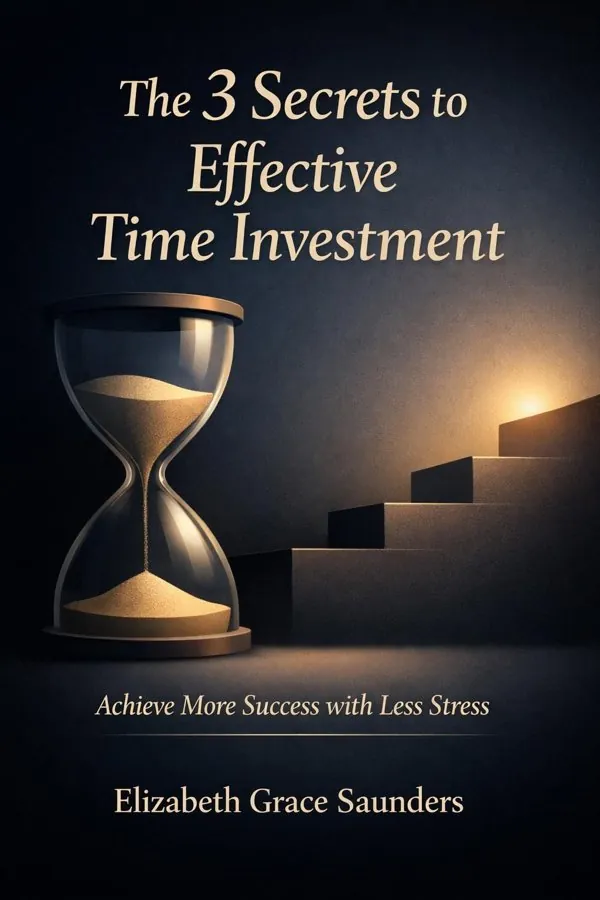
The 3 Secrets to Effective Time Investment: Achieve More Success with Less Stress: Summary & Key Insights
 10 min3 chaptersAudio available
What Is The 3 Secrets to Effective Time Investment: Achieve More Success with Less Stress About?
The 3 Secrets to Effective Time Investment: Achieve More Success with Less Stress by Elizabeth Grace Saunders is a productivity book spanning 3 pages. This book provides a practical framework for managing time effectively by focusing on priorities, setting realistic expectations, and aligning daily actions with long-term goals. Elizabeth Grace Saunders, a time management coach, shares her proven methods to help readers reduce stress, increase productivity, and achieve a balanced life.
This FizzRead summary covers all 3 key chapters of The 3 Secrets to Effective Time Investment: Achieve More Success with Less Stress in approximately 10 minutes, distilling the most important ideas, arguments, and takeaways from Elizabeth Grace Saunders's work. Also available as an audio summary and Key Quotes Podcast.
The 3 Secrets to Effective Time Investment: Achieve More Success with Less Stress
This book provides a practical framework for managing time effectively by focusing on priorities, setting realistic expectations, and aligning daily actions with long-term goals. Elizabeth Grace Saunders, a time management coach, shares her proven methods to help readers reduce stress, increase productivity, and achieve a balanced life.
Who Should Read The 3 Secrets to Effective Time Investment: Achieve More Success with Less Stress?
This book is perfect for anyone interested in productivity and looking to gain actionable insights in a short read. Whether you're a student, professional, or lifelong learner, the key ideas from The 3 Secrets to Effective Time Investment: Achieve More Success with Less Stress by Elizabeth Grace Saunders will help you think differently.
- ✓Readers who enjoy productivity and want practical takeaways
- ✓Professionals looking to apply new ideas to their work and life
- ✓Anyone who wants the core insights of The 3 Secrets to Effective Time Investment: Achieve More Success with Less Stress in just 10 minutes
Want the full summary?
Get instant access to this book summary and 100K+ more with Fizz Moment.
Get Free SummaryAvailable on App Store • Free to download
Key Chapters
The first secret is about clarity. Many of us live under invisible pressure: we respond to constant demands without questioning whether they align with our true goals. I’ve seen clients who are perpetually overwhelmed not because they lack time, but because they haven’t defined their priorities. When everything feels urgent, nothing actually becomes important.
To clarify priorities, you must start by asking yourself what success genuinely looks like for you — not for others or a distant ideal version of yourself. I encourage people to articulate both professional and personal visions. For example, a marketing executive may think her priority is to produce more campaigns, but after reflection, she realizes her true goal is developing her team’s creativity. With that clarity, decisions about meetings, projects, and delegation change dramatically.
In this chapter, I guide readers through a process of mapping personal values to professional activities. Instead of balancing work and life as opposing forces, we aim for integration. You learn to measure tasks against emotional resonance and strategic relevance — the dual criteria that distinguish investment from expenditure. By doing so, time stops being chopped into segments of obligation and becomes a coherent narrative of purpose.
Clarity also requires courage. It means saying no to good opportunities to reserve energy for great ones. Many people fear disappointing others, but every yes carries a hidden no. When we learn to say no intentionally, we gain power over our time’s direction. I tell clients: priorities are promises you make to yourself about how you will spend your finite attention. Breaking those promises leads to stress; keeping them leads to peace.
When your priorities are defined, planning becomes easier, focus becomes sharper, and distractions lose their grip. You’re not just managing tasks; you’re nurturing outcomes that matter to your growth and well-being. This is the first essential step toward effective time investment.
Once your priorities are clear, the second challenge arises: how do you stay true to them without burning out? The second secret is setting realistic expectations. I’ve witnessed countless high-achievers who believe that passion should override limitation. They commit enthusiastically but end up drained. Setting expectations is not about lowering ambition; it’s about aligning aspiration with capacity.
In my coaching practice, I teach clients to understand their bandwidth — the actual limits of time, energy, and focus available to them. When we underestimate the cost of commitments, stress accumulates. It’s not laziness that sabotages productivity; it’s unrealistic assumptions. You can do anything you choose, but not everything.
This section helps readers recognize the psychological roots of overcommitment. Many professionals equate busyness with importance or fear that boundaries reflect weakness. I share stories of leaders who transformed their workflow by recalibrating expectations. One client used to start twelve projects per quarter. After assessing his realistic capacity, he reduced it to four — and ironically, his influence grew. His team delivered higher quality outcomes, and his confidence returned.
Another aspect of expectation management is communication. When you set clear boundaries with colleagues and family, you prevent the slow erosion of trust caused by unmet promises. Transparency around what you can and cannot do fosters respect and collaboration. Realistic expectation-setting is thus both internal and relational.
Learning to manage workload also involves identifying what can be deferred or delegated. I discuss how to evaluate commitments through the lens of opportunity cost — recognizing that every yes consumes future time. By consciously budgeting both hours and emotional energy, you preserve resilience. Remember: the goal is sustainable achievement, not short-term perfection.
When readers internalize this secret, stress begins to dissolve. You realize that balance isn’t achieved by doing less arbitrarily, but by choosing wisely. Your days acquire calm rhythm; your ambitions find steady momentum. You feel capable, not frantic. That serenity is what allows the next phase — building a sustainable system — to flourish.
+ 1 more chapters — available in the FizzRead app
All Chapters in The 3 Secrets to Effective Time Investment: Achieve More Success with Less Stress
About the Author
Elizabeth Grace Saunders is a time management coach, author, and founder of Real Life E Time Coaching & Training. She has been featured in major media outlets such as Forbes, Harvard Business Review, and Fast Company for her expertise in helping professionals manage their time and achieve work-life balance.
Get This Summary in Your Preferred Format
Read or listen to the The 3 Secrets to Effective Time Investment: Achieve More Success with Less Stress summary by Elizabeth Grace Saunders anytime, anywhere. FizzRead offers multiple formats so you can learn on your terms — all free.
Available formats: App · Audio · PDF · EPUB — All included free with FizzRead
Download The 3 Secrets to Effective Time Investment: Achieve More Success with Less Stress PDF and EPUB Summary
Key Quotes from The 3 Secrets to Effective Time Investment: Achieve More Success with Less Stress
“Many of us live under invisible pressure: we respond to constant demands without questioning whether they align with our true goals.”
“Once your priorities are clear, the second challenge arises: how do you stay true to them without burning out?”
Frequently Asked Questions about The 3 Secrets to Effective Time Investment: Achieve More Success with Less Stress
The 3 Secrets to Effective Time Investment: Achieve More Success with Less Stress by Elizabeth Grace Saunders is a productivity book that explores key ideas across 3 chapters. This book provides a practical framework for managing time effectively by focusing on priorities, setting realistic expectations, and aligning daily actions with long-term goals. Elizabeth Grace Saunders, a time management coach, shares her proven methods to help readers reduce stress, increase productivity, and achieve a balanced life.
You Might Also Like



Browse by Category
Ready to read The 3 Secrets to Effective Time Investment: Achieve More Success with Less Stress?
Get the full summary and 100K+ more books with Fizz Moment.