
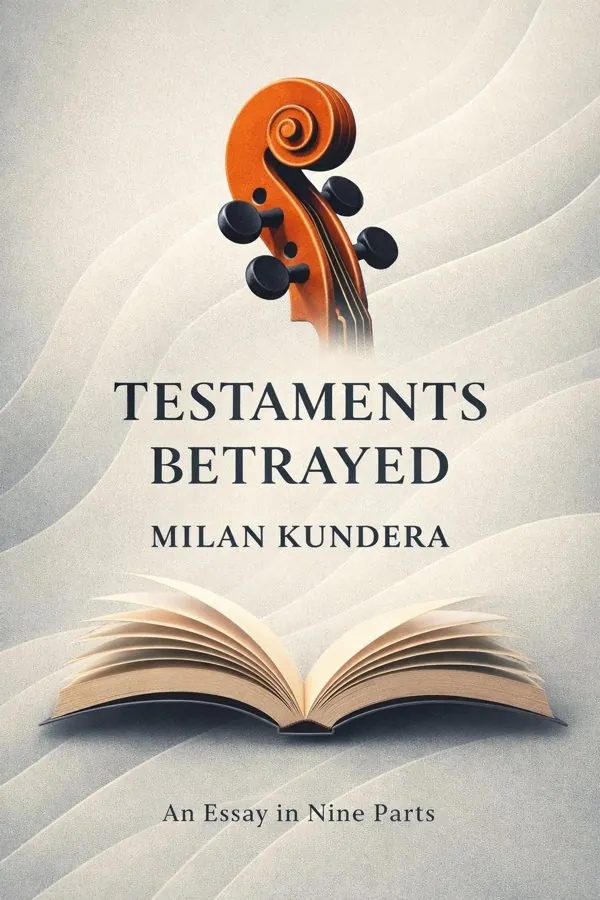
Testaments Betrayed: An Essay in Nine Parts: Summary & Key Insights
 10 min9 chaptersAudio available
What Is Testaments Betrayed: An Essay in Nine Parts About?
Testaments Betrayed: An Essay in Nine Parts by Milan Kundera is a western_phil book spanning 9 pages. In this collection of nine interlinked essays, Milan Kundera examines the betrayals of cultural and artistic legacies in modern Europe. He reflects on music, literature, and memory, defending the autonomy of art against ideological and moral simplifications. The work blends philosophical insight with literary criticism, offering a meditation on the creative spirit and its vulnerability to distortion.
This FizzRead summary covers all 9 key chapters of Testaments Betrayed: An Essay in Nine Parts in approximately 10 minutes, distilling the most important ideas, arguments, and takeaways from Milan Kundera's work. Also available as an audio summary and Key Quotes Podcast.
Testaments Betrayed: An Essay in Nine Parts
In this collection of nine interlinked essays, Milan Kundera examines the betrayals of cultural and artistic legacies in modern Europe. He reflects on music, literature, and memory, defending the autonomy of art against ideological and moral simplifications. The work blends philosophical insight with literary criticism, offering a meditation on the creative spirit and its vulnerability to distortion.
Who Should Read Testaments Betrayed: An Essay in Nine Parts?
This book is perfect for anyone interested in western_phil and looking to gain actionable insights in a short read. Whether you're a student, professional, or lifelong learner, the key ideas from Testaments Betrayed: An Essay in Nine Parts by Milan Kundera will help you think differently.
- ✓Readers who enjoy western_phil and want practical takeaways
- ✓Professionals looking to apply new ideas to their work and life
- ✓Anyone who wants the core insights of Testaments Betrayed: An Essay in Nine Parts in just 10 minutes
Want the full summary?
Get instant access to this book summary and 100K+ more with Fizz Moment.
Get Free SummaryAvailable on App Store • Free to download
Key Chapters
Kafka, perhaps more than any other writer, embodies the tragedy of modern misunderstanding. In reclaiming his legacy, I expose how political regimes and moral critics turned Kafka’s world of ambiguity into a symbol of totalitarian oppression or personal guilt. They betrayed Kafka by simplifying him. His novels, built from paradox and silence, were hijacked into moral lessons, stripped of their humor and tenderness. I argue that Kafka’s genius lies not in depicting oppression, but in inventing a new form of consciousness—a world where every human gesture trembles under the weight of mystery. Kafka did not ask for interpretation; he asked for wonder.
When I recall how post-war Europe adopted Kafka as a prophet of alienation, I see precisely the betrayal I fear: we turned him into what we needed him to be, forgetting that his art defies use, defies function. I want readers to see the playful, ironic Kafka—the man who laughed at absurd bureaucracy as much as he suffered under it. Restoring this laughter, this playful depth, means rejecting ideological readings. It means reading with tenderness, not exploitation.
Music tells the same story as literature: a journey from harmonious multiplicity toward emotional possession. With Bach, the art of composition was impersonal—pure structure, endless variation, the joy of order. But with Beethoven, something shifts; music becomes autobiographical, heroic, personal. I do not condemn Beethoven, yet I mourn what was lost—the serenity of music detached from self-expression. The betrayal lies in how we turned music into confession, demanding revelation rather than beauty.
In pondering this transformation, I ask whether the artist must always pour his soul into his work or whether creation can remain detached, objective, and generous. Bach stood at the threshold of divine geometry; Beethoven opened the door to the era of personality. The listener’s role changed too—no longer a participant in harmony, but a witness to emotion. This is the tension I trace throughout *Testaments Betrayed*: how art’s autonomy falters when it becomes a mirror of individual anguish or ideological moralism.
+ 7 more chapters — available in the FizzRead app
All Chapters in Testaments Betrayed: An Essay in Nine Parts
About the Author
Milan Kundera (1929–2023) was a Czech-born French writer known for his novels and essays that blend philosophy, fiction, and reflection on identity and memory. Originally writing in Czech, he later adopted French as his literary language. His works, including 'The Unbearable Lightness of Being' and 'The Book of Laughter and Forgetting,' explore the human condition and the tension between history and personal freedom.
Get This Summary in Your Preferred Format
Read or listen to the Testaments Betrayed: An Essay in Nine Parts summary by Milan Kundera anytime, anywhere. FizzRead offers multiple formats so you can learn on your terms — all free.
Available formats: App · Audio · PDF · EPUB — All included free with FizzRead
Download Testaments Betrayed: An Essay in Nine Parts PDF and EPUB Summary
Key Quotes from Testaments Betrayed: An Essay in Nine Parts
“Kafka, perhaps more than any other writer, embodies the tragedy of modern misunderstanding.”
“Music tells the same story as literature: a journey from harmonious multiplicity toward emotional possession.”
Frequently Asked Questions about Testaments Betrayed: An Essay in Nine Parts
Testaments Betrayed: An Essay in Nine Parts by Milan Kundera is a western_phil book that explores key ideas across 9 chapters. In this collection of nine interlinked essays, Milan Kundera examines the betrayals of cultural and artistic legacies in modern Europe. He reflects on music, literature, and memory, defending the autonomy of art against ideological and moral simplifications. The work blends philosophical insight with literary criticism, offering a meditation on the creative spirit and its vulnerability to distortion.
More by Milan Kundera
You Might Also Like
A Little History of Philosophy
Nigel Warburton
10 min
Areopagitica
John Milton
10 min
How To Think Like A Philosopher: Essential Principles For Clear Thinking
Peter Cave
10 min
Language, Truth and Logic
A. J. Ayer
10 min
The Age of Reason
Thomas Paine
10 min
The Essays
Michel De Montaigne
10 minBrowse by Category
Ready to read Testaments Betrayed: An Essay in Nine Parts?
Get the full summary and 100K+ more books with Fizz Moment.