
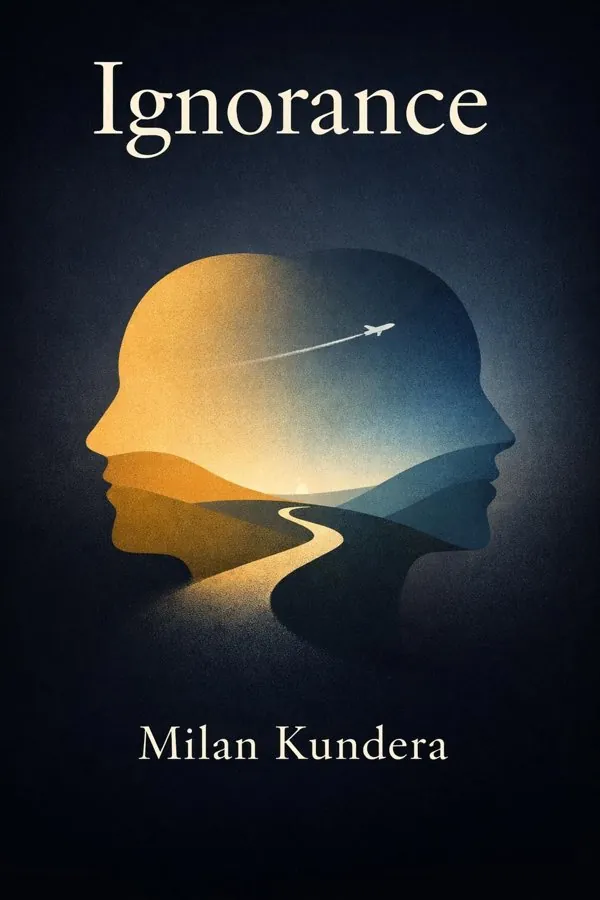
Ignorance: Summary & Key Insights
 10 min8 chaptersAudio available
Key Takeaways from Ignorance
One of Kundera’s sharpest insights is that nostalgia often tells us less about the past than about our present hunger.
Exile does not end when the border opens; sometimes return only deepens it.
We like to think memory anchors identity, but Kundera suggests it is unstable, selective, and quietly disloyal.
The most dangerous reunions are often the ones we rehearse in our minds for years.
Kundera gives the title ignorance a broader and more painful meaning than simple lack of information.
What Is Ignorance About?
Ignorance by Milan Kundera is a classics book spanning 5 pages. Milan Kundera’s Ignorance is a short, elegant, and emotionally piercing novel about exile, return, and the strange distance that can grow between people and their own past. First published in French in 2000, the book follows Irena and Josef, two Czech émigrés who return to their homeland after decades abroad following the fall of Communism. What should feel like a homecoming becomes something far more unsettling: a confrontation with memory’s distortions, the indifference of others, and the realization that the self who left can never fully come back. Kundera uses this deceptively simple story to explore questions that reach far beyond one nation’s history. What do we really long for when we long for home? Can nostalgia preserve identity, or does it quietly falsify it? And what happens when the life we imagined waiting for us no longer exists? Few modern novelists are better equipped to ask these questions. Across his career, Kundera became one of Europe’s great anatomists of memory, forgetting, desire, and political dislocation. In Ignorance, he brings those concerns into one of his clearest and most moving meditations on belonging.
This FizzRead summary covers all 8 key chapters of Ignorance in approximately 10 minutes, distilling the most important ideas, arguments, and takeaways from Milan Kundera's work. Also available as an audio summary and Key Quotes Podcast.
Ignorance
Milan Kundera’s Ignorance is a short, elegant, and emotionally piercing novel about exile, return, and the strange distance that can grow between people and their own past. First published in French in 2000, the book follows Irena and Josef, two Czech émigrés who return to their homeland after decades abroad following the fall of Communism. What should feel like a homecoming becomes something far more unsettling: a confrontation with memory’s distortions, the indifference of others, and the realization that the self who left can never fully come back. Kundera uses this deceptively simple story to explore questions that reach far beyond one nation’s history. What do we really long for when we long for home? Can nostalgia preserve identity, or does it quietly falsify it? And what happens when the life we imagined waiting for us no longer exists? Few modern novelists are better equipped to ask these questions. Across his career, Kundera became one of Europe’s great anatomists of memory, forgetting, desire, and political dislocation. In Ignorance, he brings those concerns into one of his clearest and most moving meditations on belonging.
Who Should Read Ignorance?
This book is perfect for anyone interested in classics and looking to gain actionable insights in a short read. Whether you're a student, professional, or lifelong learner, the key ideas from Ignorance by Milan Kundera will help you think differently.
- ✓Readers who enjoy classics and want practical takeaways
- ✓Professionals looking to apply new ideas to their work and life
- ✓Anyone who wants the core insights of Ignorance in just 10 minutes
Want the full summary?
Get instant access to this book summary and 100K+ more with Fizz Moment.
Get Free SummaryAvailable on App Store • Free to download
Key Chapters
One of Kundera’s sharpest insights is that nostalgia often tells us less about the past than about our present hunger. Ignorance opens by invoking Odysseus, the legendary wanderer whose long journey home became a model for Western ideas of return. But Kundera complicates that myth. He asks us to notice that while Odysseus supposedly longed for Ithaca, the emotional reality of return is never as pure, simple, or triumphant as stories suggest. Home, in this novel, is not a stable place waiting to receive us. It is a story we construct from fragments, losses, and idealizations.
For Irena and Josef, exile has not merely separated them from their country; it has transformed their idea of it. The homeland survives inside them as memory, but memory edits. It keeps certain scenes glowing while letting others fade. By the time they return, they are not encountering the country they left but a changed nation, populated by people who have also moved on. Nostalgia promises reunion, yet reunion reveals how much was invented.
This idea applies far beyond political exile. Anyone who returns to a childhood town, reconnects with an old friend, or revisits an earlier dream knows the feeling. We imagine that the past is preserved somewhere, waiting for us. Instead, we discover that both places and people continued without us. What we miss may not be a location at all, but a vanished version of ourselves.
Kundera’s point is not that nostalgia is foolish. It is human. But it becomes dangerous when we mistake longing for truth. Actionable takeaway: when you feel drawn to “go back,” ask yourself whether you are seeking an actual place, or trying to recover an identity that no longer exists.
Exile does not end when the border opens; sometimes return only deepens it. Irena, who has lived in Paris for twenty years after fleeing Communist Czechoslovakia, initially seems poised for a meaningful homecoming. Yet from the beginning, her situation is marked by ambiguity. In France she has built a life, but not an uncomplicated sense of belonging. In Prague, she expects emotional recognition, perhaps even a validation of all she lost. Instead, she discovers a second exile: she no longer fully belongs abroad, and she no longer belongs at home either.
Kundera portrays this with painful subtlety. Irena wants her suffering and adaptation to matter, but those around her are often less interested in hearing about exile than she expects. People she once knew have their own histories, disappointments, and compromises. They do not step into the roles assigned by her memory. Her return becomes a confrontation with social reality: the homeland did not remain emotionally frozen while she was away.
This is one of the novel’s most powerful emotional truths. We often imagine that recognition from others will restore our continuity. We think old friends, relatives, or communities will confirm who we “really” are. But identity is relational, and relationships change. When others fail to mirror our cherished self-image, we feel erased.
In ordinary life, this dynamic appears whenever someone returns after a long absence: a migrant revisiting family, a graduate returning home, even an employee rejoining a former company. The expectation of resuming an old place often collides with the fact that systems have reorganized without us.
Actionable takeaway: if you return to a meaningful place after years away, let curiosity lead before expectation. Instead of demanding recognition from others, notice who they have become—and who you have become too.
We like to think memory anchors identity, but Kundera suggests it is unstable, selective, and quietly disloyal. Josef, the novel’s other returning émigré, embodies this unsettling truth. Unlike Irena, whose emotional life is strongly tied to remembrance and expectation, Josef moves through return with a cooler detachment. Yet his distance does not protect him. He finds that memory has not preserved his former world in any reliable way. Names, feelings, and meanings have shifted. The people and places linked to his earlier life do not simply await retrieval.
Josef’s experience shows that forgetting is not always dramatic. Often it is subtle, almost ordinary. We misremember the emotional weight of events. We fail to recall what once seemed essential. We retain images but lose context. Kundera is especially interested in the humiliation of discovering that what we thought unforgettable has already begun to dissolve. This is not merely a personal weakness; it is part of the human condition.
That idea has practical relevance. We all curate our autobiographies. We repeat certain stories, omit others, and build a coherent narrative that helps us function. But when life changes sharply—through migration, divorce, career transformation, bereavement, or political upheaval—that narrative can crack. We realize that memory was never a complete archive. It was a living interpretation.
Josef’s detachment also reveals a paradox: emotional distance does not guarantee clarity. Sometimes it makes us less aware of what we have lost because we no longer know how to name it. In this way, forgetfulness can be less painful than nostalgia, but also more disorienting.
Actionable takeaway: treat your memory with humility. Write down significant experiences, revisit old assumptions, and allow your past to remain complex rather than forcing it into a neat story.
The most dangerous reunions are often the ones we rehearse in our minds for years. In Ignorance, the encounter between Irena and Josef carries the charge of possibility. They are linked by a shared homeland, shared displacement, and the seductive idea that one person might understand what others cannot. Yet Kundera refuses the fantasy that parallel experience automatically produces true intimacy. Their meeting becomes a study in how memory, projection, and desire can mistake one another for reality.
Both characters approach the encounter burdened by inner narratives. They are not simply meeting each other as they are in the present; they are meeting remembered images, old emotional needs, and imagined futures. This is why the reunion feels so charged and so fragile. The other person becomes a screen onto which unresolved longing is projected. What follows is not exactly deception, but mutual misalignment.
Kundera’s insight here reaches beyond romance. We do this whenever we reconnect after years apart. A former friend is supposed to revive our younger self. A first love is expected to complete an unfinished chapter. A homeland is expected to restore continuity. In every case, the present becomes difficult to see because imagination has already filled in the blanks.
That does not make reunion meaningless. It makes it revealing. We learn whether we are seeking another person, or using them as a bridge to a lost self. The pain comes when reality refuses to cooperate with our script.
In practical terms, this idea matters in relationships, family reconnections, and even professional networking. Shared history creates trust, but it can also create illusion. The fact that someone once mattered deeply does not mean they still occupy the same emotional role.
Actionable takeaway: when reconnecting with someone from your past, resist narrating the meeting in advance. Ask more questions than you answer, and let the present person replace the remembered one.
Kundera gives the title ignorance a broader and more painful meaning than simple lack of information. In this novel, ignorance describes the irreducible distance between one person’s lived experience and another person’s understanding of it. The émigré wants to be known, but those who stayed behind cannot fully grasp exile. The returnee wants to understand the homeland, but the country transformed in ways no memory could prepare for. Even lovers and compatriots remain partly opaque to one another.
This form of ignorance is not just social; it is existential. Human beings live within separate timelines, separate emotional histories, separate vocabularies of loss. We assume that explanation can bridge these distances, but Kundera shows how often it fails. A person may tell their story and still remain misunderstood. Worse, they may discover that others are not especially interested in hearing it. This indifference wounds because it denies not only memory but significance.
Yet the novel does not present ignorance as a moral failure alone. It is also a structural fact of life. No one can fully inhabit another person’s memories. No return can fully restore what has been interrupted. In that sense, ignorance is the normal state from which brief moments of recognition emerge.
This insight is especially useful today, when people often assume that visibility equals understanding. Sharing an experience online, recounting a biography, or naming an identity does not guarantee deep comprehension. Real understanding requires patience, imagination, and the acceptance that complete mutual transparency is impossible.
Actionable takeaway: approach other people’s stories with more humility than certainty. Instead of claiming immediate understanding, try saying, “I can’t fully know your experience, but I want to listen carefully.”
To leave a country is not only to move through space; it is to become displaced in time. One of Kundera’s most subtle achievements in Ignorance is his portrayal of exile as a temporal rupture. The émigré does not simply lose familiar streets, customs, and language. They lose synchronicity with those who remained. Their memories stop in one era while the homeland continues into another. Return then feels like stepping into a future built on a past you did not live.
This helps explain why homecoming can be so disorienting even when everything looks recognizable. Streets may still exist, buildings may still stand, but the timeline has diverged. Shared references are gone. Public meanings have changed. People who stayed carry decades of local history that the returnee lacks. Meanwhile, the returnee carries a private chronology shaped by adaptation abroad. They are not just geographically elsewhere; they are historically out of rhythm.
Many readers will recognize this outside formal exile. A person returning to family after years away, a veteran reintegrating into civilian life, or someone reentering a profession after caregiving or illness may feel similarly “out of time.” Others continued accumulating shared experiences while they were living under different conditions. The resulting disconnect can feel strangely invisible, which makes it harder to explain.
Kundera’s insight encourages compassion for that invisible lag. Belonging is not restored by arrival alone. People need time to translate between timelines.
Actionable takeaway: if you are reentering a place or community after a long absence, do not judge yourself for feeling behind. Ask others to help you understand what happened while you were gone, and give yourself permission to rebuild belonging gradually.
Political history may change overnight, but private feeling does not obey public milestones. Ignorance is set against the backdrop of post-Communist Europe, a moment often described in collective terms: liberation, transition, return, renewal. Kundera does not deny the significance of political transformation, but he refuses to let historical triumph flatten personal complexity. The fall of a regime may appear to invite closure, yet for individuals shaped by exile, widowhood, failed relationships, aging, and unfinished desires, history does not deliver neat redemption.
This is one reason the novel feels so psychologically honest. Public narratives tend to simplify what private lives complicate. Nations celebrate return, but returnees may feel ambivalent. Societies commemorate freedom, but individuals may experience grief for the years lost, resentment toward those who adapted differently, or indifference to the official emotional script. Kundera reminds us that the personal is not a footnote to history. It is where history is actually lived.
This idea matters whenever large events reshape ordinary life: revolutions, pandemics, economic collapses, migrations, or social reforms. Public conversation quickly settles on broad meanings, while individuals continue wrestling with contradictory emotions. Someone can be grateful and estranged, liberated and lonely, hopeful and exhausted all at once.
Reading Ignorance helps us resist simplistic interpretations of historical change. It encourages us to ask not just what happened to a country, but what happened to the inner lives of people carried through that change.
Actionable takeaway: when reflecting on major historical or organizational change, make room for personal stories that do not fit the official narrative. Complexity is not disloyalty; it is often the truest response.
Few things are more quietly devastating than discovering that the world did not preserve your absence the way you did. In Ignorance, memory is not only something individuals carry; it is something they hope others will carry for them. To return is, in part, to ask: Was I remembered? Did my departure matter? Do I still have a place in the minds of those I left behind? Kundera shows how deeply belonging depends on these questions.
This need is not vanity. It is tied to identity itself. We become ourselves partly through continuity in the eyes of others. When people remember us, they help stabilize our life story. When they forget, or remember us differently than we remember ourselves, something trembles. The returnee then confronts not merely change, but a kind of symbolic displacement.
In the novel, this takes the form of awkward conversations, mismatched emotional expectations, and the painful realization that shared pasts are not shared equally. One person’s defining memory may be another person’s faint detail. That imbalance can feel like betrayal, though it is often just human asymmetry.
This insight resonates in everyday life. Former colleagues move on. Friend groups evolve. Families reorganize around new crises and routines. If you leave, the structure adapts. Your return may therefore feel less like resuming your place and more like negotiating a new one.
Understanding this can soften disappointment. Belonging is not a stored possession. It is an ongoing practice of mutual remembrance.
Actionable takeaway: if a relationship or community matters to you, do not rely on memory alone to sustain it. Maintain contact, share updates, ask questions, and actively participate in the bonds you hope will endure.
All Chapters in Ignorance
About the Author
Milan Kundera (1929–2023) was a Czech-born novelist, essayist, and playwright whose work shaped modern European literature. Born in Brno, Czechoslovakia, he lived through Nazi occupation, Stalinism, the Prague Spring, and the political repression that followed, experiences that deeply informed his fiction. After emigrating to France in the 1970s, he later wrote many of his books in French. Kundera became internationally famous for novels such as The Joke, The Book of Laughter and Forgetting, The Unbearable Lightness of Being, and Ignorance. His writing is known for blending narrative with philosophical reflection, irony, and psychological precision. Across his career, he explored memory, identity, love, exile, politics, and the fragile, often comic contradictions of human life.
Get This Summary in Your Preferred Format
Read or listen to the Ignorance summary by Milan Kundera anytime, anywhere. FizzRead offers multiple formats so you can learn on your terms — all free.
Available formats: App · Audio · PDF · EPUB — All included free with FizzRead
Download Ignorance PDF and EPUB Summary
Key Quotes from Ignorance
“One of Kundera’s sharpest insights is that nostalgia often tells us less about the past than about our present hunger.”
“Exile does not end when the border opens; sometimes return only deepens it.”
“We like to think memory anchors identity, but Kundera suggests it is unstable, selective, and quietly disloyal.”
“The most dangerous reunions are often the ones we rehearse in our minds for years.”
“Kundera gives the title ignorance a broader and more painful meaning than simple lack of information.”
Frequently Asked Questions about Ignorance
Ignorance by Milan Kundera is a classics book that explores key ideas across 8 chapters. Milan Kundera’s Ignorance is a short, elegant, and emotionally piercing novel about exile, return, and the strange distance that can grow between people and their own past. First published in French in 2000, the book follows Irena and Josef, two Czech émigrés who return to their homeland after decades abroad following the fall of Communism. What should feel like a homecoming becomes something far more unsettling: a confrontation with memory’s distortions, the indifference of others, and the realization that the self who left can never fully come back. Kundera uses this deceptively simple story to explore questions that reach far beyond one nation’s history. What do we really long for when we long for home? Can nostalgia preserve identity, or does it quietly falsify it? And what happens when the life we imagined waiting for us no longer exists? Few modern novelists are better equipped to ask these questions. Across his career, Kundera became one of Europe’s great anatomists of memory, forgetting, desire, and political dislocation. In Ignorance, he brings those concerns into one of his clearest and most moving meditations on belonging.
More by Milan Kundera
You Might Also Like




Browse by Category
Ready to read Ignorance?
Get the full summary and 100K+ more books with Fizz Moment.