
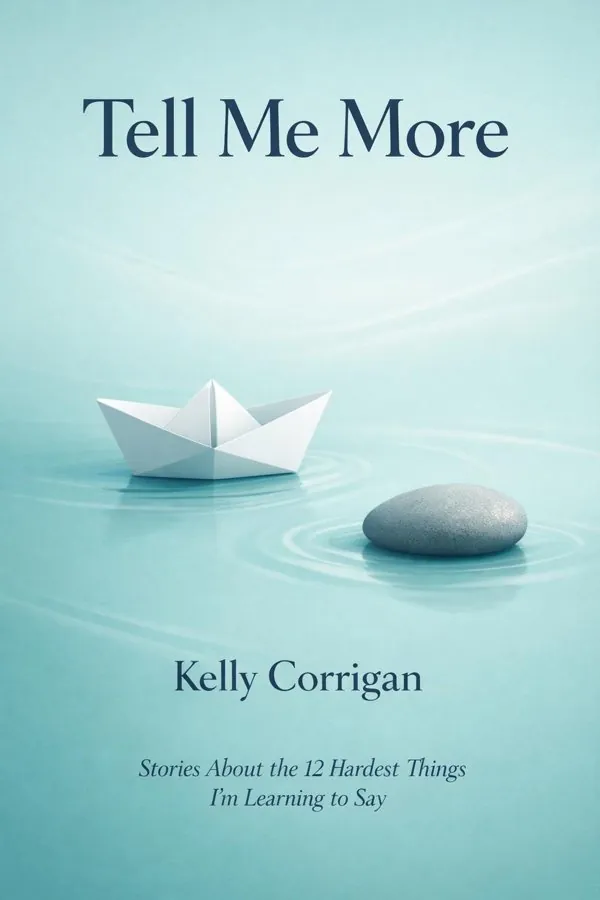
Tell Me More: Stories About the 12 Hardest Things I'm Learning to Say: Summary & Key Insights
 10 min4 chaptersAudio available
What Is Tell Me More: Stories About the 12 Hardest Things I'm Learning to Say About?
Tell Me More: Stories About the 12 Hardest Things I'm Learning to Say by Kelly Corrigan is a biographies book spanning 4 pages. In this deeply personal and humorous collection of essays, Kelly Corrigan reflects on the power of communication and the importance of the words we choose. Through twelve phrases—such as 'I don’t know,' 'Tell me more,' and 'I was wrong'—she explores themes of love, loss, friendship, and personal growth, offering insight into how language shapes our relationships and our understanding of ourselves.
This FizzRead summary covers all 4 key chapters of Tell Me More: Stories About the 12 Hardest Things I'm Learning to Say in approximately 10 minutes, distilling the most important ideas, arguments, and takeaways from Kelly Corrigan's work. Also available as an audio summary and Key Quotes Podcast.
Tell Me More: Stories About the 12 Hardest Things I'm Learning to Say
In this deeply personal and humorous collection of essays, Kelly Corrigan reflects on the power of communication and the importance of the words we choose. Through twelve phrases—such as 'I don’t know,' 'Tell me more,' and 'I was wrong'—she explores themes of love, loss, friendship, and personal growth, offering insight into how language shapes our relationships and our understanding of ourselves.
Who Should Read Tell Me More: Stories About the 12 Hardest Things I'm Learning to Say?
This book is perfect for anyone interested in biographies and looking to gain actionable insights in a short read. Whether you're a student, professional, or lifelong learner, the key ideas from Tell Me More: Stories About the 12 Hardest Things I'm Learning to Say by Kelly Corrigan will help you think differently.
- ✓Readers who enjoy biographies and want practical takeaways
- ✓Professionals looking to apply new ideas to their work and life
- ✓Anyone who wants the core insights of Tell Me More: Stories About the 12 Hardest Things I'm Learning to Say in just 10 minutes
Want the full summary?
Get instant access to this book summary and 100K+ more with Fizz Moment.
Get Free SummaryAvailable on App Store • Free to download
Key Chapters
I began with 'Tell me more' because it’s the phrase that taught me how to listen — truly listen. Most of us think we’re good at hearing others, but more often we wait for our turn to speak, or we listen only for the parts that confirm our beliefs. When my daughters were young, when friends shared their grief, or when my husband wrestled with stress, I discovered how powerful it is simply to say, 'Tell me more.' It is not a command or a prompt for gossip. It’s a gesture of curiosity and a signal that you are present.
I write about sitting beside my dying father, realizing how little I truly knew about the stories that made him. In that silence, 'Tell me more' became an invitation — a way to make room for the messy truth, for memories unearthed just before they vanished. This phrase, I learned, turns conversation into communion. It acknowledges that we don’t have all the answers and that other people’s experiences can teach us something invaluable. Listening, when done this way, is active empathy. It’s a way of saying, 'I won’t fix you, but I will stay with you.'
Living this phrase doesn’t mean you must be endlessly receptive; it means you must be endlessly curious. It has changed the way I speak to my children: instead of jumping to correction, I ask, 'Tell me more.' It reminds them that their feelings are valid even when their choices are not. It has softened friendships and sparked humility. Because once you start really listening — without agenda, without interruption — life becomes infinitely more textured. Each story you hear expands the bounds of your compassion.
If there’s one phrase that modern adulthood resists, it’s 'I don’t know.' We live in an age of expertise, of certainty, of Google answers at every turn. But in the wilderness of parenting, aging, mourning, and love, not knowing is often the truest thing we can say. I remember moments when I tried to soothe my teenage daughter’s fears or navigate the illness of a close friend, and I wanted desperately to sound wise, calm, sure. The truth was, I didn’t know. Saying so felt like failure until I understood that admitting uncertainty isn’t weakness — it’s authenticity.
'I don’t know' opens the door to new learning. It relieves us of the unbearable pressure to pretend. In our culture, we mistake confidence for competence, but in relationships, pretending often builds walls. The more I said 'I don’t know' aloud, the more my relationships deepened. It lets others see you as you are — vulnerable, figuring it out, human. I learned that my children didn’t need a mother who knew everything; they needed one who was willing to learn with them. My friends didn’t want assurance; they wanted honesty.
Through this phrase, I began to understand that the path to wisdom begins in humility. Every time we say 'I don’t know,' we carve out space for wonder, for curiosity, for grace. Life, I’ve found, is not a series of answers but a collection of evolving questions. The more we allow ourselves not to know, the freer we become.
+ 2 more chapters — available in the FizzRead app
All Chapters in Tell Me More: Stories About the 12 Hardest Things I'm Learning to Say
About the Author
Kelly Corrigan is an American author and columnist known for her memoirs and essays that explore family, friendship, and resilience. Her works, including 'The Middle Place' and 'Glitter and Glue,' have been New York Times bestsellers. Corrigan is also a public speaker and host of the PBS interview series 'Tell Me More with Kelly Corrigan.'
Get This Summary in Your Preferred Format
Read or listen to the Tell Me More: Stories About the 12 Hardest Things I'm Learning to Say summary by Kelly Corrigan anytime, anywhere. FizzRead offers multiple formats so you can learn on your terms — all free.
Available formats: App · Audio · PDF · EPUB — All included free with FizzRead
Download Tell Me More: Stories About the 12 Hardest Things I'm Learning to Say PDF and EPUB Summary
Key Quotes from Tell Me More: Stories About the 12 Hardest Things I'm Learning to Say
“I began with 'Tell me more' because it’s the phrase that taught me how to listen — truly listen.”
“If there’s one phrase that modern adulthood resists, it’s 'I don’t know.”
Frequently Asked Questions about Tell Me More: Stories About the 12 Hardest Things I'm Learning to Say
Tell Me More: Stories About the 12 Hardest Things I'm Learning to Say by Kelly Corrigan is a biographies book that explores key ideas across 4 chapters. In this deeply personal and humorous collection of essays, Kelly Corrigan reflects on the power of communication and the importance of the words we choose. Through twelve phrases—such as 'I don’t know,' 'Tell me more,' and 'I was wrong'—she explores themes of love, loss, friendship, and personal growth, offering insight into how language shapes our relationships and our understanding of ourselves.
You Might Also Like

An American Marriage
Tayari Jones
10 min
Benjamin Franklin: An American Life
Walter Isaacson
10 min
I Know Why The Caged Bird Sings
Maya Angelou
10 min
Long Walk to Freedom
Nelson Mandela
10 min
Persepolis
Marjane Satrapi
10 min
Surely You're Joking, Mr. Feynman!
Richard P. Feynman
10 minBrowse by Category
Ready to read Tell Me More: Stories About the 12 Hardest Things I'm Learning to Say?
Get the full summary and 100K+ more books with Fizz Moment.