
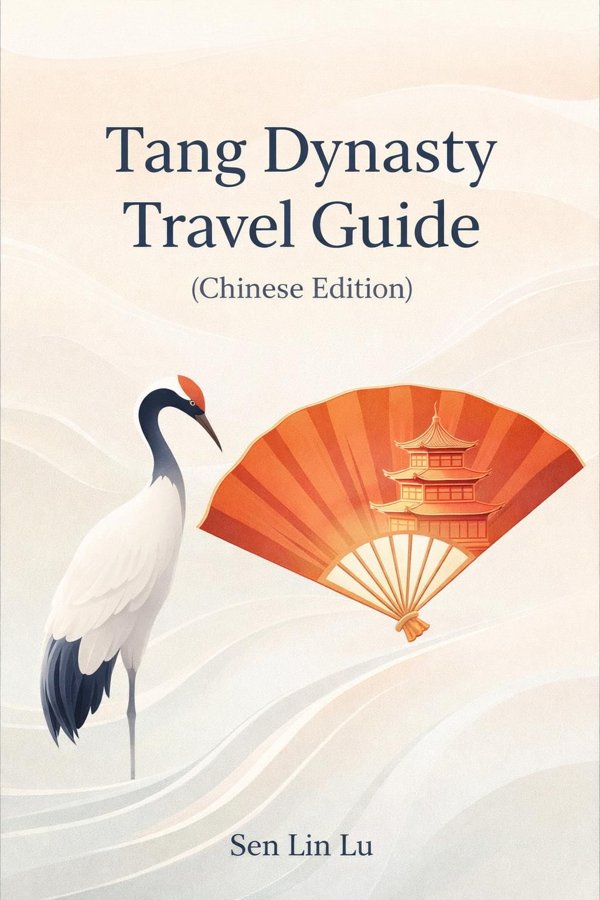
Tang Dynasty Travel Guide (Chinese Edition): Summary & Key Insights
by Sen Lin Lu
 10 min9 chaptersAudio available
Key Takeaways from Tang Dynasty Travel Guide (Chinese Edition)
A great civilization can often be understood by walking its streets.
What people wear is never just about comfort; it is a language of power, taste, and belonging.
If you want to know how people lived, ask what they ate and with whom they ate it.
Civilization is experienced not only in public splendor but in private arrangements.
A society’s amusements reveal what it celebrates, tolerates, and dreams about.
What Is Tang Dynasty Travel Guide (Chinese Edition) About?
Tang Dynasty Travel Guide (Chinese Edition) by Sen Lin Lu is a chinese_history book spanning 9 pages. What if you could visit the Tang Dynasty not through a dry textbook, but through a witty, practical, street-level guidebook? Tang Dynasty Travel Guide (Chinese Edition) by Sen Lin Lu turns one of China’s most celebrated historical eras into a vivid, immersive journey through everyday life. Rather than focusing only on emperors, wars, and court politics, the book asks a more human question: if you were actually living in the Tang Dynasty, what would you wear, eat, buy, fear, admire, and aspire to? With humor and historical detail, Lu recreates the texture of Tang life, from bustling cities and elite culture to entertainment, travel, bureaucracy, and social customs. The result is both informative and delightfully readable. The book matters because it makes history tangible. It shows that great civilizations are built not only by famous rulers, but also by ordinary habits, institutions, and desires. Sen Lin Lu’s strength lies in making complex history accessible without flattening it. He writes as a lively cultural interpreter, helping modern readers understand why the Tang Dynasty remains one of the most dazzling periods in Chinese history.
This FizzRead summary covers all 9 key chapters of Tang Dynasty Travel Guide (Chinese Edition) in approximately 10 minutes, distilling the most important ideas, arguments, and takeaways from Sen Lin Lu's work. Also available as an audio summary and Key Quotes Podcast.
Tang Dynasty Travel Guide (Chinese Edition)
What if you could visit the Tang Dynasty not through a dry textbook, but through a witty, practical, street-level guidebook? Tang Dynasty Travel Guide (Chinese Edition) by Sen Lin Lu turns one of China’s most celebrated historical eras into a vivid, immersive journey through everyday life. Rather than focusing only on emperors, wars, and court politics, the book asks a more human question: if you were actually living in the Tang Dynasty, what would you wear, eat, buy, fear, admire, and aspire to? With humor and historical detail, Lu recreates the texture of Tang life, from bustling cities and elite culture to entertainment, travel, bureaucracy, and social customs. The result is both informative and delightfully readable. The book matters because it makes history tangible. It shows that great civilizations are built not only by famous rulers, but also by ordinary habits, institutions, and desires. Sen Lin Lu’s strength lies in making complex history accessible without flattening it. He writes as a lively cultural interpreter, helping modern readers understand why the Tang Dynasty remains one of the most dazzling periods in Chinese history.
Who Should Read Tang Dynasty Travel Guide (Chinese Edition)?
This book is perfect for anyone interested in chinese_history and looking to gain actionable insights in a short read. Whether you're a student, professional, or lifelong learner, the key ideas from Tang Dynasty Travel Guide (Chinese Edition) by Sen Lin Lu will help you think differently.
- ✓Readers who enjoy chinese_history and want practical takeaways
- ✓Professionals looking to apply new ideas to their work and life
- ✓Anyone who wants the core insights of Tang Dynasty Travel Guide (Chinese Edition) in just 10 minutes
Want the full summary?
Get instant access to this book summary and 100K+ more with Fizz Moment.
Get Free SummaryAvailable on App Store • Free to download
Key Chapters
A great civilization can often be understood by walking its streets. One of the book’s most striking insights is that the Tang Dynasty was not only powerful from above, but vibrant from below, especially in its cities. Tang Chang'an, the imperial capital, appears here less as an abstract political center and more as a living metropolis filled with officials, merchants, monks, entertainers, foreign visitors, and common residents. Sen Lin Lu shows how urban planning, market regulation, ward systems, and transportation all shaped daily life. The city was orderly yet dynamic, with clearly defined districts and bustling commercial energy. Through this lens, readers see that the Tang world was astonishingly international. Influences from Central Asia, Buddhism, trade networks, and diplomatic exchange all flowed through the capital.
This matters because it challenges the stereotype of ancient societies as isolated or static. Chang'an functioned much like a premodern global city, where status, opportunity, and culture were constantly negotiated. For a modern reader, this makes Tang history feel surprisingly contemporary. Think of how today’s global cities blend regulation with diversity, hierarchy with mobility, and spectacle with routine. Lu effectively invites readers to imagine practical questions: Where would you stay? How would you move around? What rules would govern your district? What kind of people would you meet?
The actionable takeaway is simple: when studying any historical period, start with everyday urban life. Ask how streets, markets, housing, and public order shaped people’s actual experiences. It is often the quickest path to understanding a civilization from the inside.
What people wear is never just about comfort; it is a language of power, taste, and belonging. In Tang Dynasty Travel Guide, clothing becomes a revealing entry point into the social order of the age. Sen Lin Lu explains how garments, colors, fabrics, accessories, and hairstyles communicated rank, profession, gender expectations, and even cultural openness. The Tang period is famous for its elegance and cosmopolitan flair, and the book captures that richness by showing how style reflected both court regulation and broader cultural confidence.
Clothing in the Tang Dynasty was not simply personal expression in the modern sense. It was deeply tied to institution and etiquette. Officials dressed according to rank. Members of the elite used fine textiles and ornaments to display position. Women’s fashion, especially in the high Tang period, could be remarkably expansive and visually expressive, reflecting both wealth and changing aesthetics. Foreign-inspired garments and styles also entered the mainstream, reminding readers that Tang culture was receptive and outward-looking. Lu presents these details with humor, making readers imagine the social risks of dressing above one’s station or failing to meet expectations in formal settings.
The larger idea is that material culture helps us decode a society’s values. Today, uniforms, luxury brands, dress codes, and online self-presentation still signal hierarchy and aspiration. The Tang case simply makes the system more visible. By paying attention to clothing, readers learn how public identity was managed and performed.
The takeaway: use fashion as a historical clue. Whether reading about the Tang Dynasty or observing modern life, ask what appearance communicates about status, rules, ambition, and cultural exchange. Clothes often tell the truth that official narratives leave out.
Civilization is experienced not only in public splendor but in private arrangements. A valuable contribution of Tang Dynasty Travel Guide is its attention to housing, domestic space, transport, and the practical mechanics of living. Sen Lin Lu asks readers to imagine daily comfort in concrete terms: where people slept, how homes were structured, what furnishings were used, how travel was arranged, and how class shaped access to convenience. This approach makes the Tang Dynasty feel inhabited rather than merely admired.
Housing in the Tang era varied sharply by status. Elite residences projected refinement, family order, and social power, while ordinary dwellings reflected more constrained realities. Architecture was not just shelter; it expressed hierarchy, ritual, and aesthetics. At the same time, travel mattered enormously in a large empire. Officials moved on assignment, merchants crossed regions, and pilgrims and scholars journeyed with different goals. The book helps readers appreciate the infrastructure behind mobility, from roads and inns to animals, vehicles, and administrative systems. Travel was possible, but not frictionless. Distance still meant danger, cost, and uncertainty.
Modern readers benefit from this focus because it reminds us that quality of life depends on systems we often take for granted. Housing, transport, and logistics shape how societies function. By reconstructing these details, Lu reveals the Tang Dynasty as a material world of constraints and ingenuity, not a romantic fantasy.
The takeaway: when evaluating any historical or modern society, look beyond official glory and ask practical questions. How do people live? How far can they travel? What does comfort mean for different classes? These questions ground cultural admiration in reality and lead to deeper understanding.
A society’s amusements reveal what it celebrates, tolerates, and dreams about. In this book, entertainment is not treated as trivial background but as a central sign of Tang vitality. Sen Lin Lu explores music, dance, poetry, festivals, games, performances, and pleasure culture to show that the Tang Dynasty possessed an extraordinary confidence in public display and artistic expression. This was an age in which refined art and lively amusement often met in the same social world.
The Tang period is widely remembered for poetry, but Lu broadens the picture. He highlights the broader entertainment ecosystem that supported cultural life: court performances, urban spectacles, seasonal celebrations, drinking culture, and the spaces where elites and commoners alike sought diversion. Entertainment served many functions. It reinforced prestige, created commercial opportunity, offered emotional release, and shaped communal identity. Festivals especially show how public life could turn ritual into celebration. Through these examples, readers see that the Tang Dynasty was not just administratively sophisticated; it was also sensuous, playful, and highly performative.
This matters because historical narratives often overemphasize politics and understate joy. Yet what people do for pleasure tells us how they understand beauty, leisure, morality, and social order. Modern parallels are easy to see in concerts, sports, nightlife, online fandoms, and holiday culture. Entertainment remains one of the clearest mirrors of collective values.
The actionable takeaway is to include leisure in your understanding of culture. When you study a time period, ask what people did for fun, what counted as tasteful or excessive, and who had access to pleasure. These questions reveal the emotional and artistic life of a society, not just its institutions.
Behind the glamour of the Tang Dynasty stood a disciplined administrative machine. One of the book’s most useful insights is that daily life in the Tang world was shaped not only by culture, but by institutions. Sen Lin Lu explains the workings of official ranks, state offices, examinations, regulations, and the broader bureaucratic order in a way that feels accessible rather than technical. He shows that the empire’s famous sophistication depended on systems that organized power, prestige, taxation, careers, and social mobility.
For many readers, bureaucracy sounds dull, but Lu makes it vivid by connecting institutions to ordinary ambitions. What did it mean to become an official? How did one’s rank affect dress, income, and social standing? How did examination culture influence education and family aspirations? The book helps readers see the state not as a distant abstraction, but as a force woven into life chances. The bureaucracy distributed honor and opportunity, but it also produced pressure, competition, and conformity. In that sense, the Tang system feels surprisingly modern. Credentials, exams, titles, and networks still shape advancement today.
This chapter of the book matters because it corrects the fantasy that great ages flourish purely through creativity. Administrative order made prosperity and imperial reach possible, even if it also created rigidity. By tying institutions to personal desire, Lu gives readers a fuller portrait of how civilization functions.
The takeaway: whenever you admire a golden age, look for the systems beneath the beauty. Ask how people were selected, rewarded, and governed. Understanding the machinery of opportunity will help you see both the promise and the cost of a highly organized society.
A culture becomes truly dynamic when it absorbs ideas from beyond itself. One of the most illuminating themes in the book is the Tang Dynasty’s openness to religious diversity and foreign influence. Sen Lin Lu presents the era as a crossroads where Buddhism, Daoism, imported customs, and international exchange interacted with native institutions and elite life. This cosmopolitanism did not erase Chinese identity; rather, it enriched and complicated it. The Tang world appears as both rooted and receptive.
Religion in the book is not reduced to doctrine. It is shown as a living force in architecture, ritual, moral life, travel, patronage, and intellectual exchange. Buddhist monasteries, religious prestige, and cross-cultural contact all shaped the social fabric. At the same time, interactions with Central Asia and other neighboring regions influenced clothing, music, cuisine, and urban culture. Lu makes these developments feel concrete by linking them to familiar dimensions of life, such as taste, spectacle, and status. Readers come away seeing cosmopolitanism not as a slogan but as an everyday condition.
This perspective is especially useful now, when many societies struggle to balance confidence in tradition with openness to outside influence. The Tang example suggests that cultural greatness often grows through exchange rather than isolation. But it also reminds us that openness is managed through institutions and power, not pure idealism.
The takeaway: when studying a civilization, trace its imports as carefully as its inventions. Ask what foreign ideas, goods, and beliefs it adapted, and how those influences changed everyday life. Openness is often one of the clearest signs of cultural maturity.
Facts alone rarely make the past memorable; lived detail does. Perhaps the book’s greatest achievement is methodological rather than thematic: Sen Lin Lu makes history understandable by treating the Tang Dynasty as a place a modern reader might actually visit. This travel-guide framework transforms historical knowledge into concrete experience. Instead of asking readers to memorize events, Lu asks them to imagine practical situations: what to wear, how to behave, where to go, what to eat, whom to avoid offending, and how the rules of the society would affect them.
This narrative strategy matters because it bridges the gap between scholarship and curiosity. Many people are interested in history but intimidated by formal academic writing. Lu’s humor and accessible style lower that barrier without abandoning substance. By translating institutions and customs into traveler-friendly questions, he helps readers internalize information more naturally. The Tang Dynasty stops being a distant "golden age" and becomes a functioning world full of habits, systems, pleasures, and inequalities.
There is also a wider lesson here for how we learn. Abstract information is easier to retain when tied to scene, action, and personal imagination. Teachers, writers, and learners can all borrow this approach. Whether the subject is history, economics, or politics, asking how a person would actually live inside a system often produces deeper understanding than listing concepts.
The actionable takeaway is to make history experiential. When reading about any era, turn facts into lived questions: How would I travel? What social rules would I face? What would surprise me most? That shift from overview to immersion can transform passive knowledge into genuine insight.
All Chapters in Tang Dynasty Travel Guide (Chinese Edition)
About the Author
Sen Lin Lu is a Chinese author recognized for making history approachable for general readers. He is especially known for writing popular historical nonfiction in a light, humorous, and vivid style, often focusing on the social and cultural life of ancient China rather than only on dynastic politics. His strength lies in translating complex historical material into scenes, customs, and practical details that modern readers can easily imagine. In Tang Dynasty Travel Guide, this talent is on full display: he reconstructs the Tang world through food, clothing, city life, official systems, and entertainment, making the past feel immediate and human. Lu’s work appeals to readers who want substance without academic heaviness and who enjoy learning history through engaging storytelling.
Get This Summary in Your Preferred Format
Read or listen to the Tang Dynasty Travel Guide (Chinese Edition) summary by Sen Lin Lu anytime, anywhere. FizzRead offers multiple formats so you can learn on your terms — all free.
Available formats: App · Audio · PDF · EPUB — All included free with FizzRead
Download Tang Dynasty Travel Guide (Chinese Edition) PDF and EPUB Summary
Key Quotes from Tang Dynasty Travel Guide (Chinese Edition)
“A great civilization can often be understood by walking its streets.”
“What people wear is never just about comfort; it is a language of power, taste, and belonging.”
“If you want to know how people lived, ask what they ate and with whom they ate it.”
“Civilization is experienced not only in public splendor but in private arrangements.”
“A society’s amusements reveal what it celebrates, tolerates, and dreams about.”
Frequently Asked Questions about Tang Dynasty Travel Guide (Chinese Edition)
Tang Dynasty Travel Guide (Chinese Edition) by Sen Lin Lu is a chinese_history book that explores key ideas across 9 chapters. What if you could visit the Tang Dynasty not through a dry textbook, but through a witty, practical, street-level guidebook? Tang Dynasty Travel Guide (Chinese Edition) by Sen Lin Lu turns one of China’s most celebrated historical eras into a vivid, immersive journey through everyday life. Rather than focusing only on emperors, wars, and court politics, the book asks a more human question: if you were actually living in the Tang Dynasty, what would you wear, eat, buy, fear, admire, and aspire to? With humor and historical detail, Lu recreates the texture of Tang life, from bustling cities and elite culture to entertainment, travel, bureaucracy, and social customs. The result is both informative and delightfully readable. The book matters because it makes history tangible. It shows that great civilizations are built not only by famous rulers, but also by ordinary habits, institutions, and desires. Sen Lin Lu’s strength lies in making complex history accessible without flattening it. He writes as a lively cultural interpreter, helping modern readers understand why the Tang Dynasty remains one of the most dazzling periods in Chinese history.
You Might Also Like
1587, A Year of No Significance
Ray Huang
10 min
A Brief History of the Song Dynasty (Chinese Edition)
Chen Zhen
10 min
Comprehensive Mirror to Aid in Government (Zizhi Tongjian)
Sima Guang
10 min
General History of China (Chinese Edition)
Lü Simian
10 min
Modern History of China (Chinese Edition)
Li Kan
10 min
Records of the Grand Historian (Chinese Edition)
Sima Qian
10 minBrowse by Category
Ready to read Tang Dynasty Travel Guide (Chinese Edition)?
Get the full summary and 100K+ more books with Fizz Moment.