
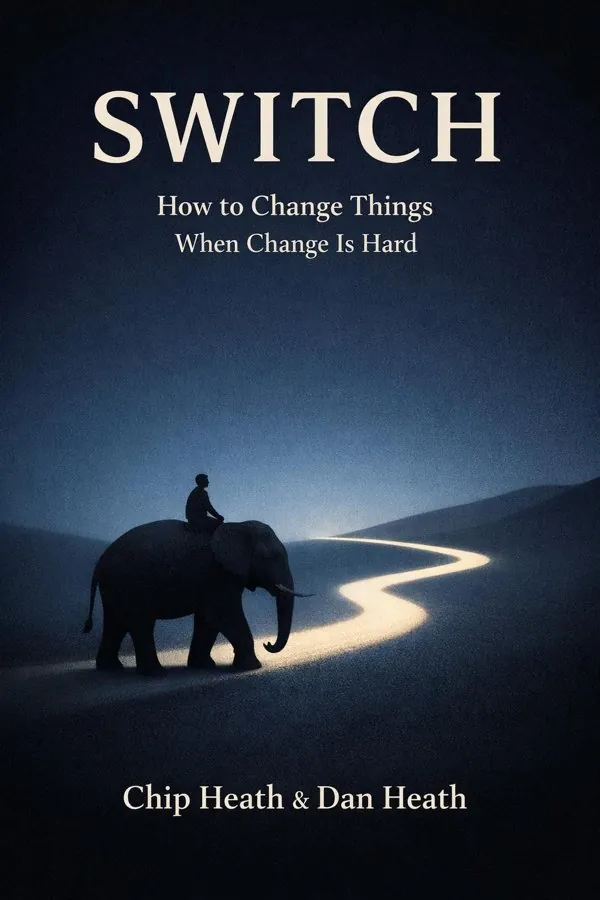
Switch: How to Change Things When Change Is Hard: Summary & Key Insights
by Chip Heath, Dan Heath
 10 min9 chaptersAudio available
Key Takeaways from Switch: How to Change Things When Change Is Hard
Most failed change efforts are not failures of character; they are failures of alignment.
What looks like resistance is often uncertainty in disguise.
When change feels overwhelming, the instinct is to study the problems.
Big change collapses when people do not know what to do next.
People do not change because they understand; they change because they care.
What Is Switch: How to Change Things When Change Is Hard About?
Switch: How to Change Things When Change Is Hard by Chip Heath, Dan Heath is a leadership book spanning 5 pages. Why do smart people cling to bad habits, teams resist obvious improvements, and organizations stall even when the need for change is urgent? In Switch, Chip Heath and Dan Heath argue that change is hard not because people are lazy or irrational, but because successful change must align three forces at once: the rational mind, the emotional mind, and the surrounding environment. Using the memorable metaphor of the Rider, the Elephant, and the Path, the authors turn a messy topic into a practical framework anyone can apply. The book matters because most change advice is incomplete. Some strategies rely too heavily on logic and plans; others focus only on motivation or culture. The Heath brothers show that lasting change happens when you provide clear direction, generate emotional energy, and redesign the context so the right behavior becomes easier. Their insights draw on research from psychology, behavioral economics, and organizational change, brought to life through vivid real-world stories. Chip Heath, a Stanford professor, and Dan Heath, a leading writer on behavior and communication, combine academic rigor with plainspoken clarity. The result is a highly actionable guide for leaders, managers, educators, and anyone trying to change themselves or others.
This FizzRead summary covers all 9 key chapters of Switch: How to Change Things When Change Is Hard in approximately 10 minutes, distilling the most important ideas, arguments, and takeaways from Chip Heath, Dan Heath's work. Also available as an audio summary and Key Quotes Podcast.
Switch: How to Change Things When Change Is Hard
Why do smart people cling to bad habits, teams resist obvious improvements, and organizations stall even when the need for change is urgent? In Switch, Chip Heath and Dan Heath argue that change is hard not because people are lazy or irrational, but because successful change must align three forces at once: the rational mind, the emotional mind, and the surrounding environment. Using the memorable metaphor of the Rider, the Elephant, and the Path, the authors turn a messy topic into a practical framework anyone can apply.
The book matters because most change advice is incomplete. Some strategies rely too heavily on logic and plans; others focus only on motivation or culture. The Heath brothers show that lasting change happens when you provide clear direction, generate emotional energy, and redesign the context so the right behavior becomes easier. Their insights draw on research from psychology, behavioral economics, and organizational change, brought to life through vivid real-world stories. Chip Heath, a Stanford professor, and Dan Heath, a leading writer on behavior and communication, combine academic rigor with plainspoken clarity. The result is a highly actionable guide for leaders, managers, educators, and anyone trying to change themselves or others.
Who Should Read Switch: How to Change Things When Change Is Hard?
This book is perfect for anyone interested in leadership and looking to gain actionable insights in a short read. Whether you're a student, professional, or lifelong learner, the key ideas from Switch: How to Change Things When Change Is Hard by Chip Heath, Dan Heath will help you think differently.
- ✓Readers who enjoy leadership and want practical takeaways
- ✓Professionals looking to apply new ideas to their work and life
- ✓Anyone who wants the core insights of Switch: How to Change Things When Change Is Hard in just 10 minutes
Want the full summary?
Get instant access to this book summary and 100K+ more with Fizz Moment.
Get Free SummaryAvailable on App Store • Free to download
Key Chapters
Most failed change efforts are not failures of character; they are failures of alignment. The core insight of Switch is that change becomes difficult when our rational side, emotional side, and environment pull in different directions. The Heath brothers capture this with a powerful metaphor: the Rider represents the analytical mind, the Elephant represents emotion and instinct, and the Path represents the situation around us.
The Rider likes planning, reasoning, and strategy. It can think far ahead, compare options, and set goals. But it also tends to overanalyze and become exhausted by too many choices. The Elephant is driven by feelings, comfort, fear, habit, and social signals. It supplies the energy for action, but it often prefers familiar routines over uncertain improvement. The Path includes systems, incentives, physical spaces, defaults, and cultural norms. Even motivated people struggle when the environment makes the desired behavior inconvenient or confusing.
Imagine a company introducing a new customer service process. Leadership explains the logic clearly, but employees still default to old routines. Why? The Rider may understand the change, but the Elephant feels anxious about doing something unfamiliar, and the Path may still reward speed over service quality. Unless all three elements are addressed, progress stalls.
This framework is useful because it prevents simplistic thinking. Instead of blaming people, ask: Is the direction unclear? Is motivation missing? Is the environment working against us? In personal life, the same questions apply to exercise, saving money, or reducing phone use.
Actionable takeaway: Before launching any change, diagnose all three dimensions. Ask what the Rider needs to understand, what the Elephant needs to feel, and what the Path needs to make easier.
What looks like resistance is often uncertainty in disguise. People rarely act on vague instructions like “be more innovative,” “eat healthier,” or “improve communication,” because the Rider needs specificity. If you want change, the first task is to give the rational mind a clear destination and a concrete route.
The Heath brothers emphasize that clarity beats inspiration when behavior must shift. A broad goal may sound motivating, but it leaves too much room for interpretation. The Rider responds better to clear scripts: do this, then that. In organizations, leaders often make the mistake of describing the vision while neglecting the next actionable steps. Employees then fill in the gaps with guesswork, often reverting to familiar behavior.
A practical example is a school trying to improve student performance. Telling teachers to “raise standards” may produce little change. But identifying specific high-performing classrooms and asking others to adopt two proven practices—such as weekly formative quizzes and targeted small-group reviews—creates a much clearer path. Likewise, a person trying to get healthier is more likely to follow “walk 30 minutes after dinner on weekdays” than “live a healthier lifestyle.”
Directing the Rider also means avoiding decision overload. Too many options create paralysis. The more complex the choice, the more likely people are to delay action or return to habit. Strong change leaders reduce ambiguity by prioritizing a few critical moves.
Actionable takeaway: Replace abstract goals with crystal-clear behaviors. Define exactly what success looks like, what steps come first, and what people should do differently tomorrow—not someday.
When change feels overwhelming, the instinct is to study the problems. But progress often starts faster when you study what is already working. One of the most practical ideas in Switch is the search for “bright spots”: examples of success that already exist within the same difficult environment.
Bright spots matter because they prove that improvement is possible without waiting for perfect conditions. In many organizations, teams waste time asking why failure happens, even though the causes are numerous and discouraging. The better question is: Where is success happening, and how can we do more of that? This approach shifts attention from diagnosis alone to replication.
The Heath brothers illustrate how bright spots reveal hidden solutions. In communities facing malnutrition, some children thrive despite poverty. Instead of focusing only on the causes of poor nutrition, researchers examined the few families with healthy children. They discovered uncommon but practical habits, such as feeding children more frequently and using nutritious local foods. Those specific behaviors then became the basis for change.
This principle applies widely. A sales manager can study the few representatives who consistently retain clients. A hospital can identify units with unusually low infection rates. A family trying to improve finances can look at the one month when spending stayed under control and examine what worked. Bright spots provide credibility because the model comes from reality, not theory.
Actionable takeaway: In any change effort, identify existing examples of success under similar conditions. Study what those people are doing differently, extract the repeatable behaviors, and scale them before inventing new solutions.
Big change collapses when people do not know what to do next. Even motivated individuals can get stuck if the path forward feels too broad or too complex. That is why Switch stresses the importance of scripting the critical moves: narrowing the focus to the few behaviors that matter most.
The Rider loves analysis, but analysis can become a trap. When facing uncertainty, people often seek more data, more meetings, more discussion, and more planning. Yet action usually requires a simpler answer: what are the key moves that must happen now? Effective change leaders do not hand people an encyclopedia. They hand them a playbook.
Consider a company trying to improve project execution. Instead of launching a massive “accountability initiative,” a leader might define three nonnegotiable practices: every project must have one owner, weekly status updates must use the same template, and risks must be escalated within 24 hours. That script reduces confusion and makes compliance visible. In personal life, someone trying to reduce digital distraction might adopt two scripted moves: keep the phone out of the bedroom and disable notifications from social apps.
Scripting is especially valuable in moments of stress. Under pressure, people do not rise to abstract ideals; they fall back on whatever behavior is easiest and most familiar. A predefined script gives them something reliable to follow. It also makes coaching easier because performance can be observed against concrete actions rather than general intentions.
Actionable takeaway: Identify the few highest-leverage behaviors that will create momentum. Turn them into a simple script people can remember and execute consistently, especially when things get busy or uncertain.
People do not change because they understand; they change because they care. Logic can guide direction, but emotion supplies the energy. That is why the Heath brothers argue that motivating the Elephant is essential. If the emotional side is fearful, discouraged, or disconnected, even the smartest plan will stall.
Many leaders assume that presenting strong evidence will be enough. They assemble charts, forecasts, and performance data, then wonder why no one moves. The problem is not information; it is emotional inertia. The Elephant responds to vivid experiences, meaningful stories, identity, and hope. To inspire action, change must feel urgent, personal, and achievable.
For example, a hospital administrator who wants to reduce medical errors may get more traction by sharing a patient story than by citing statistics alone. A manager trying to improve customer service may energize a team by replaying a heartfelt customer message that shows the human impact of their work. In personal change, someone trying to save money may become more committed by tying the goal to a dream—security for their family, freedom from debt, or the ability to travel—rather than to abstract budgeting rules.
Emotion also includes reducing fear. If change feels too threatening, the Elephant resists. That is why confidence matters as much as urgency. People need to believe they can succeed. Small wins, visible progress, and supportive feedback help transform anxiety into momentum.
Actionable takeaway: Do not rely on facts alone. Pair your case for change with emotional triggers—stories, symbols, human consequences, and signs of progress—that make people want to move, not just agree in theory.
People often resist change not because they oppose the goal, but because the goal feels too large. A giant transformation can overwhelm the Elephant, triggering avoidance instead of effort. One of the smartest strategies in Switch is to shrink the change so it feels manageable enough to begin.
This idea rests on a simple truth: progress creates motivation. When people experience an early success, they gain confidence, and confidence fuels further action. Small steps are not a compromise; they are often the fastest route to large change because they bypass paralysis.
The principle shows up everywhere. A person who wants to run a marathon might start by putting on running shoes every morning and jogging for five minutes. A team trying to improve collaboration may begin with a 15-minute daily check-in rather than a full process overhaul. A company digitizing operations may pilot one workflow in one department instead of launching an enterprise-wide transformation overnight. By reducing the scope, leaders make the first move easier and the emotional burden lighter.
Shrinking the change also helps reveal what is actually hard. Once people begin, hidden obstacles become visible, and solutions become more practical. It is far easier to improve a small pilot than to rescue a giant failing initiative. Early wins create evidence that the change is possible, making skeptics more receptive.
Actionable takeaway: Break ambitious goals into tiny, low-friction starting points. Ask, “What is the smallest version of this change that would still move us forward?” Then build momentum through a series of visible wins.
When behavior does not change, we often assume the people need fixing. But many problems are actually situational. Switch argues that shaping the Path—altering the environment around behavior—is one of the most underused and powerful tools for change.
The Path includes physical spaces, systems, defaults, reminders, tools, timing, and social expectations. These factors quietly influence what people do, often more than intention does. If the desired behavior is inconvenient, time-consuming, or easy to forget, even committed people struggle. But when the environment supports the new habit, change requires less willpower.
Think of a workplace trying to encourage healthy eating. Posters about nutrition may do little if vending machines are filled with junk food and lunch breaks are rushed. But changing cafeteria layouts, making healthy options visible, and simplifying ordering can shift behavior quickly. In personal life, someone who wants to read more can place a book on the pillow and move the phone charger out of the bedroom. Someone trying to spend less can automate savings so the default choice works in their favor.
Shaping the Path also means removing friction. If a new software tool requires six approvals, adoption will lag. If reporting a safety issue is cumbersome, people will stay silent. Effective leaders redesign systems so the right action is the easy action.
Actionable takeaway: Audit the environment around the behavior you want. Remove obstacles, add helpful cues, and redesign defaults so people can succeed with less effort and less dependence on self-control.
Change becomes durable when it stops depending on constant motivation. That is why habits and social norms are central to lasting transformation. In Switch, the Heath brothers show that people are strongly influenced by routine and by what they see others doing. To make change stick, leaders must harness both.
Habits reduce the load on the Rider because they eliminate repeated decision-making. Instead of asking people to remember, choose, and recommit every day, a good habit automates the desired behavior. Checklists, recurring meetings, standard routines, and default workflows all help convert intention into repetition.
Social influence is just as important. Human beings take cues from the herd, especially in uncertain situations. If the visible norm is that “people like us do things this way,” change spreads more easily. That is why public commitments, peer examples, and shared language matter. A team is more likely to adopt a new practice if respected colleagues are already using it and discussing it openly.
For instance, a company trying to improve meeting quality might establish a habit that every meeting ends with clear owners and deadlines. If managers consistently model this, it quickly becomes expected behavior across the team. In families, a visible habit such as screen-free dinners works better when everyone participates, making the norm collective rather than individual.
Actionable takeaway: Turn key behaviors into routines and make those routines socially visible. Use checklists, recurring cues, role models, and group expectations so the change feels normal, shared, and increasingly automatic.
The hardest part of change is often not starting but continuing when enthusiasm fades. Early excitement can carry a project for a while, but long-term change requires something deeper: a sense of identity and visible progress. Switch highlights both as essential to keeping the switch going.
People persist when the change becomes part of who they are, not just something they are trying to do. Identity is powerful because it organizes behavior. A person who says, “I’m trying to exercise” behaves differently from one who says, “I’m the kind of person who trains regularly.” A company that defines itself as “customer-obsessed” will make different trade-offs than one that merely announces a customer initiative.
Visible progress reinforces identity. Progress signals that effort matters, which keeps the Elephant motivated. That is why milestones, scoreboards, before-and-after evidence, and celebration of wins are so effective. They transform a distant goal into a series of encouraging steps. Without visible markers, people may feel they are working hard with nothing to show for it, which invites drift back to old habits.
Leaders can sustain momentum by naming the identity they want to reinforce and by making progress unmistakable. Celebrate behavior, not just results. Highlight stories of people acting in alignment with the new direction. Show improvements in ways that are easy to see and emotionally satisfying.
Actionable takeaway: Keep change alive by linking it to identity and by measuring progress visibly. Help people say, “This is who we are now,” and give them proof that their efforts are moving the mission forward.
All Chapters in Switch: How to Change Things When Change Is Hard
About the Authors
Chip Heath and Dan Heath are American authors celebrated for translating behavioral science and business research into practical tools for everyday decision-making and leadership. Chip Heath is a professor at Stanford Graduate School of Business, where his teaching and research focus on why certain ideas spread and how people make judgments. Dan Heath is a writer, researcher, and senior fellow affiliated with Duke University’s CASE center, with a strong interest in social change and communication. Together, they have written several bestselling books, including Made to Stick, Switch, Decisive, and The Power of Moments. Their work is known for its clarity, memorable frameworks, and strong use of real-world stories, making complex ideas accessible to leaders, professionals, and general readers alike.
Get This Summary in Your Preferred Format
Read or listen to the Switch: How to Change Things When Change Is Hard summary by Chip Heath, Dan Heath anytime, anywhere. FizzRead offers multiple formats so you can learn on your terms — all free.
Available formats: App · Audio · PDF · EPUB — All included free with FizzRead
Download Switch: How to Change Things When Change Is Hard PDF and EPUB Summary
Key Quotes from Switch: How to Change Things When Change Is Hard
“Most failed change efforts are not failures of character; they are failures of alignment.”
“What looks like resistance is often uncertainty in disguise.”
“When change feels overwhelming, the instinct is to study the problems.”
“Big change collapses when people do not know what to do next.”
“People do not change because they understand; they change because they care.”
Frequently Asked Questions about Switch: How to Change Things When Change Is Hard
Switch: How to Change Things When Change Is Hard by Chip Heath, Dan Heath is a leadership book that explores key ideas across 9 chapters. Why do smart people cling to bad habits, teams resist obvious improvements, and organizations stall even when the need for change is urgent? In Switch, Chip Heath and Dan Heath argue that change is hard not because people are lazy or irrational, but because successful change must align three forces at once: the rational mind, the emotional mind, and the surrounding environment. Using the memorable metaphor of the Rider, the Elephant, and the Path, the authors turn a messy topic into a practical framework anyone can apply. The book matters because most change advice is incomplete. Some strategies rely too heavily on logic and plans; others focus only on motivation or culture. The Heath brothers show that lasting change happens when you provide clear direction, generate emotional energy, and redesign the context so the right behavior becomes easier. Their insights draw on research from psychology, behavioral economics, and organizational change, brought to life through vivid real-world stories. Chip Heath, a Stanford professor, and Dan Heath, a leading writer on behavior and communication, combine academic rigor with plainspoken clarity. The result is a highly actionable guide for leaders, managers, educators, and anyone trying to change themselves or others.
More by Chip Heath, Dan Heath

You Might Also Like

Extreme Ownership
Jocko Willink
10 min
Dare to Lead
Brene Brown
10 min
Leaders Eat Last
Simon Sinek
10 min
The 21 Irrefutable Laws of Leadership
John Maxwell
10 min
Start With Why
Simon Sinek
10 min
How to Lead When You're Not in Charge
Clay Scroggins
10 minBrowse by Category
Ready to read Switch: How to Change Things When Change Is Hard?
Get the full summary and 100K+ more books with Fizz Moment.