
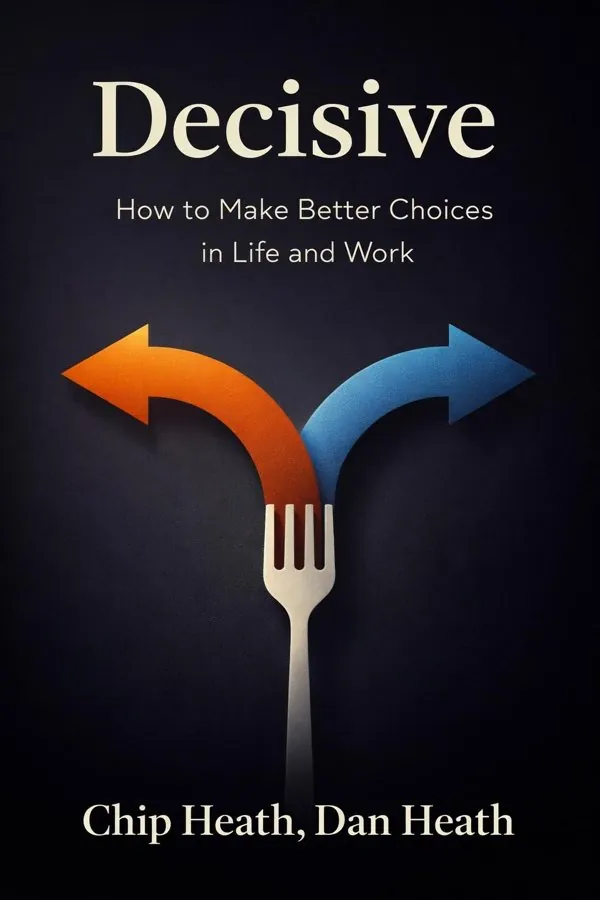
Decisive: How to Make Better Choices in Life and Work: Summary & Key Insights
by Chip Heath, Dan Heath
 10 min9 chaptersAudio available
Key Takeaways from Decisive: How to Make Better Choices in Life and Work
Most bad decisions do not begin with bad intentions; they begin with bad habits of thinking.
A decision that feels difficult is often framed too narrowly.
The mind loves a story, especially one that confirms what it already suspects.
The choices that shape our lives are often made in moods that do not last.
Even a thoughtful decision can go badly, because the future refuses to cooperate with our plans.
What Is Decisive: How to Make Better Choices in Life and Work About?
Decisive: How to Make Better Choices in Life and Work by Chip Heath, Dan Heath is a mindset book spanning 11 pages. Why do capable, intelligent people still make bad decisions? That question sits at the heart of Decisive, where Chip Heath and Dan Heath argue that poor choices usually do not come from a lack of intelligence, but from predictable flaws in the way human minds work. Whether you are choosing a career path, hiring a leader, launching a product, or navigating a family dilemma, the same mental traps tend to distort judgment. The authors identify these traps and offer a practical system for escaping them. Their solution is the WRAP process: Widen Your Options, Reality-Test Your Assumptions, Attain Distance Before Deciding, and Prepare to Be Wrong. Rather than relying on gut instinct or endless analysis, WRAP gives readers a repeatable framework for making clearer, wiser decisions under uncertainty. What makes the book especially useful is its blend of behavioral science, memorable stories, and practical tools. Chip Heath, a Stanford professor, and Dan Heath, a bestselling author and researcher, translate psychology into methods people can use immediately. Decisive matters because better decisions do not just improve isolated outcomes; they improve the direction of an entire life or organization.
This FizzRead summary covers all 9 key chapters of Decisive: How to Make Better Choices in Life and Work in approximately 10 minutes, distilling the most important ideas, arguments, and takeaways from Chip Heath, Dan Heath's work. Also available as an audio summary and Key Quotes Podcast.
Decisive: How to Make Better Choices in Life and Work
Why do capable, intelligent people still make bad decisions? That question sits at the heart of Decisive, where Chip Heath and Dan Heath argue that poor choices usually do not come from a lack of intelligence, but from predictable flaws in the way human minds work. Whether you are choosing a career path, hiring a leader, launching a product, or navigating a family dilemma, the same mental traps tend to distort judgment. The authors identify these traps and offer a practical system for escaping them.
Their solution is the WRAP process: Widen Your Options, Reality-Test Your Assumptions, Attain Distance Before Deciding, and Prepare to Be Wrong. Rather than relying on gut instinct or endless analysis, WRAP gives readers a repeatable framework for making clearer, wiser decisions under uncertainty.
What makes the book especially useful is its blend of behavioral science, memorable stories, and practical tools. Chip Heath, a Stanford professor, and Dan Heath, a bestselling author and researcher, translate psychology into methods people can use immediately. Decisive matters because better decisions do not just improve isolated outcomes; they improve the direction of an entire life or organization.
Who Should Read Decisive: How to Make Better Choices in Life and Work?
This book is perfect for anyone interested in mindset and looking to gain actionable insights in a short read. Whether you're a student, professional, or lifelong learner, the key ideas from Decisive: How to Make Better Choices in Life and Work by Chip Heath, Dan Heath will help you think differently.
- ✓Readers who enjoy mindset and want practical takeaways
- ✓Professionals looking to apply new ideas to their work and life
- ✓Anyone who wants the core insights of Decisive: How to Make Better Choices in Life and Work in just 10 minutes
Want the full summary?
Get instant access to this book summary and 100K+ more with Fizz Moment.
Get Free SummaryAvailable on App Store • Free to download
Key Chapters
Most bad decisions do not begin with bad intentions; they begin with bad habits of thinking. The Heath brothers argue that our choices are routinely undermined by four recurring “villains”: narrow framing, confirmation bias, short-term emotion, and overconfidence. These are not rare errors made by careless people. They are normal features of human judgment, which is precisely why they are so dangerous.
Narrow framing happens when we treat a decision as if there are only one or two possible options. We ask, “Should I stay or quit?” instead of “What are all the realistic ways I could redesign this situation?” Confirmation bias appears when we gather evidence selectively, searching for support for what we already want to believe. Short-term emotion takes over when immediate feelings, stress, ego, or fear drown out long-term wisdom. Overconfidence shows up when we assume we can predict the future more accurately than we really can.
These villains explain why smart executives approve weak strategies, why families make rushed financial decisions, and why individuals stick with unsatisfying paths for too long. A manager may hire the candidate who feels right in the interview, ignoring missing evidence. A parent may choose a school based on one emotional visit rather than broader data. An entrepreneur may become too attached to a product idea and overlook warning signs.
The central insight is liberating: if poor decisions are often systematic, then better decisions can also be systematic. You do not need to become perfectly rational. You need a process that protects you from predictable errors.
Actionable takeaway: Before making any important choice, ask yourself which of the four villains is most likely to sabotage you right now, and deliberately build a countermeasure into your process.
A decision that feels difficult is often framed too narrowly. One of the book’s most powerful ideas is that people frequently treat choices as binaries when they are not. We ask, “Should I accept this offer or not?” “Should we invest in this initiative or kill it?” “Should I move or stay?” But “this or that” thinking blocks creativity and increases pressure, making us more likely to choose badly.
The authors suggest widening options by forcing ourselves to look for multiple plausible paths. One practical method is to ask, “What else could we do?” Another is the “vanishing options” test: if your current options disappeared, what would you do next? This pushes your mind beyond its initial frame. They also recommend considering whether the choice is actually “and” rather than “or.” Could you test a new career before leaving the old one? Could a company pilot two strategies rather than betting everything on one?
This matters because broad option sets reduce desperation and improve quality. A student deciding on graduate school could compare full-time enrollment, part-time study, online programs, delayed application, or gaining work experience first. A company deciding whether to open a new office could consider partnerships, remote expansion, or a temporary pop-up model. Once multiple options exist, judgment improves because comparison becomes richer.
Widening options also lowers emotional overinvestment in any single path. When you believe there is only one acceptable answer, fear rises. When you generate several viable routes, you become more adaptive and less anxious.
Actionable takeaway: If a decision seems to offer only two choices, do not proceed until you have generated at least two additional credible alternatives.
The mind loves a story, especially one that confirms what it already suspects. That is why the second step of WRAP is so important: reality-test your assumptions. The Heath brothers warn that when we face a choice, we naturally become our own attorneys, building a case for the option we prefer. We collect supporting evidence, discount contradictory facts, and confuse confidence with truth.
To counter this, the book recommends gathering information that challenges your beliefs instead of merely reinforcing them. One useful technique is to ask, “What would have to be true for this option to succeed?” Another is to look outside your own perspective by consulting people who have direct experience, not just opinions. The authors also emphasize the value of small experiments. Rather than debating endlessly whether a strategy will work, test it cheaply and learn from reality.
For example, a business considering a new product might build a prototype and show it to customers before committing significant resources. Someone thinking of moving into a new profession could shadow practitioners, freelance on the side, or conduct informational interviews. A leader considering a major change in team structure could run a limited trial in one division first.
This step is especially important because many costly mistakes happen when assumptions go untested. Forecasts are often too optimistic. Interview impressions are unreliable. Excitement about a new venture can hide operational weaknesses. Reality-testing introduces friction, but it is the healthy kind of friction that prevents self-deception.
Actionable takeaway: For your next major decision, identify your most important assumption and design one way to test it in the real world before fully committing.
The choices that shape our lives are often made in moods that do not last. That is why the third step of WRAP is to attain distance before deciding. The Heath brothers show that short-term emotions can hijack judgment, making us overreact to recent disappointments, conflicts, status concerns, or bursts of excitement. What feels urgent in the moment may look insignificant a month later.
Distance means stepping back long enough to hear your wiser self. One classic tool the authors discuss is the “10/10/10” method: how will you feel about this decision 10 minutes from now, 10 months from now, and 10 years from now? That question widens time horizons and often reveals that immediate discomfort is overshadowing long-term value. Another tool is asking what you would advise a close friend in the same situation. This creates emotional space and reduces self-centered distortion.
Imagine an employee wanting to quit after a humiliating meeting. In the heat of frustration, resigning may feel satisfying. But from a broader perspective, the wiser move might be to wait, evaluate whether the pattern is chronic, and explore alternatives strategically. Or consider a founder thrilled by a flashy acquisition offer. A little distance may reveal hidden tradeoffs in culture, mission, or long-term upside.
Distance is not about suppressing emotion completely. Emotions contain information. But they should inform decisions, not dominate them. The goal is to honor feelings while preventing temporary states from dictating permanent consequences.
Actionable takeaway: When a decision feels emotionally charged, delay commitment and ask what choice your future self would thank you for one year from now.
Even a thoughtful decision can go badly, because the future refuses to cooperate with our plans. The fourth step of WRAP, prepare to be wrong, addresses the problem of overconfidence. The authors argue that we routinely underestimate uncertainty and overestimate our ability to predict outcomes. Good decision-makers are not people who are always right; they are people who build resilience into their choices.
Preparing to be wrong means acknowledging uncertainty before reality forces you to. One practical technique is setting tripwires: predetermined signals that tell you when to reassess. For example, a company launching a new service might decide in advance that if customer acquisition remains below a set threshold after three months, it will revisit the strategy. A person making an investment might define exit conditions before emotions become entangled. A family relocating for work could agree ahead of time on what signs would indicate the move is not working.
The authors also encourage “bookending the future” by considering both the best-case and worst-case plausible outcomes. This expands thinking beyond a single forecast. If the optimistic version does not happen, what is your fallback? If things go better than expected, are you ready to capitalize?
This mindset reduces the shame of course correction. Too many people cling to weak decisions because changing direction feels like admitting failure. In reality, adaptive revision is a sign of intelligence. Decisions should not be judged only by outcomes, since some sound choices still produce poor results due to luck and complexity.
Actionable takeaway: Before acting on an important decision, write down the signals that would tell you to continue, revise, or exit, so you are not improvising under pressure later.
Many organizations assume better decisions come from smarter leaders. Decisive argues that this belief is incomplete. Talent matters, but process matters more than most people think. In companies, schools, nonprofits, and governments, decisions are often shaped by politics, time pressure, hierarchy, and sunk costs. Without a disciplined method, even experienced teams fall into the same psychological traps as individuals.
A strong organizational decision process widens options, invites dissent, checks assumptions, and creates mechanisms for review. For instance, a leadership team choosing a strategic direction should avoid asking everyone to react to a single favored proposal. Instead, it should compare multiple strategies side by side. Teams should also seek disconfirming evidence, not just polished presentations from internal champions. If one executive “owns” an initiative emotionally, the group should deliberately examine what could make it fail.
The book’s lessons are especially valuable in environments where bad decisions scale quickly. A flawed hiring process does not just hurt one team; it shapes culture for years. A poorly tested expansion strategy can consume capital and attention across the company. By building WRAP into recurring decisions, organizations reduce dependence on charisma and gut feel.
Examples include using checklists for hiring, pre-mortems before launches, pilot programs before large rollouts, and clear review triggers after implementation. These are not bureaucratic obstacles. They are safeguards against expensive self-deception.
Actionable takeaway: Identify one repeating decision in your organization, such as hiring, budgeting, or project approval, and redesign it using WRAP so quality depends less on individual instinct and more on a reliable system.
When uncertainty is high, discussion alone rarely produces wisdom. One of the most practical themes in Decisive is that decision quality improves when we replace speculation with experimentation. Many arguments persist because both sides are relying on theories about what might happen. A modest real-world test can reveal more than hours of confident prediction.
The authors encourage readers to “ooch” forward, especially in complex or personal decisions. Ooching means making progress through small, low-risk exploratory steps rather than leaping blindly into a final commitment. Someone considering entrepreneurship might start with a side project, not an immediate resignation. A manager unsure whether a new workflow will improve productivity could run it with one team before company-wide adoption. A person thinking about a major move might spend extended time in the new city or work remotely from there first.
Experiments are powerful because they generate evidence while preserving flexibility. They also help neutralize fear. A decision can feel overwhelming when it seems irreversible, but much easier when reframed as a test. Instead of asking, “Should I transform my life?” you ask, “What is the smallest meaningful way to learn more?”
This approach is especially useful in modern environments where complexity makes prediction difficult. Markets shift, personal preferences evolve, and hidden constraints emerge only in action. The best decision is often not the one built on the strongest theory, but the one that creates the fastest reliable learning.
Actionable takeaway: For any choice clouded by uncertainty, define a low-cost experiment you can run within the next two weeks to gather evidence before making a full commitment.
One reason Decisive resonates is that it does not moralize about bad decisions. It explains them. The Heath brothers draw from behavioral science to show that error is built into ordinary cognition. We are not foolish because we sometimes choose poorly; we are human. Understanding this changes decision-making from a character issue into a design problem.
People tend to anchor on initial impressions, seek coherence rather than truth, and overweigh vivid anecdotes relative to statistical evidence. We also confuse confidence with competence and mistake familiarity for accuracy. These tendencies are useful in some fast-moving situations, but they become liabilities in complex decisions involving ambiguity, time, and ego.
This insight matters in both personal and professional life. A recruiter may “just know” a candidate is right because of charisma, but structured interviews often outperform intuition. A consumer may buy a home because it feels perfect during a weekend showing, while overlooking long-term commuting strain or maintenance costs. A founder may ignore weak customer interest because a few enthusiastic users feel more persuasive than broader market data.
Behavioral insights are not meant to make us cynical about judgment. They are meant to help us compensate intelligently. Once you know the mind’s default settings, you can build better safeguards: compare options side by side, seek base rates, use independent opinions, and test ideas against reality.
In this way, the book bridges psychology and practice. It shows that better decisions are less about becoming a genius and more about creating conditions where truth has a better chance to win.
Actionable takeaway: The next time you feel highly certain, pause and ask whether your certainty comes from strong evidence, or simply from a story that feels compelling.
A single decision rarely determines everything, but the pattern of our decisions determines a great deal. One of the book’s deepest messages is that decision quality compounds over time. Better choices in work, relationships, health, money, and leadership do not just improve isolated moments; they gradually shape identity, opportunity, and trust.
This is why the Heath brothers focus on process rather than brilliance. If you improve how you choose, you improve the trajectory of your life. A professional who widens options may discover more meaningful work instead of defaulting into a role that drains them. A leader who reality-tests assumptions may avoid costly strategic errors and build a stronger culture of truth. A family that gains distance before deciding may make calmer choices about schooling, relocation, or caregiving. Over years, these differences become substantial.
Long-term decision quality also depends on reflection. Good decision-makers review outcomes without self-deception. They ask not only, “Did this work?” but also, “Did I decide well based on what I knew at the time?” This helps separate bad luck from bad process and encourages learning rather than blame. Over time, this creates wisdom: a realistic sense of uncertainty paired with confidence in one’s method.
In a fast-moving world, the pressure to decide quickly is intense. Decisive offers a counterpoint: slow down enough to choose well where it matters most. The rewards are practical and cumulative, from reduced regret to stronger relationships and more resilient strategies.
Actionable takeaway: Start a decision journal for major choices, recording options, assumptions, emotional state, and expected outcomes, so you can learn how your decision process evolves over time.
All Chapters in Decisive: How to Make Better Choices in Life and Work
About the Authors
Chip Heath and Dan Heath are acclaimed authors who specialize in turning behavioral science into practical guidance for everyday decisions and organizational change. Chip Heath is a professor at Stanford Graduate School of Business, where his work explores how people communicate ideas, make judgments, and shape behavior. Dan Heath is a bestselling writer and a senior fellow connected with Duke University’s CASE center, with a strong focus on social innovation, leadership, and problem-solving. Together, they are known for writing accessible, research-driven books that blend academic insight with memorable storytelling. Their major titles include Made to Stick, Switch, The Power of Moments, and Decisive. As a writing team, they have built a reputation for offering frameworks that help readers think more clearly, communicate more effectively, and act with greater purpose.
Get This Summary in Your Preferred Format
Read or listen to the Decisive: How to Make Better Choices in Life and Work summary by Chip Heath, Dan Heath anytime, anywhere. FizzRead offers multiple formats so you can learn on your terms — all free.
Available formats: App · Audio · PDF · EPUB — All included free with FizzRead
Download Decisive: How to Make Better Choices in Life and Work PDF and EPUB Summary
Key Quotes from Decisive: How to Make Better Choices in Life and Work
“Most bad decisions do not begin with bad intentions; they begin with bad habits of thinking.”
“A decision that feels difficult is often framed too narrowly.”
“The mind loves a story, especially one that confirms what it already suspects.”
“The choices that shape our lives are often made in moods that do not last.”
“Even a thoughtful decision can go badly, because the future refuses to cooperate with our plans.”
Frequently Asked Questions about Decisive: How to Make Better Choices in Life and Work
Decisive: How to Make Better Choices in Life and Work by Chip Heath, Dan Heath is a mindset book that explores key ideas across 9 chapters. Why do capable, intelligent people still make bad decisions? That question sits at the heart of Decisive, where Chip Heath and Dan Heath argue that poor choices usually do not come from a lack of intelligence, but from predictable flaws in the way human minds work. Whether you are choosing a career path, hiring a leader, launching a product, or navigating a family dilemma, the same mental traps tend to distort judgment. The authors identify these traps and offer a practical system for escaping them. Their solution is the WRAP process: Widen Your Options, Reality-Test Your Assumptions, Attain Distance Before Deciding, and Prepare to Be Wrong. Rather than relying on gut instinct or endless analysis, WRAP gives readers a repeatable framework for making clearer, wiser decisions under uncertainty. What makes the book especially useful is its blend of behavioral science, memorable stories, and practical tools. Chip Heath, a Stanford professor, and Dan Heath, a bestselling author and researcher, translate psychology into methods people can use immediately. Decisive matters because better decisions do not just improve isolated outcomes; they improve the direction of an entire life or organization.
More by Chip Heath, Dan Heath
You Might Also Like

Browse by Category
Ready to read Decisive: How to Make Better Choices in Life and Work?
Get the full summary and 100K+ more books with Fizz Moment.