
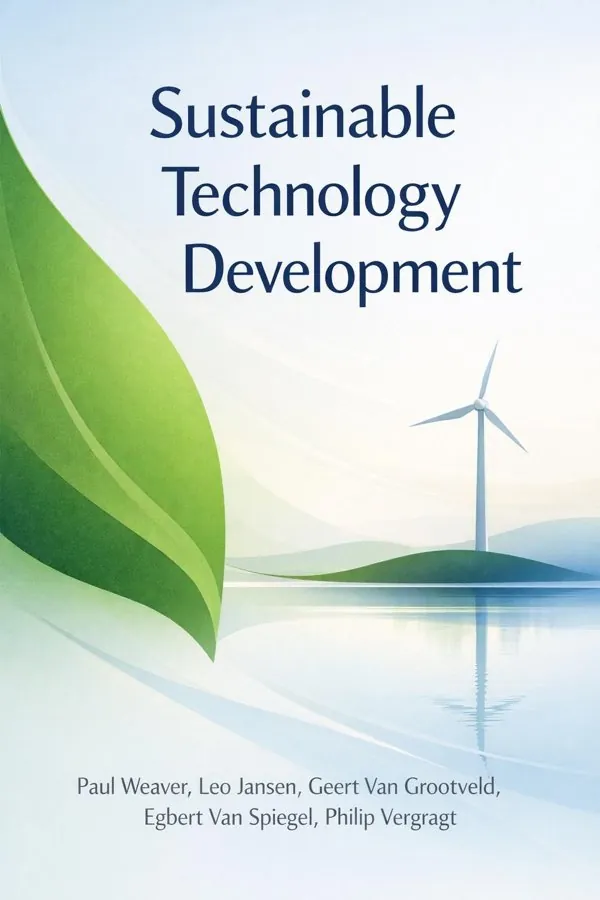
Sustainable Technology Development: Summary & Key Insights
by Paul Weaver, Leo Jansen, Geert Van Grootveld, Egbert Van Spiegel, Philip Vergragt
 10 min6 chaptersAudio available
What Is Sustainable Technology Development About?
Sustainable Technology Development by Paul Weaver, Leo Jansen, Geert Van Grootveld, Egbert Van Spiegel, Philip Vergragt is a environment book spanning 6 pages. This book explores the concept of sustainable technology development, offering a framework for integrating environmental and social considerations into technological innovation. It emphasizes the need for systemic change in industrial and policy practices to achieve long-term sustainability goals.
This FizzRead summary covers all 6 key chapters of Sustainable Technology Development in approximately 10 minutes, distilling the most important ideas, arguments, and takeaways from Paul Weaver, Leo Jansen, Geert Van Grootveld, Egbert Van Spiegel, Philip Vergragt's work. Also available as an audio summary and Key Quotes Podcast.
Sustainable Technology Development
This book explores the concept of sustainable technology development, offering a framework for integrating environmental and social considerations into technological innovation. It emphasizes the need for systemic change in industrial and policy practices to achieve long-term sustainability goals.
Who Should Read Sustainable Technology Development?
This book is perfect for anyone interested in environment and looking to gain actionable insights in a short read. Whether you're a student, professional, or lifelong learner, the key ideas from Sustainable Technology Development by Paul Weaver, Leo Jansen, Geert Van Grootveld, Egbert Van Spiegel, Philip Vergragt will help you think differently.
- ✓Readers who enjoy environment and want practical takeaways
- ✓Professionals looking to apply new ideas to their work and life
- ✓Anyone who wants the core insights of Sustainable Technology Development in just 10 minutes
Want the full summary?
Get instant access to this book summary and 100K+ more with Fizz Moment.
Get Free SummaryAvailable on App Store • Free to download
Key Chapters
Industrial society grew on the promise of abundance and innovation, yet beneath that narrative lies another truth: unsustainability has been a structural feature of our technological trajectory. During the Industrial Revolution, the goal was economic growth and productivity, with little concern for ecological costs. Those foundations—extractive industries, fossil energy dependence, linear production chains—created what we now call the unsustainable paradigm.
In our analysis, historical patterns reveal the trap of technological determinism: the belief that more advanced technologies automatically lead to better social outcomes. But blind faith in technological progress often obscures the negative externalities—pollution, inequality, and loss of resilience. Industrial systems evolved to prioritize short-term gains and centralized profit over long-term system health. These features became reinforced by institutional arrangements, supply chains, and market incentives.
By tracing this trajectory, we see how modern innovation systems still inherit the same assumptions. Research funding focuses on competitiveness rather than sustainability; manufacturing emphasizes cost efficiency rather than circularity; policy frameworks reward output rather than regeneration. This historical context sets the stage for a different path, one where technological development is consciously aligned with ecological and social well-being.
The recognition of these patterns is not about blame—it’s about learning. When we understand how the past has shaped unsustainable practices, we gain insight into where interventions should begin. Industrial history shows us the potential for change: each technological revolution—from steam to electricity, to digital—brings opportunities for rethinking structure. The key is to ensure that the next transformation integrates sustainability as a guiding principle, not as an afterthought.
At the heart of this book lies the definition of sustainable technology development (STD). We define it as a process of technological innovation that explicitly integrates environmental and social objectives into its design, implementation, and diffusion. This concept goes beyond pollution control or eco-efficiency—it involves transforming the systems that produce and use technology.
STD rests on several guiding principles. First, it recognizes that technology does not exist in isolation but co-evolves with society and ecosystems. Second, it seeks long-term sustainability goals—meeting human needs without compromising the planet’s regenerative capacity. Third, it demands participatory approaches across stakeholders: industry, government, research institutions, and civil society. Fourth, it emphasizes systemic thinking, understanding how materials, energy, and social structures interconnect.
Our theoretical framework bridges ecological economics, socio-technical systems theory, and innovation studies. Rather than assuming that market forces alone can steer sustainability, STD calls for deliberate governance and collective learning. Innovation must be directed toward transitions—toward circular economies, renewable energy systems, and equitable access to technology benefits. In other words, it’s about fostering a co-evolutionary alignment between what society values and what technology enables.
The framework is built to be practical. We propose methods for assessing sustainability impacts at the stage of research and development, not just in the aftermath of commercialization. We highlight life-cycle considerations, systemic feedback loops, and anticipatory exploration of future contexts. Technology development becomes a strategic lever—not merely an instrument of competitiveness, but a means for shaping resilient societies. This shift requires a redefinition of success, seeing innovation not as speed or quantity, but as quality of transformation.
+ 4 more chapters — available in the FizzRead app
All Chapters in Sustainable Technology Development
About the Authors
Paul Weaver, Leo Jansen, Geert Van Grootveld, Egbert Van Spiegel, and Philip Vergragt are researchers and scholars specializing in sustainability studies, environmental policy, and technology innovation. Their collaborative work focuses on developing frameworks for sustainable industrial transformation.
Get This Summary in Your Preferred Format
Read or listen to the Sustainable Technology Development summary by Paul Weaver, Leo Jansen, Geert Van Grootveld, Egbert Van Spiegel, Philip Vergragt anytime, anywhere. FizzRead offers multiple formats so you can learn on your terms — all free.
Available formats: App · Audio · PDF · EPUB — All included free with FizzRead
Download Sustainable Technology Development PDF and EPUB Summary
Key Quotes from Sustainable Technology Development
“Industrial society grew on the promise of abundance and innovation, yet beneath that narrative lies another truth: unsustainability has been a structural feature of our technological trajectory.”
“At the heart of this book lies the definition of sustainable technology development (STD).”
Frequently Asked Questions about Sustainable Technology Development
Sustainable Technology Development by Paul Weaver, Leo Jansen, Geert Van Grootveld, Egbert Van Spiegel, Philip Vergragt is a environment book that explores key ideas across 6 chapters. This book explores the concept of sustainable technology development, offering a framework for integrating environmental and social considerations into technological innovation. It emphasizes the need for systemic change in industrial and policy practices to achieve long-term sustainability goals.
You Might Also Like

A Life on Our Planet: My Witness Statement and a Vision for the Future
David Attenborough
10 min
A Sky Full Of Birds
Matt Merritt
10 min
Carbon Zero: Imagining Cities That Can Save the Planet
Alex Steffen
10 min
Eaarth: Making a Life on a Tough New Planet
Bill McKibben
10 min
The Social Contract and Environmental Governance
Various Editors
10 min
The Wild Places
Robert Macfarlane
10 minBrowse by Category
Ready to read Sustainable Technology Development?
Get the full summary and 100K+ more books with Fizz Moment.