
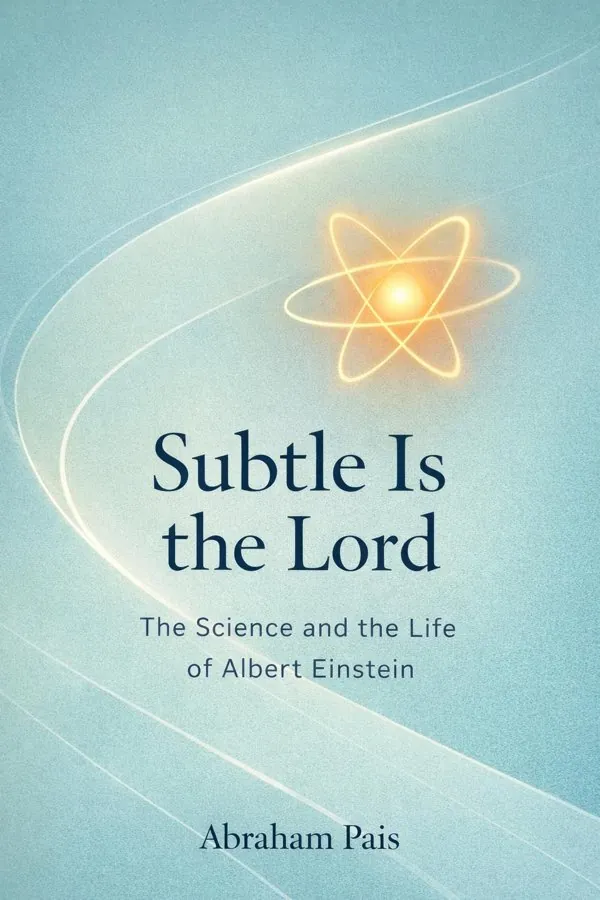
Subtle Is the Lord: The Science and the Life of Albert Einstein: Summary & Key Insights
by Abraham Pais
 10 min11 chaptersAudio available
What Is Subtle Is the Lord: The Science and the Life of Albert Einstein About?
Subtle Is the Lord: The Science and the Life of Albert Einstein by Abraham Pais is a biographies book spanning 11 pages. This biography, written by physicist Abraham Pais, offers a detailed and authoritative account of Albert Einstein’s scientific achievements and personal life. It combines rigorous scientific exposition with historical and biographical narrative, providing insight into Einstein’s intellectual development and his contributions to modern physics.
This FizzRead summary covers all 11 key chapters of Subtle Is the Lord: The Science and the Life of Albert Einstein in approximately 10 minutes, distilling the most important ideas, arguments, and takeaways from Abraham Pais's work. Also available as an audio summary and Key Quotes Podcast.
Subtle Is the Lord: The Science and the Life of Albert Einstein
This biography, written by physicist Abraham Pais, offers a detailed and authoritative account of Albert Einstein’s scientific achievements and personal life. It combines rigorous scientific exposition with historical and biographical narrative, providing insight into Einstein’s intellectual development and his contributions to modern physics.
Who Should Read Subtle Is the Lord: The Science and the Life of Albert Einstein?
This book is perfect for anyone interested in biographies and looking to gain actionable insights in a short read. Whether you're a student, professional, or lifelong learner, the key ideas from Subtle Is the Lord: The Science and the Life of Albert Einstein by Abraham Pais will help you think differently.
- ✓Readers who enjoy biographies and want practical takeaways
- ✓Professionals looking to apply new ideas to their work and life
- ✓Anyone who wants the core insights of Subtle Is the Lord: The Science and the Life of Albert Einstein in just 10 minutes
Want the full summary?
Get instant access to this book summary and 100K+ more with Fizz Moment.
Get Free SummaryAvailable on App Store • Free to download
Key Chapters
Einstein’s beginnings were modest and marked by an uneasy relationship with authority. Born in Ulm in 1879 and raised in Munich, he soon showed resistance to rote schooling and a preference for solitary reflection. His early dislike for regimented education was not rebellion for its own sake—it was the instinct of a mind unwilling to accept received truth without proof. Mathematics and geometry fascinated him because they offered structure without arbitrariness; through them, he learned that thought could liberate itself from external command.
In Aarau, Switzerland, Einstein found the environment that would nurture his independence. There, the teaching emphasized understanding rather than memorization—a principle that would accompany him throughout his philosophical and scientific life. It was in those formative years that he began meditating on light, time, and the nature of motion. By the time he entered the Polytechnic in Zürich, his defiance of authority had matured into an insistence on thinking for himself, even when it cost him institutional favor. This period laid the groundwork for his later radical departures from classical physics—his strength came from skepticism fused with deep moral belief in rational order.
After graduating without distinction and with few prospects, Einstein found employment at the Swiss Patent Office in Bern—a job that became ironically fertile ground for theoretical innovation. The office offered him both steady income and mental space, allowing private contemplation apart from academic politics. In 1905, he produced four papers that reshaped physics: on the photoelectric effect, Brownian motion, special relativity, and mass–energy equivalence.
Working outside academia, Einstein dared to question fundamental assumptions. For the photoelectric effect, he argued that light consists of quanta—energy packets. For Brownian motion, he gave experimental physicists the theoretical key to confirm the atomic theory of matter. In special relativity, he unified mechanics and electromagnetism by reexamining time and simultaneity, showing that the laws of physics are invariant for all observers in uniform motion. And through E = mc² he revealed the profound unity between mass and energy. These papers were not bursts of momentary inspiration but products of years of reflection. In Bern, Einstein lived in a world of ideas where simplicity and beauty were guiding principles. As he later said, he sought formulations so clear that nature itself could not contradict them.
+ 9 more chapters — available in the FizzRead app
All Chapters in Subtle Is the Lord: The Science and the Life of Albert Einstein
About the Author
Abraham Pais (1918–2000) was a Dutch-American physicist and science historian. He worked with Niels Bohr and Albert Einstein and later became known for his scholarly biographies of major physicists, including Einstein and Niels Bohr.
Get This Summary in Your Preferred Format
Read or listen to the Subtle Is the Lord: The Science and the Life of Albert Einstein summary by Abraham Pais anytime, anywhere. FizzRead offers multiple formats so you can learn on your terms — all free.
Available formats: App · Audio · PDF · EPUB — All included free with FizzRead
Download Subtle Is the Lord: The Science and the Life of Albert Einstein PDF and EPUB Summary
Key Quotes from Subtle Is the Lord: The Science and the Life of Albert Einstein
“Einstein’s beginnings were modest and marked by an uneasy relationship with authority.”
“After graduating without distinction and with few prospects, Einstein found employment at the Swiss Patent Office in Bern—a job that became ironically fertile ground for theoretical innovation.”
Frequently Asked Questions about Subtle Is the Lord: The Science and the Life of Albert Einstein
Subtle Is the Lord: The Science and the Life of Albert Einstein by Abraham Pais is a biographies book that explores key ideas across 11 chapters. This biography, written by physicist Abraham Pais, offers a detailed and authoritative account of Albert Einstein’s scientific achievements and personal life. It combines rigorous scientific exposition with historical and biographical narrative, providing insight into Einstein’s intellectual development and his contributions to modern physics.
You Might Also Like

An American Marriage
Tayari Jones
10 min
Benjamin Franklin: An American Life
Walter Isaacson
10 min
I Know Why The Caged Bird Sings
Maya Angelou
10 min
Long Walk to Freedom
Nelson Mandela
10 min
Persepolis
Marjane Satrapi
10 min
Surely You're Joking, Mr. Feynman!
Richard P. Feynman
10 minBrowse by Category
Ready to read Subtle Is the Lord: The Science and the Life of Albert Einstein?
Get the full summary and 100K+ more books with Fizz Moment.