
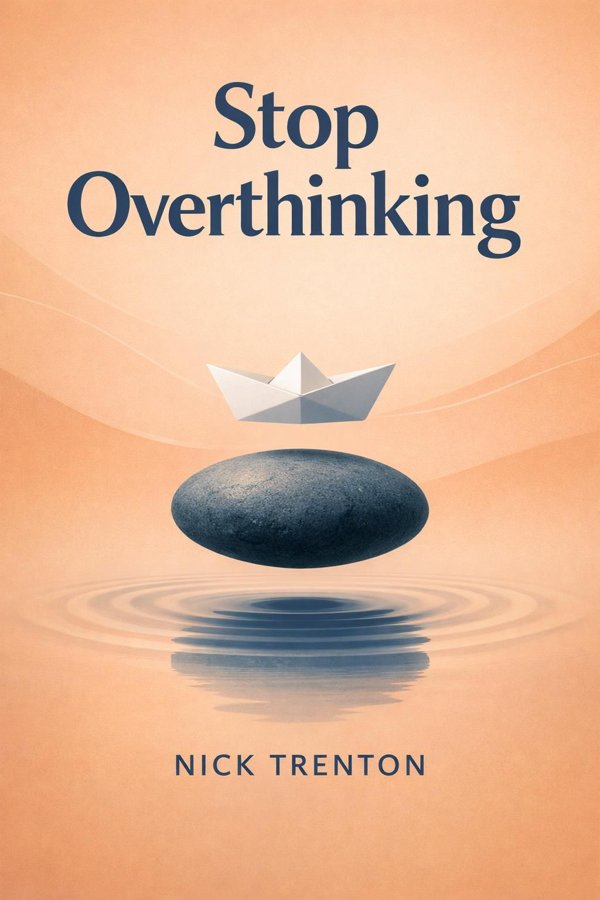
Stop Overthinking: 23 Techniques to Relieve Stress, Stop Negative Spirals, Declutter Your Mind, and Focus on the Present: Summary & Key Insights
by Nick Trenton
 10 min5 chaptersAudio available
What Is Stop Overthinking: 23 Techniques to Relieve Stress, Stop Negative Spirals, Declutter Your Mind, and Focus on the Present About?
Stop Overthinking: 23 Techniques to Relieve Stress, Stop Negative Spirals, Declutter Your Mind, and Focus on the Present by Nick Trenton is a mental_health book spanning 5 pages. Stop Overthinking by Nick Trenton is a practical self-help guide that provides readers with 23 proven techniques to manage anxiety, control negative thought patterns, and cultivate mindfulness. The book focuses on actionable strategies to help individuals declutter their minds, reduce stress, and live more intentionally in the present moment.
This FizzRead summary covers all 5 key chapters of Stop Overthinking: 23 Techniques to Relieve Stress, Stop Negative Spirals, Declutter Your Mind, and Focus on the Present in approximately 10 minutes, distilling the most important ideas, arguments, and takeaways from Nick Trenton's work. Also available as an audio summary and Key Quotes Podcast.
Stop Overthinking: 23 Techniques to Relieve Stress, Stop Negative Spirals, Declutter Your Mind, and Focus on the Present
Stop Overthinking by Nick Trenton is a practical self-help guide that provides readers with 23 proven techniques to manage anxiety, control negative thought patterns, and cultivate mindfulness. The book focuses on actionable strategies to help individuals declutter their minds, reduce stress, and live more intentionally in the present moment.
Who Should Read Stop Overthinking: 23 Techniques to Relieve Stress, Stop Negative Spirals, Declutter Your Mind, and Focus on the Present?
This book is perfect for anyone interested in mental_health and looking to gain actionable insights in a short read. Whether you're a student, professional, or lifelong learner, the key ideas from Stop Overthinking: 23 Techniques to Relieve Stress, Stop Negative Spirals, Declutter Your Mind, and Focus on the Present by Nick Trenton will help you think differently.
- ✓Readers who enjoy mental_health and want practical takeaways
- ✓Professionals looking to apply new ideas to their work and life
- ✓Anyone who wants the core insights of Stop Overthinking: 23 Techniques to Relieve Stress, Stop Negative Spirals, Declutter Your Mind, and Focus on the Present in just 10 minutes
Want the full summary?
Get instant access to this book summary and 100K+ more with Fizz Moment.
Get Free SummaryAvailable on App Store • Free to download
Key Chapters
The first truth about overthinking is that it’s not a personal flaw—it’s a cognitive trap built out of an understandable desire for certainty. Our brains are prediction machines, and when something feels uncertain, we automatically start running simulations of every possible outcome. That might be useful in moderation, but when it becomes habitual, when every small decision spirals into an endless inner debate, it no longer serves us. Instead, it reinforces anxiety.
As I explain, overthinking is a loop. It begins with a trigger—a stressful event, an awkward social situation, an unfinished goal. The mind reacts with emotional discomfort and tries to think its way out of it. But the more you think, the more emotional data you generate; the more feelings arise, the more you think. Thoughts fuel sensations, sensations fuel thoughts. This closed circuit feels like control, but it’s actually the opposite—it’s avoidance dressed up as problem-solving. You’re trying to feel safe by predicting everything that could go wrong, yet you end up feeling overwhelmed precisely because you imagine too much.
To understand overthinking is to see how it thrives on rumination—the repetitive dwelling on what can’t be immediately resolved. Rumination often disguises itself as productive analysis or emotional processing, but it’s stuck thinking, not constructive reflection. Left unchecked, it creates anxiety fatigue and even depression. The key, therefore, is awareness. When you begin to notice that your mind is spinning instead of engaging, when you catch yourself repeating a thought you’ve had twenty times before, you’ve already taken the first step toward freedom. Overthinking loses power the moment you stop believing every thought must be resolved.
In my own journey, this realization was profound: most people don’t need more self-control—they need more self-understanding. Once you recognize the cycle, you can learn to interrupt it not with judgment but with a gentle shift of attention. The mind can’t be forced silent, but it can be guided to presence.
The most powerful antidote to overthinking is the simplest: come back to the present. But simplicity doesn’t mean ease. For those of us with habitually active minds, stillness feels intolerable. We’ve trained our attention to constantly chase the next hypothetical. The purpose of mindfulness is not to empty your mind—it is to return your attention to what is real right now. When you do that often enough, mental noise begins to lose its authority.
In the book, I translate mindfulness into approachable, sensory practices—techniques that help you anchor yourself in tangible experience. For instance, notice the feeling of your feet against the floor when anxiety rises, or pay attention to one slow exhale when worry begins to accelerate. By deliberately shifting focus to something concrete, you interrupt the feedback loop of fear. Mindfulness is really a form of mental decluttering: it strips away everything that’s not actually happening.
Overthinking thrives on abstraction. It lives in tomorrow, in yesterday, in assumptions. The present moment, by contrast, has detail and texture. When you train yourself to observe specific sensory data—the temperature of air on your skin, the sound of a conversation, the weight of an object in your hand—you instinctively disengage from mental simulations because your attention can’t fully rest in both places. This is how grounding works physiologically: it re-engages the sensory cortex and reduces the dominance of the prefrontal worry centers.
Practicing presence doesn’t mean suppressing thought. It means noticing thought as thought. Once you can label an internal dialogue as ‘thinking’ rather than as truth, you can watch it pass like a cloud instead of being swallowed by it. With time, this turns into a habit of non-identification. The mind continues to generate noise, but you no longer chase every echo. That quiet gap between awareness and reaction—that’s where mental freedom begins.
+ 3 more chapters — available in the FizzRead app
All Chapters in Stop Overthinking: 23 Techniques to Relieve Stress, Stop Negative Spirals, Declutter Your Mind, and Focus on the Present
About the Author
Nick Trenton is an author and behavioral psychology enthusiast from Illinois, USA. His work focuses on emotional intelligence, self-improvement, and mental well-being, helping readers develop healthier thought patterns and habits for a more balanced life.
Get This Summary in Your Preferred Format
Read or listen to the Stop Overthinking: 23 Techniques to Relieve Stress, Stop Negative Spirals, Declutter Your Mind, and Focus on the Present summary by Nick Trenton anytime, anywhere. FizzRead offers multiple formats so you can learn on your terms — all free.
Available formats: App · Audio · PDF · EPUB — All included free with FizzRead
Download Stop Overthinking: 23 Techniques to Relieve Stress, Stop Negative Spirals, Declutter Your Mind, and Focus on the Present PDF and EPUB Summary
Key Quotes from Stop Overthinking: 23 Techniques to Relieve Stress, Stop Negative Spirals, Declutter Your Mind, and Focus on the Present
“The first truth about overthinking is that it’s not a personal flaw—it’s a cognitive trap built out of an understandable desire for certainty.”
“The most powerful antidote to overthinking is the simplest: come back to the present.”
Frequently Asked Questions about Stop Overthinking: 23 Techniques to Relieve Stress, Stop Negative Spirals, Declutter Your Mind, and Focus on the Present
Stop Overthinking: 23 Techniques to Relieve Stress, Stop Negative Spirals, Declutter Your Mind, and Focus on the Present by Nick Trenton is a mental_health book that explores key ideas across 5 chapters. Stop Overthinking by Nick Trenton is a practical self-help guide that provides readers with 23 proven techniques to manage anxiety, control negative thought patterns, and cultivate mindfulness. The book focuses on actionable strategies to help individuals declutter their minds, reduce stress, and live more intentionally in the present moment.
You Might Also Like

Big Feelings: How to Be Okay When Things Are Not Okay
Liz Fosslien, Mollie West Duffy
10 min
Creative Arts Therapies Handbook: Art, Music and Dance Therapy Practices for Wellbeing
Susan I. Buchalter
10 min
Emotional First Aid: Healing Rejection, Guilt, Failure, and Other Everyday Hurts
Guy Winch
10 min
Lost Connections: Why You're Depressed and How to Find Hope
Johann Hari
10 min
No Time to Panic: How to Stop Worrying and Embrace Life
Matt Gutman
10 min
Overcoming Mobbing: A Recovery Guide for Workplace Aggression and Bullying
Maureen Duffy, Len Sperry
10 minBrowse by Category
Ready to read Stop Overthinking: 23 Techniques to Relieve Stress, Stop Negative Spirals, Declutter Your Mind, and Focus on the Present?
Get the full summary and 100K+ more books with Fizz Moment.