
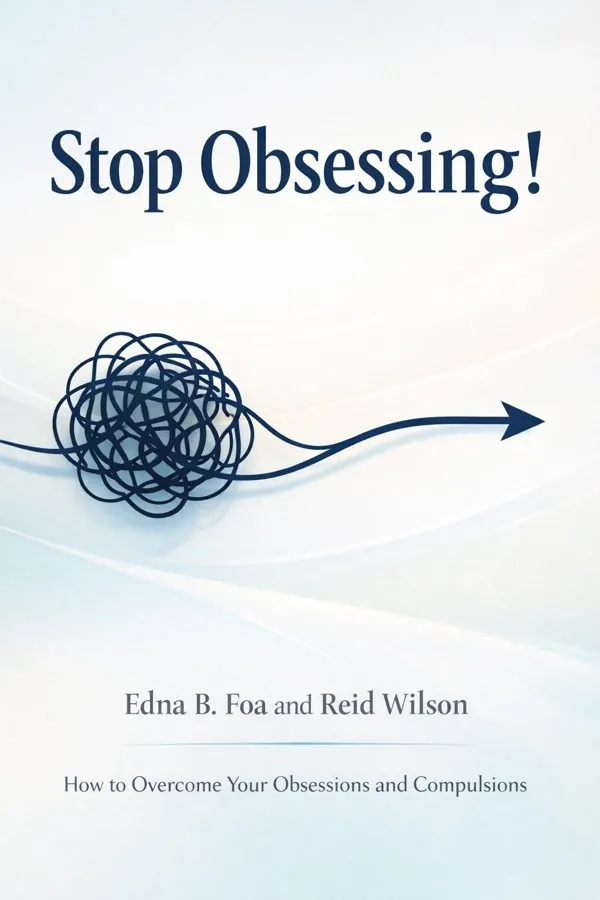
Stop Obsessing!: How to Overcome Your Obsessions and Compulsions: Summary & Key Insights
 10 min4 chaptersAudio available
What Is Stop Obsessing!: How to Overcome Your Obsessions and Compulsions About?
Stop Obsessing!: How to Overcome Your Obsessions and Compulsions by Edna B. Foa and Reid Wilson is a mental_health book spanning 4 pages. This book provides a practical, scientifically grounded approach to overcoming obsessive-compulsive disorder (OCD). Written by leading psychologists Edna Foa and Reid Wilson, it introduces readers to exposure and response prevention (ERP), a proven method for reducing obsessive thoughts and compulsive behaviors. The authors guide readers through step-by-step exercises designed to help them confront fears, resist rituals, and regain control over their lives.
This FizzRead summary covers all 4 key chapters of Stop Obsessing!: How to Overcome Your Obsessions and Compulsions in approximately 10 minutes, distilling the most important ideas, arguments, and takeaways from Edna B. Foa and Reid Wilson's work. Also available as an audio summary and Key Quotes Podcast.
Stop Obsessing!: How to Overcome Your Obsessions and Compulsions
This book provides a practical, scientifically grounded approach to overcoming obsessive-compulsive disorder (OCD). Written by leading psychologists Edna Foa and Reid Wilson, it introduces readers to exposure and response prevention (ERP), a proven method for reducing obsessive thoughts and compulsive behaviors. The authors guide readers through step-by-step exercises designed to help them confront fears, resist rituals, and regain control over their lives.
Who Should Read Stop Obsessing!: How to Overcome Your Obsessions and Compulsions?
This book is perfect for anyone interested in mental_health and looking to gain actionable insights in a short read. Whether you're a student, professional, or lifelong learner, the key ideas from Stop Obsessing!: How to Overcome Your Obsessions and Compulsions by Edna B. Foa and Reid Wilson will help you think differently.
- ✓Readers who enjoy mental_health and want practical takeaways
- ✓Professionals looking to apply new ideas to their work and life
- ✓Anyone who wants the core insights of Stop Obsessing!: How to Overcome Your Obsessions and Compulsions in just 10 minutes
Want the full summary?
Get instant access to this book summary and 100K+ more with Fizz Moment.
Get Free SummaryAvailable on App Store • Free to download
Key Chapters
Imagine the way a small thought—perhaps a random doubt or fleeting image—can suddenly expand into something immense: a fixation that hijacks your attention and feels impossible to ignore. That is how obsessions begin. They are intrusive thoughts, urges, or images that create anxiety because you misidentify them as signs of danger or moral failure. Compulsions are the behaviors or mental rituals you perform to undo or neutralize those thoughts. Together, they form a partnership that sustains suffering.
Every time you perform a ritual to relieve anxiety, your brain learns that avoidance equals safety. The fleeting comfort from a hand wash after contamination fears, or checking the door just one more time, subtly reinforces the idea that anxiety must be escaped. The paradox is this: the more you try to stop anxiety through compulsive relief, the stronger it becomes.
Our first task is to see that anxiety itself is harmless—an unpleasant but safe emotion. The obsession–compulsion cycle thrives on misinterpretation: you see discomfort as danger, and therefore, you act as though it were truly threatening. Reversing OCD starts with acknowledging that anxiety does not require rescue. You can learn to let anxious thoughts occur without performing rituals, recognizing that every act of endurance rewires your fear response.
From this understanding grows power—the power to pause and observe rather than react. OCD cannot survive without your participation; every time you refuse to perform a compulsion, you break one link in its chain. This early awareness sets the stage for real change, because the moment you see that anxiety is tolerable, you also see that you are stronger than you believed.
The transformation begins with Exposure and Response Prevention (ERP), a method we developed and tested through years of clinical research. Exposure means facing the situations, thoughts, or sensations that spark your obsessions. Response prevention means resisting the urge to perform the ritual that normally follows. The sequence is simple: approach the fear, stay present with anxiety, and refrain from using compulsive relief.
ERP rests on one natural law of psychology: anxiety diminishes when you stop feeding avoidance. Think of it this way—fear is like an alarm system wired to your memory of danger. Each time you expose yourself to the feared stimulus without retreating, you teach your brain new information: there is no real danger here. Slowly, the alarm grows quieter.
We encourage organizing exposures through a hierarchy—from least to most disturbing. If contamination fears dominate your life, you might start by touching a doorknob and not washing immediately. Later, you may handle items you once considered unbearable. Each step teaches your mind that anxiety peaks and then falls naturally, without your intervention.
What sustains recovery is your willingness to feel discomfort and not fix it. The exposure process doesn’t eliminate anxiety instantly; it alters your relationship with it. Rather than seeking certainty or relief, you practice acceptance—the skill of living beside uncertainty. Over time, anxiety stops ruling your actions; it becomes background noise, something you can acknowledge and move past.
The heart of ERP is courage in practice. You will learn to invite anxiety in, to let it teach you that distress passes and that you never needed compulsions to survive it. This discovery is the quiet miracle of healing: freedom born not from control, but from surrender to experience.
+ 2 more chapters — available in the FizzRead app
All Chapters in Stop Obsessing!: How to Overcome Your Obsessions and Compulsions
About the Authors
Edna B. Foa is a clinical psychologist and professor at the University of Pennsylvania, internationally recognized for her research on anxiety disorders and OCD. Reid Wilson is a psychologist specializing in anxiety treatment and the author of several self-help books on overcoming fear and worry.
Get This Summary in Your Preferred Format
Read or listen to the Stop Obsessing!: How to Overcome Your Obsessions and Compulsions summary by Edna B. Foa and Reid Wilson anytime, anywhere. FizzRead offers multiple formats so you can learn on your terms — all free.
Available formats: App · Audio · PDF · EPUB — All included free with FizzRead
Download Stop Obsessing!: How to Overcome Your Obsessions and Compulsions PDF and EPUB Summary
Key Quotes from Stop Obsessing!: How to Overcome Your Obsessions and Compulsions
“Imagine the way a small thought—perhaps a random doubt or fleeting image—can suddenly expand into something immense: a fixation that hijacks your attention and feels impossible to ignore.”
“The transformation begins with Exposure and Response Prevention (ERP), a method we developed and tested through years of clinical research.”
Frequently Asked Questions about Stop Obsessing!: How to Overcome Your Obsessions and Compulsions
Stop Obsessing!: How to Overcome Your Obsessions and Compulsions by Edna B. Foa and Reid Wilson is a mental_health book that explores key ideas across 4 chapters. This book provides a practical, scientifically grounded approach to overcoming obsessive-compulsive disorder (OCD). Written by leading psychologists Edna Foa and Reid Wilson, it introduces readers to exposure and response prevention (ERP), a proven method for reducing obsessive thoughts and compulsive behaviors. The authors guide readers through step-by-step exercises designed to help them confront fears, resist rituals, and regain control over their lives.
You Might Also Like
Big Feelings: How to Be Okay When Things Are Not Okay
Liz Fosslien, Mollie West Duffy
10 min
Creative Arts Therapies Handbook: Art, Music and Dance Therapy Practices for Wellbeing
Susan I. Buchalter
10 min
Emotional First Aid: Healing Rejection, Guilt, Failure, and Other Everyday Hurts
Guy Winch
10 min
Lost Connections: Why You're Depressed and How to Find Hope
Johann Hari
10 min
No Time to Panic: How to Stop Worrying and Embrace Life
Matt Gutman
10 min
Overcoming Mobbing: A Recovery Guide for Workplace Aggression and Bullying
Maureen Duffy, Len Sperry
10 minBrowse by Category
Ready to read Stop Obsessing!: How to Overcome Your Obsessions and Compulsions?
Get the full summary and 100K+ more books with Fizz Moment.