
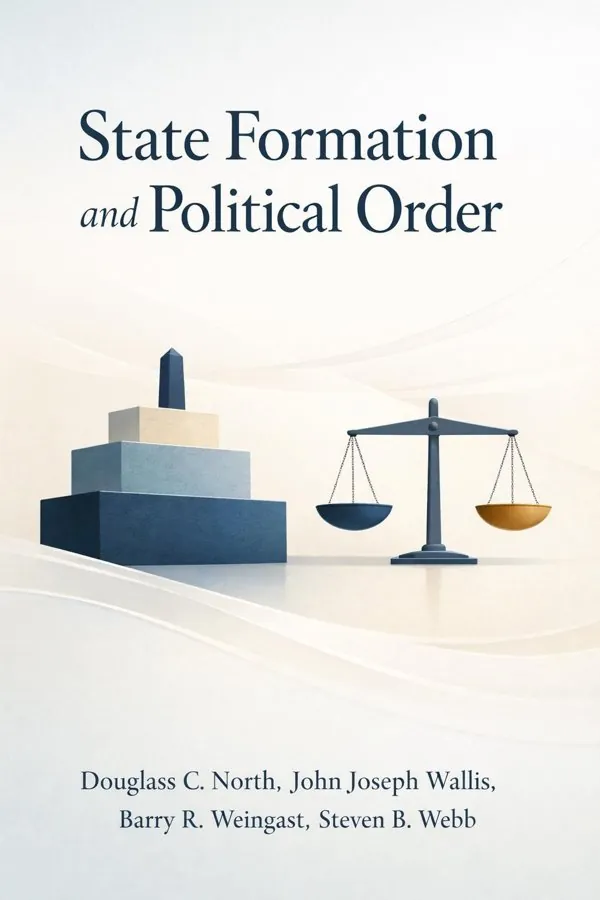
State Formation and Political Order: The Political Economy of Institutions and Decisions: Summary & Key Insights
by Douglass C. North, John Joseph Wallis, Barry R. Weingast, Steven B. Webb
 10 min9 chaptersAudio available
Key Takeaways from State Formation and Political Order: The Political Economy of Institutions and Decisions
A society’s first political problem is not prosperity, justice, or even representation; it is violence.
Most societies in human history have not been open, competitive, or broadly inclusive.
Institutions do not float above society; they are shaped by the organizations that operate within them.
Societies do not jump directly from fragile patronage systems to modern open democracies.
Open access orders are rare in history, but where they emerge, they transform both politics and economics.
What Is State Formation and Political Order: The Political Economy of Institutions and Decisions About?
State Formation and Political Order: The Political Economy of Institutions and Decisions by Douglass C. North, John Joseph Wallis, Barry R. Weingast, Steven B. Webb is a politics book spanning 9 pages. Why do some societies become stable, prosperous, and politically inclusive while others remain trapped in corruption, violence, and fragility? In State Formation and Political Order: The Political Economy of Institutions and Decisions, Douglass C. North, John Joseph Wallis, Barry R. Weingast, and Steven B. Webb tackle that question by linking political power, economic incentives, and institutional design. Their core insight is that political order does not emerge automatically from elections, markets, or constitutional language. It is built through arrangements that control violence, organize elite competition, and shape who can access economic and political opportunities. The book matters because it offers a realistic alternative to simplistic development advice. Instead of assuming all countries should immediately imitate modern democracies, the authors explain how most societies historically operate as limited access orders, where elites preserve peace by restricting entry to organizations, offices, and valuable markets. They then show how some societies gradually transition toward open access orders, where impersonal rules, broad participation, and durable institutions support growth and liberty. With North’s Nobel Prize-winning authority in institutional economics and his coauthors’ deep expertise in political economy and governance, this book provides one of the most influential frameworks for understanding state formation, development, and political order.
This FizzRead summary covers all 9 key chapters of State Formation and Political Order: The Political Economy of Institutions and Decisions in approximately 10 minutes, distilling the most important ideas, arguments, and takeaways from Douglass C. North, John Joseph Wallis, Barry R. Weingast, Steven B. Webb's work. Also available as an audio summary and Key Quotes Podcast.
State Formation and Political Order: The Political Economy of Institutions and Decisions
Why do some societies become stable, prosperous, and politically inclusive while others remain trapped in corruption, violence, and fragility? In State Formation and Political Order: The Political Economy of Institutions and Decisions, Douglass C. North, John Joseph Wallis, Barry R. Weingast, and Steven B. Webb tackle that question by linking political power, economic incentives, and institutional design. Their core insight is that political order does not emerge automatically from elections, markets, or constitutional language. It is built through arrangements that control violence, organize elite competition, and shape who can access economic and political opportunities.
The book matters because it offers a realistic alternative to simplistic development advice. Instead of assuming all countries should immediately imitate modern democracies, the authors explain how most societies historically operate as limited access orders, where elites preserve peace by restricting entry to organizations, offices, and valuable markets. They then show how some societies gradually transition toward open access orders, where impersonal rules, broad participation, and durable institutions support growth and liberty. With North’s Nobel Prize-winning authority in institutional economics and his coauthors’ deep expertise in political economy and governance, this book provides one of the most influential frameworks for understanding state formation, development, and political order.
Who Should Read State Formation and Political Order: The Political Economy of Institutions and Decisions?
This book is perfect for anyone interested in politics and looking to gain actionable insights in a short read. Whether you're a student, professional, or lifelong learner, the key ideas from State Formation and Political Order: The Political Economy of Institutions and Decisions by Douglass C. North, John Joseph Wallis, Barry R. Weingast, Steven B. Webb will help you think differently.
- ✓Readers who enjoy politics and want practical takeaways
- ✓Professionals looking to apply new ideas to their work and life
- ✓Anyone who wants the core insights of State Formation and Political Order: The Political Economy of Institutions and Decisions in just 10 minutes
Want the full summary?
Get instant access to this book summary and 100K+ more with Fizz Moment.
Get Free SummaryAvailable on App Store • Free to download
Key Chapters
A society’s first political problem is not prosperity, justice, or even representation; it is violence. The authors begin from a stark but clarifying premise: any social order must find a way to control organized violence among groups capable of fighting. Political institutions are therefore not abstract moral achievements. They are practical arrangements that make peace more rewarding than conflict for powerful actors.
This is the foundation of the book’s framework. When multiple individuals or coalitions possess the means to use force, stability depends on creating incentives for them to cooperate rather than compete violently. Institutions, organizations, and belief systems all help structure those incentives. Governments are not merely neutral enforcers of law; they are themselves organizations embedded in broader balances of power. The army, political parties, courts, business groups, clans, and regional elites all matter because they shape who can threaten order and who can preserve it.
Think of a fragile state where local militias, wealthy families, military officers, and political bosses each command followers. In such a setting, writing a liberal constitution may achieve little if those groups do not believe their interests are protected. By contrast, even imperfect arrangements can produce order when elites receive enough benefits from cooperation to avoid open conflict.
This insight has broad applications. It helps explain why state-building efforts often fail when outsiders focus on elections or legal reform without understanding the local violence structure. It also explains why some regimes that appear inefficient can persist for long periods: they are solving, however imperfectly, the problem of elite violence.
Actionable takeaway: when evaluating any political system, first ask how it controls violence and aligns powerful groups behind order. Without that, every other reform rests on unstable ground.
Most societies in human history have not been open, competitive, or broadly inclusive. They have been what the authors call limited access orders, also known as natural states. Their defining logic is simple: elites maintain peace by restricting access to valuable political and economic opportunities. Privilege is not a side effect of the system; it is the mechanism that keeps the system together.
In a limited access order, powerful groups receive rents through monopolies, offices, licenses, land rights, patronage, or protected business opportunities. These privileges give them a stake in preserving the system rather than attacking it. Instead of fighting over total control, elites share enough benefits to make cooperation preferable. Political order, then, depends on structured exclusion.
This idea challenges modern assumptions. We often think corruption, favoritism, and closed markets are simply failures to modernize. The authors argue that in many contexts they are part of the political bargain that restrains violence. That does not make them desirable, but it does make them intelligible. A ruler may distribute import licenses, state contracts, or military commands not only to reward allies, but to prevent destabilizing conflict among rival factions.
Examples appear across history and in many developing states today. Feudal arrangements, patronage-based party systems, and oligarchic business networks can all function as limited access orders. These systems often generate some stability and growth, but they usually block broad competition, reduce innovation, and keep institutions personal rather than impersonal.
For reformers, this means that simply abolishing privileges can be dangerous if no alternative mechanism exists to keep elites committed to peace. Removing rents without creating new institutions may intensify conflict rather than reduce it.
Actionable takeaway: do not treat elite privileges only as moral failures; analyze which political bargains they sustain, and design reforms that replace their stabilizing function instead of merely denouncing them.
Institutions do not float above society; they are shaped by the organizations that operate within them. One of the book’s most valuable insights is the constant interaction between institutions, which are the rules of the game, and organizations, which are the players built to pursue goals within those rules. Political order changes when that relationship changes.
In limited access orders, organizations are often personal and privilege-based. Political parties revolve around leaders, businesses depend on connections, and public agencies serve factional interests. Because access is restricted, organizations themselves reinforce exclusion. They are not independent arenas of competition; they are vehicles for managing elite bargains.
As societies become more complex, however, organizations can put pressure on institutions. Expanding commerce may require more reliable contract enforcement. A professional military may demand clearer chains of command. Regional interests may push for more predictable political representation. Over time, organizations that need stability and scale can become carriers of institutional transformation.
The reverse is also true. When institutions become more impersonal and durable, they allow new organizations to form. Secure incorporation laws, independent courts, and transparent administrative procedures encourage businesses, civic groups, parties, and media organizations to emerge beyond elite patronage. This creates a virtuous cycle of broader access.
A practical example is the contrast between a country where opening a business requires personal ties to ministers and one where any citizen can register a corporation under predictable law. In the first, business organization remains tied to politics. In the second, economic and social groups can organize autonomously, changing the political landscape itself.
This framework is useful for understanding why transplanted institutions often fail. A constitutional court, an anticorruption agency, or a civil service law cannot function as intended if the surrounding organizations remain deeply personal and rent-seeking.
Actionable takeaway: when assessing reform, examine both the formal rules and the organizations that must live under them. Durable change happens when institutions and organizations reinforce each other.
Societies do not jump directly from fragile patronage systems to modern open democracies. The authors argue that successful transitions occur through specific preconditions they call doorstep conditions. These conditions make it possible for a limited access order to begin moving toward an open access order without collapsing into violence.
The first doorstep condition is rule of law for elites. Even if law is not yet universal, powerful actors must begin to accept that some rules apply beyond personal whim. The second is the existence of perpetually lived organizations in the public and private spheres, meaning organizations that outlast particular individuals. The third is consolidated political control of the military, so violence is not independently available to competing factions.
These conditions matter because they reduce the personalization of power. If elite rights are more secure, conflict becomes less existential. If organizations endure beyond leaders, social coordination becomes more predictable. If the military is subordinated to political authority, disputes are less likely to escalate into armed confrontation.
Consider a state where each election threatens imprisonment or exile for the losers, businesses collapse when founders die, and generals operate as autonomous political actors. In that environment, broad political competition is too dangerous. By contrast, when elite rivals can lose office without losing everything, when firms and parties survive leadership change, and when armed force is centralized, more open competition becomes imaginable.
This is an especially important corrective for development policy. It suggests that reform sequencing matters. Demanding immediate mass inclusion, unfettered competition, or full legal universalism without first improving elite rule of law and organizational durability may produce instability rather than progress.
Actionable takeaway: evaluate whether a society has the basic doorstep conditions for openness, and if not, prioritize reforms that strengthen elite legal constraints, durable organizations, and civilian control over violence.
Open access orders are rare in history, but where they emerge, they transform both politics and economics. Their central feature is not perfection or total equality. It is open entry. Individuals and groups can create organizations, compete in markets, contest political power, and defend rights under impersonal rules rather than personal privilege.
In an open access order, competition is the stabilizing mechanism. Political parties can form without elite permission. Businesses can enter markets without negotiating special favors. Civil associations, universities, media outlets, and advocacy groups can organize continuously. Because access is open, rents are harder to preserve, and power must be justified through rules rather than exclusive bargains.
This shift has enormous consequences. Economically, open entry encourages innovation, investment, and productivity because success depends less on connections and more on performance. Politically, it lowers the stakes of competition because losers are not permanently excluded from the system. Socially, it multiplies organizations that can check state power and represent diverse interests.
Examples include modern constitutional democracies with strong corporate law, competitive elections, independent courts, and broad associational freedom. Such societies are hardly free from inequality or conflict, but they tend to channel conflict through institutions rather than violence. Importantly, their stability comes not from suppressing competition, but from making competition safe and regular.
The authors emphasize that open access orders are sustained by beliefs as well as formal laws. Citizens and elites alike must expect that organizations can form, rivals can compete, and rules will remain in force across political turnover. Once those expectations are embedded, the system becomes self-reinforcing.
Actionable takeaway: to recognize genuine openness, look for whether ordinary people can form organizations and compete under impersonal rules, not merely whether a constitution promises liberty on paper.
Economic growth is often treated as a technical challenge of investment, trade, or education. This book insists that growth is deeply political. The structure of political order determines who can access opportunities, how secure property rights are, whether organizations can form freely, and whether elites allow creative destruction. In that sense, economic development depends on the political economy of access.
Limited access orders can generate growth for periods of time. Elites may support infrastructure, trade, or industrial policy when it benefits their coalition. But such growth is usually constrained. Monopoly rights, regulatory favoritism, and personal rule discourage broad entrepreneurship and weaken long-term credibility. Investors hesitate when economic success depends on remaining close to those in power.
Open access orders, by contrast, create more durable conditions for sustained development because entry is wider and rules are more predictable. Entrepreneurs can invest without first joining a political patronage network. Courts are more likely to enforce contracts impartially. Organizations from banks to universities to civic groups can emerge and support a complex economy.
This perspective helps explain why some countries experience bursts of growth without institutional transformation, only to stagnate later. Resource booms, protected industries, or charismatic governments may temporarily raise output, but if access remains restricted, the economy often cannot adapt or diversify. Political closure eventually limits economic dynamism.
The argument also warns against purely technocratic reform. Better tax systems, business regulations, or development plans matter, but their impact depends on the underlying political settlement. If elites use the state primarily to distribute rents and suppress challengers, economic policy will be bent toward those ends.
Actionable takeaway: when thinking about development, ask who gets access to organizations, markets, and rights. Sustainable prosperity comes from expanding impersonal access, not only from improving policy technique.
One of the book’s strengths is its historical sensibility. Rather than proposing a single universal model, the authors show that societies have followed different paths in forming states and political order. The contrast between fragile states, basic natural states, mature natural states, and open access orders helps explain why institutional development is uneven and context-dependent.
Fragile states struggle to maintain centralized control of violence. Their institutions are weak, and elite bargains are unstable. Basic natural states achieve a limited settlement among powerful actors but remain vulnerable. Mature natural states build more durable public and private organizations, creating greater stability while still limiting access. Open access orders go further by generalizing organizational rights and impersonal competition.
This layered view helps make sense of historical cases. Medieval European kingdoms, postcolonial states, military-dominated regimes, and modern democracies differ not simply in how rich they are, but in how they structure access and control violence. A mature natural state may have functioning courts, bureaucracies, and large firms, yet still reserve meaningful opportunity for insiders. That is a different problem from the chaos of a fragile state and requires different remedies.
This framework is practical because it discourages lazy comparison. It is not useful to measure a fragile state directly against an advanced democracy and conclude that it lacks everything. More useful is identifying where it sits in the progression of political order, what kinds of organizations it can sustain, and what reforms are realistic at that stage.
For students, policymakers, and analysts, this historical approach deepens strategic thinking. Institutional reforms succeed when they fit the society’s current level of organizational capacity and political settlement.
Actionable takeaway: diagnose political systems by stage and structure, not by ideals alone. The right reform depends on whether a society is fragile, limited-access but stable, or moving toward openness.
Political order is never permanently solved. Even stable states can decay if institutions stop adapting, if organizations become captured, or if elites abandon the norms that make competition peaceful. The book’s framework is therefore not only about how order emerges, but also about how it is sustained over time.
In limited access orders, maintenance often means continual renegotiation among elites. Rents must be distributed, conflicts managed, and challengers incorporated or suppressed. These systems can endure for long periods, but they remain vulnerable to shocks such as fiscal crisis, succession struggles, or changes in military power. Their stability depends heavily on personalized bargains.
Open access orders are more resilient, but not invulnerable. They rely on impersonal institutions, broad organizational entry, and the belief that competition can occur without destroying the system. If those beliefs weaken, politics can become more exclusionary, more polarized, and more tied to personal power. Economic concentration, attacks on independent institutions, and politicization of security forces can all erode openness.
A modern example might be a democracy where political losers increasingly view defeat as catastrophic, where independent agencies are turned into partisan tools, and where public trust in rules collapses. Even if elections continue, the underlying logic of openness is under strain. Stability then requires active institutional defense, not complacency.
The authors implicitly remind us that institutions are not self-executing. Courts need legitimacy, bureaucracies need professionalism, and civic organizations need room to operate. Sustaining order means preserving the organizational ecosystem that makes impersonal competition credible.
Actionable takeaway: treat political stability as an ongoing achievement. Support the institutions and norms that make conflict manageable before crisis reveals how fragile they have become.
Perhaps the book’s most important practical lesson is that policy advice fails when it ignores the underlying social order. Reformers often recommend best-practice institutions such as competitive elections, anticorruption agencies, independent regulators, and market liberalization as if these tools work the same way everywhere. The authors argue that outcomes depend on the political order into which such reforms are introduced.
In a limited access order, imported institutions may be repurposed to serve elite bargains. Elections become patronage contests. Regulatory bodies become new sites of rent distribution. Privatization transfers assets to insiders. Anticorruption campaigns weaken rivals rather than strengthen law. The problem is not that reform ideas are inherently bad. It is that they interact with existing incentives.
This does not mean reform is futile. It means reform must be sequenced and adapted. A realistic strategy asks what forms of change can strengthen organizational durability, legal credibility, and controlled competition without destabilizing the coalition that holds violence in check. In some cases, expanding local administrative capacity or clarifying elite legal rights may matter more than immediately copying the institutions of advanced democracies.
Development agencies, constitutional designers, and political leaders can all benefit from this perspective. Instead of asking, “What institutions do rich democracies have?” they should ask, “What institutional changes can this society sustain, given how power is organized today?” That shift from ideal forms to political feasibility is one of the book’s greatest contributions.
The argument also applies beyond state-building. In organizations, firms, and communities, formal rules only work when they fit underlying incentives and power relations.
Actionable takeaway: before proposing reform, map the real distribution of power, violence, and organizational interests. Effective policy starts with institutional realism, not institutional wishful thinking.
All Chapters in State Formation and Political Order: The Political Economy of Institutions and Decisions
About the Authors
Douglass C. North (1920–2015) was an American economist and Nobel laureate whose groundbreaking work in institutional economics transformed how scholars understand long-run economic and political development. He showed that institutions, not just resources or technology, shape national outcomes. John Joseph Wallis is an economic historian known for his research on American development, public finance, and the evolution of political institutions. Barry R. Weingast is a major figure in political economy whose work explores constitutional systems, market-supporting institutions, and the foundations of democracy. Steven B. Webb is a scholar and development specialist with deep expertise in governance, public sector reform, and state capacity. Together, these authors bring economics, history, and political science into a single influential framework for understanding state formation and political order.
Get This Summary in Your Preferred Format
Read or listen to the State Formation and Political Order: The Political Economy of Institutions and Decisions summary by Douglass C. North, John Joseph Wallis, Barry R. Weingast, Steven B. Webb anytime, anywhere. FizzRead offers multiple formats so you can learn on your terms — all free.
Available formats: App · Audio · PDF · EPUB — All included free with FizzRead
Download State Formation and Political Order: The Political Economy of Institutions and Decisions PDF and EPUB Summary
Key Quotes from State Formation and Political Order: The Political Economy of Institutions and Decisions
“A society’s first political problem is not prosperity, justice, or even representation; it is violence.”
“Most societies in human history have not been open, competitive, or broadly inclusive.”
“Institutions do not float above society; they are shaped by the organizations that operate within them.”
“Societies do not jump directly from fragile patronage systems to modern open democracies.”
“Open access orders are rare in history, but where they emerge, they transform both politics and economics.”
Frequently Asked Questions about State Formation and Political Order: The Political Economy of Institutions and Decisions
State Formation and Political Order: The Political Economy of Institutions and Decisions by Douglass C. North, John Joseph Wallis, Barry R. Weingast, Steven B. Webb is a politics book that explores key ideas across 9 chapters. Why do some societies become stable, prosperous, and politically inclusive while others remain trapped in corruption, violence, and fragility? In State Formation and Political Order: The Political Economy of Institutions and Decisions, Douglass C. North, John Joseph Wallis, Barry R. Weingast, and Steven B. Webb tackle that question by linking political power, economic incentives, and institutional design. Their core insight is that political order does not emerge automatically from elections, markets, or constitutional language. It is built through arrangements that control violence, organize elite competition, and shape who can access economic and political opportunities. The book matters because it offers a realistic alternative to simplistic development advice. Instead of assuming all countries should immediately imitate modern democracies, the authors explain how most societies historically operate as limited access orders, where elites preserve peace by restricting entry to organizations, offices, and valuable markets. They then show how some societies gradually transition toward open access orders, where impersonal rules, broad participation, and durable institutions support growth and liberty. With North’s Nobel Prize-winning authority in institutional economics and his coauthors’ deep expertise in political economy and governance, this book provides one of the most influential frameworks for understanding state formation, development, and political order.
You Might Also Like
Antifa: The Anti-Fascist Handbook
Mark Bray
10 min
Attack from Within: How Disinformation Is Sabotaging America
Barbara McQuade
10 min
Coercion, Capital, and European States, AD 990–1992
Charles Tilly
10 min
Digital Democracy: Concepts, Methodologies, Tools, and Applications
Various Authors
10 min
Fascism
Stanley G. Payne
10 min
Fire And Fury: Inside The Trump White House
Michael Wolff
10 minBrowse by Category
Ready to read State Formation and Political Order: The Political Economy of Institutions and Decisions?
Get the full summary and 100K+ more books with Fizz Moment.