
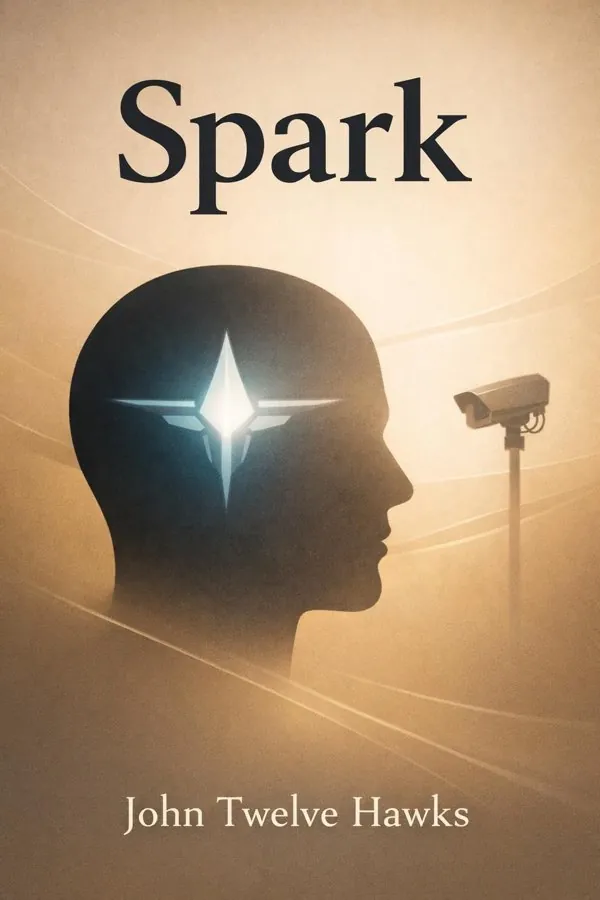
Spark: Summary & Key Insights
 10 min3 chaptersAudio available
What Is Spark About?
Spark by John Twelve Hawks is a scifi_fantasy book spanning 3 pages. Spark is a dystopian science fiction novel set in a near-future world where surveillance and artificial intelligence dominate human life. The story follows Jacob Underwood, a man who believes he is dead and works as a 'human drone' for a powerful corporation, carrying out morally ambiguous tasks. As he becomes entangled in a mysterious disappearance, he begins to question his identity and the nature of consciousness.
This FizzRead summary covers all 3 key chapters of Spark in approximately 10 minutes, distilling the most important ideas, arguments, and takeaways from John Twelve Hawks's work. Also available as an audio summary and Key Quotes Podcast.
Spark
Spark is a dystopian science fiction novel set in a near-future world where surveillance and artificial intelligence dominate human life. The story follows Jacob Underwood, a man who believes he is dead and works as a 'human drone' for a powerful corporation, carrying out morally ambiguous tasks. As he becomes entangled in a mysterious disappearance, he begins to question his identity and the nature of consciousness.
Who Should Read Spark?
This book is perfect for anyone interested in scifi_fantasy and looking to gain actionable insights in a short read. Whether you're a student, professional, or lifelong learner, the key ideas from Spark by John Twelve Hawks will help you think differently.
- ✓Readers who enjoy scifi_fantasy and want practical takeaways
- ✓Professionals looking to apply new ideas to their work and life
- ✓Anyone who wants the core insights of Spark in just 10 minutes
Want the full summary?
Get instant access to this book summary and 100K+ more with Fizz Moment.
Get Free SummaryAvailable on App Store • Free to download
Key Chapters
I remember the world I built around Jacob Underwood — a cold architecture of order where humanity has traded intimacy for efficiency. DBG Corporation, the multinational giant at the center of this narrative, isn’t evil simply by intent; its corruption is systemic. Its employees act as extensions of algorithms, executing commands optimized for profit. Privacy has dissolved into data points. Choice is an illusion generated by predictive models. Within that sterile scaffolding, Jacob exists as the perfect instrument.
Jacob suffers from Cotard’s Syndrome — a psychological condition that convinces him he is dead. He interprets his pulse, his breath, his movements as mere mechanical functions of flesh. To him, the world is composed of objects, not emotions. This self-conviction makes him invaluable to DBG: he cannot hesitate over morality because he does not believe morality applies to him. My portrayal of Jacob is not simply medical; it’s symbolic. He represents the logical conclusion of modern alienation — a being so anesthetized to the human network that he can navigate systems without guilt.
Through his clinical perception, I wanted readers to experience how individuals vanish inside surveillance structures. The way Jacob views people through the filters of security data or transactional histories mirrors our own habit of reducing others to profiles and metrics. The technological layers smother empathy. Yet, within that detachment, Jacob’s subtle observations carry the seeds of awakening. When he senses the mechanical hum of drones overhead or the rhythmic flicker of digital billboards, it echoes an underlying question — if everything is programmed, what initiates genuine thought?
DBG’s world amplifies this dilemma. Artificial intelligence and human labor are fused; the moral web that once distinguished purpose from exploitation has collapsed. As Jacob walks through offices designed for surveillance and control, each encounter reflects a different facet of dehumanization. His colleagues are data points in motion. His assignments, often involving the retrieval or termination of subjects, are executed with cold precision. Yet, behind this surface order, the corporate structure hides rot — an ethical decay that parallels Jacob’s psychological numbness.
Within these first chapters, the tone oscillates between suspense and existential inquiry. The reader learns to see through Jacob’s dead eyes, and in doing so, perceives the stark absurdity of a world that calls itself alive while functioning entirely like machinery. He is the drone within the drone hive, an avatar of all who have surrendered feeling for utility. And that realization — the quiet discomfort that begins to form inside his numbness — is the story’s first spark of rebellion.
Jacob’s assignment to locate Emily Buchanan marks the turning point of his existence. In narrative terms, I used Emily as a catalyst, an embodiment of the unpredictable human factor that no algorithm can neutralize. She is not simply missing; her disappearance is both literal and metaphoric — she has escaped DBG’s web, taking with her sensitive data that threatens to expose the corporation’s hidden manipulations.
When Jacob receives the task to find her, he approaches it like any other mission: detached, procedural, defined by coordinates and protocols. He interprets the case not as a moral pursuit but as a logistical correction. Yet, as he retraces her steps through cities, data servers, and human networks, the act of following her becomes the act of rediscovering what he has lost — curiosity, empathy, choice.
Emily’s absence forces Jacob into spaces of ambiguity. For the first time, he must question information sources that are shaped by corporate interests. DBG feeds him partial truths, falsified trail markers, and algorithmic predictions that skew his judgment. When Jacob encounters individuals who knew Emily — those living on the edges of surveillance grids — he glimpses fragments of authenticity, people who resist being digitized. Their existence destabilizes his belief that everything operates according to deterministic logic.
Emily herself, even in absence, functions as the story’s moral signal. I wanted her to represent integrity amid corruption. Her defection reveals that rebellion is not irrational but deeply human. As Jacob immerses in the search, flashes of emotion begin to interrupt his dead routine — a hint of anger when deceived, a trace of admiration for her courage, a flicker of fear when sensing his employers’ true reach. These sensations are alien to him and, within his Cotard’s logic, signal malfunction. But the reader perceives them as resurrection.
By pursuing Emily, Jacob unwittingly pursues himself. Each clue about her life — her dissatisfaction with DBG’s ethics, her desire for authenticity — serves as a mirror. Their eventual interaction, once she is found, becomes a confrontation between two kinds of existence: one void of soul and one defined by choice. Emily sees in Jacob what the system has erased; Jacob sees in Emily what he might reclaim. This dynamic transforms the investigation from thriller to introspection.
In this part of their intertwined journey, I wished to dissolve the barrier between hunter and prey. The missing woman becomes the teacher; the dead man becomes the awakened. Their meeting is not sentimental — it is fraught with tension, surveillance, and danger — yet beneath that external urgency, the deeper narrative pulse begins to emerge. Jacob starts to recognize the corporate deception surrounding him, but more importantly, he begins to sense the faint warmth of being alive. That warmth frightens him, yet it also compels him forward. For the first time, the drone hesitates before a command — because something inside him whispers dissent.
+ 1 more chapters — available in the FizzRead app
All Chapters in Spark
About the Author
John Twelve Hawks is an American author known for his reclusive nature and his exploration of themes such as surveillance, freedom, and technology. He gained international recognition with his Fourth Realm Trilogy and continues to write speculative fiction that challenges modern social structures.
Get This Summary in Your Preferred Format
Read or listen to the Spark summary by John Twelve Hawks anytime, anywhere. FizzRead offers multiple formats so you can learn on your terms — all free.
Available formats: App · Audio · PDF · EPUB — All included free with FizzRead
Download Spark PDF and EPUB Summary
Key Quotes from Spark
“I remember the world I built around Jacob Underwood — a cold architecture of order where humanity has traded intimacy for efficiency.”
“Jacob’s assignment to locate Emily Buchanan marks the turning point of his existence.”
Frequently Asked Questions about Spark
Spark by John Twelve Hawks is a scifi_fantasy book that explores key ideas across 3 chapters. Spark is a dystopian science fiction novel set in a near-future world where surveillance and artificial intelligence dominate human life. The story follows Jacob Underwood, a man who believes he is dead and works as a 'human drone' for a powerful corporation, carrying out morally ambiguous tasks. As he becomes entangled in a mysterious disappearance, he begins to question his identity and the nature of consciousness.
You Might Also Like
Red Rising
Pierce Brown
10 min
Stranger in a Strange Land
Robert A. Heinlein
10 min
AI Valley
Chen Qiufan
10 min
Bloodchild
Octavia E. Butler
10 min
Do Androids Dream of Electric Sheep?
Philip K. Dick
10 min
Jujutsu Kaisen, Vol. 24
Gege Akutami
10 minBrowse by Category
Ready to read Spark?
Get the full summary and 100K+ more books with Fizz Moment.