
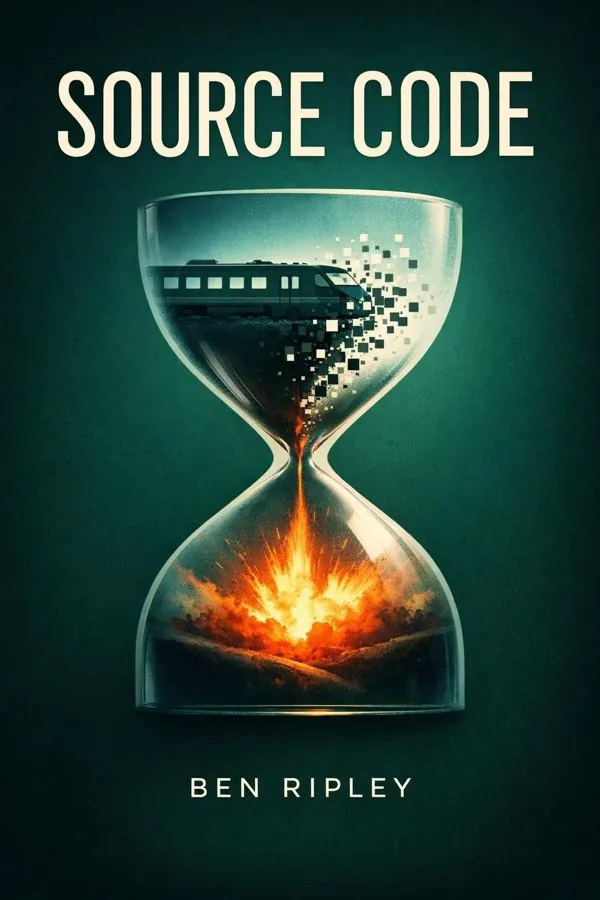
Source Code: Summary & Key Insights
by Ben Ripley
 10 min4 chaptersAudio available
What Is Source Code About?
Source Code by Ben Ripley is a scifi_fantasy book spanning 4 pages. Source Code is a science fiction thriller novelization based on the 2011 film of the same name. It follows Captain Colter Stevens, a soldier who wakes up in another man’s body and discovers he is part of a government experiment that allows him to relive the last eight minutes of another person’s life to prevent a terrorist attack. The story explores identity, time loops, and moral dilemmas surrounding technology and sacrifice.
This FizzRead summary covers all 4 key chapters of Source Code in approximately 10 minutes, distilling the most important ideas, arguments, and takeaways from Ben Ripley's work. Also available as an audio summary and Key Quotes Podcast.
Source Code
Source Code is a science fiction thriller novelization based on the 2011 film of the same name. It follows Captain Colter Stevens, a soldier who wakes up in another man’s body and discovers he is part of a government experiment that allows him to relive the last eight minutes of another person’s life to prevent a terrorist attack. The story explores identity, time loops, and moral dilemmas surrounding technology and sacrifice.
Who Should Read Source Code?
This book is perfect for anyone interested in scifi_fantasy and looking to gain actionable insights in a short read. Whether you're a student, professional, or lifelong learner, the key ideas from Source Code by Ben Ripley will help you think differently.
- ✓Readers who enjoy scifi_fantasy and want practical takeaways
- ✓Professionals looking to apply new ideas to their work and life
- ✓Anyone who wants the core insights of Source Code in just 10 minutes
Want the full summary?
Get instant access to this book summary and 100K+ more with Fizz Moment.
Get Free SummaryAvailable on App Store • Free to download
Key Chapters
I woke surrounded by the rhythmic hum of a commuter train hurtling toward downtown Chicago. Across from me sat Christina, a woman whose voice carried an easy familiarity, whose smile told of shared mornings I had never lived. But as I caught my reflection in the window, confusion gripped me—the face was not mine. The man whose identity I inhabited was Sean Fentress, a schoolteacher caught in the ordinary rhythm of life, unaware of the storm about to unfold. In those brief minutes, the sense of displacement swelled: memories I didn’t own collided with instincts honed by combat.
It was only when the train exploded—metal twisted, glass shattered, fire roared—that I understood something greater was at play. I did not die. Instead, I awoke inside a sterile pod, disoriented, with the voice of a woman named Goodwin calmly guiding me to focus. She was my tether to reality—or what passed for it. My mind, my thoughts, my consciousness—all confined within a system that reactivated those final eight minutes of another man’s life. The transition between realities felt seamless, yet beneath the surface, the question tore through me: what was real, and what had I become?
That awakening was more than a shock; it was the threshold of transformation. From soldier to investigator, from man of flesh to ghost of cognition, I began to realize that I existed in fragments—the dying body of Captain Colter Stevens preserved by machines, my mind projected through the Source Code to achieve a mission that demanded repeating death itself. Every return to the train was another rebirth, another test of purpose. And in the quiet between explosions, I began to see the beauty in the fleeting moments, even as I searched for meaning in them.
Dr. Rutledge, the architect of the Source Code, described it as the pinnacle of quantum reconfiguration—a means of sending consciousness into the electromagnetic afterglow of a recently deceased brain. It sounded clinical, detached, perhaps even miraculous. For me, it was torment disguised as duty. Rutledge’s words were laced with precision and control, but I saw the cracks: the utilitarian calm of a man who saw human lives as data points in his grand design. To him, those eight minutes offered endless variables to collapse probability into certainty. To me, they were a battlefield, one where emotional truth collided with technological ambition.
In each iteration, I boarded the train searching for the bomber. The suspects varied—the man with the suspicious bag, the businessman hiding discomfort, the nervous youth glancing at his watch. Each loop revealed new fragments of humanity: kindness, impatience, love. The tragedy was that these people were already dead in the reality Rutledge inhabited. Yet in mine, they were vividly alive, sharing laughter, hope, even mundane frustrations. That realization shifted my perspective. The mission was not solely about prevention—it was about honoring the fleeting pulse of existence that each loop preserved.
As the loops accumulated, so did my understanding of the Source Code’s paradox. It wasn’t a simulation, as Rutledge insisted; it was another timeline, another strand of reality birthed by repetition. In that realization lay both hope and rebellion. For if alternate realities could exist, then perhaps death wasn’t the end—and maybe I could save these people for real, not just identify their killer. The Source Code became a crucible of morality: was I playing God, rewriting time for my comfort, or fulfilling my duty as a man who refused to let tragedy repeat? That question became the measure of my humanity.
+ 2 more chapters — available in the FizzRead app
All Chapters in Source Code
About the Author
Ben Ripley is an American screenwriter known for his work in science fiction and thriller genres. He wrote the screenplay for the film Source Code, which was later adapted into a novelization. Ripley’s writing often explores complex scientific and ethical questions through suspenseful storytelling.
Get This Summary in Your Preferred Format
Read or listen to the Source Code summary by Ben Ripley anytime, anywhere. FizzRead offers multiple formats so you can learn on your terms — all free.
Available formats: App · Audio · PDF · EPUB — All included free with FizzRead
Download Source Code PDF and EPUB Summary
Key Quotes from Source Code
“I woke surrounded by the rhythmic hum of a commuter train hurtling toward downtown Chicago.”
“Rutledge, the architect of the Source Code, described it as the pinnacle of quantum reconfiguration—a means of sending consciousness into the electromagnetic afterglow of a recently deceased brain.”
Frequently Asked Questions about Source Code
Source Code by Ben Ripley is a scifi_fantasy book that explores key ideas across 4 chapters. Source Code is a science fiction thriller novelization based on the 2011 film of the same name. It follows Captain Colter Stevens, a soldier who wakes up in another man’s body and discovers he is part of a government experiment that allows him to relive the last eight minutes of another person’s life to prevent a terrorist attack. The story explores identity, time loops, and moral dilemmas surrounding technology and sacrifice.
You Might Also Like
Red Rising
Pierce Brown
10 min
Stranger in a Strange Land
Robert A. Heinlein
10 min
AI Valley
Chen Qiufan
10 min
Bloodchild
Octavia E. Butler
10 min
Do Androids Dream of Electric Sheep?
Philip K. Dick
10 min
Jujutsu Kaisen, Vol. 24
Gege Akutami
10 minBrowse by Category
Ready to read Source Code?
Get the full summary and 100K+ more books with Fizz Moment.