
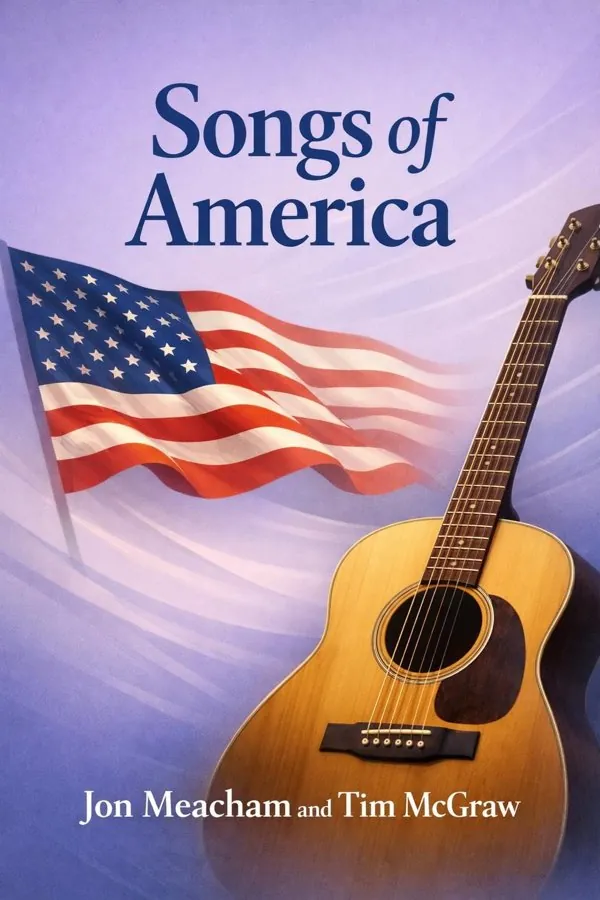
Songs of America: Patriotism, Protest, and the Music That Made a Nation: Summary & Key Insights
 10 min10 chaptersAudio available
What Is Songs of America: Patriotism, Protest, and the Music That Made a Nation About?
Songs of America: Patriotism, Protest, and the Music That Made a Nation by Jon Meacham and Tim McGraw is a world_history book spanning 10 pages. A richly illustrated exploration of American history through its music, this book traces how songs have reflected and shaped the nation’s identity from the Revolution to the present. Historian Jon Meacham and musician Tim McGraw examine the cultural and political power of music in times of unity and division, revealing how melodies and lyrics have expressed the American spirit across generations.
This FizzRead summary covers all 10 key chapters of Songs of America: Patriotism, Protest, and the Music That Made a Nation in approximately 10 minutes, distilling the most important ideas, arguments, and takeaways from Jon Meacham and Tim McGraw's work. Also available as an audio summary and Key Quotes Podcast.
Songs of America: Patriotism, Protest, and the Music That Made a Nation
A richly illustrated exploration of American history through its music, this book traces how songs have reflected and shaped the nation’s identity from the Revolution to the present. Historian Jon Meacham and musician Tim McGraw examine the cultural and political power of music in times of unity and division, revealing how melodies and lyrics have expressed the American spirit across generations.
Who Should Read Songs of America: Patriotism, Protest, and the Music That Made a Nation?
This book is perfect for anyone interested in world_history and looking to gain actionable insights in a short read. Whether you're a student, professional, or lifelong learner, the key ideas from Songs of America: Patriotism, Protest, and the Music That Made a Nation by Jon Meacham and Tim McGraw will help you think differently.
- ✓Readers who enjoy world_history and want practical takeaways
- ✓Professionals looking to apply new ideas to their work and life
- ✓Anyone who wants the core insights of Songs of America: Patriotism, Protest, and the Music That Made a Nation in just 10 minutes
Want the full summary?
Get instant access to this book summary and 100K+ more with Fizz Moment.
Get Free SummaryAvailable on App Store • Free to download
Key Chapters
In the cradle of rebellion, music became both weapon and refuge. During the American Revolution, songs carried ideals that words alone could not. 'Yankee Doodle,' once a British mockery of colonial soldiers, was transformed into a defiant expression of pride and unity. In those bustling taverns and encampments, melody became the common language of hope. Every verse was a rallying cry, every chorus a reminder that independence was not merely a political concept but a living emotion shared among ordinary people.
We see in these early anthems how music performs a dual role — it narrates and it persuades. Patriots sang not only to celebrate victories but to declare the legitimacy of their cause. Across towns and battlefields, the rhythm of a nation in formation could be heard. As historians, we understand that in those harmonies lay a psychological glue: they reminded colonists who they were and what they were fighting for. As a musician, Tim McGraw reflects on the way simple refrains can strengthen community; when men and women joined voices, their fears diminished slightly under the force of shared rhythm.
These songs laid the foundation for America’s enduring belief that music can be an equalizer — a bridge between classes and regions. The Revolution’s tunes were folksongs at heart, accessible and adaptable, much like the ideals of freedom they championed. From them sprung a tradition that continues today: the use of song as a means to assert identity and resilience against power.
In the early Republic, as the new nation sought a voice distinct from Europe, music became a canvas on which to paint civic pride and cultural independence. The folk ballads and patriotic airs of the early nineteenth century expressed faith in the democratic experiment. Songs such as 'The Star-Spangled Banner,' which emerged from the War of 1812, crystallized national sentiment into verse and melody, memorializing courage under fire and the endurance of liberty.
What fascinates historians about this era is the direct correlation between political optimism and musical creativity. The people were inventing their own symbols — flags, festivals, and tunes — to build what George Washington called 'a sacred fire of liberty.' Musically, America began to depart from Old World traditions, embracing the vernacular styles that reflected its diverse population. Meacham sees this as the emergence of cultural autonomy: the moment when art ceased to imitate and began to define.
From Tim’s perspective, these early patriotic songs also mark the birth of performance as civic participation. Singing was not passive consumption; it was a declaration of belonging. Town gatherings, political rallies, and parades sounded with melodies that reaffirmed shared purpose. Through these communal acts of singing, Americans rehearsed democracy itself — one voice joining another until harmony, literal and metaphorical, emerged from difference.
+ 8 more chapters — available in the FizzRead app
All Chapters in Songs of America: Patriotism, Protest, and the Music That Made a Nation
About the Authors
Jon Meacham is a Pulitzer Prize–winning historian and author known for works on American presidents and political history. Tim McGraw is a Grammy Award–winning country music artist and actor whose career spans more than two decades.
Get This Summary in Your Preferred Format
Read or listen to the Songs of America: Patriotism, Protest, and the Music That Made a Nation summary by Jon Meacham and Tim McGraw anytime, anywhere. FizzRead offers multiple formats so you can learn on your terms — all free.
Available formats: App · Audio · PDF · EPUB — All included free with FizzRead
Download Songs of America: Patriotism, Protest, and the Music That Made a Nation PDF and EPUB Summary
Key Quotes from Songs of America: Patriotism, Protest, and the Music That Made a Nation
“In the cradle of rebellion, music became both weapon and refuge.”
“In the early Republic, as the new nation sought a voice distinct from Europe, music became a canvas on which to paint civic pride and cultural independence.”
Frequently Asked Questions about Songs of America: Patriotism, Protest, and the Music That Made a Nation
Songs of America: Patriotism, Protest, and the Music That Made a Nation by Jon Meacham and Tim McGraw is a world_history book that explores key ideas across 10 chapters. A richly illustrated exploration of American history through its music, this book traces how songs have reflected and shaped the nation’s identity from the Revolution to the present. Historian Jon Meacham and musician Tim McGraw examine the cultural and political power of music in times of unity and division, revealing how melodies and lyrics have expressed the American spirit across generations.
You Might Also Like
The Age of Capital
Eric Hobsbawm
10 min
The Gulag Archipelago
Aleksandr Solzhenitsyn
10 min
Jerusalem: The Biography
Simon Sebag Montefiore
10 min
The Anglo-Saxons
James Campbell
10 min
The Boer War
Thomas Pakenham
10 min
The Industrial Revolutionaries: The Making of the Modern World 1776–1914
Gavin Weightman
10 minBrowse by Category
Ready to read Songs of America: Patriotism, Protest, and the Music That Made a Nation?
Get the full summary and 100K+ more books with Fizz Moment.