
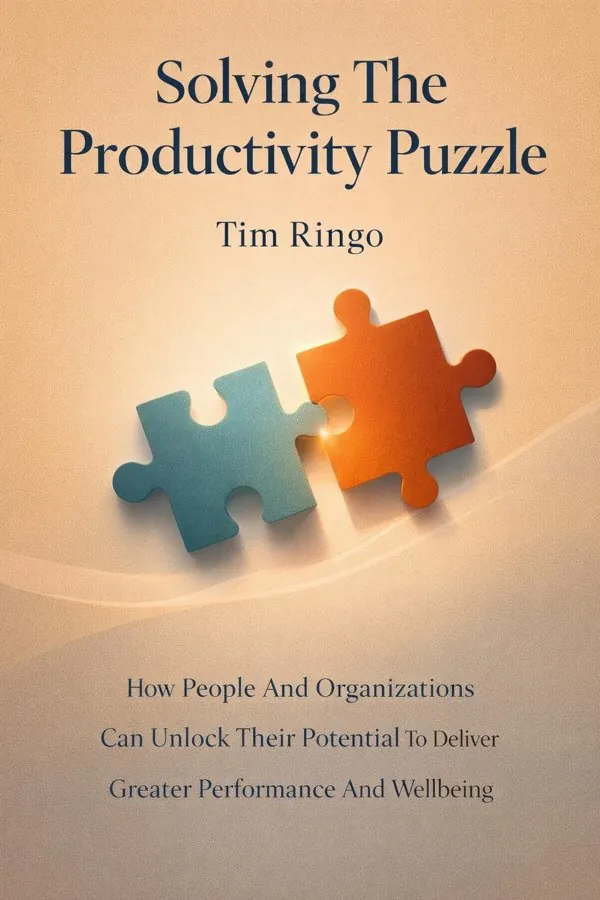
Solving The Productivity Puzzle: How People And Organizations Can Unlock Their Potential To Deliver Greater Performance And Wellbeing: Summary & Key Insights
by Tim Ringo
 10 min7 chaptersAudio available
What Is Solving The Productivity Puzzle: How People And Organizations Can Unlock Their Potential To Deliver Greater Performance And Wellbeing About?
Solving The Productivity Puzzle: How People And Organizations Can Unlock Their Potential To Deliver Greater Performance And Wellbeing by Tim Ringo is a productivity book spanning 7 pages. This book explores the reasons behind the productivity slowdown in modern economies and offers practical strategies for individuals and organizations to improve performance and wellbeing. Tim Ringo combines insights from human capital management, technology, and organizational psychology to propose a new model for sustainable productivity growth.
This FizzRead summary covers all 7 key chapters of Solving The Productivity Puzzle: How People And Organizations Can Unlock Their Potential To Deliver Greater Performance And Wellbeing in approximately 10 minutes, distilling the most important ideas, arguments, and takeaways from Tim Ringo's work. Also available as an audio summary and Key Quotes Podcast.
Solving The Productivity Puzzle: How People And Organizations Can Unlock Their Potential To Deliver Greater Performance And Wellbeing
This book explores the reasons behind the productivity slowdown in modern economies and offers practical strategies for individuals and organizations to improve performance and wellbeing. Tim Ringo combines insights from human capital management, technology, and organizational psychology to propose a new model for sustainable productivity growth.
Who Should Read Solving The Productivity Puzzle: How People And Organizations Can Unlock Their Potential To Deliver Greater Performance And Wellbeing?
This book is perfect for anyone interested in productivity and looking to gain actionable insights in a short read. Whether you're a student, professional, or lifelong learner, the key ideas from Solving The Productivity Puzzle: How People And Organizations Can Unlock Their Potential To Deliver Greater Performance And Wellbeing by Tim Ringo will help you think differently.
- ✓Readers who enjoy productivity and want practical takeaways
- ✓Professionals looking to apply new ideas to their work and life
- ✓Anyone who wants the core insights of Solving The Productivity Puzzle: How People And Organizations Can Unlock Their Potential To Deliver Greater Performance And Wellbeing in just 10 minutes
Want the full summary?
Get instant access to this book summary and 100K+ more with Fizz Moment.
Get Free SummaryAvailable on App Store • Free to download
Key Chapters
Over the last two decades, productivity across advanced economies has slowed dramatically. Governments, economists, and executives alike have puzzled over why our world, so saturated with digital innovation, has not translated those gains into proportional output. My analysis begins with this paradox. Historically, productivity growth was tied to industrial and technological revolutions: mechanization, electrification, and later, computerization each produced clear surges in efficiency. But around the mid-2000s, the curve flattened. Despite smartphones, cloud computing, and automation, labor productivity in many countries plateaued.
It might seem that technology failed us—but I believe the problem is more subtle. We’ve reached a point where technology has outpaced our human systems. Our organizations, management models, and workforce practices are still shaped by industrial-era assumptions. We measure outputs, control processes, and design hierarchies that stifle creativity. As technology accelerates, the human side of work has stagnated.
To understand this slowdown, one must also look at how economies have shifted from industrial to knowledge-based. In manufacturing, productivity was tangible: more cars per hour, more widgets per line. But in knowledge work, value creation depends on innovation, collaboration, and emotional engagement—factors less visible and harder to manage. Yet these are precisely where modern workplaces often fall short. The burnout epidemic, disengagement, and lack of purpose reported across industries reveal a critical gap: the human experience of work has not evolved fast enough to match our tools.
In *Solving the Productivity Puzzle*, I argue that to reignite growth, we must treat human wellbeing as an input, not a byproduct, of performance. The key is to design ecosystems that harmonize people and technology rather than letting one dominate the other.
When I speak with executives, I often ask a simple question: what truly drives productivity in your organization? Most point to operational metrics or machine efficiency. Few mention engagement, morale, or wellbeing. Yet research repeatedly shows that these human factors explain a significant share of output variance. People perform best when they feel valued, trusted, and aligned with a purpose larger than themselves.
During my years advising global firms, I saw this principle confirmed again and again. A retail company improved profitability not by cutting costs, but by engaging store employees in designing better customer experiences. A tech firm boosted innovation when it shifted from rigid performance reviews to continuous coaching. These examples reveal a truth we’ve ignored for too long: productivity thrives in environments where people’s intrinsic motivation is unlocked.
However, unlocking motivation requires system-level change. Too often, corporate culture erodes human potential by overemphasizing compliance and control. The challenge is not that people don’t care—it’s that workplaces often make it hard for them to care. Bureaucracy, poorly communicated strategy, and a lack of trust slowly drain enthusiasm. Leaders must reverse this dynamic by cultivating autonomy and shared ownership.
In this book, I also highlight the essential link between wellbeing and performance. Burnout is not a badge of honor; it’s a barrier to productivity. When employees are physically, mentally, and socially well, they bring greater focus and creativity. Organizations that balance wellbeing with performance ambitions see sustained gains rather than short bursts of effort followed by decline. The most productive teams are not the most exhausted—they are the most energized and resilient.
+ 5 more chapters — available in the FizzRead app
All Chapters in Solving The Productivity Puzzle: How People And Organizations Can Unlock Their Potential To Deliver Greater Performance And Wellbeing
About the Author
Tim Ringo is an experienced business leader, author, and speaker specializing in human capital management and workforce strategy. He has held senior roles at Accenture, IBM, and SAP, and is recognized for his expertise in helping organizations enhance performance through people-focused transformation.
Get This Summary in Your Preferred Format
Read or listen to the Solving The Productivity Puzzle: How People And Organizations Can Unlock Their Potential To Deliver Greater Performance And Wellbeing summary by Tim Ringo anytime, anywhere. FizzRead offers multiple formats so you can learn on your terms — all free.
Available formats: App · Audio · PDF · EPUB — All included free with FizzRead
Download Solving The Productivity Puzzle: How People And Organizations Can Unlock Their Potential To Deliver Greater Performance And Wellbeing PDF and EPUB Summary
Key Quotes from Solving The Productivity Puzzle: How People And Organizations Can Unlock Their Potential To Deliver Greater Performance And Wellbeing
“Over the last two decades, productivity across advanced economies has slowed dramatically.”
“When I speak with executives, I often ask a simple question: what truly drives productivity in your organization?”
Frequently Asked Questions about Solving The Productivity Puzzle: How People And Organizations Can Unlock Their Potential To Deliver Greater Performance And Wellbeing
Solving The Productivity Puzzle: How People And Organizations Can Unlock Their Potential To Deliver Greater Performance And Wellbeing by Tim Ringo is a productivity book that explores key ideas across 7 chapters. This book explores the reasons behind the productivity slowdown in modern economies and offers practical strategies for individuals and organizations to improve performance and wellbeing. Tim Ringo combines insights from human capital management, technology, and organizational psychology to propose a new model for sustainable productivity growth.
You Might Also Like



Browse by Category
Ready to read Solving The Productivity Puzzle: How People And Organizations Can Unlock Their Potential To Deliver Greater Performance And Wellbeing?
Get the full summary and 100K+ more books with Fizz Moment.