
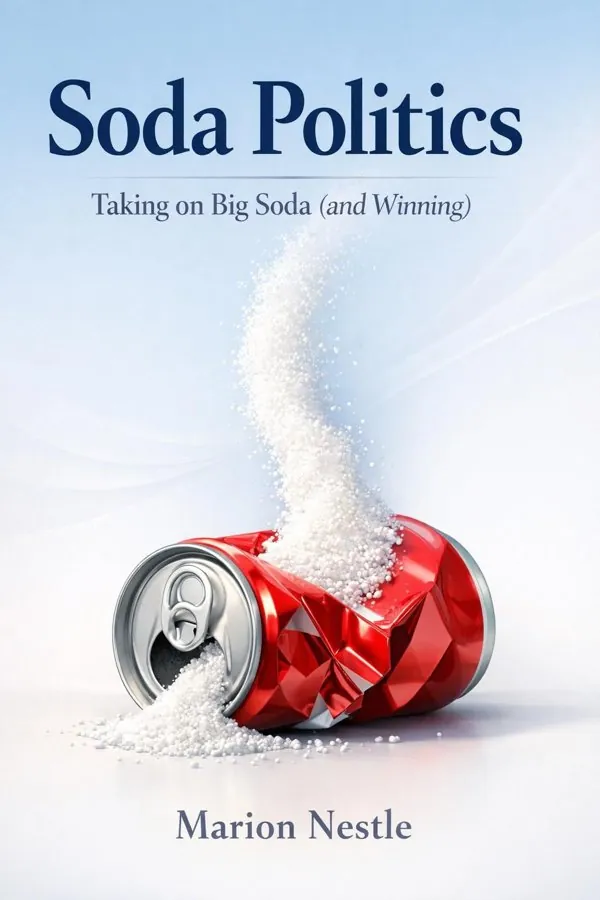
Soda Politics: Taking on Big Soda (and Winning): Summary & Key Insights
 10 min9 chaptersAudio available
Key Takeaways from Soda Politics: Taking on Big Soda (and Winning)
A product does not become normal by accident.
Science can be used to illuminate truth, but it can also be used to delay it.
People rarely buy only a product; they buy the story wrapped around it.
When evidence threatens profits, companies do not sit still.
Doubt is often more useful to corporations than denial.
What Is Soda Politics: Taking on Big Soda (and Winning) About?
Soda Politics: Taking on Big Soda (and Winning) by Marion Nestle is a health_med book spanning 8 pages. Sugary drinks may look like simple consumer products, but Marion Nestle shows they are also political tools, cultural symbols, and major drivers of preventable disease. In Soda Politics: Taking on Big Soda (and Winning), she investigates how soft drink companies built enormous power by shaping scientific debate, influencing public policy, targeting children and low-income communities, and presenting themselves as responsible corporate citizens even as evidence mounted against their products. The book is not just about soda; it is about how industries protect profits when public health is at stake. What makes Nestle’s argument so compelling is her ability to connect nutrition science with lobbying, marketing, and regulation. As a professor of nutrition, food studies, and public health at New York University, she brings deep expertise and a long record of analyzing how food companies affect what people eat and what governments permit. She writes with clarity, urgency, and practical insight. For readers trying to understand obesity, diabetes, food policy, or the hidden mechanics of corporate influence, Soda Politics offers a sharp and deeply relevant account of why reducing sugary drink consumption matters and how citizens can push back effectively.
This FizzRead summary covers all 9 key chapters of Soda Politics: Taking on Big Soda (and Winning) in approximately 10 minutes, distilling the most important ideas, arguments, and takeaways from Marion Nestle's work. Also available as an audio summary and Key Quotes Podcast.
Soda Politics: Taking on Big Soda (and Winning)
Sugary drinks may look like simple consumer products, but Marion Nestle shows they are also political tools, cultural symbols, and major drivers of preventable disease. In Soda Politics: Taking on Big Soda (and Winning), she investigates how soft drink companies built enormous power by shaping scientific debate, influencing public policy, targeting children and low-income communities, and presenting themselves as responsible corporate citizens even as evidence mounted against their products. The book is not just about soda; it is about how industries protect profits when public health is at stake.
What makes Nestle’s argument so compelling is her ability to connect nutrition science with lobbying, marketing, and regulation. As a professor of nutrition, food studies, and public health at New York University, she brings deep expertise and a long record of analyzing how food companies affect what people eat and what governments permit. She writes with clarity, urgency, and practical insight. For readers trying to understand obesity, diabetes, food policy, or the hidden mechanics of corporate influence, Soda Politics offers a sharp and deeply relevant account of why reducing sugary drink consumption matters and how citizens can push back effectively.
Who Should Read Soda Politics: Taking on Big Soda (and Winning)?
This book is perfect for anyone interested in health_med and looking to gain actionable insights in a short read. Whether you're a student, professional, or lifelong learner, the key ideas from Soda Politics: Taking on Big Soda (and Winning) by Marion Nestle will help you think differently.
- ✓Readers who enjoy health_med and want practical takeaways
- ✓Professionals looking to apply new ideas to their work and life
- ✓Anyone who wants the core insights of Soda Politics: Taking on Big Soda (and Winning) in just 10 minutes
Want the full summary?
Get instant access to this book summary and 100K+ more with Fizz Moment.
Get Free SummaryAvailable on App Store • Free to download
Key Chapters
A product does not become normal by accident. One of Nestle’s central insights is that soda’s rise from occasional novelty to daily habit was engineered through decades of branding, distribution, and cultural positioning. Soft drinks were once sold in pharmacies and associated with refreshment, energy, or even vague health benefits. Over time, companies transformed them into standard parts of meals, celebrations, sporting events, and school life.
Nestle traces how this happened through industrial scale and marketing sophistication. Bottling technology, refrigeration, convenience stores, fast-food partnerships, and global advertising helped soda become available everywhere and desirable to nearly everyone. Companies did not merely respond to consumer demand; they cultivated it. They sold soda as fun, modern, youthful, and patriotic. Larger portion sizes and constant visibility reinforced the idea that drinking sugary beverages regularly was harmless and normal.
This historical perspective matters because it challenges a common assumption: that current consumption patterns are simply a matter of personal preference. If habits were shaped deliberately by commercial forces, then they can also be reshaped by education, regulation, and cultural change. The same methods that normalized soda can be countered by efforts to normalize water, smaller portions, and skepticism toward health claims.
In practical terms, this means looking at your own environment. Which drinks are most visible at home, work, school, or events? Which are marketed as rewards or defaults? Once you see how habits are structured, you can begin changing them. Actionable takeaway: treat soda consumption as a socially engineered behavior, not just an individual choice, and redesign your surroundings to make healthier drinks the default.
Science can be used to illuminate truth, but it can also be used to delay it. Nestle shows that the soda industry often protects itself not by directly denying evidence, but by funding research, sponsoring experts, and promoting scientific ambiguity. This creates the impression that the health harms of sugary drinks are uncertain, exaggerated, or less important than they really are.
A key tactic is selective emphasis. Industry-backed messaging often shifts attention away from sugar intake and toward physical inactivity, personal responsibility, or overall calorie balance. While exercise and total diet do matter, Nestle argues that this framing can distract from the especially harmful role of sugary beverages, which deliver large amounts of sugar without creating fullness. Funding studies, conferences, educational materials, and professional associations helps companies embed their preferred narrative inside institutions the public assumes are impartial.
This manipulation does not always require fraud. More often, it works through agenda-setting: choosing which questions get studied, which findings receive publicity, and which experts gain influence. The result is confusion, and confusion benefits the status quo. Policymakers hesitate, consumers doubt warnings, and corporations continue business as usual.
For readers, the practical lesson is to ask who paid for the evidence and how the issue is framed. If a study about sugary drinks minimizes harm, look for funding disclosures and compare it with independent research. Actionable takeaway: become a critical consumer of nutrition science by checking funding sources, conflicts of interest, and whether claims align with the broader body of independent evidence.
People rarely buy only a product; they buy the story wrapped around it. Nestle explains that soda marketing works because it sells identity and emotion, not just sweetness. Advertisements link soft drinks to happiness, friendship, athleticism, freedom, and even social justice themes. This symbolic packaging makes an unhealthy product feel positive, even wholesome.
The book pays particular attention to children and adolescents, who are especially vulnerable to repeated messaging and brand loyalty. Companies use cartoons, celebrities, music tie-ins, sports sponsorships, social media campaigns, and product placement to enter daily life early. They also target communities strategically, including low-income neighborhoods and minority populations, where marketing intensity may be higher and healthier options less accessible. By shaping taste preferences young, companies create lifelong customers.
Nestle’s broader point is that marketing changes the decision-making environment. A child asking for soda is not acting in a vacuum. That desire may reflect years of exposure to cues designed to trigger craving, trust, and habit. Adults are not immune either. Promotions, meal combos, oversized cups, and convenience displays all push consumption upward.
Applied practically, this suggests that healthier choices require more than willpower. Families can reduce exposure by limiting branded media, avoiding impulse-buy settings when possible, and making water, unsweetened tea, or sparkling water more visible and appealing at home. Communities can support restrictions on child-directed marketing and soda sales in schools. Actionable takeaway: do not judge beverage choices only as personal preferences; identify the marketing cues shaping them and intentionally replace those cues with healthier defaults.
When evidence threatens profits, companies do not sit still. Nestle details how the soda industry uses lobbying, campaign contributions, public relations firms, trade groups, and legal threats to block policies that might reduce consumption. Taxes on sugary drinks, warning labels, portion limits, school vending restrictions, and marketing regulations often face aggressive resistance long before they can be implemented.
The industry’s political strategy is powerful because it operates on multiple fronts at once. Corporations frame proposed regulations as government overreach, attacks on consumer freedom, or threats to jobs and small businesses. They mobilize retailers, distributors, and allied organizations to amplify these messages. Even when a public health measure is modest, the response can be intense because companies fear precedent. A small local tax, if successful, could inspire broader regulation elsewhere.
Nestle helps readers see that this is not just about one beverage category. It is a case study in how corporate actors influence democratic systems. Technical policy debates are often shaped by money, access, and messaging rather than by health evidence alone. Understanding this dynamic is essential for anyone who wonders why obvious public health reforms can take so long.
On a practical level, citizens can pay attention to who funds anti-regulation campaigns, which elected officials receive industry support, and how ballot measures are framed. Public comments, local organizing, and support for independent advocacy groups all matter. Actionable takeaway: whenever you see a debate over soda taxes or labeling, follow the money and evaluate whether the loudest arguments serve public health or commercial interest.
Doubt is often more useful to corporations than denial. Nestle shows how soda companies borrow a familiar playbook used by other industries facing health criticism: raise questions, emphasize complexity, and insist that no single product should be blamed. This strategy does not need to win the scientific argument outright; it only needs to make regulation seem premature or unfair.
The book explains how companies highlight uncertainty in epidemiological findings, fund experts who stress moderation, and promote the idea that all calories are equivalent in practice. By doing so, they weaken the public’s perception that sugary drinks deserve special concern. Yet Nestle argues that these beverages are unusually problematic because they provide large amounts of rapidly consumed sugar with little satiety, making overconsumption easy.
This manufactured ambiguity affects journalists, schools, parents, and policymakers. If people believe the science is still unsettled, they are less likely to support taxes, warning labels, or changes in institutional purchasing. Meanwhile, consumption continues and the burden of obesity, diabetes, and dental disease grows.
A practical application is to recognize the difference between genuine scientific nuance and strategically amplified uncertainty. Public health decisions often must be made based on strong but not perfect evidence. Waiting for absolute certainty can become a way of protecting harmful practices indefinitely. Actionable takeaway: when evaluating health controversies, ask whether uncertainty reflects honest scientific limits or a deliberate effort to postpone action despite a clear enough pattern of harm.
Large industries look unbeatable until local movements begin winning. One of the book’s most hopeful themes is that grassroots activism can challenge corporate power when it combines strong evidence with community organizing. Nestle describes how public health advocates, parents, teachers, physicians, and local officials have pushed back against soda marketing in schools, promoted healthier beverage standards, and built support for taxes and warning measures.
These efforts matter because they change both policy and culture. Removing sodas from school vending machines, for example, does more than cut immediate access. It signals that schools should support health rather than function as marketing channels. Community coalitions can reframe the debate from individual blame to environmental responsibility, asking why unhealthy products are so heavily promoted in spaces used by children and families.
Nestle also emphasizes that activism succeeds when it is practical and persistent. Campaigns become stronger when they gather local data, tell human stories, partner with medical and educational institutions, and clearly explain how policy revenues will be used. In places where soda taxes have passed, linking the revenue to preschool, parks, or health programs has often helped win support.
For individuals, activism does not require national fame. It can start with school board meetings, city council testimony, workplace wellness policies, or neighborhood education efforts. Small institutional changes can accumulate into broader social change. Actionable takeaway: choose one setting you influence, such as a school, clinic, office, or community center, and advocate for a healthier beverage policy that makes water and unsweetened options easier to choose.
Public health policy is often criticized as intrusive, yet Nestle argues that carefully designed interventions can meaningfully reduce sugary drink consumption and improve awareness. Taxes, warning labels, school standards, procurement rules, portion guidance, and restrictions on child-directed marketing are not symbolic gestures; they are tools for reshaping the environment in which choices are made.
The logic is straightforward. Soda is cheap, ubiquitous, and heavily promoted. Policy can counter that by changing prices, visibility, and norms. A tax raises cost and can encourage consumers to buy less or switch to alternatives. Warning labels can help interrupt automatic purchasing. Limits on school sales and government procurement reduce institutional endorsement. None of these measures eliminates freedom of choice, but they do make the health costs of soda harder to ignore.
Nestle is also careful to note that industry responses are swift. Companies may oppose taxes publicly while reformulating products, expanding low- and no-sugar lines, or intensifying marketing elsewhere. This does not mean policy failed. It often means policy was strong enough to force adaptation. Still, isolated reforms are not enough; they work best as part of a larger strategy involving education and community support.
Readers can apply this idea by evaluating beverage policies in their own city, school district, hospital, or workplace. Are public institutions aligning purchases with health goals? Are healthier beverages affordable and accessible? Actionable takeaway: support evidence-based beverage policies not as punishment, but as structural corrections to a marketplace that already pushes consumers toward overconsumption.
As health criticism intensified in wealthier countries, soda companies increasingly looked abroad for growth. Nestle shows that the politics of sugary drinks are global, with multinational corporations targeting emerging markets where regulations may be weaker and consumption still rising. This expansion links soda not only to nutrition transitions, but also to broader questions of globalization, trade, and cultural influence.
In many countries, soft drinks are marketed as symbols of aspiration, modernity, and Western-style prosperity. As traditional diets are displaced by processed foods and sweetened beverages, rates of obesity, diabetes, and other chronic diseases can rise rapidly, often alongside persistent undernutrition. This creates a double burden: populations face both lack of healthy food access and increased exposure to aggressively marketed, low-nutrient products.
Nestle’s global perspective broadens the lesson of the book. Soda politics is not merely an American story about lobbying in Washington. It is a worldwide struggle over how corporations shape food systems and whether public health institutions can keep pace. Policies developed in one city or country can influence others, while industry tactics also travel across borders.
Practically, this means consumers and advocates should pay attention to international patterns, not just local ones. Support for stronger labeling, school standards, and health protections in lower- and middle-income countries matters. Actionable takeaway: think of beverage policy as a global health issue, and support organizations, research, and regulations that protect vulnerable populations from the export of unhealthy consumption patterns.
The language of personal responsibility sounds empowering, but Nestle argues it often hides the reality of constrained choice. People do make decisions, yet those decisions are shaped by price, availability, advertising, social norms, stress, and institutional settings. Telling people to simply drink less soda ignores the commercial environment designed to make the opposite easy.
This does not mean individuals are powerless. Rather, it means that lasting change depends on aligning personal goals with supportive systems. A parent trying to limit sugary drinks will have a harder time if school fundraisers sell soda, restaurants default to sweetened beverages, stores place giant bottles at eye level, and children are bombarded with marketing. Likewise, low-income communities may face fewer safe water options, heavier advertising, and stronger promotional pressure.
Nestle’s contribution is to unite public health and everyday life. She does not dismiss individual behavior; she situates it. Better outcomes emerge when healthy choices are convenient, visible, affordable, and socially reinforced. This insight applies beyond soda to many nutrition problems.
A practical response is to make environmental changes wherever possible: carry a reusable water bottle, choose restaurants that offer unsweetened defaults for kids, ask schools and workplaces to improve beverage options, and support policies that expand access to clean drinking water. Actionable takeaway: stop treating healthier beverage habits as a test of willpower alone, and instead build systems around you that make the healthier choice routine.
All Chapters in Soda Politics: Taking on Big Soda (and Winning)
About the Author
Marion Nestle is an American nutritionist, public health scholar, and one of the most influential commentators on food politics in the United States. She is a professor of nutrition, food studies, and public health at New York University, where her work has focused on how food environments, industry practices, and government policies shape what people eat. Nestle is widely known for translating complex nutrition research into accessible arguments about corporate influence, health, and consumer choice. Her books, including Food Politics, What to Eat, and Soda Politics, have helped define modern discussions about the food industry’s role in chronic disease. Through teaching, writing, and public advocacy, she has become a leading voice on the intersection of nutrition science, regulation, and social responsibility.
Get This Summary in Your Preferred Format
Read or listen to the Soda Politics: Taking on Big Soda (and Winning) summary by Marion Nestle anytime, anywhere. FizzRead offers multiple formats so you can learn on your terms — all free.
Available formats: App · Audio · PDF · EPUB — All included free with FizzRead
Download Soda Politics: Taking on Big Soda (and Winning) PDF and EPUB Summary
Key Quotes from Soda Politics: Taking on Big Soda (and Winning)
“A product does not become normal by accident.”
“Science can be used to illuminate truth, but it can also be used to delay it.”
“People rarely buy only a product; they buy the story wrapped around it.”
“When evidence threatens profits, companies do not sit still.”
“Doubt is often more useful to corporations than denial.”
Frequently Asked Questions about Soda Politics: Taking on Big Soda (and Winning)
Soda Politics: Taking on Big Soda (and Winning) by Marion Nestle is a health_med book that explores key ideas across 9 chapters. Sugary drinks may look like simple consumer products, but Marion Nestle shows they are also political tools, cultural symbols, and major drivers of preventable disease. In Soda Politics: Taking on Big Soda (and Winning), she investigates how soft drink companies built enormous power by shaping scientific debate, influencing public policy, targeting children and low-income communities, and presenting themselves as responsible corporate citizens even as evidence mounted against their products. The book is not just about soda; it is about how industries protect profits when public health is at stake. What makes Nestle’s argument so compelling is her ability to connect nutrition science with lobbying, marketing, and regulation. As a professor of nutrition, food studies, and public health at New York University, she brings deep expertise and a long record of analyzing how food companies affect what people eat and what governments permit. She writes with clarity, urgency, and practical insight. For readers trying to understand obesity, diabetes, food policy, or the hidden mechanics of corporate influence, Soda Politics offers a sharp and deeply relevant account of why reducing sugary drink consumption matters and how citizens can push back effectively.
More by Marion Nestle
You Might Also Like

On Immunity
Eula Biss
10 min
The Three-Body Problem
Liu Cixin
10 min
Community Health Volunteer Toolkit: Training and Practical Activities
World Health Organization
10 min
Healing Back Pain: The Mind-Body Connection
John E. Sarno
10 min
Health Literacy for All: Practical Guides to Communicate Health Information (Compilations)
World Health Organization
10 min
The Complete Guide to Sports Supplements: An Evidence-Based Review
Anita Bean
10 minBrowse by Category
Ready to read Soda Politics: Taking on Big Soda (and Winning)?
Get the full summary and 100K+ more books with Fizz Moment.