
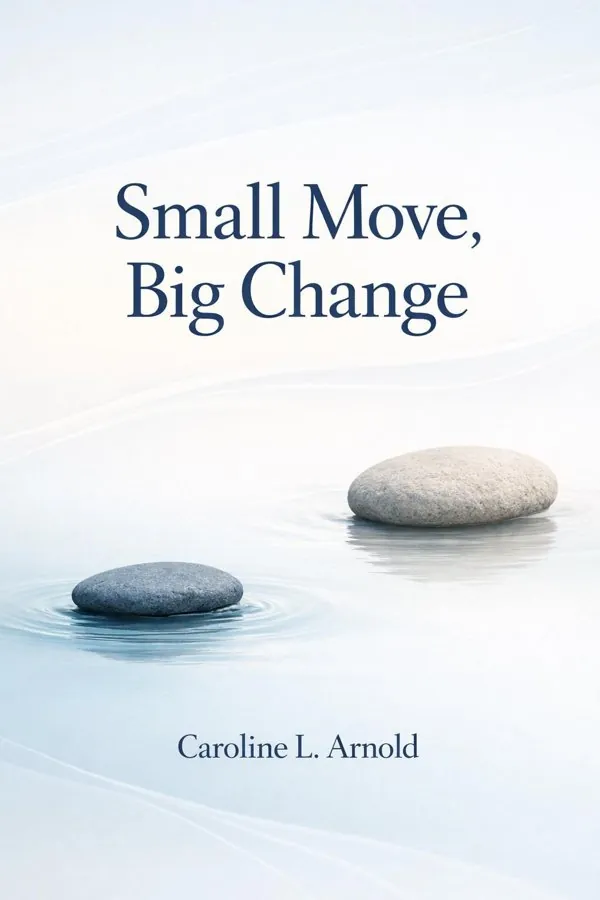
Small Move, Big Change: Using Microresolutions to Transform Your Life Permanently: Summary & Key Insights
 10 min9 chaptersAudio available
Key Takeaways from Small Move, Big Change: Using Microresolutions to Transform Your Life Permanently
Most people do not fail because they lack desire; they fail because desire is not a behavior.
Change becomes durable when it is smaller than your excuses.
People often treat self-discipline as a personality trait, but Arnold shows it is often a design problem instead.
A habit does not live in isolation; it lives in a sequence.
The most effective resolutions are not the most admirable; they are the most truthful.
What Is Small Move, Big Change: Using Microresolutions to Transform Your Life Permanently About?
Small Move, Big Change: Using Microresolutions to Transform Your Life Permanently by Caroline L. Arnold is a productivity book spanning 6 pages. Why do so many ambitious life changes fail while tiny adjustments quietly reshape people for good? In Small Move, Big Change, Caroline L. Arnold argues that lasting transformation rarely comes from dramatic reinvention. Instead, it comes from microresolutions: precise, manageable behavioral commitments so small they can fit into real life and so concrete they are hard to misunderstand. Rather than vowing to “get healthy,” “be more productive,” or “be a better parent,” Arnold shows readers how to choose specific actions they can repeat consistently until those actions become automatic. The book matters because it offers an antidote to the cycle of overpromising and underdelivering that defines most resolutions. Arnold explains why willpower alone is unreliable, why vague goals drain motivation, and why success depends on designing habits that work under ordinary pressures, not ideal conditions. Drawing on her experience as a Goldman Sachs executive and on stories from work, home, and daily routines, she presents a practical system for behavioral change that is realistic, disciplined, and surprisingly empowering. For anyone tired of big intentions that go nowhere, this book provides a smarter path: smaller moves, better systems, permanent results.
This FizzRead summary covers all 9 key chapters of Small Move, Big Change: Using Microresolutions to Transform Your Life Permanently in approximately 10 minutes, distilling the most important ideas, arguments, and takeaways from Caroline L. Arnold's work. Also available as an audio summary and Key Quotes Podcast.
Small Move, Big Change: Using Microresolutions to Transform Your Life Permanently
Why do so many ambitious life changes fail while tiny adjustments quietly reshape people for good? In Small Move, Big Change, Caroline L. Arnold argues that lasting transformation rarely comes from dramatic reinvention. Instead, it comes from microresolutions: precise, manageable behavioral commitments so small they can fit into real life and so concrete they are hard to misunderstand. Rather than vowing to “get healthy,” “be more productive,” or “be a better parent,” Arnold shows readers how to choose specific actions they can repeat consistently until those actions become automatic.
The book matters because it offers an antidote to the cycle of overpromising and underdelivering that defines most resolutions. Arnold explains why willpower alone is unreliable, why vague goals drain motivation, and why success depends on designing habits that work under ordinary pressures, not ideal conditions. Drawing on her experience as a Goldman Sachs executive and on stories from work, home, and daily routines, she presents a practical system for behavioral change that is realistic, disciplined, and surprisingly empowering. For anyone tired of big intentions that go nowhere, this book provides a smarter path: smaller moves, better systems, permanent results.
Who Should Read Small Move, Big Change: Using Microresolutions to Transform Your Life Permanently?
This book is perfect for anyone interested in productivity and looking to gain actionable insights in a short read. Whether you're a student, professional, or lifelong learner, the key ideas from Small Move, Big Change: Using Microresolutions to Transform Your Life Permanently by Caroline L. Arnold will help you think differently.
- ✓Readers who enjoy productivity and want practical takeaways
- ✓Professionals looking to apply new ideas to their work and life
- ✓Anyone who wants the core insights of Small Move, Big Change: Using Microresolutions to Transform Your Life Permanently in just 10 minutes
Want the full summary?
Get instant access to this book summary and 100K+ more with Fizz Moment.
Get Free SummaryAvailable on App Store • Free to download
Key Chapters
Most people do not fail because they lack desire; they fail because desire is not a behavior. That is the central insight behind Arnold’s idea of microresolutions. Traditional resolutions such as “eat better,” “exercise more,” or “be less distracted” are motivationally appealing but operationally useless. They point toward a destination without defining the road. A microresolution, by contrast, is exact. It names a concrete behavior you can either do or not do, making it measurable, repeatable, and easier for the brain to encode as a habit.
Arnold explains that specificity reduces the mental friction that ruins many attempts at change. When a commitment is vague, every moment requires negotiation: Does this count? Have I done enough? Can I skip today? A precise rule removes those loopholes. “No checking email during dinner,” ���Walk for ten minutes after lunch on weekdays,” or “Write the first sentence of the report before opening social media” are decisions already made in advance. That clarity saves willpower and lowers resistance.
Specificity also helps people succeed because it narrows the challenge to something proportionate. You are not trying to become a different person overnight. You are trying to perform one small action under defined circumstances. Over time, those small wins create evidence that change is possible, which strengthens motivation far more effectively than abstract inspiration.
In practice, this means translating every aspiration into a visible behavior. If you want better relationships, identify the action: no interrupting in meetings, or putting your phone away during bedtime routines. If you want better health, choose a specific rule like drinking water before coffee each morning.
Actionable takeaway: Replace every broad goal with one exact behavior, a clear context, and a yes-or-no standard you can follow consistently.
Change becomes durable when it is smaller than your excuses. Arnold emphasizes that a microresolution should feel almost modest, even underwhelming, because its real purpose is not to impress you but to survive contact with everyday life. People often sabotage themselves by choosing a resolution that requires ideal energy, perfect scheduling, or heroic self-control. The better strategy is to design a habit that still works on stressful Tuesdays, during travel, or after a poor night’s sleep.
This is why microresolutions focus on scope. A commitment like “go to the gym every day” may sound disciplined, but it creates too many opportunities for failure. A commitment like “do five minutes of stretching after brushing my teeth” is far more likely to stick because it is simple, tied to an existing routine, and realistic under nearly all conditions. Small actions are easier to repeat, and repetition is what eventually wires new behavior into your identity.
Arnold is careful to distinguish “small” from “meaningless.” A microresolution is tiny in scale but significant in effect. One extra glass of water a day, one no-phone family meal, one nightly review of tomorrow’s priorities—these may seem minor, yet they influence health, attention, and relationships in compounding ways. Small moves are powerful precisely because they can be sustained long enough to matter.
A useful way to design a microresolution is to stress-test it. Ask: Can I do this when I am tired? Busy? Traveling? Irritated? If the answer is often no, the resolution is too large or too vague. Shrink it until it becomes dependable.
Actionable takeaway: Build your next habit at the smallest level that still moves you forward, and make sure it is realistic on your most inconvenient days.
People often treat self-discipline as a personality trait, but Arnold shows it is often a design problem instead. The issue is not that we are weak; it is that we rely too heavily on moment-to-moment judgment. Every time you ask yourself whether to follow through, you create a decision point where fatigue, temptation, or mood can intervene. Microresolutions work because they transform intentions into personal rules, and rules reduce the need for constant self-debate.
A rule such as “I do not hit snooze” is psychologically different from “I will try to wake up earlier.” The former is binary and binding. The latter invites negotiation. This distinction matters because habits flourish in environments of certainty. When behavior becomes rule-based, it no longer depends on feeling inspired. You simply execute the rule because that is what you do.
Arnold notes that consistency matters more than intensity. You do not need extraordinary effort once in a while; you need ordinary compliance again and again. Rules help create that rhythm. They also reveal hidden triggers. If you break a microresolution regularly, the problem may not be your character but the design of the rule, the cue, or the environment surrounding it.
In practical terms, rules can help in many domains. To improve focus, you might decide, “No phone within reach during deep work.” To improve spending, “No online shopping after 9 p.m.” To improve communication, “Pause one breath before replying when angry.” These are simple, but they create guardrails where people usually drift.
Actionable takeaway: Turn your desired change into a clear personal rule that removes ambiguity and minimizes the number of decisions you must make in the heat of the moment.
A habit does not live in isolation; it lives in a sequence. Arnold highlights that one of the most effective ways to make a microresolution stick is to attach it to an existing cue—something stable that already happens in your day. People fail when they treat new behaviors as free-floating intentions. Success rises when the behavior is anchored to a time, place, event, or preceding action that naturally prompts it.
This is why routines are so valuable. If you decide to meditate “sometime in the morning,” you have left the brain too much room to postpone. But if your rule is “Meditate for two minutes after pouring my first cup of coffee,” the cue is built in. Likewise, “Review tomorrow’s calendar before shutting my laptop” or “Put vitamins next to the toothbrush and take them after brushing” uses a reliable trigger instead of memory alone.
Cue-based design is especially useful because memory is an unreliable partner in behavior change. Most people do not break resolutions because they changed their minds; they simply get swept into the day and forget. Tying a microresolution to an existing action allows the environment to do some of the remembering for you.
Arnold also encourages thinking about friction. If the cue exists but the behavior still feels hard, make the path easier. Lay out workout clothes the night before. Keep a water bottle on your desk. Move distracting apps off the home screen. Good habit design reduces the distance between cue and action.
Actionable takeaway: Attach each microresolution to a dependable trigger already present in your day, then adjust your environment so the desired behavior is the easiest next step.
The most effective resolutions are not the most admirable; they are the most truthful. Arnold argues that designing a successful microresolution requires a clear-eyed understanding of your own tendencies, vulnerabilities, and patterns. Many people choose goals based on who they wish they were rather than how they actually behave. That gap between fantasy and reality creates fragile plans that collapse quickly.
Honest self-observation means noticing where your behavior predictably goes off course. Do you snack mindlessly while cooking? Do you delay hard tasks by checking messages? Do you become impatient with your children when you are rushing? The better you understand the moments that derail you, the more precisely you can target a microresolution. Instead of making a broad character judgment—“I’m disorganized” or “I lack discipline”—you identify a repeatable behavior and redesign it.
This approach is empowering because it shifts the focus from shame to strategy. You are not trying to fix your whole personality. You are adjusting one pattern. For example, someone who overspends might notice the real issue is browsing shopping apps late at night. A more effective microresolution is not “be financially responsible,” but “Delete retail apps from my phone” or “Wait 24 hours before any nonessential purchase.”
Arnold’s method requires humility. You may need to admit that your mornings are chaotic, your evenings are vulnerable, or your stress habits are stronger than your ideals. But that honesty is what allows practical change. Self-knowledge turns behavior design from guesswork into targeted intervention.
Actionable takeaway: Observe when and where your current behavior breaks down, then build a microresolution that addresses that exact pattern instead of a vague self-improvement ambition.
Many people think of self-improvement as personal, but some of the most meaningful changes happen in how we treat others. Arnold extends the microresolution method to relationships, showing that communication, patience, and presence are also shaped by small repeatable behaviors. Grand promises such as “I’ll be a better spouse” or “I’ll be more patient with my team” are too broad to guide action. Tiny interpersonal rules, however, can transform daily interactions.
A relationship-focused microresolution might be “Do not look at my phone while someone is speaking,” “Ask one genuine question at dinner,” or “Never begin feedback with irritation.” These are modest commitments, yet they alter the emotional climate of home and work. People experience love, respect, and attentiveness not through our intentions but through our habits.
Arnold is especially strong on the idea that small acts of restraint can have outsized effects. Not interrupting, not raising your voice, not checking your screen during a conversation—these behaviors signal dignity and care. Likewise, small proactive gestures matter: greeting a coworker warmly, thanking a partner specifically, or pausing before reacting defensively. Because these actions recur frequently, their cumulative effect is powerful.
This framework is also useful in conflict. Rather than vowing to “communicate better,” choose a behavior such as waiting five minutes before replying to provocative messages, or summarizing the other person’s point before making your own. These microresolutions slow emotional escalation and create space for better judgment.
Actionable takeaway: Identify one specific interpersonal habit that would make others feel more heard, respected, or supported, and practice it consistently until it becomes your default way of relating.
Failure is often not a sign that a goal is impossible; it is a sign that the plan did not account for reality. Arnold stresses that lasting change depends on anticipating the moments that will challenge your microresolution. Stress, travel, social pressure, fatigue, and disruption are not exceptional events—they are the normal conditions of life. A resolution that works only when life is smooth is not robust enough.
The value of a microresolution is that it can be engineered with obstacles in mind. If your goal is to eat more deliberately, decide in advance what you will do at restaurants, parties, or airports. If your goal is focused work, define how you will handle urgent-looking emails, chat notifications, or interruptions. Pre-commitment is crucial because once temptation arrives, rationalization becomes easier than reflection.
Arnold encourages readers to distinguish between temporary slips and abandonment. Missing once does not matter much; what matters is how quickly you return. The all-or-nothing mindset turns small breaks into total collapse. Microresolutions make recovery easier because the commitment is narrow and manageable. You do not need to restart your life. You only need to resume one defined behavior.
A practical obstacle plan may include backup versions of the habit. If you cannot do your full walk, take the stairs for two minutes. If you cannot journal at night, write one sentence. This keeps the identity and routine intact even when circumstances are imperfect.
Actionable takeaway: Before starting a microresolution, list the three situations most likely to derail it and decide in advance exactly how you will respond when those moments occur.
People are more likely to continue changing when they can see themselves succeeding. Arnold shows that microresolutions create momentum because they generate frequent, observable wins. A giant goal may take months to show results, leaving motivation to starve in the meantime. A small behavior, however, offers immediate proof of progress: today you followed the rule or you did not. That clarity creates a reinforcing loop of confidence and consistency.
This is important because behavior change is psychological as well as practical. When people keep failing at oversized goals, they begin to mistrust their own promises. Each broken resolution becomes evidence that they are unreliable. Microresolutions reverse that pattern. Every completed action says, in effect, “I do what I say I will do.” That restored self-trust is one of the book’s deepest contributions.
Visible wins also help sustain effort before external results appear. You may not lose weight immediately, but you can still complete your nightly no-snacking rule. You may not become calm overnight, but you can still practice one pause before responding in meetings. Arnold’s framework shifts attention from outcomes, which are often delayed, to behaviors, which are available now.
Tracking can strengthen this effect. A simple checklist, calendar mark, or app log gives shape to progress and helps you notice patterns. The point is not perfectionism but awareness. Tracking turns private effort into something tangible, which can be highly motivating.
Actionable takeaway: Choose a microresolution you can complete daily or frequently, and track it in a simple visible way so your progress builds confidence before bigger results arrive.
Personal habits do not stay personal for long; they spill into teams, families, and cultures. Arnold broadens the microresolution concept beyond individual self-improvement by suggesting that small behavioral commitments can improve organizational life as well. Culture is often described in lofty terms, but in practice it is built from repeated behaviors: who speaks, who listens, how meetings run, how emails are handled, and what standards people model.
In workplaces, leaders often announce abstract values such as collaboration, accountability, or respect, yet employees experience culture through concrete routines. A team microresolution might be “Meetings start on time,” “No devices during one-on-ones,” or “Every project ends with a brief lessons-learned review.” These are not cosmetic details. They influence trust, focus, and performance in cumulative ways.
Arnold’s perspective is especially useful for leaders because it encourages behavioral modeling instead of rhetorical ambition. If a manager wants a calmer, more focused team, they might begin with one rule: no sending nonurgent emails late at night. If they want more inclusion, they could adopt a practice of inviting the quietest person to speak before closing a discussion. Tiny rules communicate priorities more credibly than speeches do.
The same logic applies to families. A household culture can be changed through simple shared behaviors such as screen-free dinners, a five-minute evening reset, or one appreciation voiced at bedtime. Over time, these rituals become norms, and norms become identity.
Actionable takeaway: If you want to change a group’s culture, define one small repeatable behavior that embodies the value you care about, then model it consistently until others begin to adopt it too.
All Chapters in Small Move, Big Change: Using Microresolutions to Transform Your Life Permanently
About the Author
Caroline L. Arnold is a business executive, leadership practitioner, and author best known for Small Move, Big Change. She has served as a managing director at Goldman Sachs, where she built deep experience in high-performance work environments and the challenges of sustaining discipline under pressure. Her writing stands out because it blends executive realism with practical behavior-change advice, focusing less on inspiration and more on systems that actually work in everyday life. Arnold developed the concept of microresolutions as a response to the repeated failure of broad, ambitious self-improvement goals. Drawing on personal experience, workplace insight, and close observation of how habits form, she offers readers a disciplined framework for making small changes that lead to durable results in productivity, relationships, health, and leadership.
Get This Summary in Your Preferred Format
Read or listen to the Small Move, Big Change: Using Microresolutions to Transform Your Life Permanently summary by Caroline L. Arnold anytime, anywhere. FizzRead offers multiple formats so you can learn on your terms — all free.
Available formats: App · Audio · PDF · EPUB — All included free with FizzRead
Download Small Move, Big Change: Using Microresolutions to Transform Your Life Permanently PDF and EPUB Summary
Key Quotes from Small Move, Big Change: Using Microresolutions to Transform Your Life Permanently
“Most people do not fail because they lack desire; they fail because desire is not a behavior.”
“Change becomes durable when it is smaller than your excuses.”
“People often treat self-discipline as a personality trait, but Arnold shows it is often a design problem instead.”
“A habit does not live in isolation; it lives in a sequence.”
“The most effective resolutions are not the most admirable; they are the most truthful.”
Frequently Asked Questions about Small Move, Big Change: Using Microresolutions to Transform Your Life Permanently
Small Move, Big Change: Using Microresolutions to Transform Your Life Permanently by Caroline L. Arnold is a productivity book that explores key ideas across 9 chapters. Why do so many ambitious life changes fail while tiny adjustments quietly reshape people for good? In Small Move, Big Change, Caroline L. Arnold argues that lasting transformation rarely comes from dramatic reinvention. Instead, it comes from microresolutions: precise, manageable behavioral commitments so small they can fit into real life and so concrete they are hard to misunderstand. Rather than vowing to “get healthy,” “be more productive,” or “be a better parent,” Arnold shows readers how to choose specific actions they can repeat consistently until those actions become automatic. The book matters because it offers an antidote to the cycle of overpromising and underdelivering that defines most resolutions. Arnold explains why willpower alone is unreliable, why vague goals drain motivation, and why success depends on designing habits that work under ordinary pressures, not ideal conditions. Drawing on her experience as a Goldman Sachs executive and on stories from work, home, and daily routines, she presents a practical system for behavioral change that is realistic, disciplined, and surprisingly empowering. For anyone tired of big intentions that go nowhere, this book provides a smarter path: smaller moves, better systems, permanent results.
You Might Also Like




Browse by Category
Ready to read Small Move, Big Change: Using Microresolutions to Transform Your Life Permanently?
Get the full summary and 100K+ more books with Fizz Moment.