
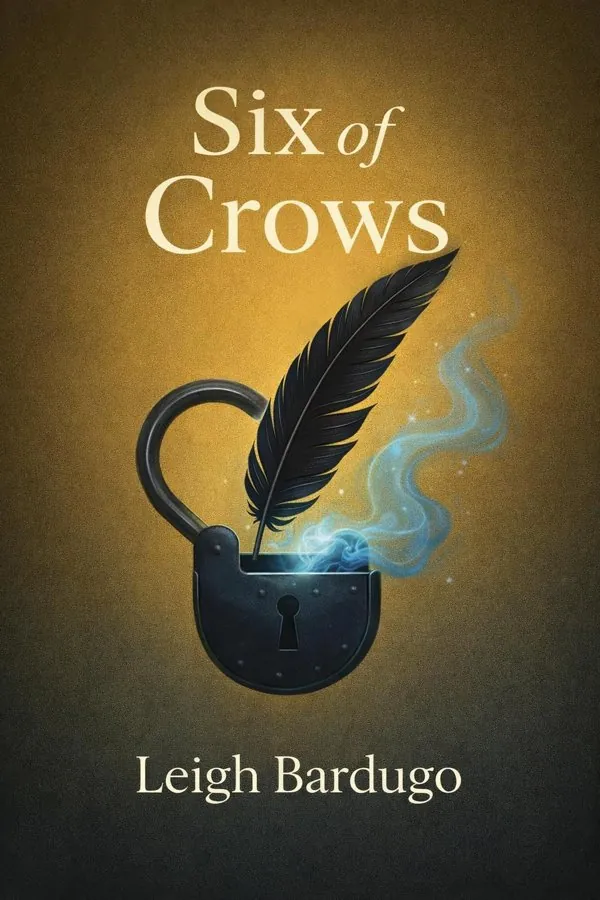
Six of Crows: Summary & Key Insights
 10 min9 chaptersAudio available
Key Takeaways from Six of Crows
A city can shape a person as surely as any family, and in Six of Crows, Ketterdam creates predators by rewarding hunger, speed, and emotional hardening.
Great teams are rarely built from comfort; they are forged from necessity, tension, and complementary strengths.
Trust becomes most meaningful when there are good reasons to withhold it.
Pressure does not create character so much as reveal it.
Success means little in a world where victory can be stolen before it is secured.
What Is Six of Crows About?
Six of Crows by Leigh Bardugo is a scifi_fantasy book spanning 5 pages. Leigh Bardugo’s Six of Crows is a high-stakes fantasy heist novel set in the richly imagined Grishaverse, where crime, politics, and magic collide in the mercantile city of Ketterdam. At the center of the story is Kaz Brekker, a teenage criminal mastermind offered an impossible job: break into the most secure fortress in the world and rescue a scientist whose discovery could shatter the balance of power across nations. To do it, Kaz assembles a crew of six dangerous outsiders, each carrying rare talents and private wounds. What follows is not just a thrilling caper, but a deeply character-driven story about trauma, trust, loyalty, and the cost of survival. What makes the novel matter is its rare combination of momentum and emotional depth. Bardugo delivers intricate plotting, unforgettable character dynamics, and a morally complex world where no one is entirely innocent, yet everyone longs for freedom. Already acclaimed for her Grishaverse novels, Bardugo brings authority through sharp worldbuilding and a distinctive voice that elevates young adult fantasy into something darker, smarter, and more emotionally resonant. Six of Crows is both an adventure and a study of how broken people learn to become indispensable to one another.
This FizzRead summary covers all 9 key chapters of Six of Crows in approximately 10 minutes, distilling the most important ideas, arguments, and takeaways from Leigh Bardugo's work. Also available as an audio summary and Key Quotes Podcast.
Six of Crows
Leigh Bardugo’s Six of Crows is a high-stakes fantasy heist novel set in the richly imagined Grishaverse, where crime, politics, and magic collide in the mercantile city of Ketterdam. At the center of the story is Kaz Brekker, a teenage criminal mastermind offered an impossible job: break into the most secure fortress in the world and rescue a scientist whose discovery could shatter the balance of power across nations. To do it, Kaz assembles a crew of six dangerous outsiders, each carrying rare talents and private wounds. What follows is not just a thrilling caper, but a deeply character-driven story about trauma, trust, loyalty, and the cost of survival.
What makes the novel matter is its rare combination of momentum and emotional depth. Bardugo delivers intricate plotting, unforgettable character dynamics, and a morally complex world where no one is entirely innocent, yet everyone longs for freedom. Already acclaimed for her Grishaverse novels, Bardugo brings authority through sharp worldbuilding and a distinctive voice that elevates young adult fantasy into something darker, smarter, and more emotionally resonant. Six of Crows is both an adventure and a study of how broken people learn to become indispensable to one another.
Who Should Read Six of Crows?
This book is perfect for anyone interested in scifi_fantasy and looking to gain actionable insights in a short read. Whether you're a student, professional, or lifelong learner, the key ideas from Six of Crows by Leigh Bardugo will help you think differently.
- ✓Readers who enjoy scifi_fantasy and want practical takeaways
- ✓Professionals looking to apply new ideas to their work and life
- ✓Anyone who wants the core insights of Six of Crows in just 10 minutes
Want the full summary?
Get instant access to this book summary and 100K+ more with Fizz Moment.
Get Free SummaryAvailable on App Store • Free to download
Key Chapters
A city can shape a person as surely as any family, and in Six of Crows, Ketterdam creates predators by rewarding hunger, speed, and emotional hardening. The city is a bustling trade hub of canals, gambling dens, pleasure houses, and criminal empires. On the surface, it thrives on commerce; beneath that surface, it runs on manipulation, debt, and violence. This setting is not just background scenery. It explains why people like Kaz Brekker become so sharp-edged. Known as Dirtyhands, Kaz rises through the criminal underworld not because he is the strongest, but because he understands that information, leverage, and fear can be more powerful than brute force.
Kaz’s ascent reflects one of the novel’s central insights: power often belongs to those who can read systems rather than simply fight within them. He studies weaknesses in institutions, rival gangs, and even individuals. His brilliance lies in strategy, patience, and his refusal to show vulnerability. Yet the novel also reveals the cost of this survival method. Kaz’s coldness protects him, but it isolates him. His reputation is armor, and armor is heavy.
In practical terms, this idea applies far beyond fantasy. In competitive environments, from workplaces to social systems, those who recognize hidden rules often gain an advantage. But Six of Crows reminds us that mastering a system is not the same as escaping its damage. Competence without connection can become its own prison.
Actionable takeaway: Learn to read the systems around you with Kaz-like clarity, but do not let survival skills become your entire identity.
Great teams are rarely built from comfort; they are forged from necessity, tension, and complementary strengths. Kaz’s crew is not a group of friends brought together by trust. It is a collection of desperate, highly skilled outsiders: Inej, the silent spy and acrobat; Jesper, a reckless sharpshooter; Nina, a powerful Grisha Heartrender; Matthias, a disgraced Fjerdan soldier; and Wylan, a merchant’s son with hidden talents. Each member is chosen because the mission demands a specific capability. Together, they form a heist team where every weakness can be compensated for by someone else’s strength.
What makes this assembly compelling is that Bardugo never pretends teamwork is easy. The crew is fractured by prejudice, secrecy, debt, trauma, and personal agendas. Matthias mistrusts Nina because of political and cultural indoctrination. Jesper masks insecurity with humor and risk-taking. Wylan hides his identity and fears inadequacy. Inej works with Kaz but keeps testing whether he sees her as a person or merely an asset. These internal tensions make the crew feel real.
The book offers a practical lesson in collaboration: strong teams do not require sameness. They require purpose, role clarity, and an increasing willingness to rely on each other under pressure. Diversity of skill and perspective becomes an advantage only when members begin to move from suspicion to interdependence.
In real life, whether in creative projects, business teams, or community work, assembling the right group means looking beyond personality fit alone. The best collaborators may challenge one another, but they also expand what is possible.
Actionable takeaway: Build teams around complementary abilities and shared stakes, then create conditions where trust can be earned through action.
Trust becomes most meaningful when there are good reasons to withhold it. The crew’s journey into Fjerda raises the stakes of every decision because the mission requires them to enter hostile territory, infiltrate the Ice Court, and depend on people they do not fully believe in. Fjerda is not only geographically dangerous; it is ideologically rigid and openly hostile to Grisha. This makes Nina especially vulnerable and Matthias emotionally conflicted. The mission therefore becomes more than a physical break-in. It is a test of whether enemies, skeptics, and wounded survivors can cooperate long enough to achieve something larger than themselves.
Bardugo uses this phase of the novel to show that trust is rarely a sudden feeling. It is a sequence of choices made under pressure. Characters reveal themselves through risk, sacrifice, competence, and restraint. Matthias begins confronting the limits of the beliefs he inherited. Nina’s strength is balanced by her emotional intelligence and refusal to let hatred define her. Kaz continues controlling variables, but even he must admit that no plan survives without human reliability.
This idea is deeply practical. In many areas of life, trust is not built through promises but through repeated evidence. Teams, relationships, and partnerships often begin with uncertainty. What matters is whether people act with consistency when the stakes rise. The novel also warns that betrayal hurts most where dependence is unavoidable, which is why wise trust must include both hope and discernment.
Actionable takeaway: Treat trust as something built through tested behavior, not wishful thinking, and evaluate people by what they do when pressure removes their masks.
Pressure does not create character so much as reveal it. Once the Ice Court heist begins, Six of Crows becomes a masterclass in escalation. Every carefully planned move meets an unexpected complication, forcing the crew to improvise across impossible odds. Disguises, split-second timing, surveillance, sabotage, and physical danger all collide. Yet the true brilliance of this section is that the heist is never only mechanical. Each setback also tests a psychological fault line within the crew.
Kaz must adapt without losing control. Inej must decide what she is willing to sacrifice and for whom. Jesper’s talent shines brightest when chaos peaks, but so does his appetite for risk. Nina’s powers become both a tool and a danger, especially as parem, the drug at the center of the plot, demonstrates how quickly ability can turn monstrous. Matthias confronts duty, guilt, and changing loyalty. Wylan begins stepping out of the role others have assigned him and proving that cleverness can be quiet.
The sequence shows why heist stories resonate so strongly: they externalize inner conflict. Locks, guards, and walls are tangible obstacles, but fear, grief, addiction, and shame are the subtler barriers each character must also cross. In everyday life, high-pressure projects do the same. Deadlines, crises, and uncertainty expose weaknesses in plans, but also in habits and identity.
The lesson is not to avoid pressure. It is to prepare for the reality that stress will test both systems and self-understanding. Flexibility, emotional awareness, and backup plans matter as much as ambition.
Actionable takeaway: When planning something difficult, account not only for external risks but also for how stress may magnify personal blind spots and group tensions.
Success means little in a world where victory can be stolen before it is secured. After surviving the near-impossible mission, the crew returns to Ketterdam expecting payment and perhaps a chance to redefine their futures. Instead, they meet betrayal that reveals how unstable power remains in their world. Wealthy patrons, political interests, and criminal bosses operate by the same rule: use people until a better deal appears. The promised reward is not simply withheld; it becomes a weapon, and the crew learns that escaping danger is not the same as escaping exploitation.
This final movement of the novel is especially effective because it refuses tidy closure. Bardugo emphasizes that betrayal wounds not only through financial loss, but through the reopening of old injuries. Kaz’s obsession with revenge and control intensifies. Inej’s freedom remains uncertain. The group’s hard-won bond is tested by the realization that their enemies are more powerful and more personal than before. The ending does not diminish the crew’s achievements; it sharpens them by showing that one successful operation cannot undo a broken system.
In practical terms, this idea mirrors experiences many people face after major effort. Finishing the job does not guarantee fair treatment, recognition, or security. Contracts can shift. Gatekeepers can exploit dependence. Systems that reward results may still punish vulnerability. The answer is not cynicism alone, but strategic vigilance.
Actionable takeaway: Protect your interests beyond the moment of success, because negotiation, leverage, and boundaries often matter most after the hardest work is already done.
Some of the strongest moments in Six of Crows come from the truth that every member of the crew carries a past that still speaks into the present. Bardugo does not treat trauma as decorative darkness. She shows how it alters behavior, relationships, self-worth, and even physical response. Kaz’s touch aversion, Inej’s memories of captivity, Nina and Matthias’s grief and betrayal, Jesper’s self-destructive impulses, and Wylan’s family wounds all influence how they move through the world. Their talents are inseparable from their pain, but they are not reducible to it.
This matters because the novel rejects simplistic recovery arcs. No one is healed by one conversation or one victory. Instead, healing appears in fragments: an act of loyalty, a moment of honesty, a refusal to abandon someone, a choice to imagine a future wider than revenge. These moments do not erase damage, but they create movement. The characters remain haunted, yet they also become more than what happened to them.
That insight is highly relevant outside fiction. People often build identities around what they survived, especially when survival required vigilance, control, or emotional distance. Those adaptations may have once been necessary. The challenge is recognizing when they begin limiting growth. Six of Crows suggests that dignity returns not through forgetting pain, but through finding connection, agency, and purpose alongside it.
Actionable takeaway: Honor the survival strategies that carried you through hardship, but keep asking whether they are still protecting you or quietly preventing your next chapter.
Stories become more honest when they refuse to divide people neatly into heroes and villains. Six of Crows thrives in moral grayness. The central characters are thieves, con artists, smugglers, and killers, yet the novel invites readers to care deeply about them. Bardugo achieves this not by excusing their actions, but by giving context, consequence, and conscience. Kaz manipulates people. Nina lies when necessary. Jesper gambles away trust. Even the most noble impulses exist alongside selfish motives. At the same time, supposedly respectable institutions are shown to be exploitative, prejudiced, and cruel.
This ambiguity is one reason the novel feels mature. It recognizes that people often act from mixed motives: fear and love, greed and loyalty, vengeance and justice. Matthias’s arc is especially important here, as he learns that certainty can be a form of blindness. His moral code is not useless, but it is incomplete until he begins seeing individuals instead of categories.
In practical life, moral ambiguity appears whenever values collide. Loyalty to one person may mean disappointing another. Ambition may bring opportunity but also compromise. Six of Crows encourages deeper judgment rather than quick judgment. Understanding why someone acts does not require approving the action, but it does make wisdom possible.
For readers, this complexity creates a richer kind of engagement. We are asked not simply whom to cheer, but what kind of person survives a corrupt world without becoming entirely corrupt within it.
Actionable takeaway: Resist simplistic labels in your own life and look for motive, context, and consequence before deciding what someone’s actions truly mean.
The most frightening power is often the kind that promises control at the cost of humanity. At the center of the novel’s heist is jurda parem, a drug that amplifies Grisha abilities to terrifying levels. What begins as a scientific breakthrough quickly becomes a political and moral catastrophe. Nations want it as a weapon, criminals want it for profit, and individuals risk becoming tools the moment such power exists. Parem is not merely a fantasy device; it symbolizes the seductive logic of escalation. If a little power is useful, then more must be better—until the human cost becomes impossible to ignore.
Through Nina’s experience, the novel explores how enhancement can slide into dependence, distortion, and bodily damage. The promise of increased capacity comes paired with loss of control. This dynamic parallels real-world issues involving addiction, militarization, exploitative technology, and any system that values output over personhood. The drug intensifies a recurring concern in the book: people are constantly being priced, traded, and instrumentalized.
What makes this idea resonant is its modern relevance. Societies routinely celebrate innovation without adequately confronting the ethical consequences of misuse. Individuals do something similar on a smaller scale when they chase performance, status, or efficiency in ways that erode health and relationships. Not every advantage is worth its hidden cost.
Actionable takeaway: Be wary of any tool, opportunity, or shortcut that expands your capabilities while quietly reducing your freedom, judgment, or regard for human limits.
One of the novel’s most enduring pleasures is the way companionship grows where no one expected safety. Six of Crows is often described as a heist story, but its emotional center is the gradual formation of a found family. These characters do not become soft or suddenly uncomplicated. Instead, they begin making room for one another’s vulnerabilities. A joke at the right time, a rescue no one was obligated to attempt, a secret entrusted instead of hidden, a willingness to return for someone when escape would be easier—these are the moments that transform a temporary alliance into something more durable.
For people who have been abandoned, exploited, or misunderstood, chosen connection can feel more radical than blood loyalty. Inej’s longing for freedom, Wylan’s hunger to be seen accurately, Jesper’s fear of disappointment, Nina’s refusal to reduce Matthias to his worst beliefs, and Kaz’s guarded care all show that belonging is not always loud. Sometimes it appears as consistency. Sometimes as being remembered. Sometimes as someone refusing to let your pain be used against you.
This idea has wide application. Many readers recognize that support systems are not always inherited; often they are built intentionally through shared work, mutual respect, and repeated presence. In unstable environments, found family becomes more than comfort. It becomes protection, identity, and resistance against dehumanization.
Actionable takeaway: Invest in relationships where care is demonstrated through reliability and respect, because chosen community can become one of life’s strongest defenses against isolation.
All Chapters in Six of Crows
About the Author
Leigh Bardugo is a bestselling American author known for her influential work in fantasy fiction, especially the Grishaverse series. Born in Jerusalem and raised in Los Angeles, she graduated from Yale University before working in advertising, journalism, and other creative fields. Bardugo first gained major recognition with Shadow and Bone, but Six of Crows helped establish her as a standout voice in contemporary fantasy thanks to its darker tone, intricate plotting, and unforgettable ensemble cast. Her writing is widely praised for blending rich worldbuilding with emotional complexity, morally layered characters, and themes of identity, power, and survival. In addition to young adult fantasy, Bardugo has written adult fiction and short stories, expanding her reach across genres while maintaining a distinctive, character-driven style.
Get This Summary in Your Preferred Format
Read or listen to the Six of Crows summary by Leigh Bardugo anytime, anywhere. FizzRead offers multiple formats so you can learn on your terms — all free.
Available formats: App · Audio · PDF · EPUB — All included free with FizzRead
Download Six of Crows PDF and EPUB Summary
Key Quotes from Six of Crows
“A city can shape a person as surely as any family, and in Six of Crows, Ketterdam creates predators by rewarding hunger, speed, and emotional hardening.”
“Great teams are rarely built from comfort; they are forged from necessity, tension, and complementary strengths.”
“Trust becomes most meaningful when there are good reasons to withhold it.”
“Pressure does not create character so much as reveal it.”
“Success means little in a world where victory can be stolen before it is secured.”
Frequently Asked Questions about Six of Crows
Six of Crows by Leigh Bardugo is a scifi_fantasy book that explores key ideas across 9 chapters. Leigh Bardugo’s Six of Crows is a high-stakes fantasy heist novel set in the richly imagined Grishaverse, where crime, politics, and magic collide in the mercantile city of Ketterdam. At the center of the story is Kaz Brekker, a teenage criminal mastermind offered an impossible job: break into the most secure fortress in the world and rescue a scientist whose discovery could shatter the balance of power across nations. To do it, Kaz assembles a crew of six dangerous outsiders, each carrying rare talents and private wounds. What follows is not just a thrilling caper, but a deeply character-driven story about trauma, trust, loyalty, and the cost of survival. What makes the novel matter is its rare combination of momentum and emotional depth. Bardugo delivers intricate plotting, unforgettable character dynamics, and a morally complex world where no one is entirely innocent, yet everyone longs for freedom. Already acclaimed for her Grishaverse novels, Bardugo brings authority through sharp worldbuilding and a distinctive voice that elevates young adult fantasy into something darker, smarter, and more emotionally resonant. Six of Crows is both an adventure and a study of how broken people learn to become indispensable to one another.
More by Leigh Bardugo
You Might Also Like
Red Rising
Pierce Brown
10 min
Stranger in a Strange Land
Robert A. Heinlein
10 min
AI Valley
Chen Qiufan
10 min
Bloodchild
Octavia E. Butler
10 min
Do Androids Dream of Electric Sheep?
Philip K. Dick
10 min
Jujutsu Kaisen, Vol. 24
Gege Akutami
10 minBrowse by Category
Ready to read Six of Crows?
Get the full summary and 100K+ more books with Fizz Moment.