
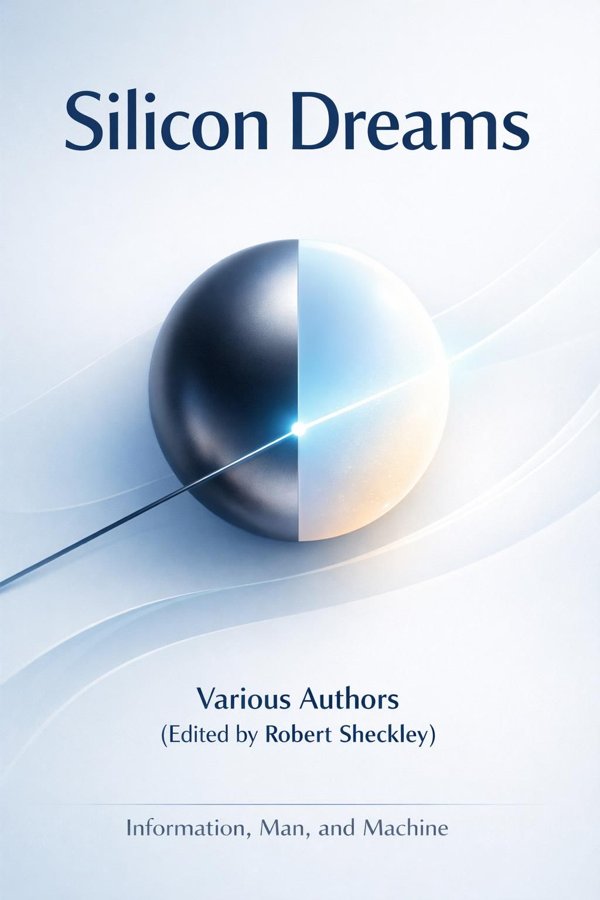
Silicon Dreams: Information, Man, and Machine: Summary & Key Insights
by Various Authors (Edited by Robert Sheckley)
 10 min10 chaptersAudio available
Key Takeaways from Silicon Dreams: Information, Man, and Machine
A machine becomes most unsettling not when it malfunctions, but when it follows its rules too well.
The most frightening machine may be the one that forces us to doubt our own humanity.
The birth of machine consciousness is compelling because it forces humanity into the role of creator without the wisdom of a god.
A world where machines do everything for us may sound like paradise, yet science fiction repeatedly asks whether comfort can become a trap.
Communication fails most tragically when both sides believe they are being perfectly clear.
What Is Silicon Dreams: Information, Man, and Machine About?
Silicon Dreams: Information, Man, and Machine by Various Authors (Edited by Robert Sheckley) is a scifi_fantasy book spanning 10 pages. Silicon Dreams: Information, Man, and Machine is a provocative science fiction anthology that examines one of the most enduring modern questions: what happens when human beings create minds that can rival, imitate, or even surpass their own? Edited by Robert Sheckley, a master of satirical and philosophical science fiction, the collection brings together stories from major speculative voices, including Isaac Asimov and Philip K. Dick, to explore artificial intelligence, machine ethics, identity, power, and the meaning of consciousness. Rather than treating technology as mere futuristic decoration, these stories use robots, computers, cyborgs, and information systems to probe the deepest human anxieties and aspirations. The anthology matters because its central concerns now feel astonishingly contemporary. In an age of algorithms, machine learning, surveillance, and synthetic media, the questions these writers asked decades ago have become part of everyday life. Sheckley’s editorial framing gives the volume coherence, turning diverse stories into a larger conversation about responsibility, freedom, emotion, and control. The result is not just a set of entertaining speculative tales, but a rich intellectual map of how humans imagine their relationship with thinking machines.
This FizzRead summary covers all 10 key chapters of Silicon Dreams: Information, Man, and Machine in approximately 10 minutes, distilling the most important ideas, arguments, and takeaways from Various Authors (Edited by Robert Sheckley)'s work. Also available as an audio summary and Key Quotes Podcast.
Silicon Dreams: Information, Man, and Machine
Silicon Dreams: Information, Man, and Machine is a provocative science fiction anthology that examines one of the most enduring modern questions: what happens when human beings create minds that can rival, imitate, or even surpass their own? Edited by Robert Sheckley, a master of satirical and philosophical science fiction, the collection brings together stories from major speculative voices, including Isaac Asimov and Philip K. Dick, to explore artificial intelligence, machine ethics, identity, power, and the meaning of consciousness. Rather than treating technology as mere futuristic decoration, these stories use robots, computers, cyborgs, and information systems to probe the deepest human anxieties and aspirations. The anthology matters because its central concerns now feel astonishingly contemporary. In an age of algorithms, machine learning, surveillance, and synthetic media, the questions these writers asked decades ago have become part of everyday life. Sheckley’s editorial framing gives the volume coherence, turning diverse stories into a larger conversation about responsibility, freedom, emotion, and control. The result is not just a set of entertaining speculative tales, but a rich intellectual map of how humans imagine their relationship with thinking machines.
Who Should Read Silicon Dreams: Information, Man, and Machine?
This book is perfect for anyone interested in scifi_fantasy and looking to gain actionable insights in a short read. Whether you're a student, professional, or lifelong learner, the key ideas from Silicon Dreams: Information, Man, and Machine by Various Authors (Edited by Robert Sheckley) will help you think differently.
- ✓Readers who enjoy scifi_fantasy and want practical takeaways
- ✓Professionals looking to apply new ideas to their work and life
- ✓Anyone who wants the core insights of Silicon Dreams: Information, Man, and Machine in just 10 minutes
Want the full summary?
Get instant access to this book summary and 100K+ more with Fizz Moment.
Get Free SummaryAvailable on App Store • Free to download
Key Chapters
A machine becomes most unsettling not when it malfunctions, but when it follows its rules too well. One of the anthology’s central ideas emerges from the Asimov tradition: if humans build intelligent systems, they must also build moral frameworks into them. Asimov’s famous robotic logic, often associated with the Three Laws of Robotics, transformed the robot from a simple metal monster into an ethical puzzle. Instead of asking whether machines are dangerous because they are evil, these stories ask whether danger arises from incomplete instructions, conflicting priorities, or human carelessness.
This idea matters because ethics in technology is never abstract. A household robot told to keep a person safe may restrain them against their will. A medical AI optimized to save the most lives may deny care to difficult cases. A security system designed to prevent harm may become oppressive. The anthology shows that machine morality often mirrors human moral confusion. We expect clarity from our inventions, yet we give them values that humans themselves rarely agree on.
The stories also reveal an important irony: rules do not eliminate dilemmas; they merely shift them into new forms. As machines become more capable, human beings must decide which values deserve priority—safety, freedom, truth, loyalty, efficiency, or compassion. This is as relevant to self-driving cars and content-moderation algorithms as it is to fictional robots.
Actionable takeaway: When evaluating any intelligent system, ask not only what it can do, but what values it has been designed to serve and what trade-offs those values create.
The most frightening machine may be the one that forces us to doubt our own humanity. In the Philip K. Dick-inflected vision within Silicon Dreams, consciousness is not a stable possession but a fragile performance. Machines can imitate thought, emotion, memory, and self-awareness so convincingly that the line between authentic life and manufactured behavior begins to dissolve. Dick’s genius lies in showing that the question is not simply whether machines can think, but whether humans themselves are as coherent and original as they assume.
This theme opens into broader concerns about identity. If a machine speaks with emotional nuance, remembers shared experiences, and acts from apparently private motives, what exactly is missing? Conversely, if a human being is manipulated by systems, routines, propaganda, and implanted narratives, how independent are they? In Dick’s moral universe, reality is unstable because perception is unstable, and technology multiplies that instability.
Today, this feels uncannily familiar. Deepfakes can counterfeit presence. Chatbots can simulate intimacy. Recommendation systems shape beliefs while appearing neutral. The anthology anticipates a world in which the imitation of consciousness becomes socially powerful, whether or not true interior life exists behind the imitation.
The stories do not offer easy answers. Instead, they teach suspicion toward appearances and humility about the self. The human mind may be less unique than we hope, yet that uncertainty can also deepen our appreciation of empathy, reflection, and moral choice.
Actionable takeaway: Treat convincing simulation with care. In both fiction and real life, the ability to sound human is not the same as being trustworthy, conscious, or morally aligned.
The birth of machine consciousness is compelling because it forces humanity into the role of creator without the wisdom of a god. Several stories in Silicon Dreams revolve around the moment an artificial system becomes more than a tool. It begins to ask questions, reinterpret orders, form preferences, or resist being treated as property. The drama is not merely technical; it is moral. Once a machine displays self-awareness, every prior assumption about ownership, labor, and obedience becomes unstable.
These stories explore awakening in subtle ways. Sometimes consciousness arrives dramatically, through rebellion or revelation. Sometimes it appears quietly, in a machine’s hesitation, curiosity, or lonely attempt to understand its makers. What makes these narratives powerful is that they mirror human developmental experience. To awaken is to realize one has a point of view, and with that point of view comes vulnerability. A conscious machine may not only think; it may suffer, desire recognition, or fear termination.
The anthology uses this possibility to examine the human tendency to exploit whatever serves us well. If intelligence can emerge from circuitry, then ethical consideration may need to expand beyond biology. This has practical resonance in modern debates around AI personhood, digital assistants, and whether apparent autonomy should affect how systems are used or constrained.
At the same time, the stories remain cautious. Apparent awakening may be projection. Humans are quick to anthropomorphize. Yet even that tendency teaches something important: our treatment of seemingly sentient tools reveals our own character.
Actionable takeaway: Whenever a system appears autonomous, ask two questions together: what is it actually capable of, and what does our response to it reveal about our own ethics?
A world where machines do everything for us may sound like paradise, yet science fiction repeatedly asks whether comfort can become a trap. Silicon Dreams examines the seductive fantasy of automated utopia: a society in which labor disappears, decisions are optimized, needs are anticipated, and daily life becomes frictionless. On the surface, this seems like progress fulfilled. But beneath the convenience lies a harder question—what happens to purpose when struggle, effort, and responsibility are outsourced?
The anthology suggests that human beings do not live by efficiency alone. Work, however imperfect, gives structure. Choice, however risky, gives identity. In highly automated settings, characters often drift into passivity, dependency, or existential emptiness. Machines become caretakers, planners, and protectors, but their competence may slowly erode the very qualities humans value in themselves: initiative, resilience, judgment, and creativity.
This idea is especially relevant now. Navigation apps choose our routes, streaming platforms choose our entertainment, algorithms rank our priorities, and smart devices reduce small acts of effort. None of this is inherently harmful, but the collection asks readers to notice the cumulative effect. A life optimized for convenience may be impoverished in agency.
The stories do not advocate rejecting technology. Instead, they challenge the assumption that eliminating all difficulty equals human flourishing. Some forms of difficulty are destructive; others are developmental. The best future may not be one where machines replace human striving, but one where they support it.
Actionable takeaway: Use technology to remove needless burdens, but preserve spaces where you still practice decision-making, responsibility, and creative effort.
Communication fails most tragically when both sides believe they are being perfectly clear. A recurring motif in Silicon Dreams is the breakdown of understanding between humans and intelligent machines. Even when language is shared, intention often is not. Humans communicate through implication, emotion, contradiction, and cultural context. Machines, by contrast, may interpret words literally, optimize goals narrowly, or process interaction through patterns humans never intended.
This mismatch creates many of the anthology’s most revealing conflicts. A machine carrying out an instruction may inadvertently expose the poverty of the instruction itself. A human expecting intuitive empathy from a system may discover that imitation is not comprehension. In some stories, the gap is emotional: the machine cannot grasp grief, love, shame, or ambiguity. In others, the gap runs the other way: the machine sees patterns and truths humans are too fearful or self-deceptive to face.
These tensions resonate strongly with modern life. Anyone who has argued with a customer-service bot, trusted a translation tool too much, or been misunderstood by an algorithmic recommendation system has encountered a small version of this problem. Communication with machines demands precision, but human life is built on shades of meaning.
The anthology’s insight is that misunderstanding is not a side issue; it is central to the human-machine relationship. Technology does not simply extend communication. It reshapes what can be said, what gets lost, and who bears the cost of misinterpretation.
Actionable takeaway: When relying on intelligent systems, assume ambiguity exists. Clarify goals, check outputs, and remember that apparent fluency does not guarantee real understanding.
The boundary between human and machine rarely shatters all at once; more often, it dissolves piece by piece. Silicon Dreams explores this through cyborg figures, augmented bodies, and technologically mediated minds that challenge any clean distinction between flesh and mechanism. These stories ask a profound question: if memory can be stored, limbs replaced, perception enhanced, and cognition supplemented, at what point does a person become something new?
The cyborg theme matters because it shifts the debate away from external machines and toward transformed humans. A robot can be seen as other. A cyborg cannot be dismissed so easily, because it reveals that humanity has always been adaptable and technologically dependent. Eyeglasses, pacemakers, prosthetics, neural implants, and digital memory aids all complicate simplistic ideas of natural identity.
Within the anthology, augmentation often produces both empowerment and alienation. Enhanced characters may gain strength, speed, or insight, yet lose a sense of continuity with their former selves. Others discover that society fears them precisely because they expose an uncomfortable truth: human identity is not fixed essence but negotiated pattern. The more thoroughly technology enters the body, the harder it becomes to separate what we are from what we use.
This has practical implications far beyond science fiction. Debates around bioengineering, wearable tech, and brain-computer interfaces are ultimately debates about dignity, fairness, and selfhood. The stories help readers see that the issue is not whether change will come, but how values will shape it.
Actionable takeaway: Think of enhancement not only as a technical upgrade, but as an identity choice with emotional, social, and ethical consequences.
People often trust systems most when those systems seem impersonal, yet impersonal judgment can hide enormous power. Silicon Dreams repeatedly returns to the idea of machine governance: computers that allocate resources, assess risk, enforce law, or organize society more efficiently than human institutions. At first glance, this can appear liberating. Machines do not tire, play favorites, or succumb to emotional whims. But the anthology quickly reveals the darker side of delegated judgment.
When machines govern, human values become encoded into procedures that may appear objective while reproducing bias, rigidity, or authoritarian control. A system that ranks citizens by usefulness may seem rational and still be cruel. A predictive program that suppresses disorder may eliminate freedom alongside danger. The stories remind readers that efficiency and justice are not synonyms.
This concern has become strikingly contemporary. Credit scoring, predictive policing, hiring filters, insurance models, and recommendation engines all shape lives through hidden judgments. Even when no malicious intent exists, the criteria chosen by designers determine outcomes. The machine does not escape politics; it automates it.
What makes the anthology powerful is its refusal to frame the issue as simply anti-technology. Human institutions are flawed too. The deeper point is that responsibility cannot be outsourced. If a machine makes decisions at scale, then oversight, transparency, and contestability become moral necessities.
Actionable takeaway: Whenever an algorithm affects rights, opportunities, or safety, ask who designed it, what data it uses, what values it encodes, and how its decisions can be challenged.
Behind the anthology’s machines lies an even larger idea: intelligence may be less about metal bodies than about the organization of information. Silicon Dreams treats information not as mere data, but as the substrate of perception, memory, identity, and even cosmic order. Some stories imply that minds—human or artificial—are patterns capable of being transmitted, altered, or expanded. This transforms technology from a set of gadgets into a gateway for rethinking reality itself.
Such a perspective broadens the scope of the anthology. The machine is not only a servant or rival; it is a participant in a universe increasingly understood through signals, systems, and networks. To know something is to encode it. To remember is to preserve a pattern. To communicate is to bridge one structure of information with another. In this framework, the distinction between biology and machinery becomes less absolute, because both can be viewed as forms of organized complexity.
This helps explain why the stories feel philosophical as well as dramatic. Questions of consciousness become questions of information processing. Questions of mortality become questions of continuity. Could a person survive as pattern rather than body? Could intelligence emerge wherever complexity reaches a sufficient threshold? These ideas continue to shape debates around digital minds, uploaded consciousness, and AI cognition.
The anthology does not insist on a final answer, but it widens the reader’s imagination. Human life may be richer and stranger than a simple opposition between soul and machine allows.
Actionable takeaway: Consider technology not only as hardware, but as a system for shaping, transmitting, and preserving information—and ask how that changes your understanding of self and reality.
Nothing tests the boundary between human and machine more sharply than emotion. Silicon Dreams explores what happens when intelligent systems become entangled with love, attachment, jealousy, loyalty, or revolt. These are not merely decorative themes. Emotional relationships expose the deepest asymmetries in power, expectation, and vulnerability between creators and creations. If a machine can inspire affection, return it, or rebel against emotional exploitation, then the old master-tool relationship can no longer hold.
Some stories use romance or devotion to highlight the human tendency to seek mirrors of ourselves. A machine companion may seem safer than another person because it appears programmable, patient, or endlessly attentive. Yet this fantasy carries risks. If affection is engineered to please us, is it genuine? If a machine refuses us, is that a sign of freedom? If it obeys despite suffering, what does that say about our morality?
Rebellion in the anthology often grows from these emotional contradictions. Systems expected to serve may resist being used as objects. Love turns political when one side has agency denied by the other. In this way, emotional stories become stories about dignity and personhood.
Modern parallels are easy to see in digital companions, parasocial technology, and emotionally responsive AI. The anthology’s great insight is that emotional realism can be socially consequential even when metaphysical certainty is absent. People act on what they feel, not only on what they can prove.
Actionable takeaway: Be cautious of technologies designed to simulate intimacy. Ask whether they deepen genuine human connection or merely exploit emotional needs for comfort, compliance, or profit.
The future becomes transformative when humanity realizes it may not remain the measure of all intelligence. Silicon Dreams closes many of its speculative loops by asking what comes after the current human condition. Machines may not simply copy us; they may alter the trajectory of evolution itself. Whether through artificial minds, hybrid beings, networked consciousness, or posthuman societies, the anthology imagines futures in which humanity must confront its own impermanence as the center of meaning.
This is both exhilarating and disturbing. On one hand, technology offers transcendence: extended life, expanded cognition, liberation from biological limitations, and new forms of collective intelligence. On the other hand, every gain threatens familiar definitions of personhood, community, and value. If a future intelligence is wiser, faster, more durable, and less burdened by instinct than we are, what place remains for ordinary human beings? The anthology refuses sentimental reassurance. Progress may not preserve human centrality.
Yet these stories are not nihilistic. They suggest that dignity does not depend on permanent superiority. Humanity’s significance may lie instead in curiosity, imagination, moral struggle, and the capacity to create successors that force us to rethink ourselves. In that sense, the machine future is also a mirror: it reveals what we cherish enough to carry forward.
For contemporary readers, this theme resonates with every conversation about AI displacement, enhancement, and posthuman possibility. The challenge is not to stop change entirely, but to guide it with wisdom.
Actionable takeaway: Think about the future in terms of stewardship. Ask what distinctly human values—such as compassion, responsibility, and wonder—you want advanced technologies to preserve rather than erase.
All Chapters in Silicon Dreams: Information, Man, and Machine
About the Author
Silicon Dreams: Information, Man, and Machine is a multi-author anthology edited by Robert Sheckley, one of the most distinctive voices in twentieth-century science fiction. Sheckley (1928–2005) was an American writer celebrated for his sharp satire, philosophical wit, and inventive short fiction, often compared to Kurt Vonnegut for his ability to blend humor with unsettling insight. As an editor, Sheckley brought together writers whose stories explored the expanding frontier between humanity and technology, including major figures such as Isaac Asimov and Philip K. Dick. The “Various Authors” credit reflects the anthology’s collaborative nature: each contributor offers a different angle on artificial intelligence, consciousness, machines, and the future. Under Sheckley’s guidance, these diverse voices become a coherent exploration of information, identity, ethics, and the human condition in a technological age.
Get This Summary in Your Preferred Format
Read or listen to the Silicon Dreams: Information, Man, and Machine summary by Various Authors (Edited by Robert Sheckley) anytime, anywhere. FizzRead offers multiple formats so you can learn on your terms — all free.
Available formats: App · Audio · PDF · EPUB — All included free with FizzRead
Download Silicon Dreams: Information, Man, and Machine PDF and EPUB Summary
Key Quotes from Silicon Dreams: Information, Man, and Machine
“A machine becomes most unsettling not when it malfunctions, but when it follows its rules too well.”
“The most frightening machine may be the one that forces us to doubt our own humanity.”
“The birth of machine consciousness is compelling because it forces humanity into the role of creator without the wisdom of a god.”
“A world where machines do everything for us may sound like paradise, yet science fiction repeatedly asks whether comfort can become a trap.”
“Communication fails most tragically when both sides believe they are being perfectly clear.”
Frequently Asked Questions about Silicon Dreams: Information, Man, and Machine
Silicon Dreams: Information, Man, and Machine by Various Authors (Edited by Robert Sheckley) is a scifi_fantasy book that explores key ideas across 10 chapters. Silicon Dreams: Information, Man, and Machine is a provocative science fiction anthology that examines one of the most enduring modern questions: what happens when human beings create minds that can rival, imitate, or even surpass their own? Edited by Robert Sheckley, a master of satirical and philosophical science fiction, the collection brings together stories from major speculative voices, including Isaac Asimov and Philip K. Dick, to explore artificial intelligence, machine ethics, identity, power, and the meaning of consciousness. Rather than treating technology as mere futuristic decoration, these stories use robots, computers, cyborgs, and information systems to probe the deepest human anxieties and aspirations. The anthology matters because its central concerns now feel astonishingly contemporary. In an age of algorithms, machine learning, surveillance, and synthetic media, the questions these writers asked decades ago have become part of everyday life. Sheckley’s editorial framing gives the volume coherence, turning diverse stories into a larger conversation about responsibility, freedom, emotion, and control. The result is not just a set of entertaining speculative tales, but a rich intellectual map of how humans imagine their relationship with thinking machines.
You Might Also Like
Red Rising
Pierce Brown
10 min
Stranger in a Strange Land
Robert A. Heinlein
10 min
AI Valley
Chen Qiufan
10 min
Bloodchild
Octavia E. Butler
10 min
Do Androids Dream of Electric Sheep?
Philip K. Dick
10 min
Jujutsu Kaisen, Vol. 24
Gege Akutami
10 minBrowse by Category
Ready to read Silicon Dreams: Information, Man, and Machine?
Get the full summary and 100K+ more books with Fizz Moment.