
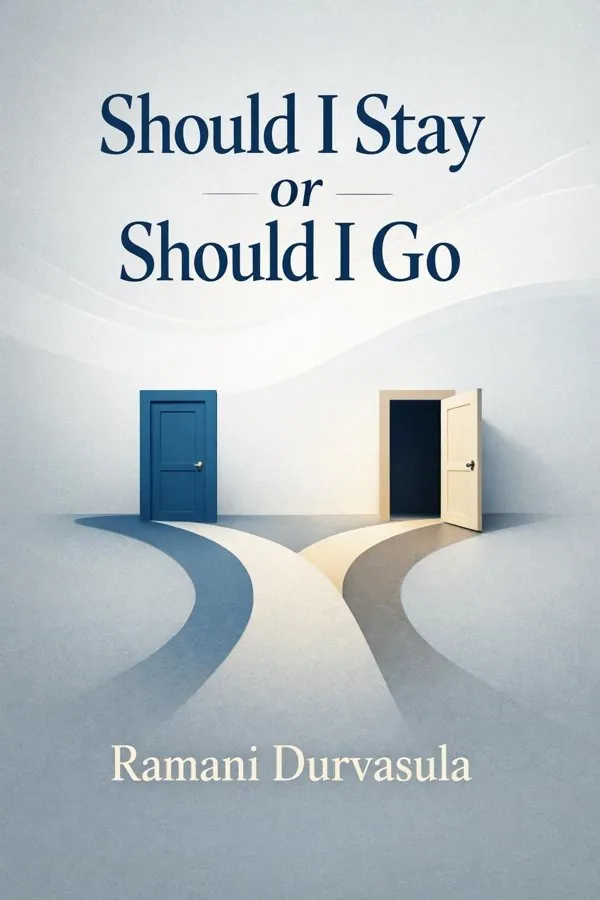
Should I Stay or Should I Go: Surviving a Relationship with a Narcissist: Summary & Key Insights
 10 min5 chaptersAudio available
What Is Should I Stay or Should I Go: Surviving a Relationship with a Narcissist About?
Should I Stay or Should I Go: Surviving a Relationship with a Narcissist by Ramani Durvasula is a mental_health book spanning 5 pages. In this book, clinical psychologist Dr. Ramani Durvasula offers a comprehensive guide for individuals struggling in relationships with narcissistic partners. Drawing on psychological research and clinical experience, she helps readers recognize patterns of manipulation, emotional abuse, and gaslighting, and provides practical strategies for self-protection, boundary-setting, and recovery. The book empowers readers to make informed decisions about whether to remain in or leave such relationships.
This FizzRead summary covers all 5 key chapters of Should I Stay or Should I Go: Surviving a Relationship with a Narcissist in approximately 10 minutes, distilling the most important ideas, arguments, and takeaways from Ramani Durvasula's work. Also available as an audio summary and Key Quotes Podcast.
Should I Stay or Should I Go: Surviving a Relationship with a Narcissist
In this book, clinical psychologist Dr. Ramani Durvasula offers a comprehensive guide for individuals struggling in relationships with narcissistic partners. Drawing on psychological research and clinical experience, she helps readers recognize patterns of manipulation, emotional abuse, and gaslighting, and provides practical strategies for self-protection, boundary-setting, and recovery. The book empowers readers to make informed decisions about whether to remain in or leave such relationships.
Who Should Read Should I Stay or Should I Go: Surviving a Relationship with a Narcissist?
This book is perfect for anyone interested in mental_health and looking to gain actionable insights in a short read. Whether you're a student, professional, or lifelong learner, the key ideas from Should I Stay or Should I Go: Surviving a Relationship with a Narcissist by Ramani Durvasula will help you think differently.
- ✓Readers who enjoy mental_health and want practical takeaways
- ✓Professionals looking to apply new ideas to their work and life
- ✓Anyone who wants the core insights of Should I Stay or Should I Go: Surviving a Relationship with a Narcissist in just 10 minutes
Want the full summary?
Get instant access to this book summary and 100K+ more with Fizz Moment.
Get Free SummaryAvailable on App Store • Free to download
Key Chapters
We begin by untangling what narcissism truly means in psychological terms. Too often the word is thrown around casually, but in reality, narcissistic personality patterns lie on a spectrum that ranges from self-centeredness to full-blown narcissistic personality disorder. At its core are traits like grandiosity, entitlement, exploitativeness, envy, and—most destructively—a stark absence of empathy. In relationships, this combination produces a dynamic that starts as intoxicating and ends in devastation.
At the start, the narcissist may seem ideal: attentive, passionate, even worshipful. This initial phase, known as love-bombing, feels like destiny—you are finally seen, finally adored. But soon, subtle shifts begin. Affection becomes conditional; minor criticisms erupt into blame. Partners of narcissists often tell me, “I can’t do anything right anymore.” This confusion marks the onset of emotional control. The narcissist’s attention alternates between warmth and withdrawal, keeping you perpetually striving for the return of that early adoration.
This cycle has a profound psychological cost. Your nervous system remains in a chronic state of vigilance, leading to fatigue, anxiety, and self-doubt. Because narcissists externalize blame, their partners internalize it. Over time, you begin to believe that the peace of the relationship depends on your perfection—that if you could just say the right thing, avoid the wrong reaction, things would return to the way they were. But they won’t, because narcissism is not cured through your love or effort. The relationship functions to serve one person’s fragile ego, not mutual growth. Recognizing this is the first step toward emotional liberation.
Every narcissistic relationship follows a pattern—idealization, devaluation, and discard, sometimes recycling back again. I illustrate this as a loop because it rarely ends cleanly until the non-narcissistic partner consciously breaks it.
During the idealization phase, the narcissist mirrors your dreams and values. They seem like a soulmate who understands you at a soul-deep level. But soon, that reflection turns into critique. They begin to diminish your accomplishments, question your motives, or make subtle jokes at your expense. This is the devaluation stage, and it is psychologically destabilizing because it contradicts everything you experienced earlier. You’re left chasing that original version of them, hoping your patience will bring it back. When discard occurs—the cold withdrawal, the silent treatment, or outright abandonment—you’re stunned, desperate, and still believing you did something wrong.
In therapy, I often explain that this cycle isn’t love; it’s control through conditioning. Positive reinforcement alternates with emotional punishment, training you to respond to their moods rather than your own needs. Even after a discard, the narcissist may return with renewed affection, reigniting the hope that this time will be different. But genuine change is rare, because their empathy deficits make introspection nearly impossible. Understanding this cycle reframes your experience—it wasn’t random, and it wasn’t your fault. The pattern was designed to keep you hooked.
+ 3 more chapters — available in the FizzRead app
All Chapters in Should I Stay or Should I Go: Surviving a Relationship with a Narcissist
About the Author
Dr. Ramani Durvasula is a licensed clinical psychologist, professor of psychology, and author known for her expertise in narcissism and relationships. She has written extensively on the psychological impact of narcissistic abuse and frequently appears in media as an expert commentator on mental health and personality disorders.
Get This Summary in Your Preferred Format
Read or listen to the Should I Stay or Should I Go: Surviving a Relationship with a Narcissist summary by Ramani Durvasula anytime, anywhere. FizzRead offers multiple formats so you can learn on your terms — all free.
Available formats: App · Audio · PDF · EPUB — All included free with FizzRead
Download Should I Stay or Should I Go: Surviving a Relationship with a Narcissist PDF and EPUB Summary
Key Quotes from Should I Stay or Should I Go: Surviving a Relationship with a Narcissist
“We begin by untangling what narcissism truly means in psychological terms.”
“Every narcissistic relationship follows a pattern—idealization, devaluation, and discard, sometimes recycling back again.”
Frequently Asked Questions about Should I Stay or Should I Go: Surviving a Relationship with a Narcissist
Should I Stay or Should I Go: Surviving a Relationship with a Narcissist by Ramani Durvasula is a mental_health book that explores key ideas across 5 chapters. In this book, clinical psychologist Dr. Ramani Durvasula offers a comprehensive guide for individuals struggling in relationships with narcissistic partners. Drawing on psychological research and clinical experience, she helps readers recognize patterns of manipulation, emotional abuse, and gaslighting, and provides practical strategies for self-protection, boundary-setting, and recovery. The book empowers readers to make informed decisions about whether to remain in or leave such relationships.
You Might Also Like
Big Feelings: How to Be Okay When Things Are Not Okay
Liz Fosslien, Mollie West Duffy
10 min
Creative Arts Therapies Handbook: Art, Music and Dance Therapy Practices for Wellbeing
Susan I. Buchalter
10 min
Emotional First Aid: Healing Rejection, Guilt, Failure, and Other Everyday Hurts
Guy Winch
10 min
Lost Connections: Why You're Depressed and How to Find Hope
Johann Hari
10 min
No Time to Panic: How to Stop Worrying and Embrace Life
Matt Gutman
10 min
Overcoming Mobbing: A Recovery Guide for Workplace Aggression and Bullying
Maureen Duffy, Len Sperry
10 minBrowse by Category
Ready to read Should I Stay or Should I Go: Surviving a Relationship with a Narcissist?
Get the full summary and 100K+ more books with Fizz Moment.