
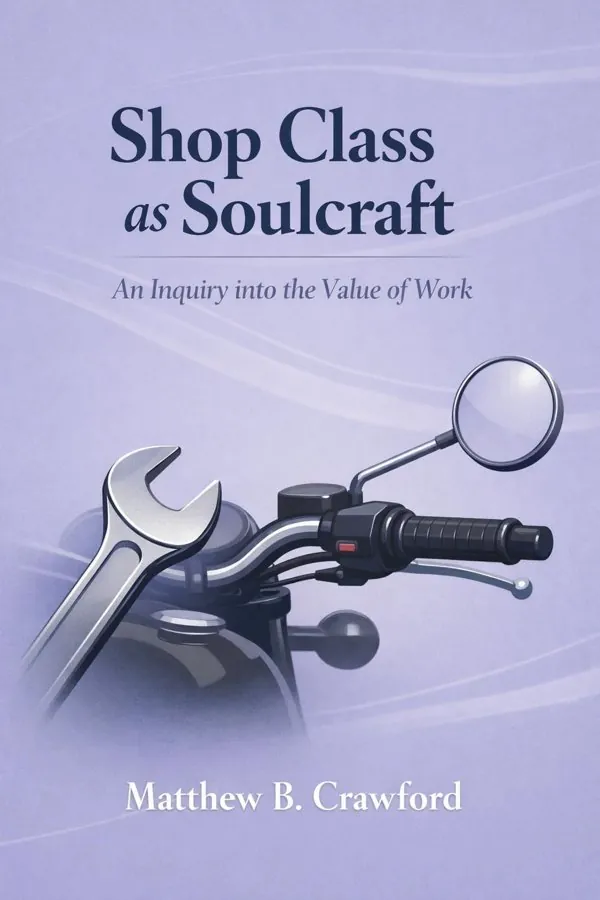
Shop Class as Soulcraft: An Inquiry into the Value of Work: Summary & Key Insights
 10 min9 chaptersAudio available
What Is Shop Class as Soulcraft: An Inquiry into the Value of Work About?
Shop Class as Soulcraft: An Inquiry into the Value of Work by Matthew B. Crawford is a philosophy book spanning 9 pages. In this philosophical and cultural exploration, Matthew B. Crawford argues for the intellectual and moral value of manual labor. Drawing from his own experience as a motorcycle mechanic and political philosopher, Crawford critiques the modern separation of thinking from doing, suggesting that craftsmanship offers a path to genuine agency, satisfaction, and understanding of the world.
This FizzRead summary covers all 9 key chapters of Shop Class as Soulcraft: An Inquiry into the Value of Work in approximately 10 minutes, distilling the most important ideas, arguments, and takeaways from Matthew B. Crawford's work. Also available as an audio summary and Key Quotes Podcast.
Shop Class as Soulcraft: An Inquiry into the Value of Work
In this philosophical and cultural exploration, Matthew B. Crawford argues for the intellectual and moral value of manual labor. Drawing from his own experience as a motorcycle mechanic and political philosopher, Crawford critiques the modern separation of thinking from doing, suggesting that craftsmanship offers a path to genuine agency, satisfaction, and understanding of the world.
Who Should Read Shop Class as Soulcraft: An Inquiry into the Value of Work?
This book is perfect for anyone interested in philosophy and looking to gain actionable insights in a short read. Whether you're a student, professional, or lifelong learner, the key ideas from Shop Class as Soulcraft: An Inquiry into the Value of Work by Matthew B. Crawford will help you think differently.
- ✓Readers who enjoy philosophy and want practical takeaways
- ✓Professionals looking to apply new ideas to their work and life
- ✓Anyone who wants the core insights of Shop Class as Soulcraft: An Inquiry into the Value of Work in just 10 minutes
Want the full summary?
Get instant access to this book summary and 100K+ more with Fizz Moment.
Get Free SummaryAvailable on App Store • Free to download
Key Chapters
My own story begins with an uncomfortable realization that intellect alone could not sustain meaning in work. After earning a doctorate in political philosophy, I entered what was supposed to be the pinnacle of intellectual employment: a research position at a policy think tank in Washington, D.C. Every day I was tasked with producing arguments, policy briefs, and theoretical analyses—all of which took place in the realm of words and abstract reasoning. There was almost no feedback from reality itself. Whether I worked well or poorly, the tangible world remained unchanged. I began to feel that the connection between human thought and the material world, that grounding which gives thought its authenticity, had been severed.
When I finally left that position and began repairing motorcycles, I experienced a profound shift. Unlike the abstractions of policy, the motorcycle existed in the realm of things. It could not be persuaded by rhetoric or made to function through clever argumentation. When something was broken, it had to be fixed with direct engagement. In those moments of problem-solving, where my hands moved according to both practical logic and intuitive judgment, I rediscovered a genuine form of thinking—what Aristotle called phronesis, or practical wisdom. Repairing a carburetor or aligning a drive chain required an active negotiation between mental precision and bodily skill. The mind and hands became one system of attention.
This transition helped me articulate a larger cultural critique: how modern society systematically separates thinking from doing. The division between mental and manual work, often justified as economic progress, has exacted a moral and epistemic cost. Intellectual work, disconnected from tangible outcomes, tends toward abstraction and alienation. Manual work, often dismissed as low-status, turns out to be a site of rich cognitive and ethical complexity. Through the lens of my own experience, I began to see that a mechanic’s shop could be as intellectually demanding as any philosophical seminar, and far more honest in its relationship to reality.
The rhetoric of the so-called knowledge economy celebrates flexibility, creativity, and innovation, but beneath these ideals lies a troubling abstraction. In white-collar environments, workers are asked to process information and generate reports, algorithms, or strategies that often bear no direct connection to material outcomes. The result is a subtle form of alienation—one where individuals lose sight of their own agency. Because modern work increasingly occurs in symbolic space, the worker no longer sees the concrete fruits of effort, and therefore cannot easily grasp its meaning.
In my years in intellectual institutions, I witnessed how this abstraction fosters dependency. Without direct experience of reality, the worker’s judgment becomes mediated by systems and metrics, which are themselves products of bureaucratic thinking. Risk-taking, improvisation, and personal accountability—all essential traits of practical reasoning—are replaced by compliance and proceduralism. The paradox is that this environment claims to cultivate the mind while systematically depriving it of direct sensory and cognitive engagement.
Contrast this with manual labor: the plumber must understand pressure and flow as physical phenomena, not as equations on a screen. The carpenter’s success is measured by the alignment of joints, the consistency of finish—objective facts that demand attention to detail and respect for the material. In evaluating knowledge work, I argue that the absence of this factual grounding undermines not just productivity but moral coherence. When work no longer tests our ideas against reality, our thinking becomes speculative and self-confirming. The alienation here is not only economic but spiritual; the worker feels disconnected from the world’s intelligible order.
+ 7 more chapters — available in the FizzRead app
All Chapters in Shop Class as Soulcraft: An Inquiry into the Value of Work
About the Author
Matthew B. Crawford is an American writer, philosopher, and mechanic. He holds a Ph.D. in political philosophy from the University of Chicago and has written extensively on work, technology, and culture. He is also the author of 'The World Beyond Your Head' and operates a motorcycle repair shop in Richmond, Virginia.
Get This Summary in Your Preferred Format
Read or listen to the Shop Class as Soulcraft: An Inquiry into the Value of Work summary by Matthew B. Crawford anytime, anywhere. FizzRead offers multiple formats so you can learn on your terms — all free.
Available formats: App · Audio · PDF · EPUB — All included free with FizzRead
Download Shop Class as Soulcraft: An Inquiry into the Value of Work PDF and EPUB Summary
Key Quotes from Shop Class as Soulcraft: An Inquiry into the Value of Work
“My own story begins with an uncomfortable realization that intellect alone could not sustain meaning in work.”
“The rhetoric of the so-called knowledge economy celebrates flexibility, creativity, and innovation, but beneath these ideals lies a troubling abstraction.”
Frequently Asked Questions about Shop Class as Soulcraft: An Inquiry into the Value of Work
Shop Class as Soulcraft: An Inquiry into the Value of Work by Matthew B. Crawford is a philosophy book that explores key ideas across 9 chapters. In this philosophical and cultural exploration, Matthew B. Crawford argues for the intellectual and moral value of manual labor. Drawing from his own experience as a motorcycle mechanic and political philosopher, Crawford critiques the modern separation of thinking from doing, suggesting that craftsmanship offers a path to genuine agency, satisfaction, and understanding of the world.
More by Matthew B. Crawford
You Might Also Like






Browse by Category
Ready to read Shop Class as Soulcraft: An Inquiry into the Value of Work?
Get the full summary and 100K+ more books with Fizz Moment.