
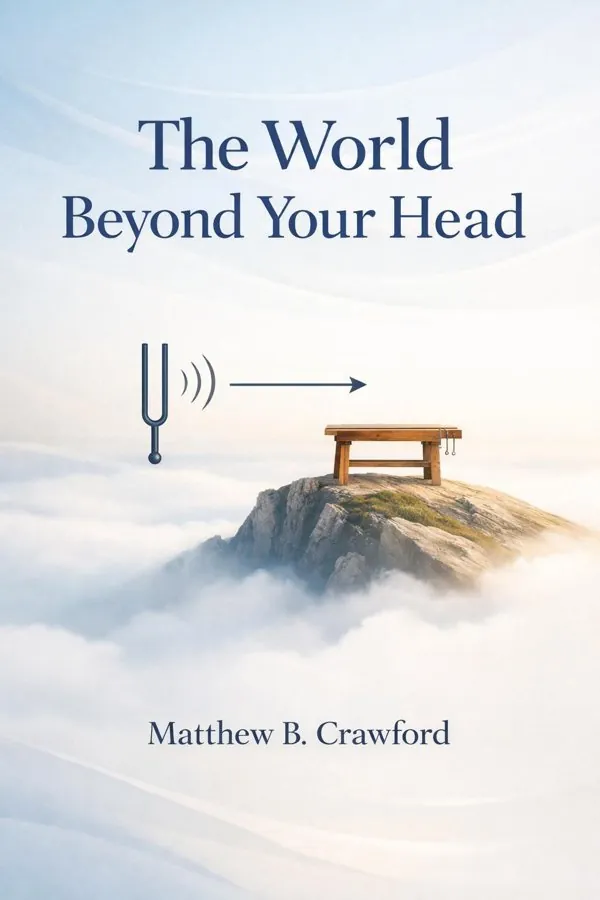
The World Beyond Your Head: On Becoming an Individual in an Age of Distraction: Summary & Key Insights
 10 min9 chaptersAudio available
What Is The World Beyond Your Head: On Becoming an Individual in an Age of Distraction About?
The World Beyond Your Head: On Becoming an Individual in an Age of Distraction by Matthew B. Crawford is a mindset book spanning 9 pages. In this philosophical and cultural critique, Matthew B. Crawford explores how modern life fragments our attention and erodes our sense of agency. Drawing on examples from craftsmanship, music, and everyday experience, he argues that true individuality arises not from self-absorption but from skilled engagement with the world. The book challenges the dominance of virtual and commercial distractions, urging readers to reclaim focus and meaning through tangible, embodied practices.
This FizzRead summary covers all 9 key chapters of The World Beyond Your Head: On Becoming an Individual in an Age of Distraction in approximately 10 minutes, distilling the most important ideas, arguments, and takeaways from Matthew B. Crawford's work. Also available as an audio summary and Key Quotes Podcast.
The World Beyond Your Head: On Becoming an Individual in an Age of Distraction
In this philosophical and cultural critique, Matthew B. Crawford explores how modern life fragments our attention and erodes our sense of agency. Drawing on examples from craftsmanship, music, and everyday experience, he argues that true individuality arises not from self-absorption but from skilled engagement with the world. The book challenges the dominance of virtual and commercial distractions, urging readers to reclaim focus and meaning through tangible, embodied practices.
Who Should Read The World Beyond Your Head: On Becoming an Individual in an Age of Distraction?
This book is perfect for anyone interested in mindset and looking to gain actionable insights in a short read. Whether you're a student, professional, or lifelong learner, the key ideas from The World Beyond Your Head: On Becoming an Individual in an Age of Distraction by Matthew B. Crawford will help you think differently.
- ✓Readers who enjoy mindset and want practical takeaways
- ✓Professionals looking to apply new ideas to their work and life
- ✓Anyone who wants the core insights of The World Beyond Your Head: On Becoming an Individual in an Age of Distraction in just 10 minutes
Want the full summary?
Get instant access to this book summary and 100K+ more with Fizz Moment.
Get Free SummaryAvailable on App Store • Free to download
Key Chapters
To understand what is at stake, we first need to grasp attention itself—not as a fleeting mental focus, but as a moral and cultural capacity. Attention determines what is real for us, what matters, and therefore who we become. Philosophers from Descartes to Kant imagined the self as an autonomous consciousness projecting meaning onto a neutral world. Yet this abstraction blinds us to the concrete, lived nature of perception. Reality impresses itself upon us when we care enough to attend.
I learned this lesson not in a seminar room but in a motorcycle repair shop. There, attention becomes submission to the object at hand—a carburetor that resists easy understanding, a stubborn bolt that insists on being known through touch and patience. This kind of attention is active and receptive simultaneously. It teaches humility and precision. When we look closely, attention always connects subject and object, self and world. It is ethical because it asks us to meet what is other than ourselves without domination or self-centered projection.
From music to sport, the same pattern holds: the attentive practitioner does not impose will on the world but joins with it in a participatory circuit. The violinist must yield to the instrument’s physics; the athlete must attune body to rhythm and resistance. In this yielding lies a paradoxical freedom. Attention thus becomes a practice of self-transcendence—a cultivated openness whereby individuality arises through encounter, not isolation. To lose this capacity, as our current culture encourages, is to lose ourselves.
The modern economy thrives on fragmented consciousness. Digital media, advertising, and consumer environments are engineered to interrupt, lure, and gratify fleeting impulses. This systematic scattering of attention undermines the integrity of the self. We celebrate freedom of choice, yet our choices are often orchestrated by algorithms far better at predicting our desires than we are. The irony is profound: what passes for autonomy today is often passive responsiveness to stimuli carefully designed by others.
I argue that this crisis is not merely technological but moral. When attention is diverted constantly, our capacity for sustained engagement—the very condition of thought, empathy, and craftsmanship—atrophies. The consumer-self becomes weightless, floating through experiences without commitment. In the workshop, by contrast, mistakes have consequences; matter resists fantasy. The craftsman’s world restores gravity. It reminds us that agency requires friction, not frictionless consumption.
The fragmentation of attention also produces political consequences. A distracted populace cannot deliberate meaningfully, nor can it sustain shared norms. We slip into the illusion that we can curate reality around our preferences, yet the world is indifferent to our settings. The crisis of the self thus mirrors the crisis of citizenship—both arise from the illusion that independence means exemption from external constraints. In truth, our humanity deepens only when we learn to negotiate the demands of reality attentively.
+ 7 more chapters — available in the FizzRead app
All Chapters in The World Beyond Your Head: On Becoming an Individual in an Age of Distraction
About the Author
Matthew B. Crawford is an American philosopher and mechanic known for his writings on work, attention, and the value of manual competence. He holds a Ph.D. in political philosophy from the University of Chicago and is the author of the bestselling book 'Shop Class as Soulcraft.' Crawford divides his time between academic research and running a motorcycle repair shop in Richmond, Virginia.
Get This Summary in Your Preferred Format
Read or listen to the The World Beyond Your Head: On Becoming an Individual in an Age of Distraction summary by Matthew B. Crawford anytime, anywhere. FizzRead offers multiple formats so you can learn on your terms — all free.
Available formats: App · Audio · PDF · EPUB — All included free with FizzRead
Download The World Beyond Your Head: On Becoming an Individual in an Age of Distraction PDF and EPUB Summary
Key Quotes from The World Beyond Your Head: On Becoming an Individual in an Age of Distraction
“To understand what is at stake, we first need to grasp attention itself—not as a fleeting mental focus, but as a moral and cultural capacity.”
“The modern economy thrives on fragmented consciousness.”
Frequently Asked Questions about The World Beyond Your Head: On Becoming an Individual in an Age of Distraction
The World Beyond Your Head: On Becoming an Individual in an Age of Distraction by Matthew B. Crawford is a mindset book that explores key ideas across 9 chapters. In this philosophical and cultural critique, Matthew B. Crawford explores how modern life fragments our attention and erodes our sense of agency. Drawing on examples from craftsmanship, music, and everyday experience, he argues that true individuality arises not from self-absorption but from skilled engagement with the world. The book challenges the dominance of virtual and commercial distractions, urging readers to reclaim focus and meaning through tangible, embodied practices.
More by Matthew B. Crawford
You Might Also Like


Browse by Category
Ready to read The World Beyond Your Head: On Becoming an Individual in an Age of Distraction?
Get the full summary and 100K+ more books with Fizz Moment.