
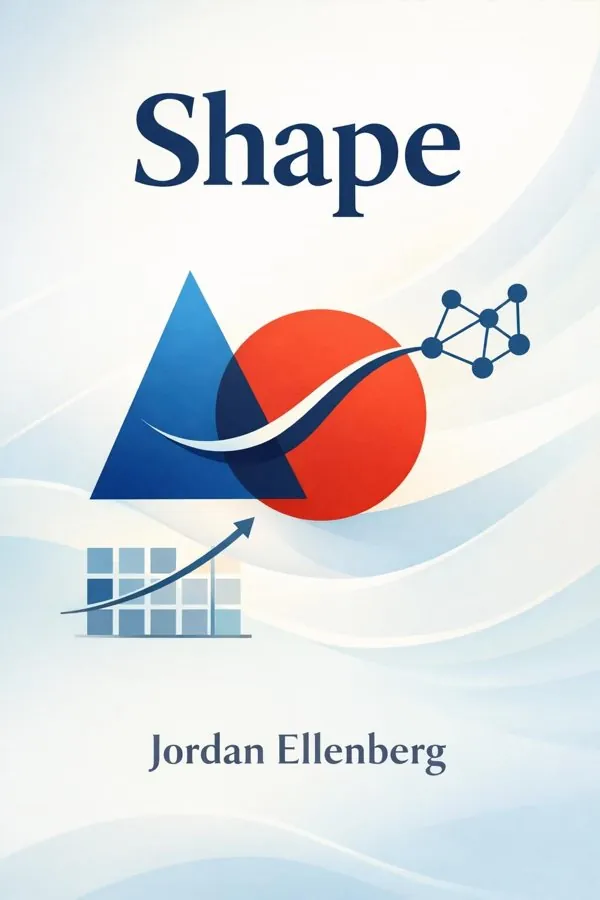
Shape: The Hidden Geometry of Information, Biology, Strategy, Democracy, and Everything Else: Summary & Key Insights
 10 min10 chaptersAudio available
What Is Shape: The Hidden Geometry of Information, Biology, Strategy, Democracy, and Everything Else About?
Shape: The Hidden Geometry of Information, Biology, Strategy, Democracy, and Everything Else by Jordan Ellenberg is a popular_sci book spanning 10 pages. A far-ranging exploration of how geometry underlies everything from elections to pandemics, revealing its power to help us think better about complex problems. Mathematician Jordan Ellenberg shows how geometric thinking can illuminate the hidden structures of information, biology, strategy, and democracy, offering insights into how the world is shaped by mathematical relationships.
This FizzRead summary covers all 10 key chapters of Shape: The Hidden Geometry of Information, Biology, Strategy, Democracy, and Everything Else in approximately 10 minutes, distilling the most important ideas, arguments, and takeaways from Jordan Ellenberg's work. Also available as an audio summary and Key Quotes Podcast.
Shape: The Hidden Geometry of Information, Biology, Strategy, Democracy, and Everything Else
A far-ranging exploration of how geometry underlies everything from elections to pandemics, revealing its power to help us think better about complex problems. Mathematician Jordan Ellenberg shows how geometric thinking can illuminate the hidden structures of information, biology, strategy, and democracy, offering insights into how the world is shaped by mathematical relationships.
Who Should Read Shape: The Hidden Geometry of Information, Biology, Strategy, Democracy, and Everything Else?
This book is perfect for anyone interested in popular_sci and looking to gain actionable insights in a short read. Whether you're a student, professional, or lifelong learner, the key ideas from Shape: The Hidden Geometry of Information, Biology, Strategy, Democracy, and Everything Else by Jordan Ellenberg will help you think differently.
- ✓Readers who enjoy popular_sci and want practical takeaways
- ✓Professionals looking to apply new ideas to their work and life
- ✓Anyone who wants the core insights of Shape: The Hidden Geometry of Information, Biology, Strategy, Democracy, and Everything Else in just 10 minutes
Want the full summary?
Get instant access to this book summary and 100K+ more with Fizz Moment.
Get Free SummaryAvailable on App Store • Free to download
Key Chapters
Information, at first glance, seems abstract—strings of digits, packets of data, words on a screen. Yet beneath all this abstraction is a deeply geometric structure. Information occupies a space—a multidimensional one—where relationships between bits of data have shape and distance. The way data clusters, the correlations between features, even the errors in transmission all take on geometric forms.
In this exploration, I show that information theory, which deals with coding and message transmission, relies heavily on geometry’s insights. When Claude Shannon defined the limits of information transmission, he was describing a shape—a boundary between what’s possible and impossible when sending signals through noisy channels. Coding schemes that optimize data compression can be visualized as points and regions in a vast geometric space. The efficiency of these codes, their resistance to noise, and their ability to retrieve meaning all depend on how we map data onto geometric structures.
This is not only a theoretical delight but a practical foundation for our digital world. Each time you stream a song or encrypt your messages, you are working within geometrical frameworks of information distance and error correction. By visualizing information geometrically, we can identify patterns invisible in pure numbers. Geometry gives software engineers, physicists, and analysts a way to see data organization vividly—to measure not just quantity but relationship.
When we understand this deeper geometry of information, we begin to see that knowledge itself is shaped—structured by similarity, difference, and dimensionality. Geometric thinking offers a new kind of literacy for our age of big data, where everything from social media profiles to genomes can be seen as points in high-dimensional spaces, defined not by location but by connection.
In the modern era, there may be no more essential geometric concept than the network. Networks are everywhere—from friendships and collaborations to transportation grids and the underlying architecture of the internet. Their geometry determines how quickly ideas spread, how resilient systems are, and how influence moves.
When I speak of network geometry, I refer not only to the visual representation—dots linked by lines—but to the mathematical relationships they encode. These links are not merely connections; they are distances, weights, and probabilities. A social network, for example, has regions of density—clusters where people know each other—and sparse spaces between them. The shape of this network reveals how information and behaviors propagate. Certain configurations breed echo chambers, while others invite innovation and movement.
Topology, the study of spaces and their connectivity, gives us tools to understand network shape far beyond simple diagrams. In a topological sense, what matters is not distance by scale but continuity of connection. The internet is a living example: physically scattered, yet topologically tight. Its performance and vulnerabilities depend on how its shape is structured.
Geometric reasoning helps us understand why some systems resist collapse while others crumble at a single break. In epidemics, network geometry defines spread; in commerce, it governs markets. To think geometrically about networks is to recognize that architecture and behavior are inseparable. Once you see connections as shapes—not lists—you begin to grasp why relationships matter more than isolated parts, and how the world’s complexity is, in the end, a matter of geometry.
+ 8 more chapters — available in the FizzRead app
All Chapters in Shape: The Hidden Geometry of Information, Biology, Strategy, Democracy, and Everything Else
About the Author
Jordan Ellenberg is a professor of mathematics at the University of Wisconsin–Madison and a bestselling author known for making complex mathematical ideas accessible to general readers. His previous works include 'How Not to Be Wrong: The Power of Mathematical Thinking.'
Get This Summary in Your Preferred Format
Read or listen to the Shape: The Hidden Geometry of Information, Biology, Strategy, Democracy, and Everything Else summary by Jordan Ellenberg anytime, anywhere. FizzRead offers multiple formats so you can learn on your terms — all free.
Available formats: App · Audio · PDF · EPUB — All included free with FizzRead
Download Shape: The Hidden Geometry of Information, Biology, Strategy, Democracy, and Everything Else PDF and EPUB Summary
Key Quotes from Shape: The Hidden Geometry of Information, Biology, Strategy, Democracy, and Everything Else
“Information, at first glance, seems abstract—strings of digits, packets of data, words on a screen.”
“In the modern era, there may be no more essential geometric concept than the network.”
Frequently Asked Questions about Shape: The Hidden Geometry of Information, Biology, Strategy, Democracy, and Everything Else
Shape: The Hidden Geometry of Information, Biology, Strategy, Democracy, and Everything Else by Jordan Ellenberg is a popular_sci book that explores key ideas across 10 chapters. A far-ranging exploration of how geometry underlies everything from elections to pandemics, revealing its power to help us think better about complex problems. Mathematician Jordan Ellenberg shows how geometric thinking can illuminate the hidden structures of information, biology, strategy, and democracy, offering insights into how the world is shaped by mathematical relationships.
More by Jordan Ellenberg
You Might Also Like

Structures: Or Why Things Don"t Fall Down
J.E. Gordon
10 min
The Road to Wigan Pier
George Orwell
10 min
Bonk: The Curious Coupling of Science and Sex
Mary Roach
10 min
First Bite: How We Learn to Eat
Bee Wilson
10 min
In Pursuit Of The Unknown: 17 Equations That Changed The World
Ian Stewart
10 min
Napoleon's Buttons: 17 Molecules That Changed History
Penny Le Couteur and Jay Burreson
10 minBrowse by Category
Ready to read Shape: The Hidden Geometry of Information, Biology, Strategy, Democracy, and Everything Else?
Get the full summary and 100K+ more books with Fizz Moment.