
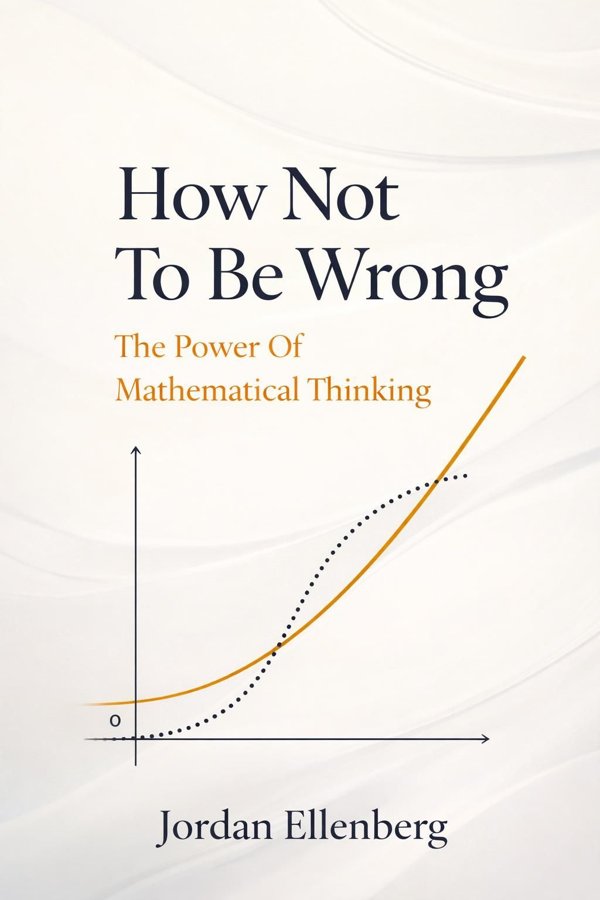
How Not To Be Wrong: The Power Of Mathematical Thinking: Summary & Key Insights
 10 min11 chaptersAudio available
What Is How Not To Be Wrong: The Power Of Mathematical Thinking About?
How Not To Be Wrong: The Power Of Mathematical Thinking by Jordan Ellenberg is a popular_sci book spanning 11 pages. In this engaging and accessible book, mathematician Jordan Ellenberg reveals how mathematical thinking can illuminate the hidden structures of the world around us. Through real-world examples—from politics and medicine to lotteries and baseball—he demonstrates how math helps us make better decisions, avoid common fallacies, and see the world more clearly. Ellenberg shows that mathematics is not about rote calculation but about understanding patterns, logic, and the limits of certainty.
This FizzRead summary covers all 11 key chapters of How Not To Be Wrong: The Power Of Mathematical Thinking in approximately 10 minutes, distilling the most important ideas, arguments, and takeaways from Jordan Ellenberg's work. Also available as an audio summary and Key Quotes Podcast.
How Not To Be Wrong: The Power Of Mathematical Thinking
In this engaging and accessible book, mathematician Jordan Ellenberg reveals how mathematical thinking can illuminate the hidden structures of the world around us. Through real-world examples—from politics and medicine to lotteries and baseball—he demonstrates how math helps us make better decisions, avoid common fallacies, and see the world more clearly. Ellenberg shows that mathematics is not about rote calculation but about understanding patterns, logic, and the limits of certainty.
Who Should Read How Not To Be Wrong: The Power Of Mathematical Thinking?
This book is perfect for anyone interested in popular_sci and looking to gain actionable insights in a short read. Whether you're a student, professional, or lifelong learner, the key ideas from How Not To Be Wrong: The Power Of Mathematical Thinking by Jordan Ellenberg will help you think differently.
- ✓Readers who enjoy popular_sci and want practical takeaways
- ✓Professionals looking to apply new ideas to their work and life
- ✓Anyone who wants the core insights of How Not To Be Wrong: The Power Of Mathematical Thinking in just 10 minutes
Want the full summary?
Get instant access to this book summary and 100K+ more with Fizz Moment.
Get Free SummaryAvailable on App Store • Free to download
Key Chapters
One of the first things I emphasize is that our intuitive grip on chance is fragile. The law of large numbers tells us that random variation evens out as we take more samples—the average converges to the expected value. But human instinct rebels against this: we see patterns in small samples and draw reckless conclusions. That’s what happens when investors misinterpret streaks in the market or when policy makers change course because of a few atypical data points. The larger the sample, the more stable the truth it reveals, but most real-world decisions are made under small samples. We need mathematics to remind us that what we call luck might often be statistical noise.
In one example, I discuss how small counties sometimes top cancer-rate statistics. It’s tempting to infer that something special—perhaps an environmental factor—lurks there. Yet small population size itself magnifies apparent variation: with fewer people, random clustering looks dramatic. The very same counties can be both the healthiest and the sickest in different years merely because of sampling fluctuation. Understanding this humbles our desire to find causes where none exist. The law of large numbers doesn’t just state that averages stabilize—it warns us against overreacting to fluctuations, a lesson as much psychological as mathematical.
We love straight lines because they are simple. Draw two points, connect them, and we have a relationship. That’s our default mental model of cause and effect: if I work twice as hard, I’ll earn twice as much; if the car goes twice as fast, it must consume twice the fuel. But nature laughs at our lines. Most relationships are nonlinear: they bend, flatten out, or explode beyond certain limits. Linear thinking seduces us because it’s easy to compute, yet it hides the truth by ignoring curvature.
I explain this with a story about air resistance. If speed and drag were linearly related, airplanes could fly with predictable efficiency. But as speed doubles, drag quadruples. The relationship isn’t proportional; it’s exponential. Recognizing that many systems behave this way—whether in economics, population growth, or disease spread—changes how we make decisions. The COVID-19 pandemic made us all witnesses: infection rates grow nonlinearly, and small changes in behavior make enormous differences in outcomes.
Mathematical thinking means always asking whether the line we draw through experience truly matches the world’s curve. Linear approximations can be useful, but only if we keep in mind what they ignore. Once you see the world as nonlinear, your mind stops trying to force symmetry where there is complexity. That’s when mathematics becomes not constraint but liberation.
+ 9 more chapters — available in the FizzRead app
All Chapters in How Not To Be Wrong: The Power Of Mathematical Thinking
About the Author
Jordan Ellenberg is a professor of mathematics at the University of Wisconsin–Madison. His research focuses on number theory, and he is also known for his popular writing on mathematics and its applications in everyday life. Ellenberg has contributed to publications such as The New York Times, The Wall Street Journal, and Slate.
Get This Summary in Your Preferred Format
Read or listen to the How Not To Be Wrong: The Power Of Mathematical Thinking summary by Jordan Ellenberg anytime, anywhere. FizzRead offers multiple formats so you can learn on your terms — all free.
Available formats: App · Audio · PDF · EPUB — All included free with FizzRead
Download How Not To Be Wrong: The Power Of Mathematical Thinking PDF and EPUB Summary
Key Quotes from How Not To Be Wrong: The Power Of Mathematical Thinking
“One of the first things I emphasize is that our intuitive grip on chance is fragile.”
“We love straight lines because they are simple.”
Frequently Asked Questions about How Not To Be Wrong: The Power Of Mathematical Thinking
How Not To Be Wrong: The Power Of Mathematical Thinking by Jordan Ellenberg is a popular_sci book that explores key ideas across 11 chapters. In this engaging and accessible book, mathematician Jordan Ellenberg reveals how mathematical thinking can illuminate the hidden structures of the world around us. Through real-world examples—from politics and medicine to lotteries and baseball—he demonstrates how math helps us make better decisions, avoid common fallacies, and see the world more clearly. Ellenberg shows that mathematics is not about rote calculation but about understanding patterns, logic, and the limits of certainty.
More by Jordan Ellenberg

You Might Also Like

Structures: Or Why Things Don"t Fall Down
J.E. Gordon
10 min
The Road to Wigan Pier
George Orwell
10 min
Bonk: The Curious Coupling of Science and Sex
Mary Roach
10 min
First Bite: How We Learn to Eat
Bee Wilson
10 min
In Pursuit Of The Unknown: 17 Equations That Changed The World
Ian Stewart
10 min
Napoleon's Buttons: 17 Molecules That Changed History
Penny Le Couteur and Jay Burreson
10 minBrowse by Category
Ready to read How Not To Be Wrong: The Power Of Mathematical Thinking?
Get the full summary and 100K+ more books with Fizz Moment.