
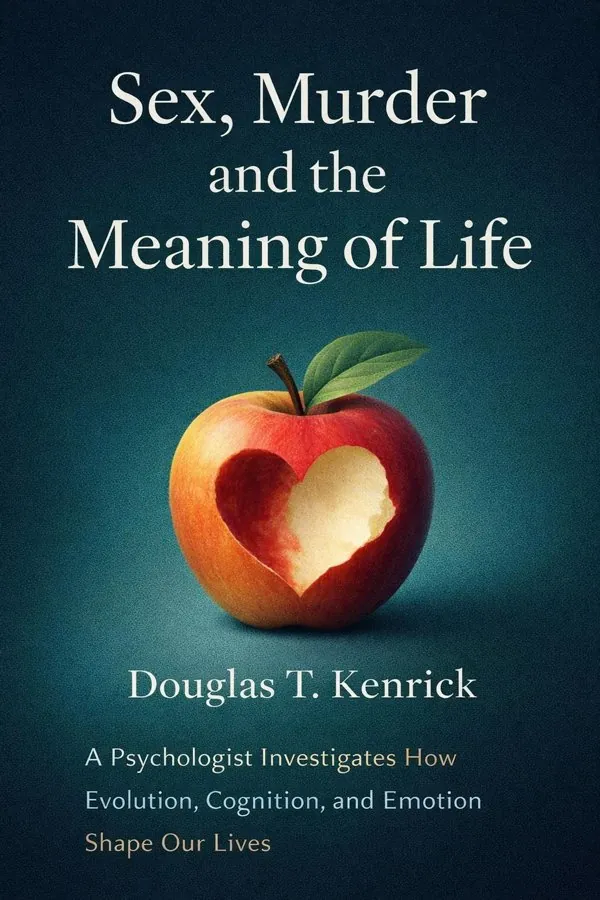
Sex, Murder and the Meaning of Life: A Psychologist Investigates How Evolution, Cognition, and Emotion Shape Our Lives: Summary & Key Insights
 10 min9 chaptersAudio available
What Is Sex, Murder and the Meaning of Life: A Psychologist Investigates How Evolution, Cognition, and Emotion Shape Our Lives About?
Sex, Murder and the Meaning of Life: A Psychologist Investigates How Evolution, Cognition, and Emotion Shape Our Lives by Douglas T. Kenrick is a psychology book spanning 9 pages. In this book, psychologist Douglas T. Kenrick explores how evolutionary psychology explains human behavior, from our attraction to danger and sex to our moral decisions and social interactions. Drawing on decades of research, Kenrick connects primal instincts with modern life, offering insights into why people act irrationally and how understanding our evolutionary past can help us live more meaningfully.
This FizzRead summary covers all 9 key chapters of Sex, Murder and the Meaning of Life: A Psychologist Investigates How Evolution, Cognition, and Emotion Shape Our Lives in approximately 10 minutes, distilling the most important ideas, arguments, and takeaways from Douglas T. Kenrick's work. Also available as an audio summary and Key Quotes Podcast.
Sex, Murder and the Meaning of Life: A Psychologist Investigates How Evolution, Cognition, and Emotion Shape Our Lives
In this book, psychologist Douglas T. Kenrick explores how evolutionary psychology explains human behavior, from our attraction to danger and sex to our moral decisions and social interactions. Drawing on decades of research, Kenrick connects primal instincts with modern life, offering insights into why people act irrationally and how understanding our evolutionary past can help us live more meaningfully.
Who Should Read Sex, Murder and the Meaning of Life: A Psychologist Investigates How Evolution, Cognition, and Emotion Shape Our Lives?
This book is perfect for anyone interested in psychology and looking to gain actionable insights in a short read. Whether you're a student, professional, or lifelong learner, the key ideas from Sex, Murder and the Meaning of Life: A Psychologist Investigates How Evolution, Cognition, and Emotion Shape Our Lives by Douglas T. Kenrick will help you think differently.
- ✓Readers who enjoy psychology and want practical takeaways
- ✓Professionals looking to apply new ideas to their work and life
- ✓Anyone who wants the core insights of Sex, Murder and the Meaning of Life: A Psychologist Investigates How Evolution, Cognition, and Emotion Shape Our Lives in just 10 minutes
Want the full summary?
Get instant access to this book summary and 100K+ more with Fizz Moment.
Get Free SummaryAvailable on App Store • Free to download
Key Chapters
Attraction is not random; it is the echo of ancestral logic. As an evolutionary psychologist, I’ve spent decades studying what kinds of faces, bodies, voices, and behaviors draw people together. The evidence is strikingly consistent across cultures and times: men tend to be drawn to indicators of youth and fertility, while women, more often, seek signs of status and stability. These preferences are not a cultural accident—they arise from differential parental investment, a principle proposed by Trivers. Because women bear greater biological costs in reproduction, their minds evolved to be careful investors. Men, by contrast, have historically maximized their reproductive chances through access to mates. That difference underlies everything from courtship rituals to the subtle symphony of flirtation.
When we ask why love feels so transcendent, it helps to recall that sexual selection operates not just on bodies but on emotions. The intensity of romantic desire, the pain of rejection, and the rush of bonding—all evolved to ensure not mere mating but commitment and childrearing. These instinctual patterns sometimes misfire in the modern world, where dating apps and urban anonymity distort ancient cues. We still react viscerally to symmetry or confidence because those signals once indicated health and protection. If we understand that attraction is an evolved response rather than an objective evaluation, we can be more compassionate with ourselves and others. Evolution does not make our hearts less spiritual; it makes them comprehensible.
The human story is not just one of tenderness—it is also one of rivalry. Competition is woven through our ancestry, especially among males who fought for mates, territory, and status. Violence, though repugnant, is not an evolutionary error; it is an ancient tool. In small hunter-gatherer bands, dominance could mean direct access to resources and reproductive opportunities. The male propensity toward risk-taking and aggression arose because, under certain circumstances, dangerous acts paid off in evolutionary currency.
But we are not condemned to replay those battles mindlessly. Aggression today often manifests in career conflict, social comparison, or online hostility rather than physical combat. Yet the biological roots remain visible. Testosterone, threat perception, and social hierarchy all influence how dominance plays out. Crucially, evolution also endowed us with the capacity for restraint and empathy—mechanisms for regulating aggression to protect group stability. Understanding the evolutionary origins of competition allows us to redirect its energy constructively. Ambition can serve art, innovation, and leadership rather than violence. When we comprehend that our rivals trigger primal circuits, we can master them, not be mastered by them.
+ 7 more chapters — available in the FizzRead app
All Chapters in Sex, Murder and the Meaning of Life: A Psychologist Investigates How Evolution, Cognition, and Emotion Shape Our Lives
About the Author
Douglas T. Kenrick is an American psychologist and professor at Arizona State University. His research focuses on evolutionary psychology, social cognition, and human motivation. He has published extensively on topics such as mating, aggression, and altruism, and is known for integrating evolutionary theory with everyday human behavior.
Get This Summary in Your Preferred Format
Read or listen to the Sex, Murder and the Meaning of Life: A Psychologist Investigates How Evolution, Cognition, and Emotion Shape Our Lives summary by Douglas T. Kenrick anytime, anywhere. FizzRead offers multiple formats so you can learn on your terms — all free.
Available formats: App · Audio · PDF · EPUB — All included free with FizzRead
Download Sex, Murder and the Meaning of Life: A Psychologist Investigates How Evolution, Cognition, and Emotion Shape Our Lives PDF and EPUB Summary
Key Quotes from Sex, Murder and the Meaning of Life: A Psychologist Investigates How Evolution, Cognition, and Emotion Shape Our Lives
“Attraction is not random; it is the echo of ancestral logic.”
“The human story is not just one of tenderness—it is also one of rivalry.”
Frequently Asked Questions about Sex, Murder and the Meaning of Life: A Psychologist Investigates How Evolution, Cognition, and Emotion Shape Our Lives
Sex, Murder and the Meaning of Life: A Psychologist Investigates How Evolution, Cognition, and Emotion Shape Our Lives by Douglas T. Kenrick is a psychology book that explores key ideas across 9 chapters. In this book, psychologist Douglas T. Kenrick explores how evolutionary psychology explains human behavior, from our attraction to danger and sex to our moral decisions and social interactions. Drawing on decades of research, Kenrick connects primal instincts with modern life, offering insights into why people act irrationally and how understanding our evolutionary past can help us live more meaningfully.
More by Douglas T. Kenrick
You Might Also Like
The Body Keeps the Score
Bessel van der Kolk
10 min
Surrounded by Idiots
Thomas Erikson
10 min
Emotional Intelligence
Daniel Goleman
10 min
Attached
Amir Levine
10 min
Why Does He Do That
Lundy Bancroft
10 min
Women Who Run with the Wolves
Clarissa Pinkola Estés
10 minBrowse by Category
Ready to read Sex, Murder and the Meaning of Life: A Psychologist Investigates How Evolution, Cognition, and Emotion Shape Our Lives?
Get the full summary and 100K+ more books with Fizz Moment.