
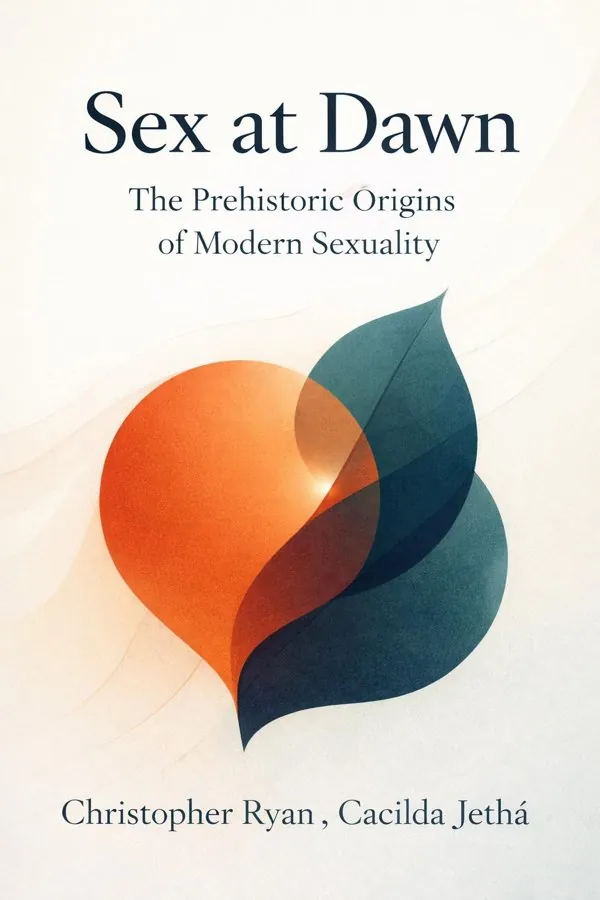
Sex at Dawn: The Prehistoric Origins of Modern Sexuality: Summary & Key Insights
by Christopher Ryan, Cacilda Jethá
 10 min11 chaptersAudio available
What Is Sex at Dawn: The Prehistoric Origins of Modern Sexuality About?
Sex at Dawn: The Prehistoric Origins of Modern Sexuality by Christopher Ryan, Cacilda Jethá is a popular_sci book spanning 11 pages. Sex at Dawn explora la evolución de la sexualidad humana, argumentando que los humanos prehistóricos eran promiscuos y que las normas modernas sobre la monogamia son una construcción cultural reciente. Basado en antropología, biología evolutiva y psicología, el libro desafía las ideas convencionales sobre el amor, el deseo y las relaciones.
This FizzRead summary covers all 11 key chapters of Sex at Dawn: The Prehistoric Origins of Modern Sexuality in approximately 10 minutes, distilling the most important ideas, arguments, and takeaways from Christopher Ryan, Cacilda Jethá's work. Also available as an audio summary and Key Quotes Podcast.
Sex at Dawn: The Prehistoric Origins of Modern Sexuality
Sex at Dawn explora la evolución de la sexualidad humana, argumentando que los humanos prehistóricos eran promiscuos y que las normas modernas sobre la monogamia son una construcción cultural reciente. Basado en antropología, biología evolutiva y psicología, el libro desafía las ideas convencionales sobre el amor, el deseo y las relaciones.
Who Should Read Sex at Dawn: The Prehistoric Origins of Modern Sexuality?
This book is perfect for anyone interested in popular_sci and looking to gain actionable insights in a short read. Whether you're a student, professional, or lifelong learner, the key ideas from Sex at Dawn: The Prehistoric Origins of Modern Sexuality by Christopher Ryan, Cacilda Jethá will help you think differently.
- ✓Readers who enjoy popular_sci and want practical takeaways
- ✓Professionals looking to apply new ideas to their work and life
- ✓Anyone who wants the core insights of Sex at Dawn: The Prehistoric Origins of Modern Sexuality in just 10 minutes
Want the full summary?
Get instant access to this book summary and 100K+ more with Fizz Moment.
Get Free SummaryAvailable on App Store • Free to download
Key Chapters
For generations, evolutionary psychology has told a familiar story: humans evolved to form monogamous pairs. According to this account, males needed to ensure paternity to pass on their genes, while females required reliable providers to support their children. The union of two individuals was thus framed as a strategic alliance—monogamy for survival, fidelity for evolutionary efficiency.
The problem is that this tidy narrative is largely based on projection rather than observation. Many evolutionary theories of sexuality were drawn from assumptions about property and lineage characteristic of agricultural societies, then retroactively applied to prehistory. But early hunter-gatherers, our ancestors for the vast majority of human existence, lived under conditions radically different from those imagined by such models.
When we examined the fossil record, anthropological reports, and the behavior of extant foraging societies, a very different picture emerged. What we found is that the “standard narrative” may not describe what humans are, but rather what they became once scarcity and inheritance took over as organizing forces. Our species was not born into a world of pair-bonds enforced by ownership; we were born into a world of abundance and social interdependence.
The idea that male sexual jealousy and female selectivity are evolutionary imperatives begins to dissolve under evidence showing that communal child-rearing, group defense, and shared resources made solitary pair-bonding inefficient. The notion of monogamy as a natural human state reflects a moral lens, not a scientific one. Our purpose here is not to condemn monogamy but to recognize its origins as cultural adaptation—not universal biology. This recognition enables us to approach modern relationships with nuance and compassion, understanding that natural impulses toward desire and variety are not rooted in corruption but in ancient human cooperation.
Imagine a world where survival depended on mutual sharing, where food, security, and companionship circulated freely within a small tribe. This was the reality of prehistoric foragers. In such settings, sexual exclusivity would have been a poor strategy, cutting individuals off from the emotional web that sustained the group. Anthropological studies of hunter-gatherers—from the Hadza in Tanzania to the Pirahã in the Amazon—show that these societies valued sharing over possession. Their social systems were egalitarian, their dynamics fluid.
In this communal context, sex was not an exchange of property or moral contract—it was an act of bonding. Sexual interaction often served to reinforce social cohesion and reduce tension. The frequency and openness of sexual relationships reflected a world where kinship was extended, paternity uncertain, and resources pooled. Our ancestors’ lives were grounded in cooperation, and their erotic behavior mirrored that cooperation.
The absence of rigid ownership structures meant that hierarchies had not yet solidified around male control of resources or female reproductive capacity. This reality challenges deeply ingrained notions of 'natural' male dominance or female dependence. Instead, sexual relationships unfolded in an atmosphere of equality and playful abundance.
Modern discomfort with female desire or jealousy stems largely from cultural shifts that transformed this communal sexual model into a possessive one. Reconsidering prehistoric life helps reveal that human sexuality evolved for connection and harmony within groups, not as a transactional system between isolated pairs. Understanding that ancient context allows us to see modern love not as broken, but as misaligned with our evolutionary blueprint.
+ 9 more chapters — available in the FizzRead app
All Chapters in Sex at Dawn: The Prehistoric Origins of Modern Sexuality
About the Authors
Christopher Ryan es psicólogo y escritor estadounidense especializado en sexualidad humana y evolución. Cacilda Jethá es psiquiatra y coautora del libro, con experiencia en medicina y salud mental.
Get This Summary in Your Preferred Format
Read or listen to the Sex at Dawn: The Prehistoric Origins of Modern Sexuality summary by Christopher Ryan, Cacilda Jethá anytime, anywhere. FizzRead offers multiple formats so you can learn on your terms — all free.
Available formats: App · Audio · PDF · EPUB — All included free with FizzRead
Download Sex at Dawn: The Prehistoric Origins of Modern Sexuality PDF and EPUB Summary
Key Quotes from Sex at Dawn: The Prehistoric Origins of Modern Sexuality
“For generations, evolutionary psychology has told a familiar story: humans evolved to form monogamous pairs.”
“Imagine a world where survival depended on mutual sharing, where food, security, and companionship circulated freely within a small tribe.”
Frequently Asked Questions about Sex at Dawn: The Prehistoric Origins of Modern Sexuality
Sex at Dawn: The Prehistoric Origins of Modern Sexuality by Christopher Ryan, Cacilda Jethá is a popular_sci book that explores key ideas across 11 chapters. Sex at Dawn explora la evolución de la sexualidad humana, argumentando que los humanos prehistóricos eran promiscuos y que las normas modernas sobre la monogamia son una construcción cultural reciente. Basado en antropología, biología evolutiva y psicología, el libro desafía las ideas convencionales sobre el amor, el deseo y las relaciones.
More by Christopher Ryan, Cacilda Jethá
You Might Also Like

Structures: Or Why Things Don"t Fall Down
J.E. Gordon
10 min
The Road to Wigan Pier
George Orwell
10 min
Bonk: The Curious Coupling of Science and Sex
Mary Roach
10 min
First Bite: How We Learn to Eat
Bee Wilson
10 min
In Pursuit Of The Unknown: 17 Equations That Changed The World
Ian Stewart
10 min
Napoleon's Buttons: 17 Molecules That Changed History
Penny Le Couteur and Jay Burreson
10 minBrowse by Category
Ready to read Sex at Dawn: The Prehistoric Origins of Modern Sexuality?
Get the full summary and 100K+ more books with Fizz Moment.