
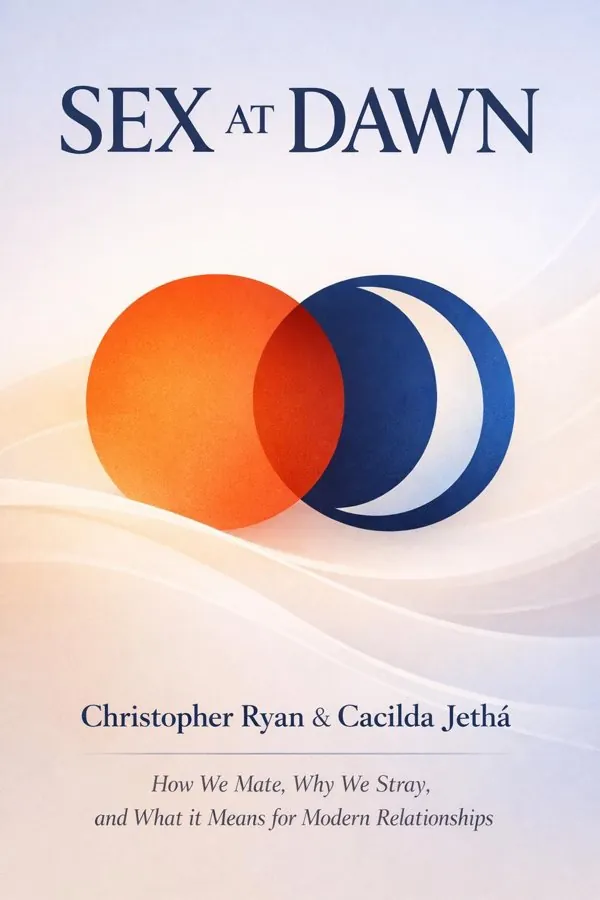
Sex at Dawn: How We Mate, Why We Stray, and What It Means for Modern Relationships: Summary & Key Insights
by Christopher Ryan, Cacilda Jethá
 10 min12 chaptersAudio available
What Is Sex at Dawn: How We Mate, Why We Stray, and What It Means for Modern Relationships About?
Sex at Dawn: How We Mate, Why We Stray, and What It Means for Modern Relationships by Christopher Ryan, Cacilda Jethá is a psychology book spanning 12 pages. Sex at Dawn challenges conventional views of human sexual evolution, arguing that monogamy is not the natural state for humans. Drawing on evidence from anthropology, primatology, and evolutionary biology, the authors propose that prehistoric societies were largely egalitarian and sexually promiscuous, and that modern sexual norms are a product of agricultural and social developments rather than innate human nature.
This FizzRead summary covers all 12 key chapters of Sex at Dawn: How We Mate, Why We Stray, and What It Means for Modern Relationships in approximately 10 minutes, distilling the most important ideas, arguments, and takeaways from Christopher Ryan, Cacilda Jethá's work. Also available as an audio summary and Key Quotes Podcast.
Sex at Dawn: How We Mate, Why We Stray, and What It Means for Modern Relationships
Sex at Dawn challenges conventional views of human sexual evolution, arguing that monogamy is not the natural state for humans. Drawing on evidence from anthropology, primatology, and evolutionary biology, the authors propose that prehistoric societies were largely egalitarian and sexually promiscuous, and that modern sexual norms are a product of agricultural and social developments rather than innate human nature.
Who Should Read Sex at Dawn: How We Mate, Why We Stray, and What It Means for Modern Relationships?
This book is perfect for anyone interested in psychology and looking to gain actionable insights in a short read. Whether you're a student, professional, or lifelong learner, the key ideas from Sex at Dawn: How We Mate, Why We Stray, and What It Means for Modern Relationships by Christopher Ryan, Cacilda Jethá will help you think differently.
- ✓Readers who enjoy psychology and want practical takeaways
- ✓Professionals looking to apply new ideas to their work and life
- ✓Anyone who wants the core insights of Sex at Dawn: How We Mate, Why We Stray, and What It Means for Modern Relationships in just 10 minutes
Want the full summary?
Get instant access to this book summary and 100K+ more with Fizz Moment.
Get Free SummaryAvailable on App Store • Free to download
Key Chapters
The dominant theory of evolutionary psychology tells us that humans evolved for pair-bonding — the tidy narrative that two parents working together improved survival for their offspring, and that sexual fidelity was thus adaptive. This neat model underpins modern moral frameworks and has even been used to justify restrictive norms around gender and marriage.
But let’s look closer. The standard narrative assumes scarcity — that resources were hard-won and that cooperation needed to be tightly structured around nuclear families. It imagines early humans living as miniature suburbs before agriculture existed. Yet the archaeological and ethnographic record of hunter-gatherer life paints a different picture. Cooperation was not limited to pairs but extended across the band. Child-rearing was communal; food was shared. The idea that a man ‘owned’ a woman or her sexuality simply didn’t apply. What mainstream evolutionary psychology often forgets is that it grew from the cultural soil of modern Western assumptions, especially from post-Victorian ideals where female chastity was prized and male proprietorship masked as protection.
This is the narrative we were raised into — one that moralizes biology instead of investigating it. Our goal is to peel away these layers and see what remains when we study our species as part of nature rather than an exception to it.
If we test the traditional model of monogamy against real cross-cultural and biological evidence, cracks appear immediately. Many anthropologists have documented societies where ‘pair bonding’ is only one expression of human sexuality among many, and where possessing exclusive sexual rights would be viewed as irrational or even destructive to group cohesion. Moreover, when we examine the sexual behavior of our closest relatives, none exhibit strict monogamy.
Bonobos, for example, use sex as a form of conflict resolution and social bonding. Chimpanzees — though more competitive — display mating systems where females mate with multiple males, ensuring genetic diversity and even social tranquility through shared paternity confusion. If humans evolved in similar ecologies, it stands to reason that sexual sharing could also serve social and evolutionary functions.
The supposed scientific consensus favoring monogamy often reflects selection bias. Early researchers measured human sexuality through moral frameworks, assuming that private property and possessiveness were natural. The result was a distorted lens that privileged social harmony over evolutionary truth. When we disentangle morality from biology, we find that our species’ sexual tendencies are far more flexible, fluid, and collective than most theories admit.
+ 10 more chapters — available in the FizzRead app
All Chapters in Sex at Dawn: How We Mate, Why We Stray, and What It Means for Modern Relationships
About the Authors
Christopher Ryan, Ph.D., is an American author and psychologist known for his work on human sexuality and evolutionary psychology. Cacilda Jethá, M.D., is a Portuguese psychiatrist and co-author of the book. Together, they explore the intersection of biology, culture, and human relationships.
Get This Summary in Your Preferred Format
Read or listen to the Sex at Dawn: How We Mate, Why We Stray, and What It Means for Modern Relationships summary by Christopher Ryan, Cacilda Jethá anytime, anywhere. FizzRead offers multiple formats so you can learn on your terms — all free.
Available formats: App · Audio · PDF · EPUB — All included free with FizzRead
Download Sex at Dawn: How We Mate, Why We Stray, and What It Means for Modern Relationships PDF and EPUB Summary
Key Quotes from Sex at Dawn: How We Mate, Why We Stray, and What It Means for Modern Relationships
“This neat model underpins modern moral frameworks and has even been used to justify restrictive norms around gender and marriage.”
“If we test the traditional model of monogamy against real cross-cultural and biological evidence, cracks appear immediately.”
Frequently Asked Questions about Sex at Dawn: How We Mate, Why We Stray, and What It Means for Modern Relationships
Sex at Dawn: How We Mate, Why We Stray, and What It Means for Modern Relationships by Christopher Ryan, Cacilda Jethá is a psychology book that explores key ideas across 12 chapters. Sex at Dawn challenges conventional views of human sexual evolution, arguing that monogamy is not the natural state for humans. Drawing on evidence from anthropology, primatology, and evolutionary biology, the authors propose that prehistoric societies were largely egalitarian and sexually promiscuous, and that modern sexual norms are a product of agricultural and social developments rather than innate human nature.
More by Christopher Ryan, Cacilda Jethá
You Might Also Like
The Body Keeps the Score
Bessel van der Kolk
10 min
Surrounded by Idiots
Thomas Erikson
10 min
Emotional Intelligence
Daniel Goleman
10 min
Attached
Amir Levine
10 min
Why Does He Do That
Lundy Bancroft
10 min
Women Who Run with the Wolves
Clarissa Pinkola Estés
10 minBrowse by Category
Ready to read Sex at Dawn: How We Mate, Why We Stray, and What It Means for Modern Relationships?
Get the full summary and 100K+ more books with Fizz Moment.