
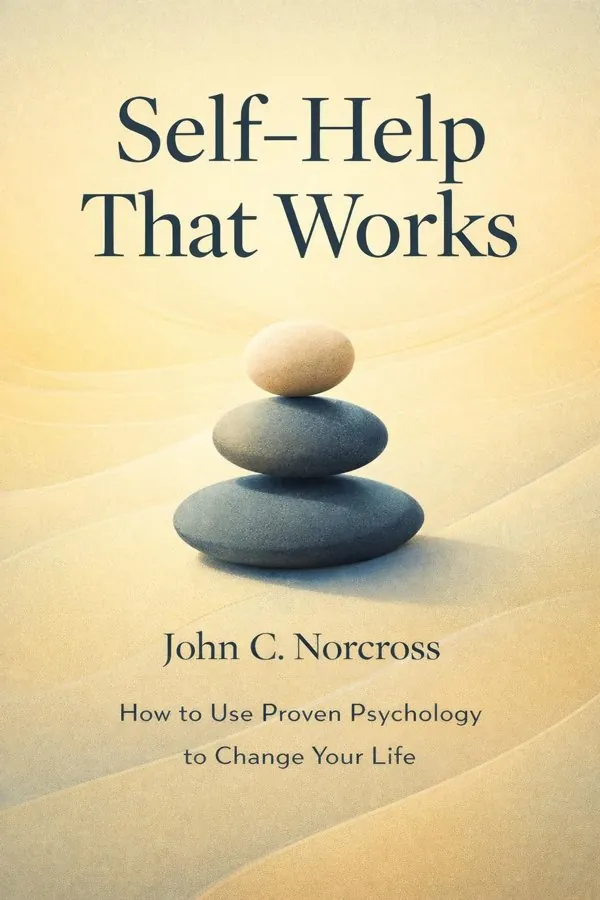
Self-Help That Works: How to Use Proven Psychology to Change Your Life: Summary & Key Insights
 10 min5 chaptersAudio available
What Is Self-Help That Works: How to Use Proven Psychology to Change Your Life About?
Self-Help That Works: How to Use Proven Psychology to Change Your Life by John C. Norcross is a mental_health book spanning 5 pages. Self-Help That Works es una guía basada en evidencia que evalúa y recomienda programas de autoayuda respaldados por la investigación psicológica. El libro ofrece una revisión crítica de libros, aplicaciones y recursos de autoayuda, ayudando a los lectores a elegir métodos eficaces para mejorar su bienestar mental y emocional.
This FizzRead summary covers all 5 key chapters of Self-Help That Works: How to Use Proven Psychology to Change Your Life in approximately 10 minutes, distilling the most important ideas, arguments, and takeaways from John C. Norcross's work. Also available as an audio summary and Key Quotes Podcast.
Self-Help That Works: How to Use Proven Psychology to Change Your Life
Self-Help That Works es una guía basada en evidencia que evalúa y recomienda programas de autoayuda respaldados por la investigación psicológica. El libro ofrece una revisión crítica de libros, aplicaciones y recursos de autoayuda, ayudando a los lectores a elegir métodos eficaces para mejorar su bienestar mental y emocional.
Who Should Read Self-Help That Works: How to Use Proven Psychology to Change Your Life?
This book is perfect for anyone interested in mental_health and looking to gain actionable insights in a short read. Whether you're a student, professional, or lifelong learner, the key ideas from Self-Help That Works: How to Use Proven Psychology to Change Your Life by John C. Norcross will help you think differently.
- ✓Readers who enjoy mental_health and want practical takeaways
- ✓Professionals looking to apply new ideas to their work and life
- ✓Anyone who wants the core insights of Self-Help That Works: How to Use Proven Psychology to Change Your Life in just 10 minutes
Want the full summary?
Get instant access to this book summary and 100K+ more with Fizz Moment.
Get Free SummaryAvailable on App Store • Free to download
Key Chapters
Early in my research, I realized the need for systematic evaluation of self-help resources. We cannot simply rely on reader popularity, bestseller status, or anecdotal testimonials. Instead, my colleagues and I developed a series of criteria to assess what qualifies as 'effective' self-help. This process, modeled on peer-reviewed psychological research, involves examining the empirical support behind the material, evaluating the clarity and accuracy of its psychological principles, and considering whether its techniques have been tested for real-world outcomes.
Our evaluative framework rests on several pillars. First, empirical validation—has the method been subject to empirical studies demonstrating improvement in emotional or behavioral outcomes? Second, professional endorsement—do mental-health experts consider the approach consistent with established therapeutic principles? Third, replicability—can the described outcomes be reproduced across different populations and settings?
When we analyzed hundreds of self-help programs, the contrast between evidence-based and unsupported materials was stark. Cognitive-behavioral books—those grounded in restructuring thought patterns and promoting active coping—showed consistent benefit for anxiety, depression, and stress-related concerns. In contrast, many inspirational or purely affirmational texts lacked measurable impact or occasionally led to frustration when promised results didn’t materialize.
The lesson emerging from scientific assessment is clear: effective self-help must mirror the rigor of professional psychotherapy, not the poetry of wishful thinking. By applying systematic evaluation, readers can distinguish practical, research-backed methods from attractive but hollow slogans—an essential step toward genuine psychological improvement.
After years of meta-analysis and review, certain self-help modalities have stood the empirical test. Cognitive-behavioral self-help, for example, consistently correlates with meaningful symptom reduction in depression and anxiety. Structured goal-setting exercises, habit-tracking systems, and guided journaling—derived from behavioral activation and self-monitoring techniques—demonstrate efficacy when participants engage regularly. Conversely, unstructured self-help, especially those relying solely on positive thinking without behavioral components, tends to yield minimal or short-lived outcomes.
Research also reveals the importance of guidance and accountability. Self-help works best when it integrates some degree of social reinforcement—a community group, digital support network, or therapist check-in. Without external cues, motivation often wanes, and progress stalls. Similarly, multimedia programs that combine reading, reflection, and active exercises outperform purely didactic materials. The common denominator in effective self-help is active engagement, not passive consumption.
We found strong evidence for specific applications: bibliotherapy using validated reading materials for mild depression; cognitive self-instruction training for stress management; and relapse prevention strategies in substance-use self-help. Meanwhile, many 'detox' or 'quick-fix' self-improvement schemes lacked controlled research or exaggerated their benefits. This book’s mission is not to scold optimism but to align it with realism—hope guided by science.
+ 3 more chapters — available in the FizzRead app
All Chapters in Self-Help That Works: How to Use Proven Psychology to Change Your Life
About the Author
John C. Norcross es psicólogo clínico, profesor de psicología en la Universidad de Scranton y reconocido investigador en psicoterapia y cambio conductual. Ha publicado numerosos libros y artículos sobre psicología clínica y autoayuda basada en evidencia.
Get This Summary in Your Preferred Format
Read or listen to the Self-Help That Works: How to Use Proven Psychology to Change Your Life summary by John C. Norcross anytime, anywhere. FizzRead offers multiple formats so you can learn on your terms — all free.
Available formats: App · Audio · PDF · EPUB — All included free with FizzRead
Download Self-Help That Works: How to Use Proven Psychology to Change Your Life PDF and EPUB Summary
Key Quotes from Self-Help That Works: How to Use Proven Psychology to Change Your Life
“Early in my research, I realized the need for systematic evaluation of self-help resources.”
“After years of meta-analysis and review, certain self-help modalities have stood the empirical test.”
Frequently Asked Questions about Self-Help That Works: How to Use Proven Psychology to Change Your Life
Self-Help That Works: How to Use Proven Psychology to Change Your Life by John C. Norcross is a mental_health book that explores key ideas across 5 chapters. Self-Help That Works es una guía basada en evidencia que evalúa y recomienda programas de autoayuda respaldados por la investigación psicológica. El libro ofrece una revisión crítica de libros, aplicaciones y recursos de autoayuda, ayudando a los lectores a elegir métodos eficaces para mejorar su bienestar mental y emocional.
You Might Also Like
Big Feelings: How to Be Okay When Things Are Not Okay
Liz Fosslien, Mollie West Duffy
10 min
Creative Arts Therapies Handbook: Art, Music and Dance Therapy Practices for Wellbeing
Susan I. Buchalter
10 min
Emotional First Aid: Healing Rejection, Guilt, Failure, and Other Everyday Hurts
Guy Winch
10 min
Lost Connections: Why You're Depressed and How to Find Hope
Johann Hari
10 min
No Time to Panic: How to Stop Worrying and Embrace Life
Matt Gutman
10 min
Overcoming Mobbing: A Recovery Guide for Workplace Aggression and Bullying
Maureen Duffy, Len Sperry
10 minBrowse by Category
Ready to read Self-Help That Works: How to Use Proven Psychology to Change Your Life?
Get the full summary and 100K+ more books with Fizz Moment.