
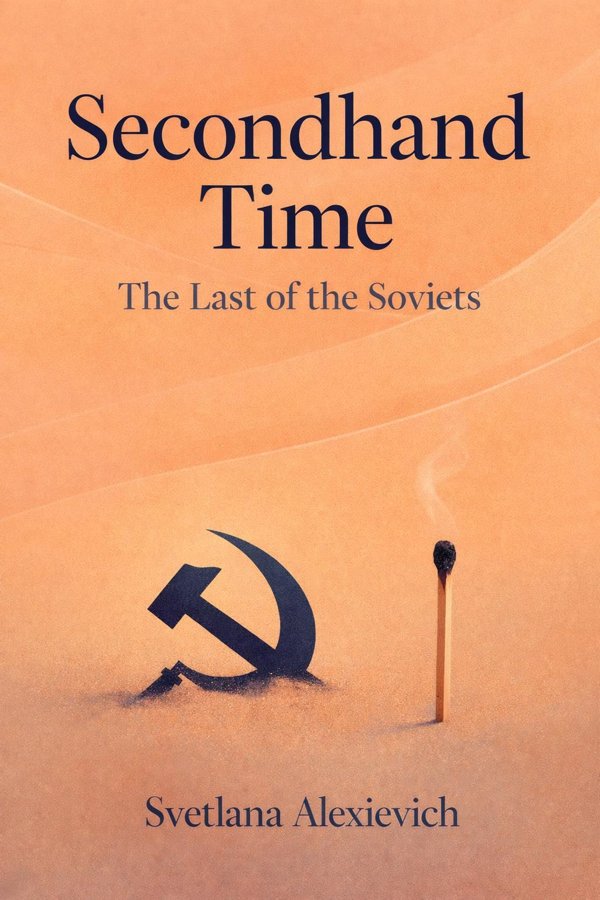
Secondhand Time: The Last of the Soviets: Summary & Key Insights
 10 min10 chaptersAudio available
What Is Secondhand Time: The Last of the Soviets About?
Secondhand Time: The Last of the Soviets by Svetlana Alexievich is a world_history book spanning 10 pages. Secondhand Time: The Last of the Soviets is a documentary-literary work by Nobel laureate Svetlana Alexievich. It concludes her acclaimed cycle 'Voices of Utopia' and gathers monologues and testimonies from people who lived through the collapse of the Soviet Union and the first decades of post-Soviet Russia. Through these voices, Alexievich constructs a polyphonic narrative about the hopes, disillusionments, and destinies of the post-Soviet individual.
This FizzRead summary covers all 10 key chapters of Secondhand Time: The Last of the Soviets in approximately 10 minutes, distilling the most important ideas, arguments, and takeaways from Svetlana Alexievich's work. Also available as an audio summary and Key Quotes Podcast.
Secondhand Time: The Last of the Soviets
Secondhand Time: The Last of the Soviets is a documentary-literary work by Nobel laureate Svetlana Alexievich. It concludes her acclaimed cycle 'Voices of Utopia' and gathers monologues and testimonies from people who lived through the collapse of the Soviet Union and the first decades of post-Soviet Russia. Through these voices, Alexievich constructs a polyphonic narrative about the hopes, disillusionments, and destinies of the post-Soviet individual.
Who Should Read Secondhand Time: The Last of the Soviets?
This book is perfect for anyone interested in world_history and looking to gain actionable insights in a short read. Whether you're a student, professional, or lifelong learner, the key ideas from Secondhand Time: The Last of the Soviets by Svetlana Alexievich will help you think differently.
- ✓Readers who enjoy world_history and want practical takeaways
- ✓Professionals looking to apply new ideas to their work and life
- ✓Anyone who wants the core insights of Secondhand Time: The Last of the Soviets in just 10 minutes
Want the full summary?
Get instant access to this book summary and 100K+ more with Fizz Moment.
Get Free SummaryAvailable on App Store • Free to download
Key Chapters
In these chapters, you will hear people describing what it felt like to be part of something immense—the Soviet idea. They speak as if recalling a lost religion. There was faith in socialism, yes, but also a faith in themselves as builders of a better world. A retired teacher tells me that to be Soviet meant waking every morning with purpose: 'We were poor, but we believed.' Her memories shine with warmth—parades, school competitions, shared sacrifices—but beneath the nostalgia lies the recognition that their happiness came from belonging to a myth.
Others recall the intimacy of collectivism, how individual desires were dissolved into the collective good. Their stories echo through dormitories and communal apartments where private life hardly existed; everything was for the people. There was pride in fixing machinery, planting wheat, composing poems for Lenin’s birthday. And yet, as they speak, a shadow creeps in—the quiet knowledge that the system demanded total emotional loyalty. To doubt was to betray love itself.
I listened to those voices for hours. They spoke of patriotism mixed with fear, of how history made them actors in a play whose ending they never wrote. They mourn not only the fall of an ideology but the loss of moral structure. In the Soviet world, to live meant to believe; in post-Soviet life, belief became a luxury. The voices of the late Soviet era remind us that utopia was not only oppression—it was belonging, rhythm, and meaning. Its collapse was not liberation alone; it was exile from one’s own certainty.
1991 was not merely a year—it was a rupture in time. I remember interviewing people who described that day when the red flag was lowered from the Kremlin. Some wept. Others celebrated. But most were astonished. For seventy years, a colossal idea filled every corner of their lives, and now it was gone, dissolving overnight into uncertainty. One woman said, 'I woke up, and the world had changed furniture.'
What marked the collapse was confusion—moral, emotional, practical. Prices changed daily. Symbols vanished. Children asked their parents what country they lived in. A former Communist youth leader told me he kept his membership card in his wallet for months, unable to throw it away, as if its disappearance might erase his youth. Everyone experienced the same paradox: freedom arrived, but meaning disappeared.
As interviewer, I rarely had to ask much. People poured their words out like confession. They were not telling stories about politics—they were grieving for themselves. 'We thought we were the future,' one man said. 'Suddenly we were relics.' The moment of collapse in this book is not only historical; it is existential. It is the moment when an entire civilization looked in the mirror and saw emptiness staring back. No fireworks marked it. Only silence filled the air.
+ 8 more chapters — available in the FizzRead app
All Chapters in Secondhand Time: The Last of the Soviets
About the Author
Svetlana Alexievich is a Belarusian writer and journalist, winner of the 2015 Nobel Prize in Literature. She is known for her documentary prose based on interviews and eyewitness accounts, united in the cycle 'Voices of Utopia'.
Get This Summary in Your Preferred Format
Read or listen to the Secondhand Time: The Last of the Soviets summary by Svetlana Alexievich anytime, anywhere. FizzRead offers multiple formats so you can learn on your terms — all free.
Available formats: App · Audio · PDF · EPUB — All included free with FizzRead
Download Secondhand Time: The Last of the Soviets PDF and EPUB Summary
Key Quotes from Secondhand Time: The Last of the Soviets
“In these chapters, you will hear people describing what it felt like to be part of something immense—the Soviet idea.”
“1991 was not merely a year—it was a rupture in time.”
Frequently Asked Questions about Secondhand Time: The Last of the Soviets
Secondhand Time: The Last of the Soviets by Svetlana Alexievich is a world_history book that explores key ideas across 10 chapters. Secondhand Time: The Last of the Soviets is a documentary-literary work by Nobel laureate Svetlana Alexievich. It concludes her acclaimed cycle 'Voices of Utopia' and gathers monologues and testimonies from people who lived through the collapse of the Soviet Union and the first decades of post-Soviet Russia. Through these voices, Alexievich constructs a polyphonic narrative about the hopes, disillusionments, and destinies of the post-Soviet individual.
You Might Also Like
The Age of Capital
Eric Hobsbawm
10 min
The Gulag Archipelago
Aleksandr Solzhenitsyn
10 min
Jerusalem: The Biography
Simon Sebag Montefiore
10 min
The Anglo-Saxons
James Campbell
10 min
The Boer War
Thomas Pakenham
10 min
The Industrial Revolutionaries: The Making of the Modern World 1776–1914
Gavin Weightman
10 minBrowse by Category
Ready to read Secondhand Time: The Last of the Soviets?
Get the full summary and 100K+ more books with Fizz Moment.