
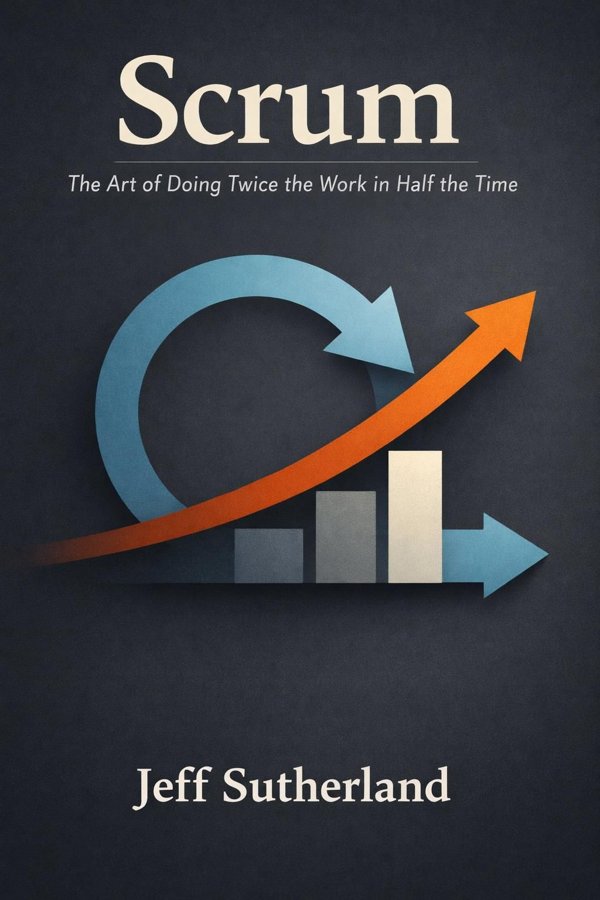
Scrum: The Art of Doing Twice the Work in Half the Time: Summary & Key Insights
 10 min11 chaptersAudio available
What Is Scrum: The Art of Doing Twice the Work in Half the Time About?
Scrum: The Art of Doing Twice the Work in Half the Time by Jeff Sutherland is a productivity book spanning 11 pages. Scrum es un método ágil para gestionar proyectos que permite a los equipos trabajar de manera más eficiente, adaptarse rápidamente a los cambios y entregar resultados de alta calidad. En este libro, Jeff Sutherland, co-creador de Scrum, explica los principios fundamentales del sistema, cómo se desarrolló y cómo puede aplicarse en cualquier ámbito, desde la tecnología hasta la educación y la gestión empresarial.
This FizzRead summary covers all 11 key chapters of Scrum: The Art of Doing Twice the Work in Half the Time in approximately 10 minutes, distilling the most important ideas, arguments, and takeaways from Jeff Sutherland's work. Also available as an audio summary and Key Quotes Podcast.
Scrum: The Art of Doing Twice the Work in Half the Time
Scrum es un método ágil para gestionar proyectos que permite a los equipos trabajar de manera más eficiente, adaptarse rápidamente a los cambios y entregar resultados de alta calidad. En este libro, Jeff Sutherland, co-creador de Scrum, explica los principios fundamentales del sistema, cómo se desarrolló y cómo puede aplicarse en cualquier ámbito, desde la tecnología hasta la educación y la gestión empresarial.
Who Should Read Scrum: The Art of Doing Twice the Work in Half the Time?
This book is perfect for anyone interested in productivity and looking to gain actionable insights in a short read. Whether you're a student, professional, or lifelong learner, the key ideas from Scrum: The Art of Doing Twice the Work in Half the Time by Jeff Sutherland will help you think differently.
- ✓Readers who enjoy productivity and want practical takeaways
- ✓Professionals looking to apply new ideas to their work and life
- ✓Anyone who wants the core insights of Scrum: The Art of Doing Twice the Work in Half the Time in just 10 minutes
Want the full summary?
Get instant access to this book summary and 100K+ more with Fizz Moment.
Get Free SummaryAvailable on App Store • Free to download
Key Chapters
Scrum’s origins are deeply personal to me. The idea didn’t emerge from a theoretical lab—it was forged through years of observing contradictions in how complex systems operate. My journey began far from software: as a fighter pilot in Vietnam, where I saw firsthand how success depended on rapid decision-making in chaotic environments. We had to constantly adapt to changing information, trust our training, and support each other under pressure. Later, as I transitioned into software development and organizational leadership, I noticed the same patterns. Teams faced complex, dynamic problems but were bound by rigid, sequential processes that killed innovation.
When I first encountered the 1986 Harvard Business Review article by Takeuchi and Nonaka, “The New New Product Development Game,” it resonated deeply. They described high-performing product teams at companies like Honda and Canon who worked iteratively, moving back and forth between stages of development, learning continuously, and collaborating across functions. They called this a “rugby approach” —a scrum—where a team moves down the field together, passing the ball fluidly, each member contributing to the next advance. That vision captured exactly what I’d been struggling to articulate. I realized we could apply those same principles to software development.
At Easel Corporation in the early 1990s, I began formalizing these insights into a system. We combined empirical process control, iterative cycles, and self-managing teams into what we eventually named Scrum. From there, I partnered with Ken Schwaber to refine the framework and bring it to the global stage. The idea caught fire because it tapped into something universal: the human desire for meaningful progress and the freedom to create without bureaucratic chains. Scrum was never about managing people harder—it was about unleashing them.
At the heart of Scrum are three deceptively simple principles: transparency, inspection, and adaptation. Together, they create a living system that learns as it moves. Everything that happens in Scrum unfolds around these values, because they mirror the way nature—and great teams—actually work.
Transparency begins with openness. In most organizations, vital information is locked away in silos or buried beneath layers of reporting. Scrum demands that every element of work be visible to all: the goals, the progress, the impediments. The Product Backlog is public. The velocity of the team is known. This visibility eliminates the guesswork and politics that slow teams down; it replaces secrecy with shared truth.
Inspection is the second principle. Rather than waiting until the end of a project to see if it succeeded, Scrum insists on continuous observation. Every daily stand-up, every sprint review is an opportunity to assess what’s working and what isn’t. But inspection without adaptation is meaningless, which brings us to the third principle. After every inspection comes change—fast, intentional, measurable change. The team adjusts its behavior, the product improves, and the process becomes smoother. These three form a continuous feedback loop that drives exponential learning.
In traditional project management, control comes from planning. In Scrum, control comes from feedback. That’s the profound shift. Instead of trying to predict the future, we create systems that can survive and thrive amid uncertainty.
+ 9 more chapters — available in the FizzRead app
All Chapters in Scrum: The Art of Doing Twice the Work in Half the Time
About the Author
Jeff Sutherland es co-creador del marco de trabajo Scrum y fundador de Scrum Inc. Con una amplia experiencia en ingeniería y gestión de proyectos, ha trabajado en la mejora de procesos organizacionales y en la implementación de metodologías ágiles en empresas de todo el mundo.
Get This Summary in Your Preferred Format
Read or listen to the Scrum: The Art of Doing Twice the Work in Half the Time summary by Jeff Sutherland anytime, anywhere. FizzRead offers multiple formats so you can learn on your terms — all free.
Available formats: App · Audio · PDF · EPUB — All included free with FizzRead
Download Scrum: The Art of Doing Twice the Work in Half the Time PDF and EPUB Summary
Key Quotes from Scrum: The Art of Doing Twice the Work in Half the Time
“Scrum’s origins are deeply personal to me.”
“At the heart of Scrum are three deceptively simple principles: transparency, inspection, and adaptation.”
Frequently Asked Questions about Scrum: The Art of Doing Twice the Work in Half the Time
Scrum: The Art of Doing Twice the Work in Half the Time by Jeff Sutherland is a productivity book that explores key ideas across 11 chapters. Scrum es un método ágil para gestionar proyectos que permite a los equipos trabajar de manera más eficiente, adaptarse rápidamente a los cambios y entregar resultados de alta calidad. En este libro, Jeff Sutherland, co-creador de Scrum, explica los principios fundamentales del sistema, cómo se desarrolló y cómo puede aplicarse en cualquier ámbito, desde la tecnología hasta la educación y la gestión empresarial.
You Might Also Like


Browse by Category
Ready to read Scrum: The Art of Doing Twice the Work in Half the Time?
Get the full summary and 100K+ more books with Fizz Moment.