
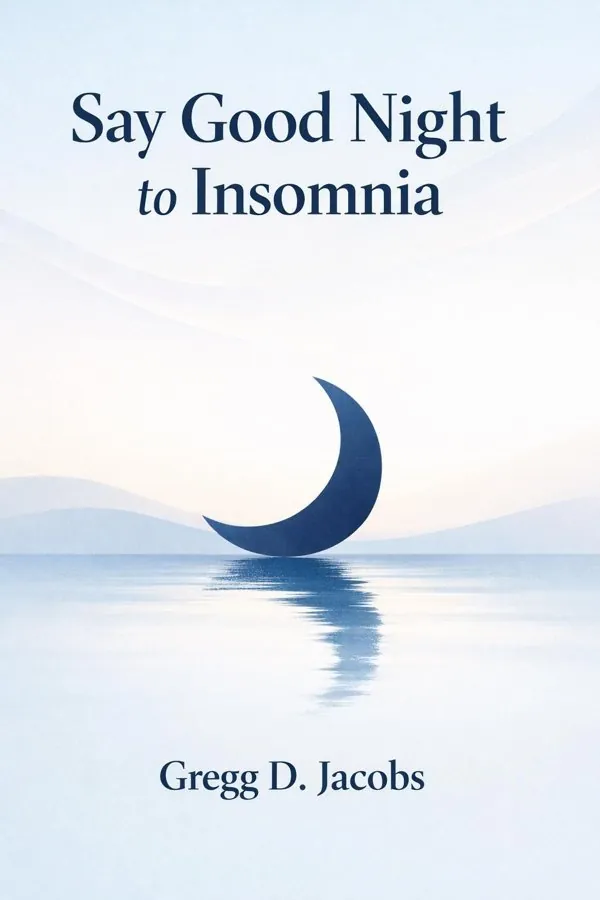
Say Good Night to Insomnia: The Six-Week, Drug-Free Program Developed At Harvard Medical School: Summary & Key Insights
 10 min9 chaptersAudio available
Key Takeaways from Say Good Night to Insomnia: The Six-Week, Drug-Free Program Developed At Harvard Medical School
One of the most surprising truths about insomnia is that exhaustion alone does not guarantee sleep.
Real change often begins with honest measurement, not motivation.
The bed should be a cue for drowsiness, yet for many insomniacs it becomes a stage for frustration.
Few ideas sound more wrong to an exhausted person than this one: if you want to sleep better, spend less time in bed.
Insomnia is not only a nighttime problem; it is also a thinking problem.
What Is Say Good Night to Insomnia: The Six-Week, Drug-Free Program Developed At Harvard Medical School About?
Say Good Night to Insomnia: The Six-Week, Drug-Free Program Developed At Harvard Medical School by Gregg D. Jacobs is a mental_health book spanning 9 pages. Insomnia often feels like a cruel paradox: the harder you try to sleep, the more awake you become. In Say Good Night to Insomnia, Gregg D. Jacobs offers a practical, research-based alternative to the exhausting cycle of sleeplessness, worry, and dependence on sleep medication. Developed from work at Harvard Medical School, his six-week program is built on cognitive behavioral therapy for insomnia, a method designed to retrain both the body and the mind for natural sleep. What makes this book especially valuable is its combination of scientific credibility and everyday usefulness. Jacobs does not treat insomnia as a mystery or a personal failure. Instead, he explains how habits, beliefs, stress responses, and irregular routines can unintentionally keep sleeplessness alive. Then he provides a structured plan to reverse that process step by step. For readers who feel trapped by restless nights, groggy mornings, and fear of bedtime, this book offers something rare: a clear path forward without drugs. It matters because it replaces helplessness with skill, and frustration with a method that aims not just to sedate, but to restore real sleep.
This FizzRead summary covers all 9 key chapters of Say Good Night to Insomnia: The Six-Week, Drug-Free Program Developed At Harvard Medical School in approximately 10 minutes, distilling the most important ideas, arguments, and takeaways from Gregg D. Jacobs's work. Also available as an audio summary and Key Quotes Podcast.
Say Good Night to Insomnia: The Six-Week, Drug-Free Program Developed At Harvard Medical School
Insomnia often feels like a cruel paradox: the harder you try to sleep, the more awake you become. In Say Good Night to Insomnia, Gregg D. Jacobs offers a practical, research-based alternative to the exhausting cycle of sleeplessness, worry, and dependence on sleep medication. Developed from work at Harvard Medical School, his six-week program is built on cognitive behavioral therapy for insomnia, a method designed to retrain both the body and the mind for natural sleep.
What makes this book especially valuable is its combination of scientific credibility and everyday usefulness. Jacobs does not treat insomnia as a mystery or a personal failure. Instead, he explains how habits, beliefs, stress responses, and irregular routines can unintentionally keep sleeplessness alive. Then he provides a structured plan to reverse that process step by step.
For readers who feel trapped by restless nights, groggy mornings, and fear of bedtime, this book offers something rare: a clear path forward without drugs. It matters because it replaces helplessness with skill, and frustration with a method that aims not just to sedate, but to restore real sleep.
Who Should Read Say Good Night to Insomnia: The Six-Week, Drug-Free Program Developed At Harvard Medical School?
This book is perfect for anyone interested in mental_health and looking to gain actionable insights in a short read. Whether you're a student, professional, or lifelong learner, the key ideas from Say Good Night to Insomnia: The Six-Week, Drug-Free Program Developed At Harvard Medical School by Gregg D. Jacobs will help you think differently.
- ✓Readers who enjoy mental_health and want practical takeaways
- ✓Professionals looking to apply new ideas to their work and life
- ✓Anyone who wants the core insights of Say Good Night to Insomnia: The Six-Week, Drug-Free Program Developed At Harvard Medical School in just 10 minutes
Want the full summary?
Get instant access to this book summary and 100K+ more with Fizz Moment.
Get Free SummaryAvailable on App Store • Free to download
Key Chapters
One of the most surprising truths about insomnia is that exhaustion alone does not guarantee sleep. Many sufferers assume the problem must be a chemical shortage that medication can fix, but Jacobs argues that chronic insomnia is often maintained by learned patterns of arousal, worry, and misdirected habits rather than by a simple lack of sedation. Pills may knock a person out temporarily, yet they rarely teach the brain how to sleep naturally again.
Jacobs is careful not to demonize medication in every circumstance. Instead, he explains that sleep aids often provide short-term symptom relief while leaving the underlying problem untouched. Over time, people may become psychologically dependent on them, believing they cannot sleep without assistance. Some also develop tolerance, rebound insomnia, morning grogginess, and anxiety about what will happen if they stop taking them. In this sense, medication can reinforce the very fear and helplessness that fuel insomnia.
The book reframes insomnia as a condition that can often be reversed through behavioral retraining. If someone lies in bed awake night after night, worries constantly about tomorrow’s fatigue, naps unpredictably, and changes their schedule in desperate attempts to recover, the body begins to associate bed with tension rather than rest. No pill truly repairs that association.
A practical example is the person who takes a sleeping tablet after several bad nights, sleeps somewhat better, then panics when trying to stop because the old sleeplessness returns. Jacobs would say the return of insomnia is not proof that the person is broken; it is evidence that the habits and beliefs surrounding sleep still need to be addressed.
Actionable takeaway: shift your goal from “finding something that makes me unconscious” to “retraining my mind and body to sleep naturally and consistently.”
Real change often begins with honest measurement, not motivation. Jacobs starts his program by asking readers to do something that feels counterintuitive: stop trying to fix sleep for a week and simply observe it. This first step, usually through a sleep diary, creates a baseline that reveals what insomnia actually looks like instead of what it feels like in the middle of the night.
This matters because people with insomnia commonly overestimate how long they stay awake, underestimate how much they sleep, and remember only the worst parts of the night. A diary records bedtime, estimated time to fall asleep, awakenings, final wake time, time out of bed, naps, caffeine use, and how rested the person feels. Patterns become visible. Someone may discover that they spend nine hours in bed but sleep only six, or that they feel most alert after late-evening screen time, or that weekend sleeping-in disrupts the next week.
Observation also reduces emotional chaos. Instead of saying, “I never sleep,” a person may begin to say, “I averaged five and a half hours this week, took two long naps, and stayed in bed an extra two hours most mornings.” That shift from panic to data is powerful. It makes treatment specific.
For example, a reader who believes stress at work is the sole cause of insomnia may find through tracking that the bigger issue is irregular bedtimes and excessive time in bed. Another may discover that a nightly glass of wine makes sleep onset easier but increases awakenings later.
Jacobs uses the baseline week to prepare readers for tailored changes rather than generic advice. You cannot correct what you have not clearly seen.
Actionable takeaway: keep a detailed sleep diary for seven days and look for patterns in bedtime, wake time, naps, time awake at night, and daily energy.
The bed should be a cue for drowsiness, yet for many insomniacs it becomes a stage for frustration. Jacobs’s stimulus control method is built on a simple but profound idea: the brain learns associations quickly. If you spend night after night lying awake in bed worrying, planning, scrolling, or watching the clock, the bed becomes linked with wakefulness and tension instead of sleep.
Stimulus control works by restoring the bed-bedroom connection to sleep. The rules are straightforward: go to bed only when truly sleepy, use the bed only for sleep and sex, get out of bed if unable to sleep within a reasonable period, wake up at the same time every morning, and avoid daytime napping. These steps reduce the mental conditioning that keeps insomnia alive.
This approach can feel harsh at first because it asks people to stop “trying harder” in the very place where they most want rest. But that is the point. If a person lies in bed for three restless hours, they are practicing insomnia. If instead they get up, sit in dim light, read something calm, and return only when sleepy, they begin to break that learned association.
Imagine someone who goes to bed at 10:00 p.m. out of fear of being tired tomorrow but does not feel sleepy until midnight. For two hours they toss, worry, and monitor every sensation. Jacobs would advise waiting to go to bed until sleepiness is present, even if that means a later bedtime initially.
The goal is not perfection in one night. It is repetition. Over time, the bedroom once again becomes a place where sleep happens rather than a battleground where it is chased.
Actionable takeaway: beginning tonight, reserve your bed for sleep, and if you are lying awake too long, get up and return only when drowsy.
Few ideas sound more wrong to an exhausted person than this one: if you want to sleep better, spend less time in bed. Yet Jacobs shows why sleep restriction is one of the most effective tools in cognitive behavioral treatment for insomnia. The principle is that too much time in bed weakens sleep drive. When people are tired, they often extend their time under the covers in hopes of capturing more rest, but this usually leads to fragmented, shallow sleep and more wakeful frustration.
Sleep restriction begins by calculating average total sleep time from the sleep diary. If a person spends eight and a half hours in bed but sleeps only six, Jacobs may recommend limiting time in bed closer to six hours at first, while keeping a fixed wake time. This creates mild sleep deprivation, which strengthens the body’s natural pressure to sleep and consolidates rest into a more continuous block.
Over time, as sleep becomes more efficient, the sleep window is gradually expanded. The process is disciplined rather than punishing. It is meant to improve sleep quality before increasing sleep quantity. Readers learn that sleeping six solid hours can feel better than spending nine restless hours in bed.
A practical example: someone waking at 6:30 a.m. and averaging five and a half hours of sleep may set an initial bedtime of 1:00 a.m. This sounds extreme, but if they consistently fall asleep quickly and stay asleep more efficiently, bedtime can later move earlier in small increments.
This method requires patience and can cause short-term sleepiness, so safety and judgment matter, especially if someone drives long distances or has medical concerns. Still, the logic is powerful: concentrated sleep often restores confidence.
Actionable takeaway: calculate your average actual sleep time and match your time in bed more closely to that number instead of stretching bedtime out of fear.
Insomnia is not only a nighttime problem; it is also a thinking problem. Jacobs emphasizes that people often suffer as much from their beliefs about sleep as from sleep loss itself. Thoughts like “If I do not get eight hours, tomorrow will be a disaster,” or “Something is seriously wrong with me because I am awake again,” create anxiety that activates the body and pushes sleep farther away.
Cognitive restructuring teaches readers to identify, question, and replace these catastrophic interpretations. The aim is not blind positivity but realism. Many beliefs about sleep are rigid, exaggerated, or inaccurate. While poor sleep does make life harder, one bad night rarely ruins an entire day. Most people function better than they predict. And the fear of not sleeping is often more damaging than the actual shortfall.
Jacobs encourages readers to notice automatic thoughts before bed, during nighttime awakenings, and upon waking tired. Then they test those thoughts against evidence. Has every short night led to failure? Are there days when you coped better than expected? Is lying in bed worrying helping in any way? As these questions become habitual, the mind becomes less reactive.
Consider a person who wakes at 3:00 a.m. and instantly thinks, “That’s it, tomorrow is destroyed.” Their pulse rises, clock-watching begins, and sleep disappears. A restructured response might be: “I’m awake right now, but I have gotten through days like this before. Resting calmly is still useful. Panicking will only make this worse.” That new thought reduces physiological arousal.
Over time, healthier thinking weakens insomnia’s emotional grip. The person no longer treats wakefulness as an emergency.
Actionable takeaway: write down one recurring sleep fear and create a more balanced replacement thought you can repeat when anxiety spikes at night.
The insomniac body is often trying to run a marathon while the mind begs it to sleep. Jacobs explains that chronic insomnia is frequently accompanied by heightened physiological arousal: racing heart, muscle tension, shallow breathing, and an alert nervous system that does not know how to power down. Relaxation training helps reverse this state, not by forcing sleep, but by making sleep more likely.
The book introduces techniques such as diaphragmatic breathing, progressive muscle relaxation, meditation, and guided imagery. These methods are not magic tricks to produce instant unconsciousness. Their real value lies in retraining the body away from chronic stress activation. When practiced regularly, especially during the day and before bedtime, they reduce baseline tension and create a more sleep-compatible internal environment.
Jacobs stresses practice over performance. Many people abandon relaxation because they say, “It didn’t make me sleep.” But that is the wrong benchmark. The question is whether it reduced tension, slowed thinking, and interrupted the cycle of panic. A relaxation method that leaves you calm but still awake is still working.
For example, progressive muscle relaxation might involve systematically tensing and releasing muscle groups from feet to face, noticing the contrast between strain and ease. Diaphragmatic breathing might involve slow breaths with extended exhales to cue parasympathetic calm. Guided imagery could mean picturing a peaceful setting in sensory detail instead of rehearsing tomorrow’s worries.
Used well, relaxation becomes a bridge between wakeful vigilance and drowsy surrender. It teaches the body that nighttime does not require defense.
Actionable takeaway: choose one relaxation practice and use it for 10 to 15 minutes daily for a week, rather than saving it only for moments of desperation in bed.
Sleep does not happen in isolation; it reflects the rhythms of the entire day. Jacobs devotes attention to lifestyle and environmental factors because even the best cognitive techniques can be undermined by habits that keep the body overstimulated or biologically confused. The goal is not to create a perfect sleep ritual but to remove avoidable obstacles to rest.
He addresses the timing of caffeine, nicotine, alcohol, meals, exercise, and light exposure. A person may insist they can drink coffee after dinner and still fall asleep, but the real question is whether sleep remains deep and continuous. Alcohol may create drowsiness, yet it often fragments sleep later in the night. Heavy meals close to bedtime can cause discomfort. Lack of daytime exercise reduces healthy fatigue, while intense late-night workouts may be too activating for some people.
The sleep environment matters too. A room that is too bright, noisy, warm, or mentally stimulating can sabotage progress. So can using the bedroom as an office, entertainment center, and anxiety chamber. Jacobs encourages readers to think of the bedroom as a cueing system: dark, quiet, comfortable, and emotionally neutral.
Daily structure is equally important. Morning light helps regulate circadian rhythms. Consistent wake times anchor the body clock. Limiting naps preserves nighttime sleep pressure. A wind-down period before bed helps the mind shift gears.
For instance, a reader who works late under bright screens, drinks wine to unwind, then sleeps poorly might improve substantially by dimming lights earlier, ending work one hour before bed, replacing alcohol with a calming routine, and getting morning sunlight.
Actionable takeaway: identify the two strongest lifestyle habits interfering with sleep—such as late caffeine or inconsistent wake times—and change those first for the biggest payoff.
The real test of a sleep program is not whether it works for one good week, but whether it holds up when life becomes difficult again. Jacobs recognizes that insomnia often returns during stress, travel, illness, grief, or schedule disruption. The difference between a brief setback and a full relapse is usually not the bad night itself, but how a person responds to it.
People who recover from insomnia can become vulnerable when they interpret a temporary sleep disruption as proof that they are back at the beginning. That thought leads them to break the rules that helped them improve: sleeping in, going to bed too early, napping excessively, returning to clock-watching, or reaching immediately for medication. These emergency reactions can restart the cycle.
Jacobs encourages a maintenance mindset. Good sleepers have bad nights too. A relapse-prevention plan means returning to fundamentals quickly rather than improvising in fear. If sleep becomes choppy for a few nights, the person can tighten wake-time consistency, review stimulus control, reduce time in bed if needed, and challenge catastrophic thinking before the problem deepens.
For example, someone facing a stressful work deadline may sleep poorly for three nights. Instead of thinking, “I’ve lost all my progress,” they can say, “Stress is temporarily increasing my arousal. I know what to do.” That confidence is itself therapeutic.
Maintenance also includes realistic expectations. The goal is not to eliminate every wakeful night forever. It is to prevent occasional sleeplessness from becoming chronic again. Long-term success comes from flexibility grounded in proven principles.
Actionable takeaway: write a personal relapse plan with three steps you will use after two or three bad nights, so you respond with structure instead of panic.
Advice about sleep is everywhere, but much of it is vague, contradictory, or anecdotal. One of the strongest contributions of Jacobs’s book is that it grounds hope in evidence. He presents his six-week program not as a collection of comforting tips, but as a clinically tested approach based on behavioral medicine and sleep research. That matters because people with chronic insomnia are often vulnerable to gimmicks after years of frustration.
The book’s larger promise is that insomnia is treatable without relying solely on drugs. Jacobs highlights the effectiveness of cognitive behavioral methods in improving sleep onset, reducing nighttime wakefulness, increasing sleep efficiency, and restoring confidence. This is especially important because insomnia often becomes self-perpetuating. Once a person understands that learned patterns can cause the problem to continue, it becomes plausible that new learned patterns can undo it.
Evidence also changes motivation. A reader may resist sleep restriction or stimulus control because those techniques initially feel unintuitive. But when they understand these methods have helped many others and are supported by clinical outcomes, they are more likely to stick with them long enough to experience benefits.
The book ultimately offers more than symptom management. It offers a model of self-efficacy. Instead of waiting passively for sleep to happen or for medication to rescue them, readers participate in a structured treatment process that has a rational basis.
In practical terms, this means the book is especially reassuring for skeptical readers who want more than feel-good advice. It combines compassion with scientific seriousness.
Actionable takeaway: treat the program like an experiment backed by evidence—follow it consistently for several weeks before deciding whether it works for you.
All Chapters in Say Good Night to Insomnia: The Six-Week, Drug-Free Program Developed At Harvard Medical School
About the Author
Gregg D. Jacobs, Ph.D., is a clinical psychologist, sleep researcher, and behavioral medicine expert affiliated with Harvard Medical School. He is best known for his work on non-drug treatments for insomnia, particularly approaches grounded in cognitive and behavioral science. Jacobs has focused much of his career on helping patients overcome sleep problems and stress-related conditions by changing the habits, thoughts, and physiological patterns that keep those problems going. His writing translates clinical research into practical methods that ordinary readers can use in daily life. In Say Good Night to Insomnia, he draws on that experience to present a structured six-week program designed to help people restore natural sleep, reduce dependence on medication, and build long-term confidence in their ability to rest well.
Get This Summary in Your Preferred Format
Read or listen to the Say Good Night to Insomnia: The Six-Week, Drug-Free Program Developed At Harvard Medical School summary by Gregg D. Jacobs anytime, anywhere. FizzRead offers multiple formats so you can learn on your terms — all free.
Available formats: App · Audio · PDF · EPUB — All included free with FizzRead
Download Say Good Night to Insomnia: The Six-Week, Drug-Free Program Developed At Harvard Medical School PDF and EPUB Summary
Key Quotes from Say Good Night to Insomnia: The Six-Week, Drug-Free Program Developed At Harvard Medical School
“One of the most surprising truths about insomnia is that exhaustion alone does not guarantee sleep.”
“Real change often begins with honest measurement, not motivation.”
“The bed should be a cue for drowsiness, yet for many insomniacs it becomes a stage for frustration.”
“Few ideas sound more wrong to an exhausted person than this one: if you want to sleep better, spend less time in bed.”
“Insomnia is not only a nighttime problem; it is also a thinking problem.”
Frequently Asked Questions about Say Good Night to Insomnia: The Six-Week, Drug-Free Program Developed At Harvard Medical School
Say Good Night to Insomnia: The Six-Week, Drug-Free Program Developed At Harvard Medical School by Gregg D. Jacobs is a mental_health book that explores key ideas across 9 chapters. Insomnia often feels like a cruel paradox: the harder you try to sleep, the more awake you become. In Say Good Night to Insomnia, Gregg D. Jacobs offers a practical, research-based alternative to the exhausting cycle of sleeplessness, worry, and dependence on sleep medication. Developed from work at Harvard Medical School, his six-week program is built on cognitive behavioral therapy for insomnia, a method designed to retrain both the body and the mind for natural sleep. What makes this book especially valuable is its combination of scientific credibility and everyday usefulness. Jacobs does not treat insomnia as a mystery or a personal failure. Instead, he explains how habits, beliefs, stress responses, and irregular routines can unintentionally keep sleeplessness alive. Then he provides a structured plan to reverse that process step by step. For readers who feel trapped by restless nights, groggy mornings, and fear of bedtime, this book offers something rare: a clear path forward without drugs. It matters because it replaces helplessness with skill, and frustration with a method that aims not just to sedate, but to restore real sleep.
You Might Also Like

Big Feelings: How to Be Okay When Things Are Not Okay
Liz Fosslien, Mollie West Duffy
10 min
Creative Arts Therapies Handbook: Art, Music and Dance Therapy Practices for Wellbeing
Susan I. Buchalter
10 min
Emotional First Aid: Healing Rejection, Guilt, Failure, and Other Everyday Hurts
Guy Winch
10 min
Lost Connections: Why You're Depressed and How to Find Hope
Johann Hari
10 min
No Time to Panic: How to Stop Worrying and Embrace Life
Matt Gutman
10 min
Overcoming Mobbing: A Recovery Guide for Workplace Aggression and Bullying
Maureen Duffy, Len Sperry
10 minBrowse by Category
Ready to read Say Good Night to Insomnia: The Six-Week, Drug-Free Program Developed At Harvard Medical School?
Get the full summary and 100K+ more books with Fizz Moment.