
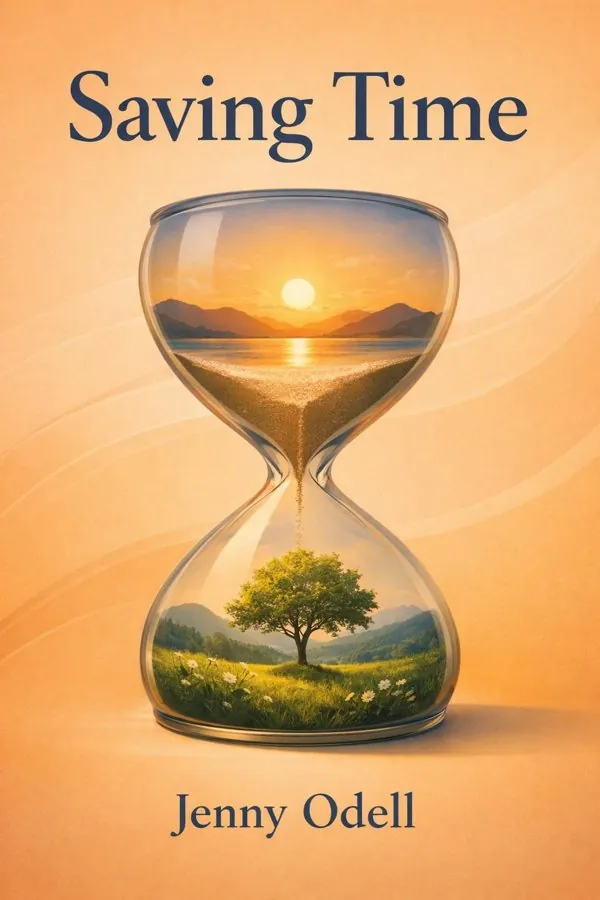
Saving Time: Discovering a Life Beyond the Clock: Summary & Key Insights
by Jenny Odell
 10 min9 chaptersAudio available
Key Takeaways from Saving Time: Discovering a Life Beyond the Clock
What feels natural is often historical.
To control people, you often have to control their time.
The planet does not move at the speed of the inbox.
There is no single human experience of time.
If technology keeps saving time, why do so many people feel they have less of it?
What Is Saving Time: Discovering a Life Beyond the Clock About?
Saving Time: Discovering a Life Beyond the Clock by Jenny Odell is a civilization book spanning 9 pages. In Saving Time, Jenny Odell asks a radical question hidden inside an ordinary phrase: what are we really trying to save when we say we want to save time? Her answer unfolds into a powerful critique of modern life. Odell shows how the clock, the calendar, and the demand for constant productivity have trained us to experience time as scarce, measurable, and marketable. Instead of living within seasons, relationships, care, and attention, many of us live under deadlines, notifications, and the pressure to optimize every hour. The result is not freedom, but exhaustion and alienation. Drawing on history, philosophy, ecology, labor politics, and personal reflection, Odell reveals that our current sense of time is neither natural nor inevitable. It was built through industrialization, capitalism, colonialism, and technological systems that reward speed and efficiency above all else. As an artist and author known for her work on attention, she brings a rare mix of intellectual depth and human sensitivity to the subject. This book matters because it offers more than critique: it helps readers imagine a fuller way of living, one rooted in presence, interdependence, and shared temporal dignity.
This FizzRead summary covers all 9 key chapters of Saving Time: Discovering a Life Beyond the Clock in approximately 10 minutes, distilling the most important ideas, arguments, and takeaways from Jenny Odell's work. Also available as an audio summary and Key Quotes Podcast.
Saving Time: Discovering a Life Beyond the Clock
In Saving Time, Jenny Odell asks a radical question hidden inside an ordinary phrase: what are we really trying to save when we say we want to save time? Her answer unfolds into a powerful critique of modern life. Odell shows how the clock, the calendar, and the demand for constant productivity have trained us to experience time as scarce, measurable, and marketable. Instead of living within seasons, relationships, care, and attention, many of us live under deadlines, notifications, and the pressure to optimize every hour. The result is not freedom, but exhaustion and alienation.
Drawing on history, philosophy, ecology, labor politics, and personal reflection, Odell reveals that our current sense of time is neither natural nor inevitable. It was built through industrialization, capitalism, colonialism, and technological systems that reward speed and efficiency above all else. As an artist and author known for her work on attention, she brings a rare mix of intellectual depth and human sensitivity to the subject. This book matters because it offers more than critique: it helps readers imagine a fuller way of living, one rooted in presence, interdependence, and shared temporal dignity.
Who Should Read Saving Time: Discovering a Life Beyond the Clock?
This book is perfect for anyone interested in civilization and looking to gain actionable insights in a short read. Whether you're a student, professional, or lifelong learner, the key ideas from Saving Time: Discovering a Life Beyond the Clock by Jenny Odell will help you think differently.
- ✓Readers who enjoy civilization and want practical takeaways
- ✓Professionals looking to apply new ideas to their work and life
- ✓Anyone who wants the core insights of Saving Time: Discovering a Life Beyond the Clock in just 10 minutes
Want the full summary?
Get instant access to this book summary and 100K+ more with Fizz Moment.
Get Free SummaryAvailable on App Store • Free to download
Key Chapters
What feels natural is often historical. One of Odell’s most important insights is that our modern experience of time as a uniform sequence of measurable units did not simply emerge from reality itself; it was constructed over centuries. For much of human history, people lived by cyclical and event-based rhythms: sunrise and sunset, planting and harvest, migration, ceremonies, weather, and communal obligations. Time was not always a grid to be filled. It was something sensed, shared, and embedded in place.
The rise of mechanical clocks, standardized schedules, and industrial labor transformed this experience. Time became abstract, divisible, and transferable. Minutes could be bought, sold, wasted, or optimized. This shift intensified during industrialization, when factories required synchronized labor and punctuality became a moral virtue. Later, railroads, national markets, and bureaucratic institutions helped standardize time zones and schedules, making clock time seem universal and unavoidable.
Odell’s point is not that clocks are useless. Rather, she asks us to notice the worldview they smuggle in: a belief that life is best understood through measurement and efficiency. Once time becomes detached from bodies, landscapes, and relationships, it becomes easier to demand more output from workers, more speed from systems, and more self-discipline from individuals.
You can see this today in calendar apps that slice days into rigid blocks, workplaces that monitor response times, and cultural narratives that equate busyness with worth. The practical lesson is to remember that clock time is only one framework among many. Actionable takeaway: spend one week noticing which parts of your life are governed by the clock and which are guided by natural, relational, or bodily rhythms, then intentionally protect at least one activity from measurement.
To control people, you often have to control their time. Odell expands the history of time beyond Europe and industry by showing how standardized, capitalist time spread through colonial power. Colonization did not only seize land and labor; it also disrupted temporal worlds. Many Indigenous cultures organized time through ecological cycles, kinship, ritual, and reciprocal obligations. These ways of keeping time were not primitive versions of the clock but sophisticated systems rooted in relationship and place.
Colonial regimes often treated those systems as backward because they conflicted with extractive goals. Plantations, mines, railways, missionary schools, and state administrations required punctual labor, regulated schedules, and obedience to externally imposed calendars. This was a temporal conquest. The colonized were expected to abandon local rhythms for the timelines of empire, trade, and profit.
Odell’s critique helps explain why conversations about time are also conversations about power. When one group gets to define what counts as being late, productive, efficient, or modern, it gains tremendous authority over others. The demand to speed up is rarely neutral. It often serves institutions that benefit from disconnection from land, memory, and communal life.
This idea still matters. Global supply chains, migrant labor systems, and digital platforms continue to impose tempo from above. Workers in one region may sacrifice sleep, family rhythms, or seasonal practices to meet deadlines set elsewhere. On a smaller scale, schools and workplaces may ignore cultural or caregiving temporalities in the name of uniform standards.
Odell encourages us to respect temporal plurality: the fact that different communities inhabit time differently. Actionable takeaway: examine one institution in your life such as work, school, or family and ask whose schedule it privileges, whose rhythms it disrupts, and what more inclusive temporal practices might look like.
The planet does not move at the speed of the inbox. Odell invites readers to step outside the narrow urgency of human scheduling and encounter ecological and planetary time. Seasons, tides, migrations, forest succession, drought cycles, coral growth, and geological change all unfold on timescales far larger and more complex than our daily routines. When we lose touch with these rhythms, we do not simply become stressed; we become ecologically blind.
Modern capitalist time trains us to focus on short-term gain, immediate output, and rapid turnover. But ecological systems depend on patience, regeneration, and long horizons. Soil takes time to build. Species take time to adapt. Wetlands take time to recover. Climate change, too, exposes the limits of our temporal assumptions. It is both slow and catastrophic, cumulative and urgent. Odell argues that many environmental crises are worsened by a culture unable to value what unfolds gradually or relationally.
This chapter is not only about environmental awareness. It is about humility. Human time is not the only time that matters. To live well, we must develop attention to nonhuman rhythms and accept that not everything valuable can be accelerated.
Practical examples include gardening, birdwatching, walking in the same place across seasons, or observing moon phases and weather patterns. These acts are not sentimental escapes. They retrain perception. They help us notice duration, recurrence, and interdependence. Even organizations can benefit from ecological thinking by planning around long-term stewardship rather than quarterly extraction.
Odell suggests that ecological awareness can widen our moral imagination. Actionable takeaway: choose one recurring natural process near you, such as a tree’s seasonal changes or the timing of birds, and follow it for several months to rebuild a sense of time larger than deadlines.
There is no single human experience of time. Odell challenges the assumption that everyone moves through life according to the same pace, milestones, and expectations. In reality, personal and social temporalities vary dramatically. A child, a caregiver, a night-shift worker, a person living with chronic illness, an elder, and a gig worker may inhabit radically different relationships to duration, interruption, waiting, and urgency.
Mainstream productivity culture tends to erase these differences. It rewards uninterrupted focus, consistent output, and self-management, as though all people have equal control over their days. But life is shaped by dependency, embodiment, inequality, and care. Some people spend much of their time responding to the needs of others. Some face bureaucratic waiting, unstable schedules, or medical uncertainty. Others are privileged with flexible time, protected attention, and the ability to plan.
Odell’s broader argument is ethical: if we want a just society, we must take temporal inequality seriously. The issue is not only who has money or resources, but who has time that is self-directed, respected, and humane. Delayed buses, unpredictable shifts, endless paperwork, or the burden of unpaid care work can all amount to forms of temporal dispossession.
Recognizing multiple temporal worlds can change how we relate to others. Instead of assuming someone is disorganized or unmotivated, we might ask what temporal pressures they are carrying. At home, this can mean respecting the nonlinear rhythms of parenting, grieving, or healing. At work, it can mean designing schedules with flexibility and acknowledging invisible labor.
A more compassionate culture begins by refusing one-size-fits-all time norms. Actionable takeaway: identify one area where you expect everyone, including yourself, to move at the same pace, and replace that assumption with a more realistic, humane standard.
If technology keeps saving time, why do so many people feel they have less of it? Odell examines the paradox of technological mediation: tools designed to increase efficiency often deepen our sense of acceleration and fragmentation. Email, calendars, messaging apps, productivity software, and algorithmic platforms promise convenience. Yet instead of creating spaciousness, they frequently increase expectations, compress response windows, and multiply demands on attention.
The key issue is not technology itself but the systems in which it operates. In a culture devoted to optimization, any time saved is quickly reinvested into more work, more communication, more consumption, or more self-improvement. Faster tools become reasons to raise the baseline. If an email can be answered in minutes, then minutes become the expected turnaround. If remote work removes commuting, the recovered time is often absorbed by meetings or availability. Efficiency becomes a treadmill.
Odell also points out that digital technologies mediate how we perceive time. Notifications create artificial urgency. Infinite feeds dissolve beginnings and endings. Metrics like streaks, read receipts, and response times turn temporal behavior into social signals. We become not only users of technology but subjects of temporal discipline.
Practical responses include disabling nonessential alerts, creating communication windows instead of constant availability, and distinguishing between truly urgent matters and merely immediate ones. Teams can adopt slower norms by clarifying response expectations and protecting uninterrupted time.
Odell’s larger invitation is to ask whether a tool serves life or merely speeds extraction. Not everything that reduces friction increases freedom. Actionable takeaway: choose one digital system that creates constant urgency in your life and redesign your use of it this week so that it supports attention rather than steals it.
A different life requires different clocks. After exposing the limits of industrial and capitalist time, Odell explores alternative temporal frameworks that have existed across cultures, philosophies, and practices. Some traditions emphasize cyclical time rather than linear progress. Others center sacred calendars, ritual repetition, ancestral memory, or event-based timing. In many cases, time is understood less as a commodity and more as a medium of relationship.
These alternatives matter because they reveal that our current model is not inevitable. Linear, future-oriented, productivity-driven time tends to frame life as a sequence of goals and deadlines. By contrast, cyclical or relational time can foreground return, maintenance, renewal, and presence. This has deep implications for how we understand success, aging, work, and belonging.
Odell does not romanticize the past or suggest abandoning schedules entirely. Instead, she encourages a pluralistic approach in which clock time is decentered rather than abolished. A person might use a calendar for appointments while also orienting life around weekly community gatherings, seasonal rituals, sabbath practices, or artistic processes that cannot be rushed. A city might organize around fiscal quarters while also honoring ecological restoration cycles and public rest.
Examples include observing seasonal transitions, building family rituals that recur without productivity goals, or adopting creative practices where timing emerges from attention rather than pressure. Even language matters: describing an afternoon as “for wandering” or “for care” creates a different temporal atmosphere than “unused time.”
Alternative temporal frameworks help reclaim meaning from mere scheduling. They remind us that repetition can be nourishing, pauses can be fertile, and not every good thing needs a deadline. Actionable takeaway: create one recurring ritual in your week or month that is not designed for achievement but for orientation, connection, or renewal.
A society reveals its values by how it distributes time. Odell argues that time is not just a personal management problem but a political issue shaped by labor systems, public policy, infrastructure, and social norms. Who gets leisure, rest, flexibility, recovery, and uninterrupted attention? Who gets waiting, overwork, precarity, commuting, and administrative burden? These questions are as political as wages and housing.
The common advice to manage time better can hide structural injustice. A single parent working multiple jobs does not need another productivity app; they may need childcare, paid leave, predictable scheduling, affordable transportation, and housing security. Likewise, overworked professionals are often told to set better boundaries, even when institutions depend on cultures of constant availability. By framing time scarcity as an individual failure, society avoids confronting the systems that produce it.
Odell places temporal politics alongside labor history and social struggle. Movements for the eight-hour day, weekends, sick leave, disability rights, and humane working conditions were all fights over time. Today, debates about remote work, universal basic income, four-day workweeks, and platform labor continue that struggle. The stakes are not abstract. Time shapes whether people can care for children, participate in civic life, rest, create, or simply think.
Readers can apply this insight by looking beyond personal habits to collective arrangements. In workplaces, temporal justice might mean meeting-free blocks, realistic deadlines, and respect for off-hours. In communities, it might mean better transit and public services that reduce wasted time.
Odell’s message is clear: saving time for a few often means taking it from others. Actionable takeaway: identify one recurring source of time pressure in your life that seems personal, then trace the institutional or political structure behind it and consider one collective response.
To give time is often to give presence. One of the most humane threads in Odell’s book is the connection between temporal experience and attention. In a culture that prizes speed and output, sustained attention can feel inefficient. Yet attention is how relationships deepen, art becomes possible, and the world becomes legible. It is also a practice of care toward people, places, and nonhuman life.
Odell suggests that the problem is not only that we are busy, but that our attention is constantly broken into monetizable fragments. When time is treated as a resource to maximize, attention becomes something to extract and redirect. This weakens our capacity for patience, observation, and responsiveness. We skim instead of noticing. We react instead of listening. We rush through experiences that might have transformed us if allowed to ripen.
Temporal care means making room for forms of time that are unproductive in the narrow economic sense but essential to a meaningful life: sitting with a grieving friend, watching a child explore, revising a sentence until it feels true, tending a plant, or staying long enough in one place to perceive change. These acts resist the idea that value only appears as measurable output.
Practical applications include single-tasking for a defined period, protecting device-free conversations, or allowing certain activities to unfold without timers. Institutions can cultivate temporal care by reducing interruptions and designing environments where concentration and reflection are possible.
Odell’s insight is both simple and profound: what we repeatedly attend to becomes our life. Actionable takeaway: choose one daily interaction or activity and give it ten undistracted minutes more than usual, treating that extra attention not as lost efficiency but as intentional care.
Not every future has to be faster. Odell ends by reimagining what it would mean to build lives and societies not organized around relentless acceleration. The dominant story of modernity assumes progress means speed: faster transport, faster production, faster communication, faster growth. But this model often leaves people exhausted, ecosystems depleted, and communities fragmented. A livable future may depend less on speeding up than on learning when to slow, pause, repair, and endure.
Odell’s vision is not nostalgic withdrawal. It is a serious political and ethical proposal for inhabiting time differently. That means valuing maintenance as much as innovation, recovery as much as achievement, and collective rhythm as much as personal ambition. It means honoring long-term commitments that do not produce immediate results, such as ecological restoration, democratic participation, artistic development, and intergenerational care.
This reframing changes how we think about hope. Hope is not only a forward rush toward an improved tomorrow. It can also be the patient work of staying with complexity, preserving conditions for life, and refusing the false urgency of systems that demand endless output. A healthier future will likely require slower infrastructures, more durable institutions, and social arrangements that let people inhabit time with dignity.
In practical terms, individuals can support this future by resisting overcommitment, choosing durable relationships over constant novelty, and backing policies that expand rest and public care. Organizations can measure success not only by growth but by resilience, repair, and sustainability.
Odell leaves readers with a liberating possibility: we do not have to be perfectly efficient to be fully alive. Actionable takeaway: define one long-term value you want your life to reflect, then remove one recurring speed-driven habit that keeps pulling you away from it.
All Chapters in Saving Time: Discovering a Life Beyond the Clock
About the Author
Jenny Odell is an American artist, writer, and educator based in Oakland, California. Her work explores how attention, technology, ecology, labor, and public space shape contemporary life. She first gained wide recognition for How to Do Nothing: Resisting the Attention Economy, a book that challenged the pressures of distraction and productivity culture. Trained in both visual art and critical inquiry, Odell brings an interdisciplinary lens to her writing, blending philosophy, social criticism, environmental thought, and close observation. Her essays and projects often examine the hidden systems that organize everyday experience, from digital platforms to ideas of usefulness and value. In Saving Time, she extends these concerns into a powerful reflection on how modern society experiences time itself, and how we might recover more humane, relational ways of living.
Get This Summary in Your Preferred Format
Read or listen to the Saving Time: Discovering a Life Beyond the Clock summary by Jenny Odell anytime, anywhere. FizzRead offers multiple formats so you can learn on your terms — all free.
Available formats: App · Audio · PDF · EPUB — All included free with FizzRead
Download Saving Time: Discovering a Life Beyond the Clock PDF and EPUB Summary
Key Quotes from Saving Time: Discovering a Life Beyond the Clock
“One of Odell’s most important insights is that our modern experience of time as a uniform sequence of measurable units did not simply emerge from reality itself; it was constructed over centuries.”
“To control people, you often have to control their time.”
“The planet does not move at the speed of the inbox.”
“There is no single human experience of time.”
“If technology keeps saving time, why do so many people feel they have less of it?”
Frequently Asked Questions about Saving Time: Discovering a Life Beyond the Clock
Saving Time: Discovering a Life Beyond the Clock by Jenny Odell is a civilization book that explores key ideas across 9 chapters. In Saving Time, Jenny Odell asks a radical question hidden inside an ordinary phrase: what are we really trying to save when we say we want to save time? Her answer unfolds into a powerful critique of modern life. Odell shows how the clock, the calendar, and the demand for constant productivity have trained us to experience time as scarce, measurable, and marketable. Instead of living within seasons, relationships, care, and attention, many of us live under deadlines, notifications, and the pressure to optimize every hour. The result is not freedom, but exhaustion and alienation. Drawing on history, philosophy, ecology, labor politics, and personal reflection, Odell reveals that our current sense of time is neither natural nor inevitable. It was built through industrialization, capitalism, colonialism, and technological systems that reward speed and efficiency above all else. As an artist and author known for her work on attention, she brings a rare mix of intellectual depth and human sensitivity to the subject. This book matters because it offers more than critique: it helps readers imagine a fuller way of living, one rooted in presence, interdependence, and shared temporal dignity.
You Might Also Like
The Structure of Scientific Revolutions
Thomas S. Kuhn
10 min
Genius
Harold Bloom
10 min
A Cultural History of the Medieval Age
Various Editors
10 min
A History of God: The 4,000-Year Quest of Judaism, Christianity and Islam
Karen Armstrong
10 min
A History of the World in 10½ Chapters
Julian Barnes
10 min
A Short History of Progress
Ronald Wright
10 minBrowse by Category
Ready to read Saving Time: Discovering a Life Beyond the Clock?
Get the full summary and 100K+ more books with Fizz Moment.