
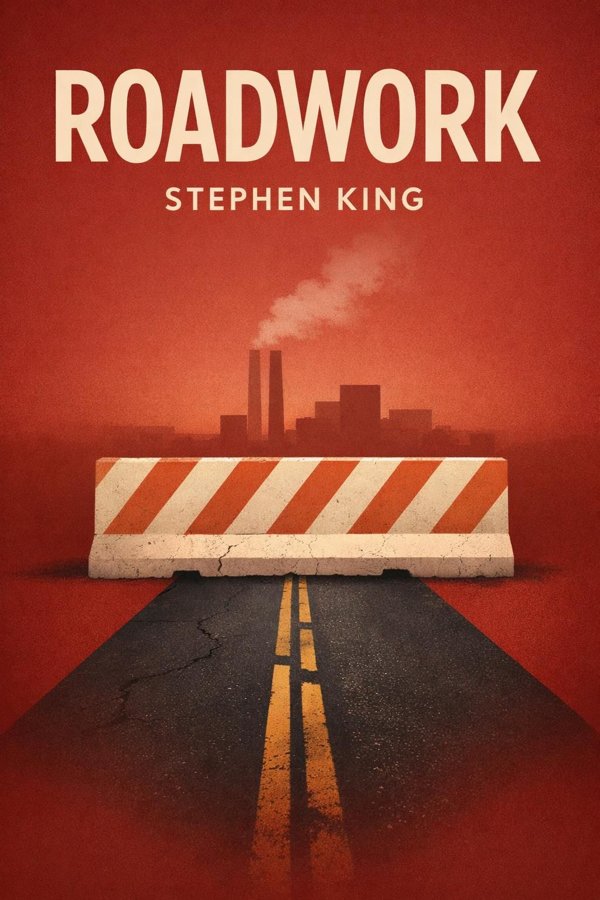
Roadwork: Summary & Key Insights
by Stephen King
 10 min8 chaptersAudio available
Key Takeaways from Roadwork
That is the force of Roadwork’s opening conflict.
People do not break only because of what is happening now; they break because the present reactivates what was never healed.
When people feel powerless, resistance can become more than a strategy; it can become the last proof that they still exist.
Progress is often celebrated in abstractions: efficiency, infrastructure, growth, modernization.
One of Roadwork’s quietest and sharpest observations is that Barton Dawes has no healthy language for his pain.
What Is Roadwork About?
Roadwork by Stephen King is a bestsellers book spanning 3 pages. Roadwork is one of Stephen King’s bleakest and most underrated novels, originally published in 1981 under the pseudonym Richard Bachman. On the surface, it tells a simple story: Barton George Dawes learns that a new highway will destroy both his home and the laundry plant where he works. But King turns this ordinary civic project into a devastating portrait of private collapse. As bureaucratic notices pile up and the bulldozers move closer, Dawes begins to unravel, and his resistance becomes less a political stand than a desperate attempt to hold onto identity, memory, and meaning. What makes Roadwork matter is its refusal to look away from the emotional cost of “progress.” King is not writing about monsters here; he is writing about grief, alienation, masculine despair, and the silent violence of systems that treat human lives as logistical problems. The novel feels especially relevant in any era shaped by redevelopment, layoffs, displacement, and emotional burnout. Few writers capture the pressure points of ordinary American life as sharply as King, and in Roadwork, he uses that gift to show how a man can be destroyed long before anything is physically torn down.
This FizzRead summary covers all 8 key chapters of Roadwork in approximately 10 minutes, distilling the most important ideas, arguments, and takeaways from Stephen King's work. Also available as an audio summary and Key Quotes Podcast.
Roadwork
Roadwork is one of Stephen King’s bleakest and most underrated novels, originally published in 1981 under the pseudonym Richard Bachman. On the surface, it tells a simple story: Barton George Dawes learns that a new highway will destroy both his home and the laundry plant where he works. But King turns this ordinary civic project into a devastating portrait of private collapse. As bureaucratic notices pile up and the bulldozers move closer, Dawes begins to unravel, and his resistance becomes less a political stand than a desperate attempt to hold onto identity, memory, and meaning.
What makes Roadwork matter is its refusal to look away from the emotional cost of “progress.” King is not writing about monsters here; he is writing about grief, alienation, masculine despair, and the silent violence of systems that treat human lives as logistical problems. The novel feels especially relevant in any era shaped by redevelopment, layoffs, displacement, and emotional burnout. Few writers capture the pressure points of ordinary American life as sharply as King, and in Roadwork, he uses that gift to show how a man can be destroyed long before anything is physically torn down.
Who Should Read Roadwork?
This book is perfect for anyone interested in bestsellers and looking to gain actionable insights in a short read. Whether you're a student, professional, or lifelong learner, the key ideas from Roadwork by Stephen King will help you think differently.
- ✓Readers who enjoy bestsellers and want practical takeaways
- ✓Professionals looking to apply new ideas to their work and life
- ✓Anyone who wants the core insights of Roadwork in just 10 minutes
Want the full summary?
Get instant access to this book summary and 100K+ more with Fizz Moment.
Get Free SummaryAvailable on App Store • Free to download
Key Chapters
Real collapse rarely begins with a dramatic explosion; more often, it starts with a notice, a delay, or a bureaucratic decision that seems minor to everyone except the person living inside it. That is the force of Roadwork’s opening conflict. When Barton George Dawes learns that a highway project will cut through his neighborhood and erase the laundry company where he works, the threat is presented in the bland language of public administration. There are forms, relocation terms, timelines, and compensation. On paper, it sounds manageable. In Dawes’s life, it is catastrophic.
Stephen King uses this setup to show how institutions often disguise violence in neutral language. The state does not see a home full of memories; it sees property. The company does not see a man whose identity is tied to routine and place; it sees an operational inconvenience. Dawes understands, before anyone around him does, that this is not merely about moving. It is about being told that the life he built is disposable.
This idea extends well beyond the novel. Many people experience a similar shock when a workplace restructures, a neighborhood gentrifies, or a family home must be sold. Others may insist that change is normal and survivable, yet the person at the center feels erased. Practical life often demands adaptation, but Roadwork reminds us that adaptation is harder when change attacks our sense of self.
A useful real-world application is to pay attention when logistical changes provoke outsized emotional responses. The paperwork may be external, but the wound is often internal. When a place or role matters deeply, name that attachment instead of minimizing it. Actionable takeaway: when major change appears in “practical” form, ask not just what is being altered, but what part of your identity feels threatened.
People do not break only because of what is happening now; they break because the present reactivates what was never healed. In Roadwork, Barton Dawes’s resistance to the highway project is inseparable from older wounds, especially the death of his son and the emotional distance that has grown between him and his wife, Mary. The road construction becomes a trigger that pulls buried grief back into the open. Every threatened wall, every relocation deadline, and every empty room exposes how much loss Dawes has been carrying for years.
King carefully shows that Dawes is not simply angry at urban development. He is trapped in memory. His house is not just a structure; it is a container for a life that no longer exists. His routines are not just habits; they are rituals protecting him from the full force of sorrow. Because he has never truly integrated his son’s death into his life, any new loss feels total. The destruction of property becomes, in his mind, the destruction of everything.
This is one of the novel’s most psychologically precise insights. Unprocessed grief often disguises itself as stubbornness, irritability, or fixation. A person may insist they are arguing about money, plans, or timing when they are really defending themselves against old pain. You can see this in everyday life when someone reacts intensely to a move, a retirement, or even a small family change. The issue is rarely just the issue.
The practical lesson is not that attachment is wrong, but that ignored grief accumulates interest. If we do not mourn honestly, we often end up fighting the wrong battle. Actionable takeaway: when your reaction to a present problem feels bigger than the facts, ask what older loss may be speaking through it.
When people feel powerless, resistance can become more than a strategy; it can become the last proof that they still exist. That is exactly what happens to Barton Dawes. As his options narrow, opposition itself gives him a sense of purpose. He lies, delays, and sabotages. He makes choices that are irrational in practical terms but emotionally coherent within his private logic. If the world has decided to erase him, then defiance becomes his way of leaving a mark.
King refuses to romanticize this process. Dawes is not a noble rebel leading a community uprising. His resistance is lonely, unstable, and increasingly self-destructive. Yet that is what makes it compelling. The novel understands that destructive behavior often grows out of a need for agency. A person who cannot stop a system may still try to disrupt it. Even failure can feel preferable to passive surrender.
This dynamic appears in many real situations. Employees who know they are being pushed out may begin undermining meetings or missing deadlines. Divorcing partners may drag out proceedings less to win than to avoid feeling discarded. Teenagers with no healthy control over their environment may choose dangerous forms of rebellion simply to feel powerful. None of this is wise, but it is human.
Roadwork challenges readers to distinguish between meaningful resistance and self-annihilating defiance. The crucial question is whether your opposition protects your values or only deepens your damage. Actionable takeaway: before escalating a conflict, ask whether your next act of resistance will actually preserve something important or merely prove that you are hurting.
Progress is often celebrated in abstractions: efficiency, infrastructure, growth, modernization. Roadwork asks a harder question: progress for whom, and at whose expense? The highway in the novel is not evil in a cartoonish sense. Roads connect places, support commerce, and serve public goals. But King focuses on the people caught underneath the rhetoric. What officials describe as improvement, Dawes experiences as dispossession.
This tension gives the novel much of its moral force. King does not argue that every public project is wrong; he argues that systems too easily ignore the intimate damage they cause. A demolished home is also a demolished archive of family life. A relocated business is also a disrupted social world. A policy may be rational on a citywide map while still feeling brutal at street level.
The theme remains highly relevant. Urban renewal projects, rising rents, warehouse development, school closures, and corporate consolidations are frequently defended as necessary signs of advancement. Sometimes they are. But those affected are often expected to absorb the emotional and financial impact silently. The people who lose familiar places are told to be realistic, flexible, and future-oriented. Roadwork reminds us that there is often hidden grief beneath those demands.
A practical application is to widen our definition of impact when evaluating change. In leadership, civic planning, or even family decision-making, numbers are never the whole story. Ask who is losing stability, memory, or dignity in the process. Actionable takeaway: whenever a change is labeled “progress,” look beyond the benefits and identify the human costs that may be disappearing from the official narrative.
One of Roadwork’s quietest and sharpest observations is that Barton Dawes has no healthy language for his pain. He drinks, deflects, jokes, drifts, and erupts, but he does not truly communicate. His suffering is intensified by a model of masculinity that prizes endurance over expression. He is expected to keep going, keep working, keep acting normal. By the time his emotions become visible, they have already become dangerous.
King presents this not as an excuse but as a tragic pattern. Dawes cannot metabolize grief because he has spent years avoiding vulnerability. His marriage suffers partly because he and Mary do not share the same emotional vocabulary anymore. Their loss has isolated them rather than joined them. Instead of speaking clearly about fear, guilt, and sorrow, Dawes tries to control the external world. Since that world cannot be controlled, he falls apart.
This pattern is deeply recognizable. Many men, though certainly not only men, are socialized to treat sadness as weakness and anger as the only acceptable emotion. As a result, grief often reappears as withdrawal, addiction, obsession, or rage. The person may insist they are “fine” while their relationships and judgment deteriorate. In workplaces, families, and friendships, this can make suffering difficult to detect until crisis arrives.
The lesson is practical and urgent: emotional suppression is not strength. Naming pain early is often what prevents destructive behavior later. Talking to a partner, friend, therapist, or support group can feel awkward, but silence rarely protects anyone for long. Actionable takeaway: if anger is the only emotion you can easily express, pause and ask what sadness, fear, or grief may be hiding underneath it.
Roadwork is a powerful reminder that horror does not require ghosts, monsters, or supernatural curses. Sometimes the most frightening thing is an ordinary life becoming unlivable. King transforms paperwork, traffic plans, domestic strain, and corporate routine into instruments of dread. The terror comes from inevitability. The letters keep arriving. The demolition gets closer. People keep speaking in calm, reasonable tones while a man’s world disintegrates.
This is part of what makes the novel distinctive in King’s body of work. Under the Bachman name, he often stripped away the supernatural to examine pressure, violence, and social decay in rawer form. In Roadwork, the horror lies in helplessness and in the gap between public normalcy and private breakdown. No one event is impossible. That is exactly why the story lingers.
Readers can apply this insight by taking seriously the slow-building stresses in their own lives. We often dismiss chronic stress because it lacks cinematic drama. But sleeplessness, workplace uncertainty, caregiving pressure, unresolved grief, and financial instability can create a cumulative atmosphere of dread. A person need not face a spectacular disaster to feel cornered.
The novel also sharpens our reading of others. Someone who seems irrational may have been living for months inside a reality that feels unbearable. Compassion does not mean approving harmful behavior, but it does mean recognizing that collapse usually has a long prelude. Actionable takeaway: do not wait for dramatic crisis to acknowledge suffering; pay attention to the ordinary pressures that can quietly turn daily life into psychological horror.
Systems are designed to process cases, not souls. Roadwork shows how bureaucracy, even when functioning as intended, can deepen suffering by treating deeply personal realities as standardized transactions. Dawes encounters the language of procedure at every turn: purchase terms, relocation schedules, business consequences, legal notices. Nothing in that machinery is built to honor grief. It is built to move forward.
King understands that this impersonality can feel dehumanizing. The more upset Dawes becomes, the less legible he is to the system. His pain cannot be entered into the correct field, so it effectively does not exist. This mismatch fuels his rage. He is not only losing his home and workplace; he is being forced to experience that loss in a vocabulary that denies its emotional truth.
Many modern experiences work the same way. Insurance claims after a death, human resources procedures during layoffs, hospital billing during illness, and housing disputes during eviction all ask people to remain orderly while their lives are in chaos. The official process may not be malicious, but it often compounds distress by demanding composure from the already wounded.
A practical response is to build translation layers between systems and human needs. That may mean bringing an advocate to meetings, writing down questions beforehand, or asking a trusted person to handle paperwork during crisis. It also means showing patience to others who seem overwhelmed by “simple” processes. Actionable takeaway: when dealing with bureaucracy under stress, do not rely on willpower alone; create support structures that protect your dignity and help you navigate systems without being swallowed by them.
We like to think identity is internal and portable, but Roadwork argues that who we are is often anchored in specific places. Barton Dawes’s home and workplace are not interchangeable settings. They are extensions of memory, routine, status, and belonging. When those places are threatened, he does not merely face inconvenience; he faces disorientation. Without the physical world that has organized his life, he no longer knows how to remain himself.
This idea helps explain why relocation can feel so destabilizing even when it is financially sensible. A house may contain the trace of a child’s life, the pattern of a marriage, or the habits that keep someone emotionally functional. A workplace may provide more than income; it may offer competence, familiarity, and structure. Remove those spaces, and you remove hidden supports that the person may not have consciously valued until they are gone.
This applies in everyday life whenever people retire, move cities, downsize homes, or work remotely after years in a physical office. They may gain convenience yet still feel strangely unreal. The environment that once reflected and reinforced identity has disappeared. That does not mean change should be avoided, but it does mean change should be understood more deeply.
The practical lesson is to treat place transitions as identity transitions. If you are moving or losing a familiar environment, plan not only the logistics but also the rituals, routines, and relationships that help you feel grounded. Actionable takeaway: when a meaningful place is changing, ask what function it served in your life and intentionally rebuild that function elsewhere.
All Chapters in Roadwork
About the Author
Stephen King is an American author born in 1947 and one of the most widely read writers in contemporary fiction. He is best known for his horror novels, but his work also spans suspense, fantasy, science fiction, and psychological drama. Over the course of his career, he has published more than sixty novels and numerous short story collections, including classics such as Carrie, The Shining, Salem’s Lot, It, and Misery. King also wrote several books under the pseudonym Richard Bachman, a name he used to explore darker, leaner stories such as Roadwork. His writing is celebrated for blending ordinary settings with extraordinary tension, while probing fear, trauma, memory, and the pressures of modern life.
Get This Summary in Your Preferred Format
Read or listen to the Roadwork summary by Stephen King anytime, anywhere. FizzRead offers multiple formats so you can learn on your terms — all free.
Available formats: App · Audio · PDF · EPUB — All included free with FizzRead
Download Roadwork PDF and EPUB Summary
Key Quotes from Roadwork
“Real collapse rarely begins with a dramatic explosion; more often, it starts with a notice, a delay, or a bureaucratic decision that seems minor to everyone except the person living inside it.”
“People do not break only because of what is happening now; they break because the present reactivates what was never healed.”
“When people feel powerless, resistance can become more than a strategy; it can become the last proof that they still exist.”
“Progress is often celebrated in abstractions: efficiency, infrastructure, growth, modernization.”
“One of Roadwork’s quietest and sharpest observations is that Barton Dawes has no healthy language for his pain.”
Frequently Asked Questions about Roadwork
Roadwork by Stephen King is a bestsellers book that explores key ideas across 8 chapters. Roadwork is one of Stephen King’s bleakest and most underrated novels, originally published in 1981 under the pseudonym Richard Bachman. On the surface, it tells a simple story: Barton George Dawes learns that a new highway will destroy both his home and the laundry plant where he works. But King turns this ordinary civic project into a devastating portrait of private collapse. As bureaucratic notices pile up and the bulldozers move closer, Dawes begins to unravel, and his resistance becomes less a political stand than a desperate attempt to hold onto identity, memory, and meaning. What makes Roadwork matter is its refusal to look away from the emotional cost of “progress.” King is not writing about monsters here; he is writing about grief, alienation, masculine despair, and the silent violence of systems that treat human lives as logistical problems. The novel feels especially relevant in any era shaped by redevelopment, layoffs, displacement, and emotional burnout. Few writers capture the pressure points of ordinary American life as sharply as King, and in Roadwork, he uses that gift to show how a man can be destroyed long before anything is physically torn down.
More by Stephen King




You Might Also Like

The Godfather
Mario Puzo
10 min
The Handmaid's Tale
Margaret Atwood
10 min
The Hunger Games
Suzanne Collins
10 min
The Nightingale
Kristin Hannah
10 min
The Seven Husbands of Evelyn Hugo
Taylor Jenkins Reid
10 min
Backwater Justice
Fern Michaels
10 minBrowse by Category
Ready to read Roadwork?
Get the full summary and 100K+ more books with Fizz Moment.